

TL;DR:
- The accredited course selection process ensures students verify quality standards recognized by authorities like ASQA and TEQSA. It involves checking institutional and programmatic accreditation, confirming delivery formats, and assessing credit transfer policies to prevent costly mistakes. Prioritizing accreditation and objective evaluations leads to qualifications that support long-term career and educational goals.
The accredited course selection process is the method students use to verify and choose courses that meet official quality standards, recognised by bodies such as the Australian Skills Quality Authority (ASQA), the Tertiary Education Quality and Standards Agency (TEQSA), and the Australian Qualifications Framework (AQF). Choosing the wrong course, or one from an unrecognised provider, can mean your qualification carries no weight with employers, cannot transfer to further study, and may not satisfy licensing requirements in your field. Approximately 66% of transfer students lose some credits when changing institutions, with losses often total when moving from nationally accredited schools to regionally accredited universities. That statistic represents real money, real time, and real career setbacks. For international students, the stakes are even higher: confirmation of degree recognition in your home country is vital to avoid wasted investment in a qualification that carries no weight once you return.
What are the key steps in the accredited course selection process?

The accredited course selection process follows a clear sequence. Skipping any step increases the risk of enrolment in a programme that does not deliver the career or academic outcomes you need.
Step 1: Confirm institutional and programmatic accreditation
Start by checking whether the institution itself holds accreditation from a recognised authority. In Australia, registered training organisations (RTOs) are listed on the National Register, which is maintained by the Australian Government. TEQSA governs universities and higher education providers. Checking both institutional and programmatic accreditation matters because a school can be accredited as an institution while offering individual programmes that are not separately recognised for specific professional licences or credit transfer.
Programmatic accreditation and delivery format specifics can impact licence eligibility and credit recognition in ways that institutional accreditation alone does not cover. A nursing programme, for example, may require separate accreditation from the Australian Nursing and Midwifery Accreditation Council (ANMAC) regardless of whether the university itself is TEQSA-registered. Always verify both levels.
Step 2: Use official registries, not marketing materials
Accreditation verification takes less than 30 minutes using official government databases, yet most students skip this step entirely and rely on a provider's own website instead. A polished website or a certificate badge does not equal accredited credit. Marketing badges do not guarantee credit transfer or recognition by receiving institutions. Use training.gov.au, the TEQSA National Register, and your state's education authority to confirm status directly.
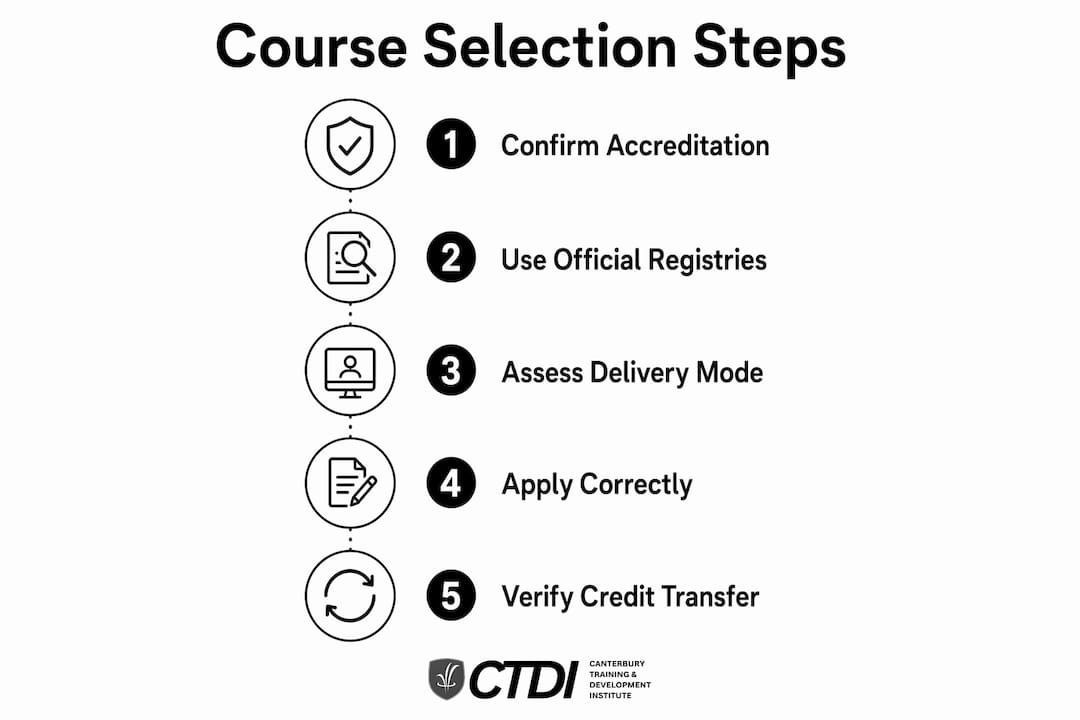
Step 3: Assess delivery mode and eligibility requirements
Once accreditation is confirmed, check whether the delivery format, whether online, on-campus, or blended, affects your eligibility for credit transfer or professional registration. Some licensing bodies specify that practical components must be completed in person. Review admission prerequisites carefully before applying, since missing a prerequisite can result in automatic rejection.
Step 4: Apply correctly through the right channel
In Victoria, students applying through VTAC can list up to eight course preferences and must verify prerequisites to avoid errors. Selecting the wrong course code, such as confusing a Certificate IV with a Diploma, can result in application rejection or enrolment in an unsuitable programme. NSW Government guidelines require providers to submit accreditation applications at least eight months before the intended start period, which means students researching new programmes need to plan well ahead of intake dates.
Pro Tip: Set a calendar reminder at least nine months before your intended start date. This gives you time to gather documents, confirm accreditation, and meet application deadlines without rushing.
Step 5: Confirm credit transfer and future study pathways
Before you commit, ask the provider directly: "Will credits from this course be recognised by universities or other RTOs if I continue studying?" Get the answer in writing. Credit transfer policies vary significantly between institutions, and verbal assurances are not enforceable.
How to evaluate accredited programs before enrolment
Accreditation is the baseline, not the finish line. Once you confirm a programme is accredited, the next task is assessing whether it is the right fit for your goals, budget, and learning style.
Curriculum content and skills alignment
Read the course outline, not just the marketing summary. Look for unit codes listed on training.gov.au, which describe exactly what competencies are taught and assessed. Compare those competencies against job advertisements in your target field to confirm the skills match what employers are actually seeking. A Certificate IV in Environmental Sustainability, for instance, should map directly to roles in environmental compliance, sustainability reporting, or resource management.
Faculty qualifications and student support
Check whether trainers hold both academic qualifications and current industry experience. In vocational education, a trainer who last worked in their industry a decade ago may teach outdated practices. Ask providers about the ratio of trainers to students, the availability of one-on-one support, and whether student services include career counselling or job placement assistance.
Cost, fees, and hidden charges
Compare the total cost of the programme, including enrolment fees, learning materials, assessment resubmission fees, and any mandatory software or equipment. Some online programmes advertise a low headline fee but charge separately for each unit. Use a decision matrix to compare programmes side by side.
Students should use a weighted decision matrix that scores cost, career outcomes, faculty support, and accreditation status together. This approach removes emotion from the decision and surfaces the programme that objectively meets the most criteria.
| Evaluation criterion | What to check |
|---|---|
| Accreditation status | Confirm on training.gov.au or TEQSA National Register |
| Curriculum relevance | Match unit codes to current job advertisements |
| Total programme cost | Include all fees, materials, and resubmission charges |
| Credit transfer policy | Confirm in writing with the receiving institution |
| Student support services | Ask about trainer ratios, career services, and online resources |
Pro Tip: Contact two or three recent graduates of the programme before enrolling. Alumni feedback on trainer quality and job placement outcomes is more reliable than any published testimonial.
Common mistakes in the accredited course selection process
The most costly errors in choosing accredited courses are not dramatic. They are small oversights that compound into significant problems after enrolment.
Treating all accreditation types as equivalent. In Australia, accreditation operates at different levels: institutional, programmatic, and industry-specific. A course accredited by one body may not satisfy the requirements of a professional association or licensing authority in your field. Always check the specific accreditation required for your intended career outcome, not just whether the provider appears on a government register.
Relying on provider marketing materials. Brochures, websites, and social media posts are promotional tools, not quality assurance documents. A polished website does not equal accredited credit, and transfer credit requires institutional or programmatic accreditation recognised by receiving schools. Cross-reference every claim against official registries.
Not verifying accreditation for the specific delivery format. A provider may be accredited to deliver a course on-campus but not hold approval to deliver the same course fully online. This distinction matters for credit transfer and, in some professions, for licence eligibility. Confirm that the specific delivery mode you intend to study is covered by the accreditation.
Entering incorrect course codes on applications. Selecting the wrong course code causes eligibility and placement issues that are difficult to reverse after submission. Double-check every code against the official course catalogue before submitting your application.
Ignoring credit transfer confirmation. Assuming credits will transfer because both institutions are accredited is a common and expensive mistake. Approximately 66% of transfer students lose credits when changing institutions. Confirm transferability in writing before you pay any fees.
"Students must prioritise accreditation first, then use objective evaluation tools to compare programme features and outcomes for the best choice." — Your Online Degree Decision Guide
International students face one additional risk: a qualification that is fully accredited in Australia may not be recognised by your home country's ministry of education. Verify university recognition on your home country government's education website before enrolling. Lack of recognition is a red flag that no amount of institutional prestige can overcome.
Online vs on-campus accredited courses: what should you consider?
Accreditation applies equally to online and on-campus programmes when both delivery modes are approved by the relevant authority. The decision between formats is about fit, not quality, provided you have confirmed accreditation for the specific mode.
| Consideration | Online accredited courses | On-campus accredited courses |
|---|---|---|
| Scheduling flexibility | Self-paced; study around work and life | Fixed timetable; requires physical attendance |
| Faculty interaction | Asynchronous forums, email, video calls | In-person lectures, tutorials, and workshops |
| Technical requirements | Reliable internet, compatible device, software access | Campus facilities provided; less personal tech needed |
| Cost | Often lower tuition; no commuting or relocation costs | May include campus fees; higher living costs if relocating |
| Practical components | May require separate in-person placements for licensed professions | Integrated labs, placements, and workshops on-site |
| Credit transfer | Equal to on-campus if delivery mode is accredited | Standard recognition; well-established transfer pathways |
Online accredited courses suit students who need flexibility, are already working in their field, or live outside major cities. On-campus study suits students who benefit from structured environments, direct peer interaction, or programmes with mandatory practical components that cannot be completed remotely.
The critical check for online study is whether the specific online delivery of the programme is accredited, not just the programme in its on-campus form. Some providers hold approval for on-campus delivery only and have not sought separate approval for online modes. This is a detail that marketing materials rarely highlight but that official registries will confirm.
For career-focused vocational training, online accredited programmes in fields such as digital marketing, AI applications, and environmental management are fully recognised under the AQF when delivered by a registered RTO. The career prospects from accredited courses in these sectors are strong, with employer demand for AQF-aligned credentials continuing to grow across Australia.
Key takeaways
Accreditation is the non-negotiable foundation of course selection, but the best outcome comes from combining verified accreditation status with objective evaluation of curriculum, cost, and career alignment.
| Point | Details |
|---|---|
| Verify accreditation first | Use training.gov.au or the TEQSA National Register before considering any other factor. |
| Check delivery mode approval | Confirm that online or on-campus delivery is specifically covered by the provider's accreditation. |
| Use a decision matrix | Score programmes on cost, career outcomes, faculty support, and credit transfer to compare objectively. |
| Confirm credit transfer in writing | Verbal assurances are not enforceable; get written confirmation from the receiving institution. |
| International students: check home recognition | Verify your qualification is recognised by your home country's ministry of education before enrolling. |
What I have learnt from watching students get this wrong
I have seen students make every mistake in this article, and the pattern is almost always the same. They find a course that sounds right, the website looks credible, the fee is reasonable, and they enrol without checking a single official registry. Six months later, they discover the credits will not transfer to the university they planned to attend next, or that their professional association does not recognise the qualification for registration purposes.
The uncomfortable truth is that the accredited course selection process is not complicated. It takes less than an hour to verify accreditation status, check unit codes, and confirm credit transfer policies. What makes it hard is that providers have no financial incentive to make the verification process obvious. A student who pauses to check official registries might find a reason not to enrol. So the friction is left in place, and students who are in a hurry, or who trust that a professional-looking website means a credible qualification, pay the price.
My practical advice: treat every provider claim as unverified until you have checked it against training.gov.au, the TEQSA National Register, or your relevant professional association's approved provider list. Then contact a recent graduate, not a current student, and ask them directly whether the qualification opened the doors they expected. Alumni are honest in ways that admissions staff cannot afford to be.
One more thing worth saying directly: convenience is not a course selection criterion. Choosing a programme because it starts next week, or because the application process is simple, is how students end up with qualifications that cost them time and money without advancing their careers. Prioritise accreditation and career alignment. The right programme is worth waiting for.
— Sam
Start your accredited course journey with CTDI
Canterbury Training and Development Institute (CTDI) offers nationally recognised, AQF-aligned vocational courses delivered 100% online, designed for students who need flexibility without compromising on quality.

Whether you are considering an Advanced Diploma of Digital Marketing, a Certificate IV in Environmental Sustainability, or another career-focused programme, CTDI's courses are built by industry experts and verified against current employer needs. Every course is delivered through a registered RTO, so your qualification carries real weight with employers and further study institutions. Explore CTDI's accredited programmes and take the next step toward a qualification that genuinely supports your career goals.
FAQ
What is the accredited course selection process?
The accredited course selection process is the structured method students use to identify, verify, and choose courses that meet official quality standards set by bodies such as ASQA, TEQSA, and the AQF. It includes confirming accreditation status, assessing curriculum relevance, and verifying credit transfer policies before enrolment.
How do I check if a course is accredited in Australia?
Search the provider's registration on training.gov.au for RTOs or the TEQSA National Register for higher education providers. Both databases are free, publicly accessible, and take less than 30 minutes to search.
Does online accreditation differ from on-campus accreditation?
Accreditation applies to the specific delivery mode approved by the accrediting body. A provider must hold separate approval to deliver a programme online; institutional accreditation alone does not automatically cover all delivery formats. Always confirm the specific mode is listed in the provider's registration.
Can international students use Australian accredited qualifications at home?
Not automatically. International students should verify that their chosen qualification is recognised by their home country's ministry of education before enrolling. Lack of home country recognition means the qualification may carry no professional or academic weight after returning home.
What happens if I choose the wrong course code on my application?
Selecting an incorrect course code, such as confusing diploma levels on a VTAC application, can result in application rejection or placement in an unsuitable programme. Always cross-check course codes against the official course catalogue and confirm prerequisites before submitting.