

TL;DR:
- Accreditation in Australia is a formal process ensuring courses meet national quality standards.
- Recognised qualifications improve job mobility, employer confidence, and university pathways.
- Verify course accreditation through training.gov.au and CRICOS register to ensure recognition and licensing compliance.
Choosing an online course feels straightforward until you realise that not every qualification carries the same weight with employers. Many Australians invest time and money into training only to discover their certificate isn't nationally recognised, can't be transferred to another state, or simply doesn't open the doors they expected. That gap between expectation and reality is costly. Understanding what makes a course genuinely accredited in Australia changes everything, from the jobs you can apply for to the university pathways available to you. This article gives you the knowledge to make a confident, informed decision about your vocational training.
Table of Contents
- What makes a course accredited in Australia?
- Why accredited courses boost your career prospects
- Navigating course options: Accredited vs non-accredited
- How to choose: Tips for finding quality accredited courses
- The role of articulation and industry pathways
- Our perspective: The missed opportunities in course selection
- Find your accredited future with CTDI
- Frequently asked questions
Key Takeaways
| Point | Details |
|---|---|
| Accreditation is essential | Accredited courses ensure your qualification is recognised by employers, education providers, and the industry across Australia. |
| Check before enrolling | Always confirm course accreditation and provider registration using official sources like training.gov.au before enrolling. |
| Boosts employability | Nationally recognised qualifications help bridge skill gaps and open doors to jobs, further study, and professional networks. |
| Industry links matter | Choosing courses tied to industry partners ensures practical training, genuine job pathways, and trusted credentials. |
| Pathways for the future | Accredited study creates opportunities for apprenticeships, university entry, and career advancement. |
What makes a course accredited in Australia?
With course confusion clarified, let's break down what "accredited" actually means in Australia.
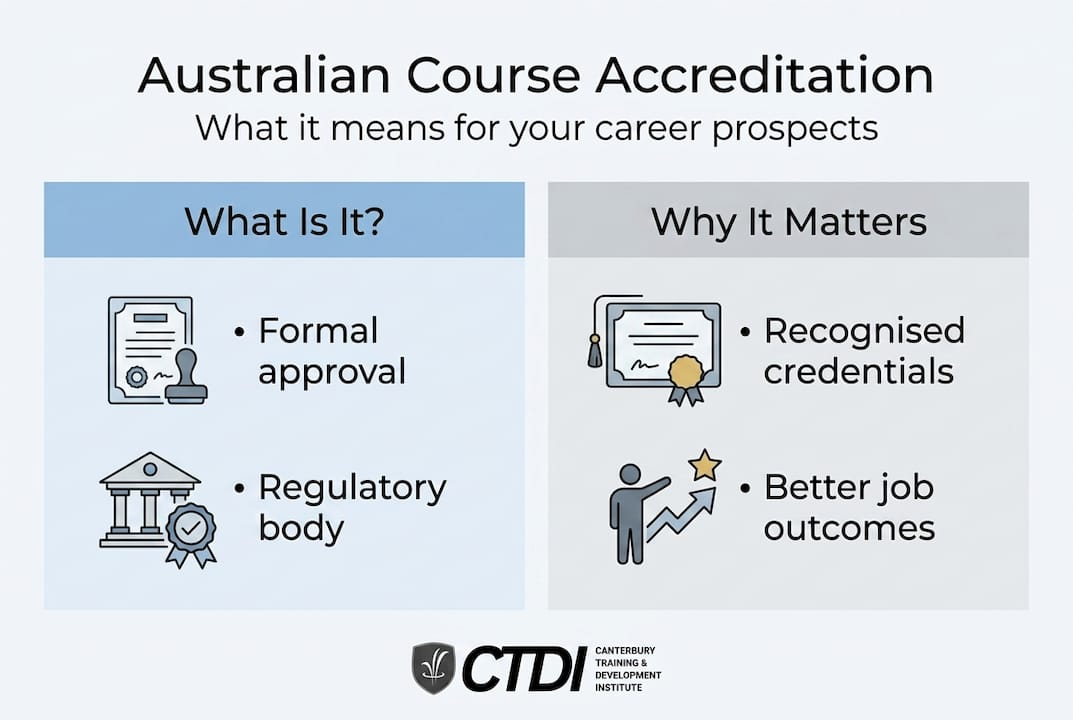
Accreditation in Australia isn't a marketing term. It's a formal process governed by specific regulatory bodies that assess whether a course meets national standards for quality, content, and outcomes. When a course is accredited, it means the qualification has been reviewed, approved, and listed on the national register. That listing is what gives your certificate real value in the job market.
The primary regulator you need to know is the Australian Skills Quality Authority, commonly called ASQA. ASQA oversees the vocational education and training (VET) sector across most states and territories, ensuring that training providers and their courses meet the requirements of the Australian Qualifications Framework (AQF). The AQF is the national policy that covers qualifications from senior secondary certificates all the way through to doctoral degrees, creating a unified, consistent system that employers and institutions can trust.
Key agencies and frameworks to understand:
- ASQA oversees most registered training organisations (RTOs) in Australia, auditing their practices and approving their courses
- CRICOS (Commonwealth Register of Institutions and Courses for Overseas Students) is the register that international students must check to confirm a provider is authorised to enrol overseas students
- RTOs (Registered Training Organisations) are the actual training providers, such as TAFEs, private colleges, and online institutes, that are licensed to deliver accredited courses
- training.gov.au is the publicly accessible national register where you can search any course or provider to verify their accreditation status
- The AQF sets the levels and types of qualifications, from Certificate I through to Doctoral Degree, ensuring consistent standards across the country
Understanding why accreditation matters before you enrol can save you from wasting months on a course that won't advance your career.
"Non-accredited courses lack recognition; international students need CRICOS-registered courses; RPL is available for prior skills." This is a critical reality that many prospective students overlook when comparing course options online. ASQA's role in regulating qualifications in Australia means that only courses delivered by registered providers carry genuine national standing.
One common misunderstanding is that any course offered by a reputable-looking organisation must be accredited. That's not true. Many professional development workshops, online subscription platforms, and short skills programmes operate outside the AQF entirely. They may deliver useful content, but the resulting certificate is not nationally recognised and won't appear on your formal qualification record.
Another edge case worth noting is Recognition of Prior Learning (RPL). If you've already developed skills through work experience or informal training, you may be able to apply for RPL through an RTO. This process assesses your existing competencies against the units in an accredited course and can award you a formal qualification without completing every unit from scratch. It's a practical pathway that many experienced workers don't realise is available to them.
For international students, the rules are even more specific. Studying in Australia on a student visa requires enrolment in a CRICOS-registered course with a CRICOS-registered provider. Choosing a provider that isn't on the CRICOS register could jeopardise your visa status entirely, so this verification step is non-negotiable.
Why accredited courses boost your career prospects
Now that you know what accreditation is, here's why it matters for your future job search.
The employment market in Australia is increasingly competitive, and employers are becoming more discerning about the qualifications they accept. An accredited qualification signals something specific: that you've completed training that meets a nationally agreed standard, assessed by an independent authority. That signal is powerful, and it travels.
Here's what nationally recognised qualifications actually deliver for your career:
-
Portability across states and territories. Because accredited courses are assessed against national standards, your Certificate III in Business or Diploma of Information Technology is recognised whether you're working in Sydney, Perth, or Darwin. You're not locked into one employer or one region.
-
Employer confidence. Hiring managers know what an AQF-aligned qualification means. They don't have to guess whether your training was rigorous or relevant. This reduces friction in the hiring process and often puts accredited graduates ahead of candidates with unrecognised certificates.
-
Direct pathways to employment and apprenticeships. Many accredited VET qualifications are directly linked to industry licensing requirements or apprenticeship frameworks. Trades, healthcare support roles, and early childhood education all require specific accredited qualifications before you can legally practise.
-
University entry and credit transfer. Completing a Diploma or Advanced Diploma through an accredited RTO can provide direct entry into the second year of a related university degree, saving you significant time and tuition fees.
-
Bridging documented skill gaps. Vocational training is growing in Australia precisely because employers have identified specific competency gaps in the workforce. Accredited courses are designed to address those gaps directly, making graduates immediately useful to employers.
The numbers support this. Australia's VET sector enrols over 4 million students annually, reflecting the enormous demand for recognised, practical qualifications. Employers consistently report that VET graduates arrive with job-ready skills that university graduates sometimes lack, particularly in technical and trade-based roles.
Consider the Certificate IV pathways available in environmental management. A student who completes this level of accredited study can move directly into environmental compliance roles, apply for positions requiring demonstrated regulatory knowledge, or use the qualification as a stepping stone into a Bachelor of Environmental Science. None of those options are available with a non-accredited short course on the same topic.

The career value of accreditation isn't theoretical. It's measurable in job offers, salary negotiations, and professional advancement. When you hold a nationally recognised qualification, you're not just claiming skills. You're proving them through a regulated, credible framework.
Navigating course options: Accredited vs non-accredited
It's just as important to know what counts and what doesn't as you compare courses.
The online learning market is crowded. Platforms offering certificates in everything from data analytics to mindfulness coaching have made it harder than ever to distinguish genuine accredited qualifications from well-marketed but unrecognised programmes. Knowing how to read the difference protects your investment.
| Feature | Accredited course | Non-accredited course |
|---|---|---|
| Nationally recognised | Yes, listed on training.gov.au | No formal national standing |
| Employer recognition | Broad, consistent recognition | Varies widely, often limited |
| AQF qualification awarded | Yes | No |
| University credit transfer | Available through articulation | Generally not available |
| CRICOS eligible (international) | Yes, if provider is registered | No |
| RPL applicable | Yes | No |
| Career licensing pathways | Often linked to licensing | Not applicable |
The risks of choosing a non-accredited course are real. You may complete months of study only to find that your target employer doesn't recognise the qualification. You may be unable to transfer credit to a university programme. In regulated industries like construction, aged care, or early childhood education, a non-accredited certificate simply won't satisfy licensing requirements, regardless of how thorough the course content was.
That said, non-accredited short courses do have a legitimate place. If you're looking to quickly refresh a specific technical skill, explore a new interest before committing to formal study, or supplement an existing accredited qualification with current industry knowledge, a non-accredited course can be a cost-effective choice. The key is knowing what you're buying and what you're not.
Pro Tip: Before enrolling in any course, search the provider's RTO number on training.gov.au to confirm their registration status. If the provider isn't listed, the course is not accredited, regardless of what their marketing materials claim.
RPL is worth revisiting here as well. According to ASQA's regulatory framework, RPL is available through accredited RTOs for students who can demonstrate existing competency. This means experienced professionals don't always need to complete a full course to gain a recognised qualification. If you've spent years working in project management, digital marketing, or environmental compliance, RPL could fast-track your formal credentials significantly.
You can review student outcomes from accredited providers to get a realistic picture of where graduates actually end up, which is one of the most reliable indicators of a course's genuine career value.
How to choose: Tips for finding quality accredited courses
Armed with knowledge of what to compare, here's how to make your decision count.
Identifying a genuinely high-quality accredited course goes beyond confirming the provider is registered. The best courses combine regulatory compliance with strong industry connections, experienced trainers, and clear pathways to employment. Here's how to evaluate your options systematically.
Verification checklist before you enrol:
- Confirm the provider's RTO registration on training.gov.au
- Check the specific course code is listed and currently active
- For international students, verify CRICOS registration separately
- Review the course's industry connections and trainer credentials
- Look at published graduate employment outcomes
- Confirm whether RPL or credit transfer is available for your prior experience
| What to check | Where to look | Why it matters |
|---|---|---|
| RTO registration | training.gov.au | Confirms legal authority to deliver accredited training |
| Course listing | training.gov.au | Verifies the specific qualification is nationally recognised |
| CRICOS status | cricos.teqsa.gov.au | Required for international student visa eligibility |
| Industry partnerships | Provider's website | Indicates real-world relevance and employer connections |
| Graduate outcomes | Provider's outcomes data | Shows actual employment and progression rates |
| Trainer qualifications | Course information page | Confirms industry experience behind the teaching |
Vocational training quality is strongly linked to whether the RTO has genuine industry partnerships. Providers who work directly with employers, industry bodies, and professional associations design courses that reflect current workplace requirements rather than outdated content. This is particularly important in fast-moving fields like digital marketing, AI, and environmental management, where industry standards shift rapidly.
The industry partnerships a provider maintains tell you a great deal about the real-world relevance of their training. An RTO that collaborates with employers in your target industry is far more likely to deliver skills that translate directly to job performance.
Pro Tip: Ask the provider directly which employers have hired their graduates. A quality RTO will have this data and will share it willingly. If they can't answer that question, treat it as a red flag.
Watch out for these common mistakes when comparing courses. Choosing based on price alone often leads to non-accredited options that seem cheaper upfront but cost more in the long run when they don't advance your career. Overlooking articulation pathways means you might miss the opportunity to use your VET qualification for university entry, which could be worth tens of thousands of dollars in saved tuition. And ignoring trainer credentials is a mistake because the quality of instruction in vocational training varies enormously between providers.
The role of articulation and industry pathways
For many, accredited study isn't the end goal, but a powerful door-opener.
Articulation is one of the most underutilised benefits of completing an accredited vocational qualification in Australia. In simple terms, an articulation agreement is a formal arrangement between a VET provider and a university that allows graduates to receive credit towards a university degree. Instead of starting a Bachelor's degree from the beginning, you may enter directly into the second year, or receive credit for specific units you've already completed.
Key ways articulation and industry pathways create career momentum:
- Direct university entry: Completing a Diploma or Advanced Diploma at an accredited RTO can satisfy entry requirements for related bachelor's degrees at partnering universities
- Credit transfer: Specific units completed in your VET course may be recognised as equivalent to university-level units, reducing the total time and cost of your degree
- Industry licensing: Many accredited VET qualifications are directly tied to professional licensing requirements, meaning graduation equals eligibility to work in regulated roles
- Apprenticeship and traineeship integration: Accredited qualifications often form the formal study component of apprenticeships, combining on-the-job training with recognised credentials
- Graduate certificate pathways: Some universities accept VET Advanced Diplomas as entry into postgraduate programmes for students with relevant work experience
"Nationally recognised qualifications from accredited courses are portable, understood by employers nationwide, reduce skills gaps, and often lead to direct employment and university pathways." This isn't just aspirational language. It reflects how the Australian education system is deliberately structured to allow movement between VET and higher education.
Consider a practical example. A student who completes an Advanced Diploma of Digital Marketing through an accredited RTO may receive credit towards the second year of a Bachelor of Marketing at a partnering university. That's a year of tuition fees saved, plus the career advantage of having already worked in the industry during their VET studies.
Industry-based learning opportunities also emerge more naturally from accredited study. RTOs with strong employer relationships often facilitate work placements, industry projects, and networking events that give students real-world experience before graduation. These connections frequently lead directly to employment offers.
The academic articulation partnerships available through quality RTOs are a concrete example of how the VET sector is designed to complement, not compete with, higher education. Understanding these pathways before you choose a course means you're not just thinking about your first job. You're thinking about your entire career trajectory.
Our perspective: The missed opportunities in course selection
With the facts laid out, here's what our experience shows matters most.
Most course comparison guides focus on accreditation status as the finish line. Confirm the RTO is registered, check the course is listed, done. But in our experience working with students across industries, the students who get the most from their vocational training are the ones who look beyond the checkbox.
The real differentiator isn't just whether a course is accredited. It's whether the accredited course is connected to the industry you're entering. A qualification from an RTO with genuine employer relationships, active industry advisory boards, and real articulation agreements with universities is worth considerably more than the same AQF-level qualification from a provider who ticks the regulatory boxes but has no meaningful industry presence.
We've seen students complete identical qualifications at different providers and have vastly different employment outcomes. The ones who secured jobs quickly almost always came from RTOs where trainers had current industry experience, where course content was updated regularly, and where the provider's education partners included employers actively looking to hire graduates.
There's also a mindset issue worth naming. Many students treat vocational training as a fallback rather than a strategic choice. That framing undersells what nationally portable credentials actually deliver. In industries like environmental management, digital marketing, and AI, a well-chosen VET qualification combined with practical industry exposure often outperforms a generic university degree in terms of immediate employability.
The hidden value of accredited credentials is the network and recognition they carry. Employers who've hired from a specific RTO before will return to that provider. That relationship is invisible in a course catalogue but enormously valuable to graduates. Choose your provider as carefully as you choose your qualification.
Find your accredited future with CTDI
Ready to put this knowledge into action? Here's how you can start.
At CTDI, every course we offer is nationally accredited, delivered by industry-experienced trainers, and designed to give you practical, job-ready skills from day one. We understand that choosing the right qualification is a significant decision, which is why our programmes are built around real industry needs and supported by genuine articulation partnerships with universities.
Whether you're starting fresh, changing careers, or building on existing skills, we have an accredited pathway for you. Our Advanced Diploma of Digital Marketing is one example of a nationally recognised qualification that opens doors to both employment and further university study. All of our courses are 100% online and self-paced, so you can study around your existing commitments. When you're ready to take the next step, enrol in an accredited course with CTDI and invest in credentials that genuinely count.
Frequently asked questions
What is the difference between accredited and non-accredited courses?
Accredited courses meet regulated national standards and are formally recognised by employers across Australia, while non-accredited courses lack formal recognition and don't lead to AQF qualifications that can be used for employment licensing or university entry.
How do I verify if a course is accredited in Australia?
Search the provider's RTO number and the specific course code on training.gov.au, which is the official national register; international students should also verify via CRICOS to confirm eligibility for student visa purposes.
Can I use accredited course qualifications to study at university?
Yes, accredited VET qualifications such as Diplomas and Advanced Diplomas can often provide direct university entry or credit transfer through formal articulation pathways negotiated between RTOs and partnering universities.
Are accredited online courses accepted by employers?
Yes, as long as the course is delivered by a registered RTO and leads to a nationally recognised AQF qualification, employers accept online credentials on the same basis as face-to-face study.
What are CRICOS-registered courses and who needs them?
CRICOS-registered courses are accredited programmes approved specifically for international students studying in Australia, and enrolment in a CRICOS-registered provider is a mandatory requirement for obtaining and maintaining a student visa.
Recommended
- Certificate IV Environmental Sustainability Australia | Green Career Online | CTDI — Canterbury Training and Development Institute
- Enrol Now — Online Diplomas in AI, Marketing & Sustainability | CTDI — Canterbury Training and Development Institute
- CTDI - Canterbury Training & Development Institute | Online Qualifications
- How Learning AI Could Earn Australians $11,000 More Per Year | CTDI — Canterbury Training and Development Institute