

TL;DR:
- Certification in digital marketing demonstrates industry-recognized skills and boosts employability.
- Combining free, paid, and accredited credentials with practical projects enhances career prospects.
- Ongoing renewal and real-world application of skills are essential for long-term industry relevance.
A digital marketing certification is far more than a badge you collect and forget about. Many people assume that finishing an online course and downloading a certificate automatically translates into job offers and promotions, but the reality is more nuanced and, frankly, more interesting. Certification opens doors, but the way you earn, apply, and build upon your credentials is what truly separates candidates in a competitive market. This guide walks you through exactly what certification means, which types are worth your time, how online education delivers real skills, and how to keep your credentials working hard for your career long after you first earn them.
Table of Contents
- Understanding digital marketing certification
- Types of digital marketing certifications
- Online education: Practical skills and industry relevance
- Renewing and stacking certifications for long-term career growth
- The real value: Why employers want practical proof, not just certificates
- Take your next step in digital marketing certification
- Frequently asked questions
Key Takeaways
| Point | Details |
|---|---|
| Certification is a career springboard | Earning a digital marketing credential opens doors to new job opportunities and skill advancement. |
| Stack and renew for impact | Combining multiple certificates and updating them every few years maximises employability and keeps your knowledge current. |
| Real projects boost credibility | Practical portfolio work proves your skills to employers and sets you apart from peers. |
| Online study is flexible and relevant | Vocational courses online are an accessible way to learn, practise, and build the skills industry wants. |
Understanding digital marketing certification
Digital marketing certification is an industry-recognised credential that confirms you have studied and demonstrated competency in one or more areas of digital marketing. These areas commonly include search engine optimisation (SEO), pay-per-click advertising (PPC), social media marketing, email campaigns, content strategy, and analytics. Think of certification as a formal signal to employers that you have put in structured learning time and can apply specific frameworks.
There is an important distinction to make here. A short course completion badge from a weekend workshop is quite different from a nationally accredited qualification or a rigorous industry credential backed by examination and ongoing renewal requirements. Both have value, but they serve different purposes. Short courses give you a quick introduction. Accredited qualifications give you a structured, verifiable pathway that employers, recruiters, and professional networks take seriously over the long term.
Why does this matter for your career? Because hiring criteria have changed considerably. Employers no longer rely on a university degree alone to assess a candidate's marketing knowledge. They want proof that you understand how algorithms work, how to run a paid campaign on a budget, and how to interpret analytics data to make smarter decisions. Certification, particularly from respected providers, signals that you meet a recognised standard.
Key reasons certification matters:
- Employability boost: Many job advertisements in digital marketing explicitly list certifications as desirable or required criteria
- Structured knowledge: Certification forces you to learn systematically rather than picking up random tips from blog posts
- Professional credibility: Credentials from recognised bodies carry weight with clients, colleagues, and hiring managers
- Career progression: Certified professionals are often considered first for senior roles and client-facing positions
- Salary leverage: Demonstrable qualifications provide concrete justification when negotiating pay
"Certifications don't replace talent, but they make talent visible. In a market full of self-taught marketers, a recognised credential gives employers confidence before they've even seen your portfolio."
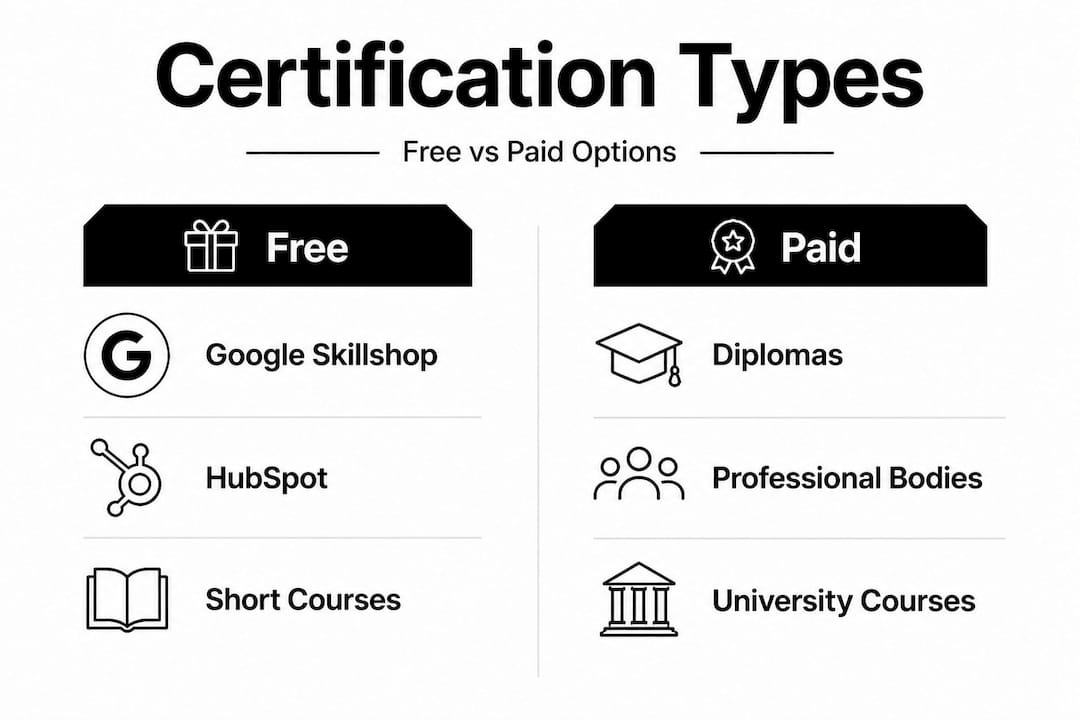
Understanding the learning process for digital marketing helps you make smarter decisions about which programmes to pursue, and online education empowerment is reshaping how Australians access quality training. According to current industry data, free certs from providers like Google and HubSpot are sufficient for entry, while paid options provide greater depth, real-world application, and more substantial credibility with mid-level and senior employers.
Types of digital marketing certifications
Not all certifications are created equal. Knowing your options helps you build a strategic plan rather than just collecting whatever is free and fast. The landscape broadly divides into free platform certifications, paid industry credentials, and accredited academic qualifications.
Free certifications
Google Skillshop offers certifications across Google Ads, Analytics, and other Google products. These are well-recognised by employers, particularly for roles involving paid search and data reporting. HubSpot Academy provides free credentials in inbound marketing, content marketing, email marketing, and social media. Both are genuinely useful, especially when you are starting out or moving into a new specialisation.
Paid certifications
Paid certifications from academic institutions and professional bodies typically involve more rigorous assessment, longer study periods, and stronger industry partnerships. They often include practical assignments, case studies, and feedback from experienced trainers. The investment reflects the depth of learning and the weight the credential carries with employers seeking mid-to-senior talent.
Accredited vocational qualifications
In Australia, nationally accredited qualifications such as diplomas and advanced diplomas sit within the Australian Qualifications Framework (AQF). These credentials are designed in consultation with industry and reflect the actual skills employers need. Studying for an advanced diploma in digital marketing gives you a formal qualification that is recognised across Australian workplaces and can even lead to credit recognition at some universities.
Here is a comparison of the main certification types:
| Certification type | Cost | Depth | Renewal required | Best for |
|---|---|---|---|---|
| Google Skillshop | Free | Introductory to intermediate | Yes, annually | Entry-level, PPC specialists |
| HubSpot Academy | Free | Introductory to intermediate | Yes, annually | Content, inbound, email roles |
| Paid industry credentials | Moderate | Intermediate to advanced | Every 1 to 3 years | Career changers, specialists |
| Accredited vocational qualification | Higher | Comprehensive | Reviewed periodically | Long-term career investment |
Stacking certifications for maximum value
One of the smartest strategies in digital marketing is stacking certifications. Rather than choosing just one, combine credentials that complement each other. For example, pairing a Google Ads certification with a HubSpot inbound marketing credential and a vocational qualification in digital marketing gives you a full-spectrum profile. Industry guidance confirms that stacking multiple certifications significantly increases your employability compared to holding a single credential.
How to build a stacked certification plan:
- Start with a free platform certification to build foundational knowledge quickly
- Identify your target role and research which credentials employers in that space value most
- Enrol in a deeper, paid or accredited qualification to add weight to your profile
- Complete a real project or campaign alongside your studies to demonstrate applied skills
- Schedule renewal dates for each certification and set reminders six weeks before expiry
Pro Tip: When you combine certifications with actual project outcomes, such as a measurable SEO result or a social campaign you managed from brief to report, your profile becomes dramatically more compelling. Certificates tell employers what you studied. Projects tell them what you can do.
Once you are ready to take a structured step forward, enrol in an online diploma to formalise your credentials within a nationally recognised framework.
Online education: Practical skills and industry relevance
Here is where many people get tripped up. They assume that completing an online course automatically means they have the skills employers want. Finishing modules and passing quizzes builds knowledge, but it does not build competence unless the learning includes practical application. The best online education programmes close this gap by integrating real-world tasks, industry feedback, and project-based assessments.

Why online education works for digital marketing
Digital marketing is, by nature, a digital discipline. Learning it online is not just convenient, it is appropriate. You are using the same tools, platforms, and environments that you will use in professional practice. Self-paced online study also lets you fit learning around existing work and personal commitments, which matters enormously for working adults who cannot afford to step away from their current role to study full-time.
The flexibility of online study is well-documented. You can access course materials at midnight if that suits you. You can revisit complex topics without embarrassment. You can complete assessments at a pace that suits your learning style rather than a classroom timetable.
What makes online digital marketing training genuinely practical?
| Learning approach | What it delivers | Why it matters to employers |
|---|---|---|
| Real campaign simulations | Hands-on experience with live tools | Shows you can function in actual work environments |
| Case study analysis | Critical thinking and problem-solving | Demonstrates strategic capability |
| Assessed projects | Documented evidence of skills applied | Provides portfolio material for job applications |
| Trainer feedback | Corrective guidance and professional input | Replicates workplace mentorship |
| Industry-aligned content | Current tools, platforms, and strategies | Reduces onboarding time for employers |
Features to look for in an online digital marketing programme:
- Trainer credentials: Look for educators who are active industry practitioners, not just academics
- Assessment variety: A mix of quizzes, written assignments, and practical projects shows comprehensive evaluation
- Community access: Peer interaction and networking opportunities that replicate professional environments
- Industry tools: Hands-on exposure to platforms like Google Analytics 4, Meta Ads Manager, and Mailchimp
- Career support: Guidance on job applications, portfolios, and interview preparation
Pro Tip: Before you enrol, check whether the course includes at least one practical assignment where you plan, execute, or analyse a real or simulated campaign. If the only assessment is multiple-choice questions, the qualification will carry less weight with experienced hiring managers.
Academic partnerships between training providers and universities can also add significant value to your qualification, offering credit pathways that reward your investment. Strong corporate training partnerships ensure course content is regularly reviewed against what employers actually need, not just what was relevant three years ago. As current industry research confirms, real projects outweigh certifications alone when it comes to genuine employability.
Renewing and stacking certifications for long-term career growth
Digital marketing moves fast. Platforms change their algorithms. New advertising formats emerge. Privacy regulations reshape data collection and audience targeting. A certification earned two years ago may not reflect current best practices, and experienced employers know this. That is why renewal and continuous learning are not optional extras for serious professionals.
Typical renewal cycles
Most leading platform certifications require annual renewal. Google Skillshop certifications, for example, expire after 12 months. HubSpot credentials vary but typically require renewal within one to two years. Paid and accredited qualifications may have longer validity periods but still benefit from supplementary learning to keep knowledge current. As the data consistently shows, certifications need renewal every one to three years to remain credible.
Why staying current matters more than you think
Consider this scenario. A candidate applies for a senior content marketing role. They hold a HubSpot certification earned three years ago and have done nothing since. Another candidate holds the same certification, renewed it last year, and added a Google Analytics 4 credential after the major platform update. The second candidate signals active professional engagement. That signal matters.
How to build a sustainable renewal and stacking strategy:
- Create a certification calendar listing every credential you hold and its renewal date
- Set reminders at least six weeks before each expiry so you have time to review updated content
- Each renewal cycle, identify one new complementary certification to add to your stack
- Aim to complete a fresh real-world project alongside each renewal to demonstrate applied current skills
- Document your renewal history on your LinkedIn profile and resume so employers can see your ongoing commitment
Benefits of maintaining a stacked, current certification portfolio:
- Demonstrates initiative: Employers see that you invest in your own professional development
- Keeps knowledge relevant: Each renewal exposes you to updated platform features and industry changes
- Strengthens salary negotiations: A portfolio of current credentials gives you concrete evidence of value
- Supports specialisation: Over time, stacking allows you to develop a clear area of expertise while maintaining broad foundational knowledge
- Builds professional networks: Many renewal programmes include community forums and events that expand your contacts
Understanding how the landscape is shifting is equally important. Reading about digital marketing jobs in the age of AI helps you anticipate which skills will be in demand and which certifications to prioritise next. The CTDI career insights blog regularly publishes guidance on industry trends worth keeping an eye on as you plan your learning roadmap.
Pro Tip: Treat your certification portfolio as a living document, not an archive. Every 12 months, review every credential you hold. Ask yourself whether each one still reflects current tools and employer expectations. If the answer is no, prioritise renewal or replacement before your next job application.
The real value: Why employers want practical proof, not just certificates
Here is an uncomfortable truth that most certification guides will not tell you directly. A hiring manager who has reviewed hundreds of applications can spot a certificate-collector quickly. They see candidates with four or five platform badges but no tangible results to show for them. No campaigns managed. No data analysed and acted upon. No audience grown. Just a list of credentials.
This is not a reason to skip certification. It is a reason to approach certification differently.
The most impressive candidates we see in the professional market hold a smaller number of well-chosen credentials, each paired with concrete evidence of applied learning. A Google Ads certification means something different when the candidate can also show a campaign they ran, the budget they managed, and the cost-per-click improvement they achieved over six weeks. That combination is almost irresistible to employers.
Our perspective is this: certifications are proof of knowledge, but portfolios are proof of capability. Knowledge without capability is interesting. Capability without documented knowledge raises questions. Together, they create a complete professional picture that hiring managers can trust and act on.
The practical implication for you is straightforward. Choose courses that build your portfolio as you study. Look for assessments that produce real outputs, such as written campaign strategies, analytics reports, or social media content plans. These outputs become your portfolio. When an employer asks what you can do, you show them rather than telling them.
Courses with strong academic partnerships tend to integrate industry-standard projects into their assessment design. Providers with active corporate training partnerships know exactly what employers expect because those employers helped shape the curriculum. That kind of connection between classroom and industry is what transforms a certification from a piece of paper into a genuine career asset.
As industry analysis confirms, real projects consistently outperform certifications alone in employer decision-making. The best digital marketing professionals understand this and design their learning accordingly. They do not just study. They practise, document, and demonstrate.
Take your next step in digital marketing certification
If you have read this far, you already understand that serious career progress in digital marketing requires more than a weekend badge. It requires structured learning, applied experience, industry-relevant credentials, and a commitment to ongoing renewal.
At CTDI, our advanced diploma in digital marketing is designed to give you exactly that combination. Developed in partnership with industry practitioners and delivered 100% online in a self-paced format, the programme integrates practical projects, expert trainer feedback, and nationally accredited credentials into a single cohesive learning experience. You will graduate with both the qualification and the portfolio evidence employers actually look for. Ready to take the next step? You can enrol in the marketing diploma today and start building a credential that genuinely advances your career.
Frequently asked questions
How long do digital marketing certifications last?
Most certifications require renewal every one to three years to stay current with platform changes and industry expectations. Keeping credentials active signals genuine professional engagement to employers.
Are free certificates like Google Skillshop and HubSpot enough for entry-level roles?
Free digital marketing certificates are generally sufficient for entry-level positions, but combining them with paid or accredited qualifications provides deeper expertise and significantly stronger candidacy for mid-level roles.
Do real project experiences matter more than certificates?
Employers consistently prioritise practical project experience over certifications alone, particularly when assessing candidates for roles that require immediate contribution rather than extended onboarding.
How can I maximise the value of my certification?
Combine multiple complementary certificates, apply your skills through live or simulated projects, and renew your credentials on schedule. As industry guidance confirms, stacking and renewing certifications every one to three years delivers the strongest long-term career outcomes.
Recommended
- Advanced Diploma Digital Marketing Australia | AI-Powered Marketing Career | CTDI — Canterbury Training and Development Institute
- Mastering the digital marketing learning process: career growth — Canterbury Training and Development Institute
- Career Insights Blog | AI Jobs, Digital Marketing & Green Careers Australia | CTDI — Canterbury Training and Development Institute
- CTDI - Canterbury Training & Development Institute | Online Qualifications