

An automation engineer course, in the vocational sense that matters for career changers, is a nationally recognised online qualification teaching AI-driven process automation and digital workflow skills. It's not a robotics or PLC engineering degree. It's a portable credential built around marketing automation platforms, integrations, and workflow design that aims to prepare you for work more efficiently than self-directed learning through YouTube tutorials.
Before you enrol anywhere, check three things:
- The AQF level the course sits at (Certificate IV, Diploma, or above)
- Whether the provider is an RTO registered with ASQA
- The specific units of competency or accredited course code listed on the course page
The fastest way to separate a serious course from a marketing exercise is to look for a course code and an RTO number on the page. If neither exists, you're looking at a workshop, not a qualification.
Your next move: pull up the provider's accredited course listing and confirm the RTO registration before you read another word of sales copy.
Key Takeaways
Accredited automation engineer courses combine AQF-recognised standing with practical, portfolio-based assessment, and that combination is what employers actually check for.
| Point | Details |
|---|---|
| Verify accreditation first | Confirm AQF level, RTO registration, and ASQA oversight before enrolling anywhere. |
| Prioritise practical output | Choose courses assessed through built projects and portfolios, not quizzes alone. |
| Match the course to your goal | Career changers, marketing technologists, and process analysts each suit slightly different entry points. |
| Plan a realistic timeline | Expect 6 to 12 months for diploma-level study, shorter with RPL or micro-credentials. |
| Consider CTDI's AI Diploma | A nationally accredited, RTO-delivered option with portfolio assessment and flexible online study. |
Table of Contents
- What automation engineer courses actually teach
- Who should take these courses, and what happens after
- Why accreditation matters and what to check
- How do you choose the right automation course?
- How long does it take to go from beginner to job-ready?
- What to do next if you're ready to enrol
- Comparing popular accredited automation courses
- Why accreditation is the smarter bet for career changers
- Ready to build a portable automation credential?
- Frequently asked questions
- Sources
What automation engineer courses actually teach
Strip away the branding and most accredited automation courses teach the same core toolkit, just packaged differently. You're learning how AI systems slot into everyday business processes, and how to build workflows that don't fall over the moment a variable changes.
Expect coverage of:
- AI-driven automation concepts and where they fit into existing business systems
- Workflow mapping (turning a messy manual process into a documented, repeatable sequence)
- API and integration basics, so tools can talk to each other without manual data entry
- Marketing automation campaign build and sequencing
- RPA (robotic process automation) fundamentals for rules-based task automation
- Data literacy and monitoring, so you can tell when an automation is working and when it's quietly breaking
The output matters more than the syllabus. A well-built course leaves you with a portfolio: a project brief, a working automation workflow, a campaign sequence, maybe a basic integration script, all sitting in an assessment folder you can show an employer. A modern curriculum built around this kind of applied project work tends to cover fundamentals through ethics and real deliverables, not just software walkthroughs.
Pro Tip: Ask to see a sample assessment before you enrol. If every task is "watch this video and answer three questions," that's a tool demo dressed up as a course. Look for tasks that ask you to build something, test it, and document what broke.
Who should take these courses, and what happens after
These courses suit a specific set of people, and it's worth being honest about who gets the most value.
- Career changers moving from admin, retail, or customer service roles into tech-adjacent work
- Marketing technologists who already run campaigns but want to formalise their automation skills
- Process analysts looking to add AI and workflow tooling to an existing operations background
- Junior automation practitioners wanting a recognised credential to back up self-taught experience
- Managers who need enough operational literacy to brief automation projects, even if they won't build them day to day
Realistic entry-level outcomes include titles like automation coordinator, marketing automation specialist, workflow analyst, or digital operations assistant. Employers hiring into these roles generally care less about where you studied and more about whether you can show a working project and explain your decisions during an interview.
This is where accreditation earns its keep. Employers routinely accept accredited qualifications for regulated or long-term roles because the credential is portable and independently verifiable, whereas unaccredited training gets picked for cost and flexibility rather than career mobility.
Why accreditation matters and what to check
"Nationally recognised training" isn't a marketing phrase. It's a defined category covering accredited qualifications, accredited courses, training package skill sets, units of competency, and accredited modules, all of which sit inside the Australian VET system. A non-accredited course can still teach useful skills, but it won't carry the same weight on a resume, and it won't show up on a formal transcript.
Run through this checklist before you hand over payment details:
- AQF level stated clearly on the course page (not buried in a PDF)
- Accredited course code or units of competency listed, not just a course name
- RTO registration number, checkable against the national register
- ASQA oversight confirmed, since ASQA is the regulator that audits RTOs
- Assessment methods described in specific terms (projects, portfolios, practical tasks)
- Recognition statements or a Statement of Attainment issued on completion
For professionals wanting a credential that survives a career pivot, accredited training is treated as the serious option, while unaccredited short courses work better as top-up learning once you're already employed. Understanding how these accredited qualifications get built and recognised helps you spot the difference between a real credential and a certificate of attendance.
Pro Tip: If a role sits in a regulated industry, or you might work overseas later, accreditation stops being optional. Portability is the entire point of an AQF-aligned qualification.
How do you choose the right automation course?
Shortlisting three or four providers and running them through the same checklist beats going with whichever ad you saw first. Compare:
- Accreditation status and AQF level
- Whether assessment is practical (built projects) or theoretical (multiple-choice quizzes)
- How closely the curriculum tracks current industry tools and workflows
- Trainer background, specifically whether they've worked in automation or marketing operations, not just taught about it
- Delivery mode and pace, self-paced versus fixed-schedule cohorts
- Student support availability, and whether you can reach a real person when you're stuck
- Recognition of prior learning (RPL) options if you already have relevant experience
When you're on a call or email chain with a provider, ask direct questions: What does a typical assessment task look like? Can I see the RTO registration number? What industry partnerships back the curriculum? What do recent graduates typically move into? Course cost varies by provider and depth, and financing often comes through payment plans, employer sponsorship, or government-subsidised places where eligible. Check each provider's own pricing and payment page rather than relying on rough averages, since offerings shift.
How much do automation engineer courses cost? Costs vary widely by provider, AQF level, and course length, from a few hundred dollars for a short skill set to several thousand for a full diploma. Payment plans and employer sponsorship are common; always confirm current pricing directly with the provider.
Do I need a technical background to start? No. Most accredited programs are designed for career changers with no coding background, building technical literacy progressively through the coursework itself.
How long does it take to go from beginner to job-ready?
- Start with a short skill set or micro-module covering one specific tool or concept, usually a few weeks of self-paced study.
- Complete a Certificate-level qualification to build foundational competency across multiple units, typically a few months part-time.
- Progress to a Diploma-level AQF qualification, the credential most employers recognise for genuine automation and digital workflow roles, generally 6 to 12 months self-paced.
- Build workplace-style projects throughout the diploma to create a portfolio you can actually show.
- Apply for entry roles or employer-sponsored placements, using RPL to shorten the timeline if you already have relevant work experience.
Micro-credentials stack well here. If you've already done a short automation course, ask providers whether it counts toward RPL before you start from scratch.
What to do next if you're ready to enrol
- Find the provider's accredited course page and confirm the RTO number and AQF level.
- Request a unit summary and a sample assessment task.
- Check start dates, payment options, and whether a payment plan is available.
- Complete the enrolment form once you're satisfied the course matches your goal.
Before day one, get basic tooling set up, sketch a sample project brief, start a simple portfolio folder, and block out weekly study time. If you want a second opinion on whether a course actually fits your career goal, CTDI's enrolments team can talk you through it.
Comparing popular accredited automation courses
Course quality in this space splits along a few clear lines rather than a long list of interchangeable options. Diploma-level programs built around AI-driven automation and digital workflow skills tend to differ most in three places: how much of the assessment is project-based versus quiz-based, how current the curriculum is against tools employers actually use, and how much trainer contact you get during self-paced study.
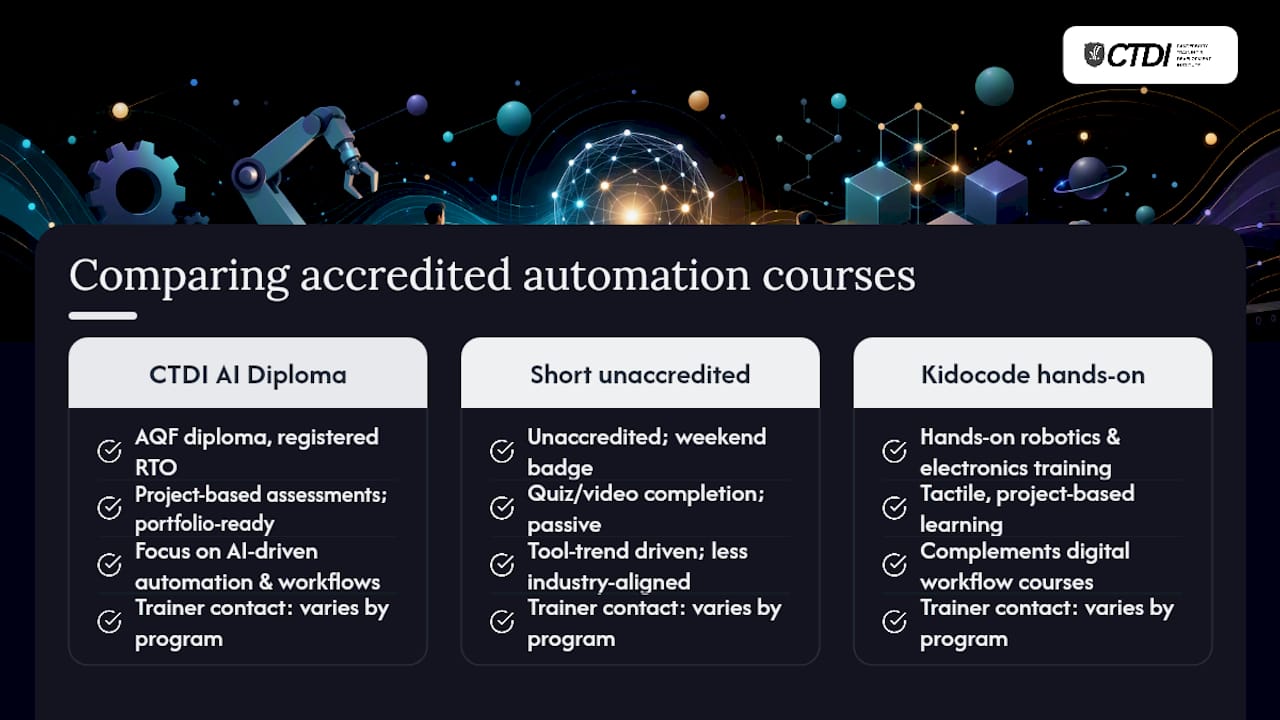
CTDI's AI Diploma is built around this exact gap. It sits at diploma level on the AQF, runs through a registered RTO, and structures assessment around practical projects rather than passive video completion, workflow builds, campaign sequencing tasks, and a portfolio you finish the course with rather than a certificate of attendance. That's a meaningfully different experience from a short unaccredited "AI marketing" course that promises a badge in a weekend.
Reputation in this sector comes down to graduate outcomes and how seriously a provider treats industry alignment. Courses that map their curriculum against current AI marketing certification standards and produce genuine portfolio-ready outputs hold up better over a five-year career than programs chasing whatever tool is trending this quarter. If you're building foundational technical confidence before tackling software-heavy automation work, hands-on programs like Kidocode's robotics and electronics training can be a useful complement, particularly for learners who want tactile grounding before moving into digital-only workflow tools.
Why accreditation is the smarter bet for career changers
Career changers rarely get a second run at picking the right qualification. CTDI recommends accredited pathways because employers can verify them instantly, unlike a certificate from a platform nobody in HR has heard of. We've built our courses around industry-aligned, portfolio-based assessment because a finished project convinces a hiring manager faster than a transcript ever will.
Ready to build a portable automation credential?
Most alternatives here are either a short unaccredited workshop that teaches one tool, or a general-purpose bootcamp with no AQF standing behind it. Neither gives you a credential a hiring manager can independently verify. CTDI's accredited AI Diploma sits at diploma level, runs through a registered RTO, and structures assessment around the same practical outputs employers actually ask for: workflow builds, campaign sequences, and a finished portfolio rather than a quiz score.
Study is 100% online and self-paced, so you can fit coursework around a current job rather than pausing income to retrain. You get direct trainer support, not just a forum you post into and hope someone answers. The curriculum gets reviewed against current industry practice rather than sitting static for years.
If you want the specifics, check the AI Diploma course page for unit details and start dates, or go straight to enrolments to lock in a place or request a course guide from the team.
Frequently asked questions
Is an automation engineer course the same as a robotics engineering degree? No. The vocational courses covered here teach AI-driven process and digital workflow automation, not industrial robotics, PLCs, or manufacturing control systems. They're built for career changers entering digital operations and marketing technology roles.
How do I confirm a provider is a genuine RTO? Search the provider's RTO number against the national training register. If a provider can't give you a registration number, treat that as a red flag rather than an oversight.
Can I finish a diploma while working full-time? Yes. Most accredited automation diplomas are self-paced and designed around working professionals, though the 6 to 12 month timeframe assumes consistent weekly study hours.
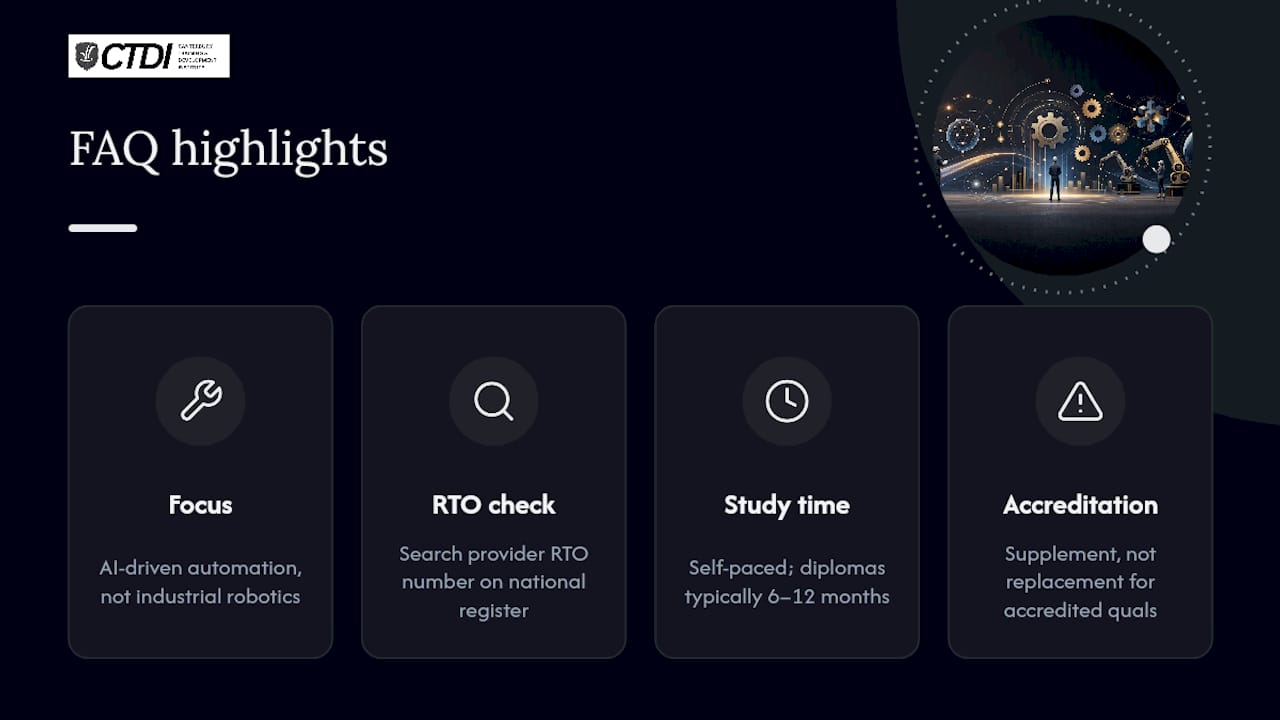
Will an unaccredited short course hurt my job prospects? Not necessarily, but it won't carry the same weight for regulated roles or long-term career moves. Treat short unaccredited courses as a supplement to an accredited qualification, not a replacement for one.
Sources
- Accredited vs Non-Accredited Training: Which Boosts Your Career?
- Unaccredited training: why employers use it and does it meet their needs?
- What are nationally recognised training and non‑nationally recognised training?
- AI for Marketers Course: Compare Top Programs | Coursiv Blog
Recommended
- How to upskill online: a practical 2026 guide — Canterbury Training and Development Institute
- Enrol Now — Online Diplomas in AI, Marketing & Sustainability | CTDI — Canterbury Training and Development Institute
- Examples of workplace upskilling that advance careers — Canterbury Training and Development Institute