

The best international student courses right now sit in six areas: computer science and AI, finance and accounting, digital marketing, engineering and construction trades, nursing and allied health, and nationally accredited vocational diplomas with built-in industry placements. Each one leads somewhere specific.
- Computer science / AI → data analyst, machine learning, and software roles
- Finance & accounting → graduate analyst programs and corporate finance
- Digital marketing → marketing coordinator and specialist roles across every industry
- Engineering & construction trades → apprenticeships and site-based technical roles
- Nursing & allied health → clinical placements leading directly to registered roles
- Vocational diplomas (AI, marketing, sustainability)
→ fast local job entry with practical, employer-ready skills
Pro Tip: Before comparing course content, check whether a program includes a mandatory or recommended industry placement and whether it's nationally recognised under the Australian Qualifications Framework (AQF). Those two factors predict employability better than the university's name on the certificate.
Key Takeaways
The strongest course choices for international students combine accreditation, industry placement, and a clear post-study employment pathway rather than academic prestige alone.
| Point | Details |
|---|---|
| Placements outperform theory | Courses with mandatory placements or a year abroad build networks and practical skills employers actively value. |
| High-demand fields lead outcomes | AI, data, finance, digital marketing, nursing, and construction trades show the clearest graduate pathways. |
| Accreditation is non-negotiable | Always verify AQF or CRICOS status before enrolling, regardless of how polished the marketing looks. |
| Language support varies widely | Ask specifically what's included, since self-paced formats often suit non-native speakers better than lecture-based courses. |
| CTDI offers a fast, accredited option | Its online diplomas in AI, digital marketing, and sustainability suit students prioritising speed, flexibility, and recognised credentials. |
Table of Contents
- Why placements and international exposure matter more than the syllabus
- What are the top course types for international students?
- How do you choose the right course for your goals?
- Where do flexible vocational diplomas fit into your study plan?
- What language support do international students actually need?
- Sources
Why placements and international exposure matter more than the syllabus
A course's reading list rarely determines whether a graduate gets hired. What matters is whether the course puts a student in front of real employers before graduation. Degrees built around a year abroad, an industry placement, or a structured internship give students something a transcript alone can't: a network and a track record of applied work.
Educational leaders at the University of Queensland point out that work-integrated learning creates industry-ready graduates, because placements force students to apply theory under real conditions rather than in a simulated classroom exercise. The same logic underpins some of the world's most competitive programs:
- Warwick's BSc International Business & Management makes a year abroad or approved placement mandatory, with partnerships spanning multiple institutions across many countries.
- HEC Paris designs its Master in International Finance around study trips to financial institutions alongside intensive career coaching, not classroom theory alone.
- WU Vienna's CEMS program requires a semester abroad plus corporate partner projects, a structure that consistently produces strong graduate placement rates.
Capstone projects and embedded internships often carry more weight with hiring managers than raw academic performance, because they show a candidate can already do the job, not just describe it.
Pro Tip: When you evaluate a placement, ask three direct questions: Is it paid or unpaid? How many hours does it require per week? And what percentage of past students converted their placement into a graduate job offer? A provider that can't answer the third question probably hasn't tracked it, which tells you something too.
What are the top course types for international students?
These are the fields that consistently deliver the strongest career return for international students, based on demand data and graduate outcome patterns.
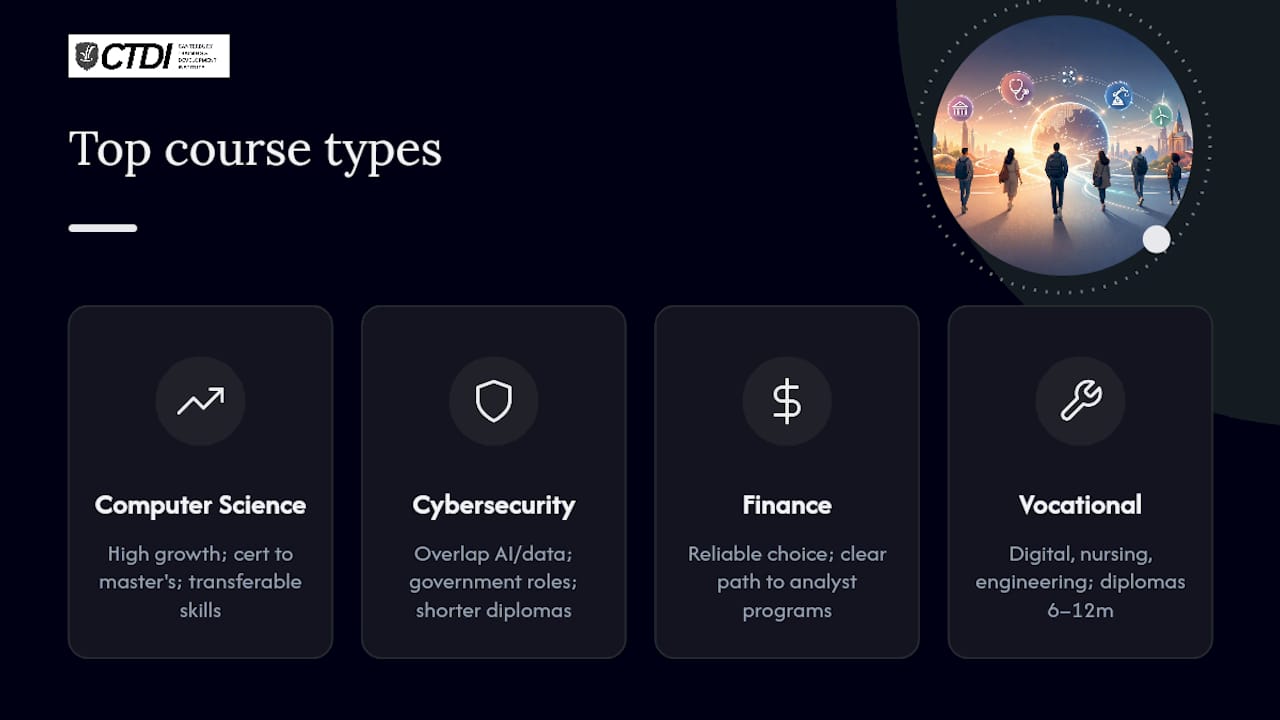
Computer science, AI and data sit at the top for a reason. Hitouch Global's 2026 course rankings place AI, data science and cybersecurity among the highest-growth fields, and these skills transfer across almost every industry. Typical entry points range from a graduate certificate through to a master's degree, delivered on campus, online, or in blended formats.
Cybersecurity overlaps heavily with the AI and data cluster but tends to attract students chasing government and enterprise-security roles specifically, often through shorter graduate diplomas rather than full degrees.
Finance and accounting remain reliable choices. UCAS data compiled by The Complete University Guide shows economics and management consistently rank among the most popular subjects for international undergraduates, largely because the career pathway into graduate analyst programs is well understood by employers.
Digital marketing suits students who want a shorter time-to-employment. It's taught at certificate, diploma and degree level, and the skill set (analytics, content, paid media) applies to almost any employer, which makes it one of the more flexible choices on this list.
Nursing and allied health offer some of the clearest pathways from study to registration, typically through bachelor's or diploma-level clinical training with mandatory placement hours.
Engineering and construction trades, along with quantity surveying and construction management, combine strong local demand with apprenticeship-style, on-the-job learning that suits students who want to earn while they study.
Vocational diplomas in AI, digital marketing and sustainability round out the list, offering shorter, self-paced, nationally accredited study focused entirely on job-ready skills. IDP's guide to top courses in Australia notes that many international students weigh both popularity and post-study pathway strength when picking a field, and these diplomas score well on the second measure.
Pro Tip: Choose a vocational diploma over a bachelor's or master's when speed to employment matters more than academic prestige. A diploma can get you working in six to twelve months; a degree usually takes two to four years.
How do you choose the right course for your goals?
Match the course to your primary objective first. Someone chasing a graduate residency pathway needs a different course than someone who wants to earn quickly or someone chasing a research career.
Before you commit, check these criteria:
- Accreditation — is it recognised under the AQF, or the equivalent national framework in your destination country?
- Industry placement — is it built into the course, optional, or nonexistent?
- Graduate outcomes — does the provider publish employment rates within six or twelve months of completion?
- Post-study work rights — does the course or field align with skilled migration pathways, where relevant?
- Cost and duration — what's the total cost against the realistic time to employment?
- Language support — does the provider offer proficiency support alongside the academic content?
- Credit recognition — can credits transfer into a higher qualification later?
Ask providers directly: "Is the placement paid?" "What proportion of international students secure a graduate role within six months?" "Is this course CRICOS-registered for international enrolments?" Vague answers to any of these are a warning sign.
Pro Tip: Verify a course's CRICOS or AQF status independently rather than trusting a provider's marketing page. CTDI's own guide to checking accreditation status walks through exactly what to look for, and the same due diligence applies to any course anywhere in the world.
Where do flexible vocational diplomas fit into your study plan?
Nationally accredited vocational diplomas are usually the best option when you want practical skills, low upfront cost, and fast entry into work. They're not built to replace a research career or a specialised professional licence, but they solve a different problem: getting employable, fast.
Accreditation matters here specifically because it determines whether employers and universities recognise the qualification at all. Explaining what national recognition actually means for a diploma helps clarify why an AQF-listed credential carries weight that an unaccredited "certificate" from an unregulated provider simply doesn't.
Vocational diplomas tend to be strongest where:
- Course duration runs months rather than years
- Curriculum is designed directly with industry input, not academic theory first
- Delivery is flexible and self-paced, suited to students juggling work or visa conditions
- Australia's vocational education sector is recognised internationally as a strong entry point into IT, business and health-adjacent careers
Pro Tip: Combine a vocational diploma with a later articulation agreement into a bachelor's degree. Many providers, including CTDI, run academic articulation partnerships that let diploma credit count toward a full degree, so the fast-entry pathway doesn't close off longer-term study later.
What language support do international students actually need?
Most Australian institutions require an IELTS score (or equivalent test like TOEFL or PTE Academic) before enrolment, with the exact threshold varying by course level and provider. Vocational diplomas generally set a lower bar than a research master's degree, which matters if English isn't your first language and you want to start working sooner rather than spend a year on language preparation alone.

Support options vary more than the entry requirements do. Some providers offer academic English bridging courses before the main program starts. Others build language support into the course itself through recorded lectures students can replay, written materials alongside spoken content, and tutors available for one-on-one clarification.
Flexible, self-paced online formats often suit non-native English speakers better than a fast-moving lecture hall, simply because students can pause, rewatch, and process material at their own speed. For more options, see How To Find Free Online Courses For Any Type Of Learning? That's a genuine, practical advantage of online vocational study that rarely gets mentioned in course marketing.
Before enrolling, ask directly what language support is included and whether it costs extra. A provider that treats language support as a bolt-on afterthought is a different experience to one that's built it into the course structure from day one.
Why flexible, accredited pathways deserve a serious look
International students often default to a bachelor's degree because it's the familiar option, not necessarily the best-fit one. CTDI's accredited online diplomas in AI, digital marketing and sustainability suit students who want nationally recognised skills, self-paced delivery, and industry-aligned content without a multi-year commitment. Always confirm accreditation and placement details before enrolling anywhere, including here.
A practical next step if you want fast, flexible accreditation
CTDI's accredited online diplomas in AI, digital marketing, and sustainability give international students a way to gain nationally recognised skills without pausing life for a multi-year degree.
Unlike a traditional bachelor's program, these diplomas are self-paced, built with industry input, and designed to get you job-ready in months rather than years. If digital marketing is the field you're weighing up, the Advanced Diploma of Digital Marketing covers AI-powered marketing skills that employers are actively hiring for right now. Ready to see where you fit? Enrol now and get started on a course built around real employment outcomes, not just a certificate.
Sources
- Work-integrated learning creates industry-ready graduates — University of Queensland
- Best courses for international students in Australia — IDP
- Master in International Finance — HEC Paris
- BSc International Business & Management — Warwick Business School