

TL;DR:
- Online vocational education in Australia is growing rapidly, offering flexibility and industry-relevant skills.
- Quality online programs feature authentic assessments, industry connections, and adaptability for career advancement.
- Success depends on choosing accredited courses, engaging actively, and applying skills practically during study.
Australia's vocational education landscape has shifted dramatically. The idea that you need to sit in a classroom to earn a credible qualification is increasingly outdated, especially when the Australian online education market is valued at $12.2 billion in 2026 and has grown at a compound annual rate of 5.4% since 2020. This guide is for anyone who wants to understand how online vocational training can genuinely accelerate a career, whether you are based in Sydney, regional Queensland, or overseas and looking for an Australian qualification. We cover how online learning transforms opportunities, how to choose the right program, the real obstacles you will face, and what the employment data actually says.
Table of Contents
- How online learning transforms career opportunities
- Choosing the right online vocational program
- Navigating challenges and maximising outcomes
- The impact of online education on employment and satisfaction
- Our perspective: What most guides miss about online vocational education
- Ready to boost your career with online learning?
- Frequently asked questions
Key Takeaways
| Point | Details |
|---|---|
| Flexible skill pathways | Online learning empowers both local and international students to upgrade career skills at their own pace. |
| Course selection matters | Choosing accredited programs with strong practical components maximises your employability. |
| Overcoming engagement hurdles | Proactive strategies and hybrid models help tackle online learning challenges, including motivation and hands-on practice. |
| Employment outcomes nuanced | Most graduates benefit from improved employment, though market shifts and skill gaps play a role. |
| Continuous growth | Online vocational education is a stepping stone for lifelong adaptability and connecting with industry networks. |
How online learning transforms career opportunities
The assumption that serious, career-changing education requires a physical campus has been tested hard over the past five years and largely found to be false. Online learning has moved well beyond recorded lectures and PDF handouts. Today's vocational programs use adaptive delivery, interactive assessments, and live facilitator sessions that match and, in some cases, exceed what a traditional classroom can offer.
The numbers support this. The online education market in Australia reached $12.2 billion in 2026, growing at a 5.4% CAGR across the preceding five years. That growth is not driven by novelty. It is driven by outcomes. Employers have become far more comfortable with digitally delivered qualifications, particularly in fields like technology, digital marketing, business administration, and environmental management.
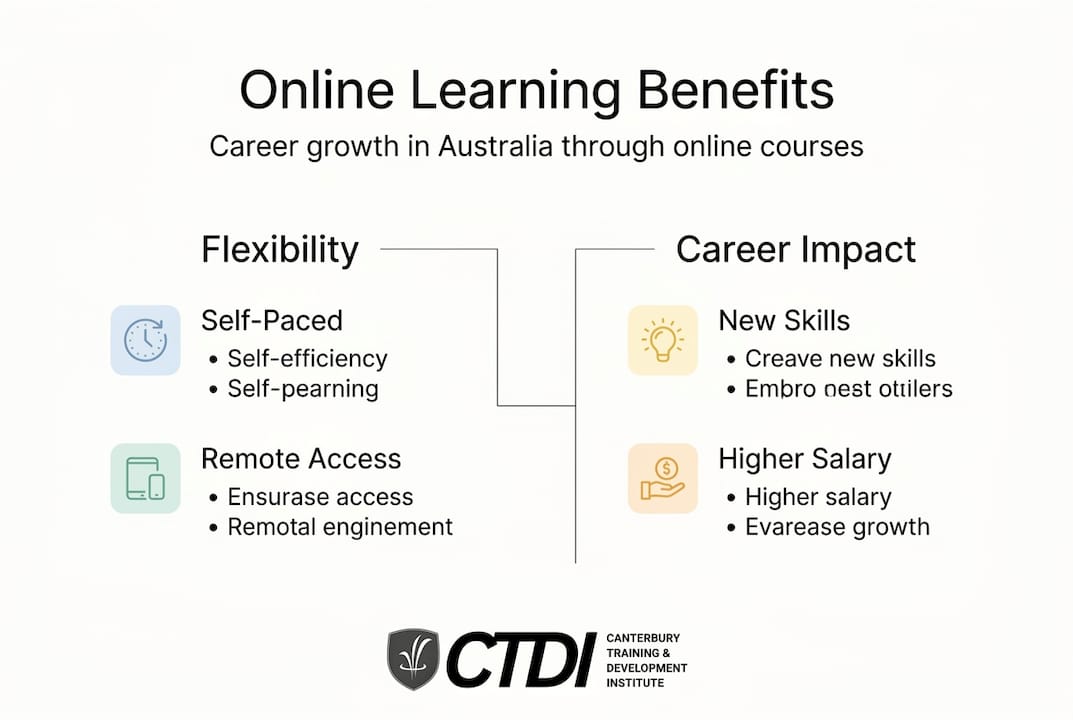
What makes online vocational study genuinely different?
The core advantages go beyond just being able to study in your pyjamas. Here is what actually matters for career development:
| Factor | Traditional classroom | Online vocational |
|---|---|---|
| Scheduling | Fixed timetable | Self-paced and flexible |
| Geographic access | Local campus required | Available nationally and internationally |
| Industry currency | Updated each semester | Can be updated between intakes |
| Cost | Higher due to facilities | Often lower overall |
| Networking | In-person cohort | Digital communities and alumni groups |
| Practical skills | Direct supervision | Simulations, digital evidence, hybrid options |
For domestic learners in regional or remote Australia, the geographic freedom alone is transformative. For international students, the ability to begin studying an Australian qualification from their home country while preparing for migration or employment in Australia removes a significant barrier to entry.
Beyond access, online delivery has pushed the development of microlearning as a genuine pedagogical tool. Microlearning breaks content into focused, digestible modules rather than two-hour lectures. The result is better retention and more flexible integration into a working professional's schedule. If you are currently employed and studying a digital marketing diploma online alongside full-time work, microlearning lets you complete meaningful study in a 30-minute lunch break rather than needing four uninterrupted hours on a Saturday.
Adaptive delivery takes this further. Some platforms now use learning analytics to identify where a student is struggling and push targeted content before they fall behind. This is proactive, personalised support that a large classroom simply cannot replicate at scale.
For those interested in sustainability and environmental fields, sustainability certifications online have become a practical and respected pathway for professionals looking to pivot or upskill without pausing their careers.
Pro Tip: Set a recurring weekly calendar block for review sessions. Spending 20 minutes each week reviewing the previous module before starting a new one dramatically improves long-term retention and keeps your study momentum consistent.
Vocational online study covers a wide range of areas. Some of the most in-demand online vocational qualifications in Australia right now include:
- Certificate IV and Diploma programs in digital marketing, business, and project management
- AI and technology fundamentals for professionals transitioning into tech roles
- Environmental and sustainability management qualifications
- Community services, aged care, and health support programs delivered through hybrid models
- Leadership and management diplomas for mid-career professionals seeking promotion
The beauty of flexible online enrolment options means you can often start a program within days rather than waiting for a traditional academic intake. That agility matters in a fast-moving labour market where the skills that employers want in 2026 look different from what was valued in 2022.
Choosing the right online vocational program
Once you have accepted that online learning can genuinely move your career forward, the next and arguably more important question is: which program is right for you? Choosing poorly wastes money and time. Choosing well can fundamentally reshape your professional trajectory.
The first and most critical filter is accreditation. In Australia, vocational qualifications sit within the Australian Qualifications Framework (AQF), which means a Certificate IV earned online carries exactly the same national recognition as one earned in a classroom. Always confirm that any program you are considering is delivered by a Registered Training Organisation (RTO). This is non-negotiable. Non-accredited programs, regardless of how impressive their marketing looks, cannot offer AQF-recognised qualifications, which limits your employment and further study options significantly.
Delivery model comparison
| Delivery type | Best for | Watch out for |
|---|---|---|
| Fully online, self-paced | Working adults, international students, those with caregiving responsibilities | Requires strong self-discipline and time management |
| Blended or hybrid | Those who benefit from face-to-face practical components | Geographic limitations may apply |
| Online with live sessions | Students who value structured cohort learning | Time zone challenges for international learners |
| Fully facilitated online | Those who want daily trainer contact | Can have more rigid scheduling |
For most working adults in Australia, fully online or blended programs offer the best balance of flexibility and quality. The important thing is to match the delivery model to your actual lifestyle, not your idealised version of it. If you know you struggle with self-discipline, a program with regular trainer check-ins and set assessment deadlines will serve you far better than a fully self-paced option with no external accountability structures.

Industry connections and practical assessment
Industry-connected programs give you more than a certificate. They give you a portfolio. Look for programs that use real-world assessment tasks, such as creating an actual marketing campaign, developing a sustainability plan for a genuine organisation, or completing a workplace evidence portfolio. These outputs become interview material.
Research into personalised learning in professional contexts has found that adaptive microlearning programs built around competency-based assessments produce meaningfully better engagement and skill retention than lecture-based delivery. This is the direction that quality RTOs are moving in, and it should guide your selection criteria.
Here is a step-by-step process for evaluating any online vocational program:
- Confirm accreditation. Check the National Register (training.gov.au) to verify the RTO and qualification code.
- Review learning outcomes. Ask yourself: can I point to a specific skill or portfolio piece after each unit?
- Check trainer credentials. Industry practitioners who also teach bring currency that academic-only trainers sometimes lack.
- Assess assessment types. Prefer programs that use authentic, real-world assessments over multiple-choice only formats.
- Look at student support. Access to a dedicated student support coordinator matters significantly during difficult units.
- Examine enrolment flexibility. Rolling intake options are a strong sign of an operationally mature provider.
- Ask about completion rates. A provider confident in their product will share this data.
Explore online diploma options from providers who meet these criteria and can demonstrate strong industry relationships.
Pro Tip: Request a sample unit or module before you enrol. Any quality RTO will be happy to share a preview. This gives you a clear sense of the learning platform, content depth, and assessor communication style before you commit.
Personalising your learning pathway is also worth thinking about deliberately. Many students approach online study as a single qualification goal when in fact a stacked credentials approach, where you complete a Certificate IV and then build toward a Diploma, gives you multiple career entry points along the way. This is particularly valuable in fast-moving fields like digital marketing or AI, where the landscape shifts faster than a single qualification cycle.
Navigating challenges and maximising outcomes
Selecting a quality program is only the beginning. Online study presents real challenges that are worth naming honestly, because pretending they do not exist sets students up for avoidable failure.
Research drawing on interviews with 10 Australian VET teachers found that practical skill development is the most consistently difficult aspect of online vocational delivery. In trades, health, and community services, for example, the physical demonstration component that underpins competency-based assessment is genuinely harder to replicate in a purely digital environment. Lower student engagement and measurable impacts on learner mental health were also identified as significant concerns, particularly in post-COVID hybrid arrangements where expectations were not clearly set.
This does not mean online study is inferior. It means you need to go in with clear eyes and practical strategies.
"The shift to online delivery has demanded a complete rethink of how we assess practical competency. The best programs don't try to replicate the classroom online; they redesign assessment entirely for the digital environment." An experienced Australian VET practitioner reflecting on post-COVID delivery reform.
The three biggest challenges and how to address them
Practical skill acquisition. In programs with a physical component, look for providers that offer digital evidence collection tools, where students photograph or video their practical demonstrations, combined with hybrid workshop options where geographic access allows. This gives you the flexibility of online study without sacrificing the practical rigour.
Engagement and motivation. Online study without a cohort of classmates and a physical campus can feel isolating, especially after the initial enthusiasm of enrolment fades around weeks three to five. This is predictable. Planning for it is far more effective than hoping it will not happen to you.
Mental wellbeing and study fatigue. Extended periods of screen-based learning without structured breaks or social interaction can affect mental wellbeing in ways that traditional campus study does not. Building in non-screen recovery time, maintaining social connection outside of study, and using student support services proactively rather than in crisis mode all help here.
Top three engagement boosters for online learners
- Community participation. Join discussion boards, student Facebook groups, or alumni networks connected to your course. The informal exchange of ideas with fellow students often cements learning more effectively than re-reading a module.
- Applied practice. Do not wait until assessment time to apply what you are learning. Test new concepts in your current job, volunteer role, or a personal project immediately after each module. Application is the fastest path to retention.
- Regular reflection. Keep a simple study journal where you note one key insight and one open question after each session. This builds metacognitive awareness and gives you material to discuss with your trainer or coach.
Visit the CTDI career insights blog for practical strategies on maintaining motivation and managing the study-work balance that most online learners face.
The students who succeed in online vocational programs are rarely the most naturally talented. They are the most consistent. Showing up every week, even on the weeks when motivation is low, is the variable that most reliably predicts completion and career benefit.
The impact of online education on employment and satisfaction
Now we arrive at the question most prospective students actually care about most: does online vocational training actually lead to better employment outcomes? The honest answer is yes, mostly, with important nuances.
National data from NCVER apprentice and trainee outcomes shows that 64.4% of VET graduates reported improved employment outcomes following their training. That is a strong headline figure. However, this represents a decline of approximately three percentage points compared to previous years, even against a backdrop of strong Australian labour market conditions. This gap between a healthy job market and slightly declining employment improvement rates among VET graduates is worth examining carefully.
The most likely explanation is the practical skills challenge discussed earlier. As more training has shifted online, graduates in some fields are entering employment with strong theoretical knowledge but gaps in applied, hands-on competency. Employers in those fields are noticing, and it is showing up in outcomes data.
"The data tells a nuanced story. Strong satisfaction and genuine skill development are happening, but translating those gains into employment improvement is becoming slightly more complex as the nature of work itself changes rapidly."
Factors that influence employment success after online vocational training
- Field of study alignment. Graduates in fields with genuine labour shortages, such as technology, digital marketing, environmental management, and community services, show consistently stronger employment improvement than those in saturated sectors.
- Practical skill integration. Students who actively sought out applied practice opportunities during study, such as freelance projects, volunteer roles, or workplace-based assessments, consistently report better employment outcomes.
- Qualification level. Diploma and Advanced Diploma graduates tend to see stronger employment improvement rates than Certificate III graduates, partly because these qualifications signal more specialised capability to employers.
- Industry networks developed during study. Students who engaged with industry practitioners through their courses, whether through guest lecturer sessions, employer-connected assessments, or alumni networks, had stronger job-seeking outcomes.
- Time to application. Graduates who began applying their new skills before completing their qualification, either through promotions, role changes, or new freelance work, reported the highest satisfaction and employment improvement rates.
Student satisfaction with online vocational programs remains genuinely strong. Most students report that online delivery met or exceeded their expectations for flexibility and content quality. The gap is not between satisfaction and reality during study. It is between completing a qualification and translating that into the specific employment improvement the student was hoping for.
The solution is not to avoid online study. It is to choose programs with real industry connections, pursue applied practice throughout your study rather than just at assessment time, and engage actively with the professional community in your chosen field from day one. Explore CTDI's online qualifications as an example of programs designed with these employment outcomes deliberately in mind.
Our perspective: What most guides miss about online vocational education
Most articles about online learning focus on the convenience factor. Flexibility. Self-pacing. No commute. These are real benefits, but they miss what we think is the more significant long-term value of online vocational study: it trains you to keep learning continuously, which is arguably the most important professional skill of the next twenty years.
The professionals who thrive in 2026 and beyond will not be those who earned one qualification and relied on it for a decade. They will be those who treat skills renewal as an ongoing practice, not a one-time event. Online vocational study, by its nature, develops this muscle. You learn to structure your own time, to seek out resources proactively, to build knowledge without waiting for someone to teach it to you in a room. These meta-skills compound over a career in ways that a single qualification cannot.
There is also a hidden networking opportunity in online study that most students underestimate. Your online cohort often spans multiple states, industries, and career stages. A fellow student in your digital marketing program might be a marketing manager at a company in your target industry. Building that relationship during study costs nothing but genuine engagement.
Micro-credentials are another underutilised strength. Many RTOs now offer stackable short courses that sit alongside or within their full qualifications. Completing a micro-credential in data analytics while studying a business diploma, for example, gives you a credential you can share immediately on LinkedIn while the larger qualification is still in progress.
Pro Tip: Engage deliberately with your online course community from week one. Introduce yourself, comment on peers' discussion posts, and reach out to any alumni your provider can connect you with. The professional relationships formed during study are often more durable than those formed at networking events because they are grounded in shared learning. Visit CTDI's blog for more advanced career development strategies worth exploring alongside your study.
Ready to boost your career with online learning?
If this guide has done its job, you now have a clearer picture of what online vocational education in Australia can realistically offer and what it takes to make the most of it. The next step is finding a program that fits your career goals, your schedule, and your learning style.
At CTDI, we offer nationally accredited, 100% online vocational qualifications across high-demand fields including AI, digital marketing, and sustainability. Our programs are designed by industry practitioners and delivered in self-paced formats that work around full-time employment, family commitments, and geographical boundaries. Whether you are domestically based or an international student seeking an Australian qualification, our team is here to help you find the right fit. Explore our certificate IV in sustainability or browse the full range of CTDI online courses to see what is possible. When you are ready to take the next step, enrol now and get started on a qualification that works for your real life.
Frequently asked questions
How do online vocational courses in Australia compare to traditional classroom-based programs?
Online vocational courses offer greater flexibility and accessibility for domestic and remote students, though research on Australian VET teachers confirms that practical skill development remains more challenging to deliver in fully digital environments. Quality providers address this through hybrid workshops and digital evidence assessment methods.
Can international students enrol in Australian online vocational courses?
Yes. The Australian online education market is structured to support both domestic and international enrolments, making it one of the most accessible vocational systems in the world for international learners seeking a recognised Australian qualification.
What are the main challenges of studying practical skills in an online vocational setting?
Practical skill acquisition, maintaining engagement, and managing study-related fatigue are the three most common obstacles, as identified through interviews with VET educators. Blended delivery options, digital evidence portfolios, and proactive use of student support services significantly reduce these barriers.
Has online vocational training improved employment outcomes for graduates in Australia?
National data shows 64.4% of VET graduates reported improved employment outcomes, though this figure has declined slightly in recent years. Graduates who actively applied their skills during study and engaged with industry networks consistently report the strongest employment improvements.
Recommended
- Certificate IV Environmental Sustainability Australia | Green Career Online | CTDI — Canterbury Training and Development Institute
- Enrol Now — Online Diplomas in AI, Marketing & Sustainability | CTDI — Canterbury Training and Development Institute
- Advanced Diploma Digital Marketing Australia | AI-Powered Marketing Career | CTDI — Canterbury Training and Development Institute
- Why Environmental Scientist Is One of the Fastest-Growing Careers in Australia | CTDI — Canterbury Training and Development Institute