

TL;DR:
- Digital marketing in 2026 is undergoing a fundamental shift driven by autonomous AI, AI citation layers, and fragmented tracking environments. Marketers must adopt agentic AI workflows, build entity authority for GEO, and develop privacy-respecting measurement strategies to stay relevant and trustworthy. Successful brands will connect their marketing systems, commit to measurable purpose, and restructure teams for agility in this new landscape.
The digital marketing strategies that delivered results in 2024 are already losing ground. The digital marketing trends 2026 brings are not incremental updates. They represent a structural shift driven by autonomous AI, fractured tracking environments, and consumers who can smell inauthenticity from a kilometre away. If you are still running the same playbook with minor adjustments, you are competing in a race where the rules have fundamentally changed. This article breaks down exactly what is shifting, why it matters, and what you need to do differently to stay relevant and profitable in 2026.
Table of Contents
- Key takeaways
- The rise of agentic AI in marketing operations
- GEO and AI visibility: the new search imperative
- Privacy, tracking, and the cookieless reality
- Brand authenticity and connected marketing systems
- Rebuilding marketing teams for agility
- My take on what actually matters in 2026
- Take your digital marketing career further with Edu
- FAQ
Key takeaways
| Point | Details |
|---|---|
| Agentic AI is now operational | Autonomous AI handles end-to-end marketing tasks; reserve human oversight for high-risk approvals only. |
| GEO replaces classic SEO goals | Optimise to be cited in AI answer layers, not just to rank on page one of search results. |
| Cookieless is partial, not total | Google reversed cookie deprecation, but Safari and Firefox block by default. Build first-party data now. |
| Brand authenticity is measurable | Vague purpose statements no longer build trust. Commit to specific, quantifiable goals consumers can track. |
| Marketing teams must restructure | Fluid, AI-augmented teams focused on outcomes outperform traditional siloed marketing departments. |
The rise of agentic AI in marketing operations
The conversation around AI in marketing has moved well past the "should we try it?" phase. Deloitte recommends CMOs architect their entire marketing function with AI as the core operating system, automating tasks like email copy, audience segmentation, and creative testing end to end. Human approval is reserved for regulatory claims and brand-sensitive decisions, not routine execution.
This is a significant departure from how most teams have used AI until now. Most marketers have experimented with AI for individual tasks like writing subject lines or generating ad copy variations. Agentic AI goes further. It runs the entire workflow autonomously, monitors results, and adjusts without waiting for a human to notice a problem. A campaign can be launched, tested, optimised, and refined before a team member reviews the morning report.
The practical implications are substantial. Consider a retail brand running seasonal promotions. With agentic AI, the system generates dozens of email copy variations, selects audiences based on purchase history, runs A/B tests across segments, and reallocates budget to the best performer overnight. What previously took a team of three people a full week now runs continuously in the background.
Successful agentic AI rollouts begin with high-volume, low-risk workflows and expand autonomy progressively as governance frameworks stabilise. This is not about replacing your team. It is about removing the friction that prevents your best people from doing their best thinking.
Pro Tip: Audit your current marketing workflows and identify the three highest-volume, lowest-risk tasks your team repeats weekly. These are your first candidates for agentic AI automation. Start there, measure rigorously, and expand only after governance is solid.
The organisational implications extend beyond efficiency. Reskilling teams for agentic AI is most effective when paired with continuous measurement and human judgment embedded at key decision points. Teams that skip the governance step and hand full control to AI systems risk amplifying errors at scale. The safeguard is not less automation. It is smarter oversight architecture.
GEO and AI visibility: the new search imperative
Search engine optimisation as most marketers know it is not dead. But its goal has changed. The emerging metric for 2026 is not your ranking on a results page. It is whether AI assistants like Google's AI Overviews, Perplexity, or Claude cite your brand as the authoritative source when your potential customers ask questions.
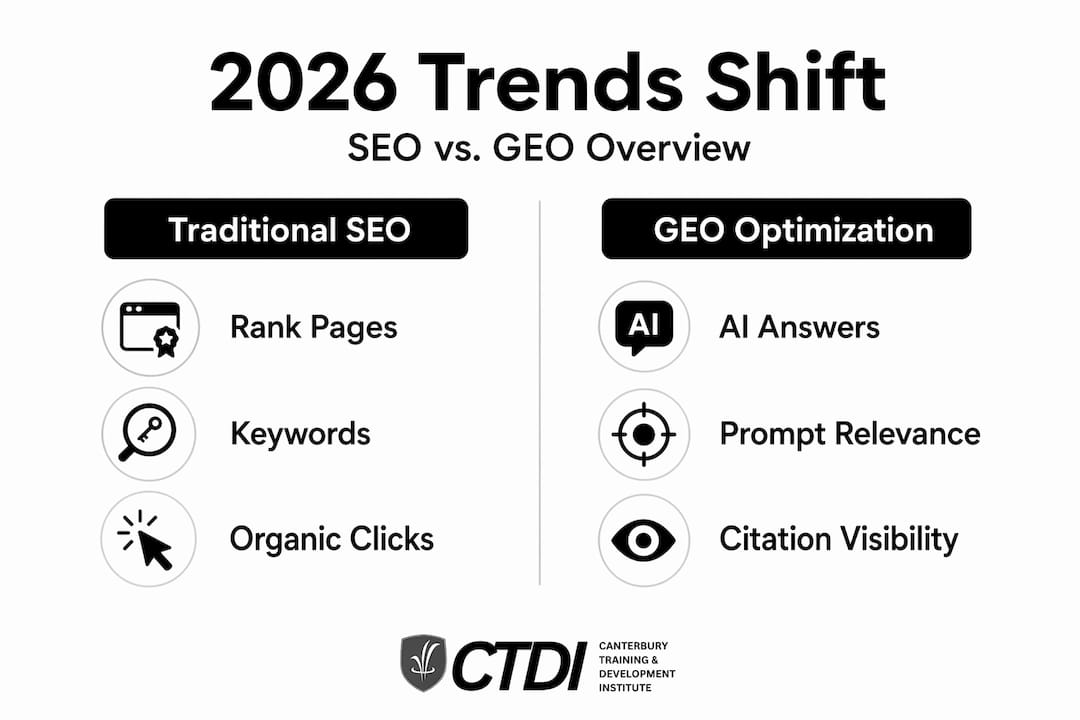
Google AI Overviews reached approximately 48% of tracked queries in February 2026, with a direct impact on organic click-through rates. Pages not cited by AI Overviews see up to a 61% reduction in organic clicks. Pages that are cited gain 35% more clicks from higher-intent users. The gap between being cited and not being cited is not a ranking difference. It is a visibility cliff.
Generative Engine Optimisation (GEO) is the methodology built to close that gap. The core principle involves shifting from optimising for keyword matches to building what practitioners call "entity authority." Your brand, your content, and your knowledge base need to be structured so AI models recognise you as a reliable, citable source of truth.
Here is how traditional SEO and GEO differ in practice:
| Factor | Traditional SEO | Generative Engine Optimisation (GEO) |
|---|---|---|
| Primary goal | Rank on page one of search results | Be cited in AI-generated answer layers |
| Key signal | Backlinks and keyword density | Entity authority and structured data |
| Content format | Long-form keyword-targeted pages | Prompt-aligned, semantically rich content |
| Success metric | Click-through rate and ranking position | AI citation frequency and brand mentions |
| Optimisation method | Title tags, meta descriptions, links | Schema markup, entity clarity, third-party validation |
The GEO methodology advises testing 50 to 100 buyer prompts to audit where your brand currently appears in AI-generated responses. This "prompt fan-out" approach identifies the specific questions your customers are asking AI assistants and reveals where competitors are being cited instead of you.
Practically, this means your content must answer real questions with precision, use structured data markup, and build third-party validation through expert citations and authoritative sources. Websites with structured data implemented correctly are cited in AI answer systems 3.2 times more frequently than those without it. That is not a marginal advantage.
Classic SEO remains a necessary baseline. But winning AI answer layer visibility requires additional strategies including entity density, multimodal content, and structured data working together. Teams still focused solely on traditional SEO metrics are likely invisible in the channels their buyers are increasingly using first.
Privacy, tracking, and the cookieless reality
Here is where many marketers are operating on outdated assumptions. Google reversed its plan to fully deprecate third-party cookies in Chrome in 2025. If your strategy was built around a clean break from cookies, you may have overcorrected. But the situation is genuinely more complex than a simple reversal.
Approximately 17 to 20% of global web traffic is already cookieless because Safari, Firefox, and Brave block third-party cookies by default. These browsers collectively account for a meaningful share of your audience depending on your industry. If your audience skews towards Apple users or privacy-aware demographics, your cookieless exposure is likely higher than 20%.
The practical takeaways for your tracking strategy right now are:
- First-party data is non-negotiable. Build your own identity graph through email capture, CRM integrations, and loyalty programmes that give customers real reasons to share data willingly.
- Server-side tracking fills measurement gaps. Moving from browser-based to server-side tag management reduces the data loss caused by browser restrictions and ad blockers.
- Contextual targeting deserves renewed investment. Serving ads based on the content environment rather than user tracking history is both privacy-compliant and increasingly effective.
- Consent frameworks must be airtight. GDPR and CCPA requirements mean that consent-based data sharing is a legal obligation, not just a best practice.
Marketing measurement in 2026 requires hybrid models that combine first-party identity, consent-based data sharing, and server-side tracking. The marketers who will thrive are not those waiting for a universal resolution to the cookie question. They are building durable, privacy-respecting measurement architectures that work regardless of what any single browser or platform decides next.
Pro Tip: Do not design your measurement strategy around Chrome's current cookie policy. Design it around the assumption that your audience is fragmented across browsers with different default behaviours. A strategy that works across Safari, Firefox, and Chrome is a strategy that survives any future platform change.
Brand authenticity and connected marketing systems
The volume of AI-generated content published online has made one thing dramatically more scarce: genuine credibility. Consumers in 2026 are not just sceptical of advertising. They are sceptical of brand purpose statements, sustainability claims, and influencer endorsements at a scale marketers have not encountered before.

Deloitte's 2026 research points to a clear shift: brands that express purpose through specific, measurable commitments build stronger consumer trust and command premium pricing. A clothing brand pledging to reduce packaging plastic by 20% by 2027 with a public tracking dashboard outperforms one with a generic sustainability mission statement. The difference is accountability. Consumers can verify the first claim. The second dissolves on contact.
Social media's role in this dynamic has also changed significantly. With 5.66 billion social media users globally, platforms like TikTok, Instagram, and Pinterest now function as search engines, discovery layers, and purchase environments simultaneously. The customer journey has compressed. A user can discover, evaluate, and buy a product without ever visiting a brand's website. This means your marketing system needs to be connected across every touchpoint, not siloed by channel.
Building that connected system requires deliberate architecture. Here are the practical steps worth prioritising:
- Map the full customer journey across organic social, paid media, email, and website to identify where disconnects occur and where prospects drop out.
- Unify your data sources so that a customer's social interaction, email engagement, and purchase history inform the same personalisation engine rather than separate systems.
- Create content that works across contexts, from a 15-second social video to a 1,500-word comparison article, without losing consistency in brand voice or factual accuracy.
- Tie purpose claims to public metrics. If your brand makes an environmental or social commitment, build a public-facing tracker so customers can see progress rather than promises.
- Integrate commerce into content where your audience already spends time rather than pushing every conversion back to your website.
For more practical digital marketing tips on building connected strategies aligned with 2026 expectations, it is worth exploring frameworks designed specifically for this environment.
Rebuilding marketing teams for agility
The organisational structure that supported traditional digital marketing, with separate teams for SEO, paid media, social, email, and content, is not built for the speed that 2026 demands. Deloitte's guidance for 2026 is unambiguous: marketing organisations need to rebuild into fluid, outcome-focused teams with AI embedded throughout their workflows, not bolted on as a tool.
What does this look like practically? The markers of a genuinely agile marketing structure include:
- Cross-functional pods built around customer segments or business outcomes rather than marketing channels. Each pod owns the full journey from acquisition to retention.
- AI literacy as a baseline skill, not a specialist competency. Every team member should understand how to brief, monitor, and audit AI outputs rather than treating AI as a black box.
- Embedded technology roles within marketing teams rather than relying on a separate IT or data function to service requests. The delay in traditional IT-marketing collaboration is too slow for continuous testing cycles.
- Governance frameworks that define clearly which AI decisions require human approval, which can run autonomously, and which need legal review before deployment.
- Measurement as a team sport, with shared dashboards and weekly outcome reviews replacing monthly campaign reports that nobody acts on.
The reskilling question is one many businesses are deferring. That deferral is a competitive liability. Understanding what AI means for digital marketing careers helps teams make smarter decisions about which human skills to develop and which workflows to hand to automation. The teams winning in 2026 are not the ones with the largest headcount. They are the ones with the clearest picture of where human judgment genuinely adds value.
My take on what actually matters in 2026
I've watched enough marketing trends cycle through to know which ones require genuine strategic change and which ones are dressed-up versions of what we were already doing. The 2026 digital marketing trends 2026 brings are, in my view, genuinely structural. And I think most teams are underestimating two specific risks.
The first is GEO invisibility. I've seen brands invest heavily in SEO over the past five years, only to find their organic visibility collapsing because they are not appearing in AI-generated answer layers. They are still ranking on page two for competitive terms and celebrating. But their target buyers are getting answers from AI assistants that never mention them. This is a quiet crisis that does not show up in a standard analytics dashboard until the revenue impact is already significant.
The second risk is what I call performative authenticity. Brands are adding purpose language to their websites without any measurable commitment behind it. In a world where AI can generate credible-sounding brand statements at scale, consumers have developed a sharper radar for this. The brands I've seen hold premium pricing and customer loyalty in 2026 are the ones that publish specific numbers and let customers hold them accountable. It is uncomfortable. It also works.
My pragmatic advice is this: do not try to do everything at once. Pick one AI workflow to fully automate, one GEO gap to close, and one brand commitment to make measurable. Do those three things with discipline before expanding. Adaptability in 2026 is not about moving fast in all directions. It is about moving deliberately in the right ones.
— Sam
Take your digital marketing career further with Edu
The trends covered in this article are not theoretical. They are reshaping job descriptions, agency briefs, and business strategies right now. If you are a marketer or business owner who wants to move beyond surface-level familiarity with these shifts and build genuine capability in AI-driven digital marketing strategies, Edu's training is designed specifically for where the industry is heading.

Canterbury Training and Development Institute (CTDI) offers an Advanced Diploma of Digital Marketing that covers agentic AI applications, privacy-compliant measurement, GEO optimisation, and connected marketing systems, all built around what Australian employers and global businesses need in 2026. The programme is fully online and self-paced, so you can study around your current role without compromising either.
Whether you are reskilling an existing team, transitioning into a senior marketing role, or building the in-house capability your business needs to compete, Edu's courses are designed by industry practitioners who work at the intersection of marketing and technology. You can enrol today and start building skills that are immediately applicable, not just conceptually current.
FAQ
What is Generative Engine Optimisation (GEO)?
GEO is the practice of optimising your content to be cited by AI-powered answer systems like Google AI Overviews and Perplexity, rather than simply ranking on traditional search results pages. It relies on structured data, entity authority, and prompt-aligned content rather than keyword density alone.
Are third-party cookies completely gone in 2026?
No. Google reversed its plan to fully deprecate third-party cookies in Chrome, but Safari, Firefox, and Brave block them by default. Around 17 to 20% of global web traffic is already cookieless, so a hybrid measurement strategy combining first-party data and server-side tracking is necessary regardless of Chrome's current policy.
How does agentic AI differ from standard AI tools in marketing?
Standard AI tools assist with individual tasks like drafting copy or generating images. Agentic AI runs entire end-to-end workflows autonomously, including audience selection, creative testing, and budget optimisation, with human oversight only at defined approval points.
Why are digital marketing strategies 2026 so different from previous years?
The combination of autonomous AI adoption, AI-generated answer layers replacing traditional search, and fragmented tracking environments creates a structural shift rather than an incremental update. Strategies built around classic SEO rankings, third-party cookie tracking, and manual campaign management are losing effectiveness faster than most teams have adjusted for.
How can marketers build trust authentically in 2026?
Replace vague purpose statements with specific, verifiable commitments. Publish metrics publicly and update them regularly so consumers can track progress. Brands that tie their values to measurable outcomes consistently outperform those relying on positioning language alone, according to Deloitte's 2026 marketing research.
Recommended
- Top digital marketing tips for career growth in 2026
- Top online courses in high-demand fields for 2026 — Canterbury Training and Development Institute
- Mastering the digital marketing learning process: career growth — Canterbury Training and Development Institute
- Launch and grow your digital marketing career in Australia — Canterbury Training and Development Institute