

TL;DR:
- Accreditation confirms a course has been independently validated to meet quality standards, protecting students' investments.
- Verifying accreditation through official registers like TEQSA, training.gov.au, and CRICOS ensures course legitimacy, especially for international students.
Choosing an online course is straightforward until you try to verify whether it actually counts for anything. Accreditation is the piece most prospective students either overlook or misunderstand, and that gap can cost you real money, time, and career momentum. This guide to online course accreditation breaks down what accreditation genuinely means in the Australian context, how to verify it through official sources, what the process involves, and what red flags to watch for when evaluating courses marketed as "accredited" without the evidence to back it up.
Table of Contents
- Understanding online course accreditation and why it matters
- Tools and prerequisites for verifying accredited online courses
- The accreditation process for online vocational courses explained
- Common pitfalls and how to avoid accreditation missteps
- Expected outcomes when enrolling in accredited online courses
- Rethinking accreditation: a student-centred view on online course quality assurance
- Enrol in accredited online diploma and certificate courses with CTDI
- Frequently asked questions
Key Takeaways
| Point | Details |
|---|---|
| Accreditation meaning varies | Accreditation differs between VET, higher education, and international contexts, so identify your study pathway first. |
| Verify with official registers | Check the TEQSA National Register and CRICOS listings to confirm current accreditation and provider registration. |
| Accreditation isn’t permanent | Courses and providers must renew accreditation periodically to remain valid and recognised. |
| Beware misleading claims | Don’t rely solely on marketing; verify the accreditor is official and recognised by government agencies. |
| Accreditation supports outcomes | Properly accredited courses lead to recognised qualifications, better career prospects, and visa eligibility for international students. |
Understanding online course accreditation and why it matters
Accreditation is external validation. An independent, authorised body reviews a course or institution against established quality standards and confirms it meets those benchmarks. It is not a self-issued badge or a marketing claim. When a course is accredited, it means someone outside the provider has assessed the curriculum, the teaching methodology, the assessment approach, and the outcomes, and found them credible.
In Australia, accreditation works differently depending on which education sector you are in, and this is where many students get confused.
- Vocational Education and Training (VET): Regulated by the Australian Skills Quality Authority (ASQA). VET courses lead to qualifications like certificates and diplomas listed on the Australian Qualifications Framework (AQF). Providers must be registered as Registered Training Organisations (RTOs) to deliver these courses.
- Higher education: Regulated by the Tertiary Education Quality and Standards Agency (TEQSA). TEQSA oversees universities and other higher education providers, accrediting degree-level courses.
- International student eligibility: Providers must be listed on the Commonwealth Register of Institutions and Courses for Overseas Students (CRICOS) to legally enrol international students on student visas.
Because accreditation can mean different things in different Australian education sectors, the practical starting point for any prospective student is to first identify which pathway applies to you: VET, higher education, or international study eligibility via CRICOS.
Internationally, the picture shifts again. In the United States, for example, regional and national accreditation bodies operate separately from government departments, which creates its own complications. The principle is the same though: external validation confirms course quality, and without it, your qualification may not be recognised by employers or other institutions.
"Accreditation is not simply a box that providers tick. It is a public signal of quality that protects students from wasting time and money on courses that do not lead anywhere meaningful."
For students pursuing accredited courses in Australia, understanding which body governs your course type is the first and most important step in the whole process.
Tools and prerequisites for verifying accredited online courses
Knowing accreditation exists is one thing. Knowing exactly where to check it is what actually protects you. Australia has official public registers for this purpose, and using them takes less than five minutes once you know where to look.
| Register | Governed by | Who it covers | What you can check |
|---|---|---|---|
| TEQSA National Register | TEQSA | Higher education providers and courses | Accreditation status, conditions, expiry dates |
| training.gov.au | ASQA | RTOs and VET qualifications | Registration status, courses offered |
| CRICOS Register | TEQSA/ASQA | Providers approved for international students | CRICOS registration, course list, expiry |
TEQSA accreditation decisions are published publicly, and providers are registered on CRICOS for up to seven years, after which renewal is required to maintain eligibility. That renewal requirement matters more than most students realise.
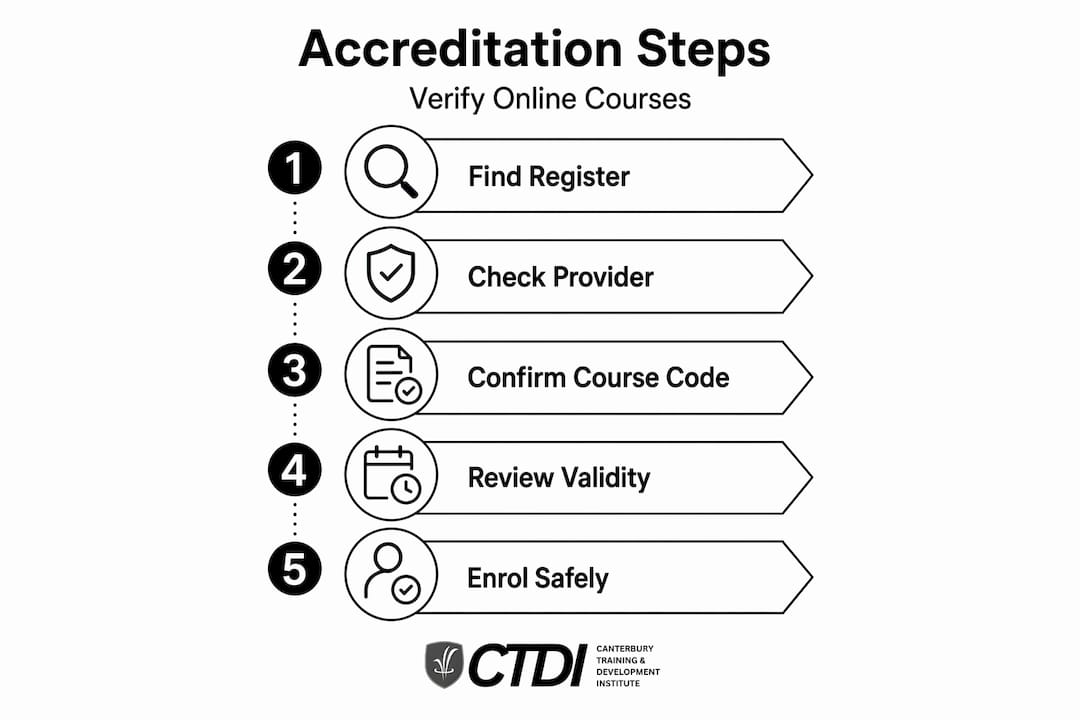
Key steps for verifying accreditation status:
- Visit the relevant official register for your course type (TEQSA for higher education, training.gov.au for VET)
- Search by provider name or course title
- Confirm the accreditation is current, not expired
- Check whether the specific course you intend to enrol in is listed, not just the provider generally
- For international students, confirm the provider is registered on CRICOS and the registration has not lapsed
That last point catches many international students off guard. A provider may still be operating and marketing courses while their CRICOS registration is under renewal or has lapsed for specific courses. Checking accreditation status before you pay a deposit is non-negotiable.
Pro Tip: Do not just check whether the provider is registered. Cross-reference the specific course code against the CRICOS or training.gov.au listing. Providers can hold registration while individual courses within their catalogue are not listed or have expired separately.
For those weighing their options around career growth through online learning, this verification step is the difference between a qualification that opens doors and one that raises eyebrows when you submit it to an employer or a visa officer.
The accreditation process for online vocational courses explained
Understanding the online course accreditation process is useful not just for providers, but for students too. When you know what a provider had to go through to achieve accreditation, you appreciate what the credential actually represents.
The accreditation process for online courses involves researching accrediting bodies, preparing course documentation, submitting applications, undergoing evaluation, and maintaining ongoing compliance. Here is what that looks like in practice:
- Identify the relevant accrediting body. For a VET provider delivering a certificate or diploma in Australia, that is ASQA. For a higher education provider, it is TEQSA. The sector and the intended student cohort determine who oversees the process.
- Prepare course documentation. This includes a detailed course outline, assessment tools, learning materials, trainer qualifications, and evidence that the content meets the relevant AQF level. For online delivery specifically, providers must also demonstrate that the online format does not compromise learning outcomes.
- Submit the application and demonstrate compliance. The provider formally applies and shows how the course meets each of the accreditation standards. This is not a brief form. Applications typically run to hundreds of pages of evidence.
- Undergo evaluation and audit. The accrediting body assesses the documentation and may conduct an audit of the provider, including reviewing student feedback, trainer records, and delivery systems.
- Maintain accreditation through ongoing reporting. Once granted, accreditation is not permanent. Providers must submit regular reports, notify the accrediting body of changes, and undergo renewal assessments. This ongoing compliance is what ensures the overview of accreditation process is a living quality assurance mechanism, not just a historical stamp.
What this means for you as a student:
- An accredited online course has been assessed by people independent of the provider
- The trainer qualifications, course materials, and assessment methods have all been reviewed
- The provider is accountable to ongoing reporting requirements, which means their standards do not quietly slip after they receive registration
Pro Tip: Ask your provider directly for their RTO number (for VET) or their TEQSA provider registration code (for higher education). A legitimate accredited provider will share this without hesitation. Then verify it yourself on the official register.
Common pitfalls and how to avoid accreditation missteps
The online education market is enormous and not every course that claims to be "accredited" actually is. Some claims are outdated, some refer to accreditation bodies that hold no real authority, and some are simply misleading.
Watch out for these specific traps:
- Unrecognised accreditation bodies. Just because something calls itself an "accreditation council" or "quality institute" does not mean it holds any legal or industry standing. In Australia, check whether the accreditor is ASQA or TEQSA. Anything else warrants significant scrutiny.
- Expired registrations presented as current. Providers sometimes continue marketing courses after their CRICOS or ASQA registration has lapsed for specific qualifications. Always check the register directly rather than trusting a course brochure.
- Conflating provider registration with course accreditation. A provider can be a registered RTO while offering specific courses that are not on their approved scope of registration. Both the provider and the course must be verified separately.
- International course claims that do not translate. A course "accredited" in one country does not automatically hold recognition in Australia. Always check whether the overseas qualification is listed on the relevant Australian recognition framework.
In the US, accreditation can be misleading if the accreditor is not recognised by the US Department of Education, and verification through official databases is vital. The same vigilance applies in Australia.
"The most expensive mistake a prospective student can make is assuming accreditation was confirmed at enrolment and never checking again. Registrations expire, and circumstances change."
CRICOS registration is provider-specific and time-bound, so you should never assume courses remain valid indefinitely without checking registration and accreditation renewal. This is especially critical for international students whose visa validity may be tied to course accreditation.
Before enrolling, spend ten minutes checking course legitimacy through official channels. That small effort protects months or years of study. And always cross-reference importance of accreditation verification against the actual register, not a screenshot or a course flyer.

Expected outcomes when enrolling in accredited online courses
So what do you actually get from choosing an accredited course over an unaccredited one? The difference is concrete and significant.
What accreditation delivers for students:
- Employer recognition. Qualifications from accredited providers sit within the AQF, which means Australian employers and many international employers understand and trust them. A certificate or diploma from a non-accredited provider often raises immediate questions during hiring.
- Pathway eligibility. Accredited VET qualifications often count as entry pathways into higher education programmes. Credit recognition between institutions is only available when the originating course is accredited.
- Visa and immigration support. For international students, studying with a CRICOS-registered provider in an accredited course is a requirement, not a preference, for most student visa categories.
- Quality instruction and resources. Accredited courses must meet standards for trainer qualifications, learning materials, and assessment rigour. That requirement pushes providers to invest in quality delivery.
Accreditation boosts course legitimacy, attracts students, and can increase job placement rates for graduates. The career benefits of accredited courses are not theoretical. Graduates who hold AQF-aligned qualifications from ASQA-registered providers regularly report faster progression into employment and clearer pathways into further study.
TEQSA accredits courses for defined multi-year periods, ensuring quality standards are maintained over time rather than assessed once and forgotten. That ongoing accountability cycle is what makes accreditation meaningful rather than cosmetic.
If you are weighing which direction to take your career, looking at top courses for 2026 alongside their accreditation status gives you the clearest picture of where industry demand and qualification quality intersect.
Rethinking accreditation: a student-centred view on online course quality assurance
Here is something the standard accreditation conversation leaves out: the system was built for providers and regulators, not for students. The language is technical, the registers are functional rather than user-friendly, and the process of actually verifying a course can feel like you need a background in education law to navigate it confidently.
That is a real problem. Most prospective students are busy working adults or international applicants who do not have time to read regulatory guidelines. They rely on provider communications, which creates an obvious conflict of interest.
The conventional assumption is that accreditation handles quality assurance automatically once a course is approved. It does not work that way. Accreditation sets a floor, not a ceiling. A course can be fully accredited and still be poorly delivered, loosely assessed, or designed with outdated industry content. Accreditation tells you the course was reviewed and met minimum standards at a point in time. It does not guarantee you will get a transformative learning experience.
What students genuinely need is transparent, accessible accreditation data presented in plain language by providers who see disclosure as a competitive strength rather than a bureaucratic obligation. Providers that proactively share their RTO or TEQSA registration number, explain what their accreditation covers, and update students on renewal timelines are doing something most do not bother with.
Accreditation should be treated as a dynamic quality assurance process, not a historical stamp. Renewal cycles, audit outcomes, and scope changes are all relevant information that students have a legitimate interest in. If a provider is reluctant to share these details, that reluctance itself is useful information.
For students, the empowered approach is to treat accreditation verification as part of your research process, not an afterthought after enrolment. Boost your career prospects by starting with the register, not the brochure, and asking providers direct questions about their scope of registration.
The students who get the most out of online vocational education are not the ones who passively trust provider marketing. They are the ones who spend an extra thirty minutes verifying credentials upfront, and then commit fully to a course they know stands behind its claims.
Enrol in accredited online diploma and certificate courses with CTDI
Navigating accreditation is complex, but choosing a provider that has already done the hard work makes the decision straightforward. Canterbury Training and Development Institute (CTDI) offers a range of fully accredited online diplomas and certificates, designed for working students and international learners who need flexibility without compromising on credential quality.
CTDI's programmes meet Australian accreditation standards, meaning your qualification is recognised by employers and supports further study or visa pathways where applicable. Expert trainers with real industry backgrounds deliver every course, and student support is available throughout your studies. Whether you are moving into digital marketing, environmental management, or emerging tech fields, CTDI has a course built for where the industry is heading.
Enrol in online diplomas today, or explore specific programmes like the Advanced Diploma of Digital Marketing or the Certificate IV in Environmental Sustainable Management to find the right fit for your career goals.
Frequently asked questions
What is online course accreditation?
Online course accreditation is official recognition that a course meets established quality standards set by an authorised accrediting body, confirming it is credible and recognised for employment or further study purposes.
How can I check if an online course is accredited in Australia?
You can verify accreditation by checking the TEQSA National Register for higher education courses, training.gov.au for VET qualifications, and the CRICOS register for courses eligible for international students on student visas.
Is accreditation important for international students in Australia?
Yes, CRICOS registration is tied to providers and registered for a defined period, making it a legal requirement for international students on visas who need both an accredited course and a CRICOS-registered provider.
How long does the online course accreditation process take?
The entire process can take anywhere from six months to a couple of years, depending on the accrediting body, the complexity of the course, and how quickly a provider completes the required documentation and evaluation stages.
Can I rely on a provider's marketing claims about accreditation?
No. Always verify accreditation through official registers because marketing claims can be outdated or inaccurate, particularly when a provider holds multiple qualifications or has undergone recent registration changes.
Recommended
- Enrol Now — Online Diplomas in AI, Marketing & Sustainability | CTDI — Canterbury Training and Development Institute
- Accredited courses in Australia: boost your career prospects — Canterbury Training and Development Institute
- Top online courses in high-demand fields for 2026 — Canterbury Training and Development Institute