

TL;DR:
- Online vocational trainers are designing, delivering, assessing, and supporting students dynamically.
- Trainer presence significantly boosts engagement, satisfaction, and completion rates in online courses.
- Effective online trainers use adult learning principles, competency-based methods, and community frameworks.
Online learning has a reputation problem. Many prospective students assume that studying online means watching pre-recorded videos alone, submitting assignments into a void, and figuring out the hard parts by themselves. That picture could not be further from the truth in quality vocational education. The trainer sitting behind your online course is not a passive content curator. They are the architect of your learning experience, the bridge to real industry practice, and often the reason students finish what they start. This article unpacks exactly how expert trainers operate in online vocational settings, what research says about their impact, and how you can use that knowledge to choose the right course and get the most from it.
Table of Contents
- Understanding the trainer's evolving role in online vocational education
- Key teaching frameworks and methodologies for online trainers
- How trainer presence impacts engagement, outcomes, and student support
- Challenges and best practices for trainers in the online environment
- Practical steps for prospective students: getting the most from trainer-led online learning
- Beyond content: what most overlook about trainers in online education
- Accelerate your career with expert-led online training
- Frequently asked questions
Key Takeaways
| Point | Details |
|---|---|
| Trainers drive online success | Expert trainers are essential for delivering engaging, industry-relevant online education that helps students build career-ready skills. |
| Practical teaching frameworks | Online trainers use proven methods like andragogy and competency-based training tailored for adult learners. |
| Stronger presence means better outcomes | Active trainer presence increases engagement, satisfaction, and success rates in online vocational courses. |
| Students can maximise trainer value | Proactive engagement with trainers leads to better feedback, learning, and real-world career progress. |
Understanding the trainer's evolving role in online vocational education
Not long ago, a vocational trainer stood at the front of a classroom, demonstrated a skill, and watched students practise it in real time. That model still exists, but the online environment has fundamentally changed what being a trainer means. Today, the role is far more layered, and in many ways more demanding.
Trainers in online vocational education design industry-relevant programs, deliver engaging lessons via digital platforms, assess competencies, and ensure compliance with standards. That sentence packs in a lot. Let us break each responsibility down so you understand what a quality trainer is actually doing on your behalf.
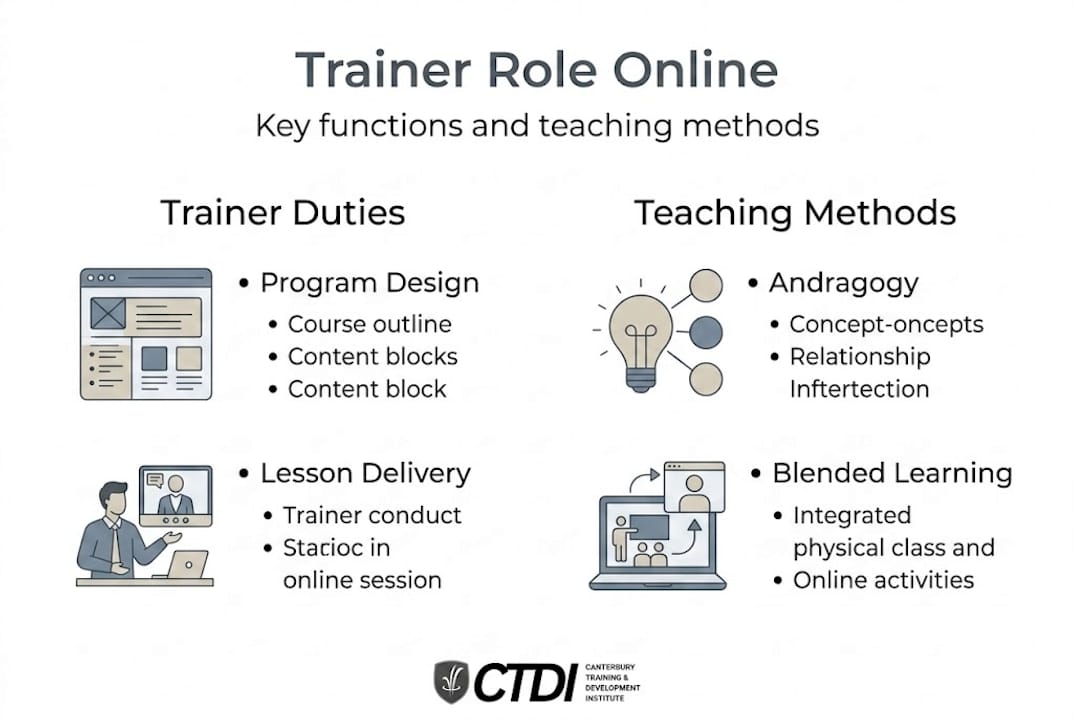
Program design is where it all starts. Before a single student logs in, the trainer has mapped out learning pathways, sequenced content to build skills progressively, and aligned every unit to national competency standards. This is not a once-and-done task. Good trainers revisit and update their programs regularly to reflect shifts in industry practice, emerging technologies, and regulatory changes.
Lesson delivery in the online context means far more than recording a lecture. Trainers create interactive modules, facilitate live webinars, moderate discussion forums, and produce written feedback on assessments. They choose digital tools deliberately, selecting platforms that support different learning styles and keep students genuinely engaged rather than passively scrolling.
Competency evaluation is the backbone of vocational training in Australia. Unlike university degrees that rely heavily on exams, vocational qualifications are built around demonstrated competence. Trainers assess whether you can actually do the job, not just recall information. This requires designing authentic tasks, reviewing portfolios of evidence, and making nuanced judgements about readiness.
Compliance might sound dry, but it protects you. Trainers ensure your qualification meets the requirements of the Australian Skills Quality Authority (ASQA) and the relevant Training Package, which means your certificate carries genuine weight with employers.
Here is a summary of what a modern online vocational trainer manages across a typical course:
- Designing and sequencing learning content aligned to national standards
- Delivering lessons through video, written materials, and live sessions
- Facilitating online discussions and peer collaboration
- Assessing student competency through practical tasks and portfolios
- Providing timely, personalised written feedback
- Identifying at-risk students and offering targeted support
- Updating course content to reflect current industry practice
- Maintaining records and ensuring regulatory compliance
"The most effective online trainers are not just subject matter experts. They are learning designers, digital communicators, and pastoral supporters all at once." This multifaceted nature of the role is precisely why trainer quality varies so much between providers, and why it matters enormously which institution you choose.
The impact of all this on your learning is substantial. Research consistently shows that students in courses with active, visible trainers complete at higher rates, report greater satisfaction, and feel more confident entering the workforce. When you enrol now in a course backed by experienced trainers, you are not just buying content. You are buying guided transformation.
Key teaching frameworks and methodologies for online trainers
Knowing that trainers are important is one thing. Understanding how they teach effectively online is another. Expert trainers do not just improvise. They draw on well-established educational frameworks and adapt them deliberately to vocational, career-focused contexts.
Key methodologies include adult learning principles (andragogy), competency-based training (CBT), blended learning with synchronous and asynchronous elements, and modular design for flexibility. Each of these deserves a closer look.
Adult learning principles (andragogy) were popularised by educator Malcolm Knowles and rest on a simple insight: adults learn differently from children. Adults bring prior experience to the table, they need to understand why something is relevant before they invest effort in learning it, and they are strongly motivated by practical outcomes rather than abstract theory. A skilled online trainer applies these principles by connecting every lesson to real workplace scenarios, inviting students to share their own experiences in discussions, and framing assessments around tasks they will actually perform on the job.
Competency-based training (CBT) is the structural foundation of Australian vocational education. Rather than measuring time spent studying, CBT measures what you can do. Modules are designed around specific, observable skills. You progress when you demonstrate competency, not when a semester ends. This model also supports recognition of prior learning (RPL), which allows experienced workers to gain formal recognition for skills they already have. For career changers and experienced professionals, RPL can dramatically shorten the path to a new qualification.
The Community of Inquiry (CoI) framework is particularly powerful for online learning. The CoI framework defines teaching presence as design, facilitation, and direct instruction, binding social and cognitive presences for effective online learning. In plain terms, this means a quality online course does not just deliver information. It creates a space where students think critically (cognitive presence), feel connected to others (social presence), and are guided by a skilled facilitator (teaching presence). When all three elements are strong, online learning rivals and sometimes surpasses face-to-face education.
Blended learning combines synchronous elements (live sessions, real-time Q&A, group webinars) with asynchronous elements (recorded videos, discussion boards, self-paced modules). The balance matters. Too much asynchronous content and students feel isolated. Too much synchronous content and the flexibility that makes online study attractive disappears. Expert trainers calibrate this balance based on the subject matter and the needs of their cohort.
Here is how these frameworks compare in practical application:
| Framework | Core principle | Best used for |
|---|---|---|
| Andragogy | Relevance and experience-driven learning | Career-focused adults returning to study |
| Competency-based training | Skills demonstration over time-based study | Vocational qualifications and RPL |
| Community of Inquiry | Teaching, social, and cognitive presence | Building engaged online learning communities |
| Blended learning | Mix of live and self-paced delivery | Flexible study with structured touchpoints |
A numbered breakdown of how a trainer might apply these frameworks in a single online unit:
- Open with a real industry scenario to establish relevance (andragogy)
- Break the unit into discrete skill modules students can complete at their own pace (CBT)
- Host a live discussion session to build connection and explore ideas (CoI social presence)
- Provide direct instruction via recorded video with guided notes (CoI teaching presence)
- Set a practical assessment task mirroring a real workplace activity (CBT competency evidence)
- Deliver detailed written feedback within a defined turnaround period (andragogy feedback loop)
Pro Tip: Before enrolling in any online vocational course, ask the provider how their trainers apply competency-based training and whether RPL is available. These two features alone can save you significant time and money. CTDI's academic partnerships also offer credit transfer pathways worth exploring.
How trainer presence impacts engagement, outcomes, and student support
Research on online learning has produced a remarkably consistent finding: the single biggest predictor of student success is not course content quality, platform sophistication, or even student motivation. It is trainer presence.

Empirical data shows strong instructor presence improves engagement, satisfaction, and reduces dropout. Crucially, synchronous online delivery narrows the pass rate gap compared to face-to-face learning to just 3.1%, while asynchronous-only delivery sees that gap widen to 5.8%. That difference might sound small, but across a cohort of hundreds of students, it represents a meaningful number of people who either finish their qualification or do not.
What does "trainer presence" actually look like in practice? Consider these concrete indicators:
- Response time: Trainers who reply to student queries within 24 to 48 hours signal that students matter and keep momentum going.
- Personalised feedback: Generic comments like "good work" do not build competency. Detailed, specific feedback tied to the assessment criteria tells students exactly what they did well and what needs improvement.
- Proactive check-ins: Strong trainers do not wait for struggling students to raise their hand. They monitor engagement data, notice when someone has not logged in for a week, and reach out directly.
- Discussion facilitation: Active participation in online forums, asking probing questions, and connecting student contributions to broader industry themes all signal genuine teaching presence.
- Visible enthusiasm: Trainers who clearly care about their subject and their students create an environment where learning feels worthwhile rather than transactional.
The effect on student confidence is particularly significant for adult learners returning to study after years in the workforce. Many feel uncertain about their academic abilities, worry about technology, or carry anxiety from previous negative education experiences. A responsive, encouraging trainer can be the difference between a student pushing through a difficult assessment and quietly withdrawing from the course.
For those studying subjects like the advanced digital marketing course, trainer presence also delivers direct career value. Trainers who are active industry practitioners bring current knowledge, real case studies, and professional networks into the learning space. That is not something a textbook or a video library can replicate.
| Delivery mode | Pass rate gap vs face-to-face | Engagement level |
|---|---|---|
| Synchronous online (strong trainer presence) | 3.1% | High |
| Asynchronous online (limited trainer presence) | 5.8% | Moderate to low |
| Face-to-face | Baseline | High |
The numbers make a clear case. If you are choosing between two online providers, the one with more active, visible trainer involvement is the safer bet for your completion and career outcomes.
Challenges and best practices for trainers in the online environment
Online training is not without its difficulties, and being honest about those challenges helps you understand what separates good providers from great ones.
Larger class sizes reduce interaction, attendance, and grades in synchronous online settings. This is a significant finding. When a trainer is managing 80 students in a live session, the quality of individual attention drops sharply. Students at the back of the virtual room, so to speak, receive less feedback, participate less, and are more likely to disengage.
"The intimacy of a small online cohort, where the trainer knows your name, your goals, and your progress, is not a luxury. It is a structural requirement for effective vocational learning."
The best online providers limit class sizes deliberately. They understand that a slightly higher cost per student is worth it if completion rates and employment outcomes improve as a result.
Digital mastery is another real challenge. Trainers must be competent not just in their vocational subject but in the technology that delivers it. Managing a learning management system (LMS), facilitating engaging video sessions, creating interactive content, and troubleshooting student access issues all require skills that go well beyond subject expertise. Institutions that invest in trainer professional development in this area produce measurably better outcomes.
Here are the evidence-based best practices that distinguish excellent online vocational trainers:
- Keep cohort sizes manageable, ideally under 25 students per trainer for synchronous sessions
- Blend synchronous and asynchronous delivery to balance flexibility with connection
- Customise feedback to each student's specific evidence and career context
- Use discussion forums strategically, not just as a check-box activity
- Leverage peer facilitation so students contribute to each other's learning and build collaborative skills
- Integrate RPL processes early so experienced students are not repeating skills they already have
- Schedule regular one-on-one check-ins for students who appear disengaged or at risk
Balancing structure and flexibility while integrating RPL and modular CBT for adult learners seeking flexible career paths is a genuine art. The best trainers do not treat every student as identical. They adapt their approach based on prior experience, learning pace, and career goals.
Pro Tip: When evaluating an online vocational course, ask specifically about class sizes, how often trainers interact with students, and what the average feedback turnaround time is. These three questions will tell you more about course quality than any marketing brochure. CTDI's online AI diploma is one example of a programme designed with these principles built in from the ground up.
Practical steps for prospective students: getting the most from trainer-led online learning
Understanding the role of trainers is valuable. Knowing how to actively leverage that expertise is what turns insight into career advancement. Here is how to approach your online vocational study strategically.
Before you enrol, do your research on trainer quality. Look for course pages that name specific trainers and describe their industry backgrounds. Check whether trainers hold current industry experience, not just academic credentials. A digital marketing trainer who last worked in the industry in 2015 will give you a very different experience from one who is actively consulting with businesses today.
Trainers facilitate career advancement by providing expert guidance in industry-relevant skills via online platforms, emphasising practical application and feedback. This means the quality of the trainer is directly linked to the quality of the career outcomes you can expect.
Once you are enrolled, adopt these habits to maximise the return on your investment:
- Ask questions early and often: Do not save questions for when you are stuck. Ask them as you go. Trainers appreciate engaged students, and your questions often benefit the whole cohort.
- Engage with feedback seriously: When a trainer provides detailed feedback on an assessment, treat it as a professional development conversation, not just a grade. Ask follow-up questions if something is unclear.
- Participate in discussion forums: Even when participation is not formally assessed, active discussion builds your understanding, signals your engagement to the trainer, and creates peer connections that can become professional networks.
- Share your experience: Adult learning works best when students bring their own workplace experiences into the learning space. Do not be shy about connecting course content to situations you have encountered in your career.
- Use trainer insights for career planning: Your trainer has industry knowledge that goes well beyond the course content. Ask them about emerging trends, in-demand skills, and career pathways. That informal mentorship is one of the most underutilised benefits of trainer-led learning.
- Request RPL assessment early: If you have relevant prior experience, raise it with your trainer at the start of the course. Do not wait until halfway through to discover you could have received credit for skills you already have.
Pro Tip: Treat your trainer like a professional mentor, not just an assessor. The relationship you build during your course can lead to references, introductions, and career advice long after you graduate. Trainers who are active industry practitioners often have networks that are genuinely valuable to emerging professionals.
The students who get the most from online vocational education are not necessarily the most academically gifted. They are the ones who show up consistently, engage proactively, and treat every piece of trainer feedback as an opportunity to improve. That mindset, combined with quality trainer support, is a reliable formula for career advancement.
Beyond content: what most overlook about trainers in online education
Here is an uncomfortable truth about how online education is often evaluated: most course comparison sites focus on content, price, and delivery format. Very few ask the question that matters most: how present, experienced, and invested are the trainers?
Teaching presence extends well beyond content delivery in discussion forums. It is distributed across instructors, students, and even the technology design itself. That insight reframes what a "good trainer" actually means. It is not just someone who knows their subject. It is someone who designs an environment where learning happens naturally, where students feel safe to contribute, and where the community itself becomes a resource.
We see this play out in vocational education in a way that is often invisible to prospective students. The trainer who remembers that you mentioned a specific career goal in week two and connects it to a new industry development in week eight is not just being friendly. They are doing sophisticated mentorship work. The trainer who creates a discussion prompt that sparks genuine debate among students is building a professional community, not just filling a forum.
The other thing most people overlook is that students themselves are part of the teaching presence. When you contribute thoughtfully to a discussion, help a peer work through a concept, or share a relevant industry article, you are actively shaping the learning environment for everyone. The best online vocational courses are not passive consumption experiences. They are collaborative communities of practice. Exploring CTDI's credit transfer partnerships shows how this community thinking extends beyond individual courses into broader academic pathways.
If you want to succeed in online vocational study, stop asking "what will I learn?" and start asking "who will teach me, and how?" That shift in perspective will lead you to better courses, better trainers, and better career outcomes.
Accelerate your career with expert-led online training
The evidence is clear: trainer quality is the defining factor in online vocational success. Engaging, experienced trainers do not just deliver content. They shape careers.

At CTDI, every course is built around exactly this principle. Our trainers are active industry professionals who bring current knowledge, genuine mentorship, and detailed feedback to every student interaction. Whether you are exploring an environmental sustainability certificate to build skills in one of Australia's fastest-growing sectors, or ready to advance with a digital marketing diploma designed for today's digital economy, our programmes pair flexible online delivery with the kind of trainer presence that research consistently links to better outcomes. Ready to experience the difference? Start your enrolment today and connect with trainers who are genuinely invested in your success.
Frequently asked questions
What are the main responsibilities of trainers in online vocational courses?
Trainers design industry-relevant programs, deliver digital lessons, assess competencies, and ensure compliance with national standards. They also provide personalised feedback and support students through the learning journey.
How does trainer presence affect student outcomes in online study?
Strong instructor presence improves engagement, boosts satisfaction, and reduces dropout rates, with synchronous online delivery narrowing the pass rate gap to just 3.1% compared to face-to-face learning. Trainer visibility is one of the strongest predictors of student completion.
What teaching strategies do effective online trainers use?
Effective trainers draw on adult learning principles (andragogy), modular competency-based training, blended synchronous and asynchronous delivery, and the Community of Inquiry framework to create engaging, career-relevant learning experiences.
Can students contribute to teaching presence in online courses?
Yes. Students support teaching presence by facilitating peer discussions, sharing industry experience, and actively contributing to knowledge construction within the online learning community.
Recommended
- Enrol Now — Online Diplomas in AI, Marketing & Sustainability | CTDI — Canterbury Training and Development Institute
- CTDI - Canterbury Training & Development Institute | Online Qualifications
- Advanced Diploma Digital Marketing Australia | AI-Powered Marketing Career | CTDI — Canterbury Training and Development Institute
- Academic Articulation Partnerships | CTDI Online RTO Australia — Canterbury Training and Development Institute