

TL;DR:
- Upskilling online involves intentionally acquiring relevant skills through structured digital learning by treating it as a project. Success depends on focused practice, choosing appropriate platforms, and building a portfolio that demonstrates your abilities. Consistent daily study, practical projects, and strategic planning are essential for career progression.
Upskilling online is the process of deliberately acquiring new, job-relevant skills through structured digital learning, and it works when you treat it like a project rather than a hobby. The right approach to how to upskill online combines focused daily practice, smart platform choices, and tangible proof of learning through real projects. Platforms like Coursera, Udemy, and FutureLearn give you access to professional-grade content at a fraction of traditional training costs. The difference between learners who advance their careers and those who collect unfinished courses comes down to three things: skill focus, consistent routine, and building work you can show. This guide gives you a clear, budget-conscious framework to make online learning count.
How to upskill online: start by choosing the right skills
The most common mistake online learners make is starting a course before identifying which skills will actually move their career forward. Upskilling without direction wastes both time and money. A skills gap analysis, where you compare your current abilities against the requirements of your target role, is the most reliable starting point.
Skill stacking: technical plus transferable
Skill stacking means combining technical knowledge with transferable skills like critical thinking, communication, and problem-solving. This combination protects career longevity in a way that purely technical skills cannot. An employer hiring a digital marketer, for example, wants someone who understands data analytics and can communicate findings clearly to a non-technical team.
High-value digital skills for the Australian job market currently include:
- Data analysis using tools like Microsoft Excel, Google Sheets, or Tableau
- Digital marketing covering SEO, paid media, and content strategy
- Project management using frameworks like Agile or tools like Asana and Trello
- AI literacy including prompt engineering and working with tools like ChatGPT
- Sustainability and environmental management, a growing area in Australian industry
- Graphic design using Canva or Adobe Creative Cloud
Transferable skills worth pairing with any of the above include written communication, stakeholder management, and data interpretation.
Focus on 2–3 skills per quarter
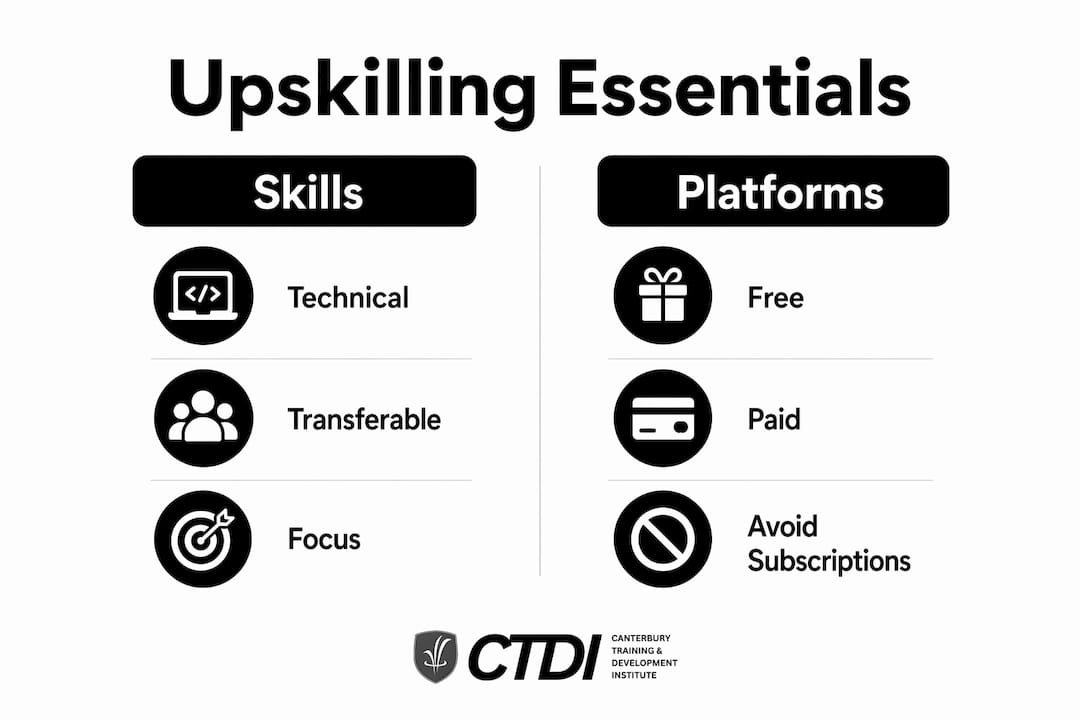
Planning 2–3 skills per quarter optimises focus and output. Spreading attention across five or six skills simultaneously reduces retention and rarely produces portfolio-ready work. Concentrating on a smaller number means you finish courses, build projects, and actually demonstrate competence.
Pro Tip: Before enrolling in anything, list the five skills mentioned most frequently in job ads for your target role. Cross-reference that list against what you already do well. The gap between those two lists is your upskilling priority.
Knowing which skills to target also helps you choose the right platforms, which is where most learners make their second big mistake.
Which platforms are worth your money?
The online learning market is enormous, and not every platform suits every learner or every skill. The smartest approach is to combine multiple platforms rather than committing to one, because different providers excel in different areas.
Free vs paid: what you actually need
Free resources are genuinely useful for testing commitment and filling knowledge gaps. YouTube channels, official documentation (such as Google's own Digital Garage), and free course audits on Coursera all provide real learning value at no cost. Start with 2–3 weeks of free resources before investing in paid courses to confirm you are interested enough to finish.
Paid courses make sense when you need structured progression, assessments, or a recognised credential. The key is not overspending. Keep your budget under $50 per skill by buying Udemy courses during their frequent sales, where courses regularly drop from over $200 to under $20. Accredited vocational courses from providers like Edu (Canterbury Training and Development Institute) sit at a higher investment level but deliver nationally recognised qualifications with direct employment relevance.
| Platform | Best For | Cost Model |
|---|---|---|
| Coursera | University-backed certificates, structured programmes | Free audit or paid certificate |
| Udemy | Practical skill courses, frequent sales | One-off purchase, often under $20 |
| FutureLearn | Short professional development courses | Free or low-cost subscription |
| Google Digital Garage | Digital marketing and data fundamentals | Free |
| Edu (CTDI) | Nationally recognised Australian vocational qualifications | Paid, accredited |
Avoiding the subscription trap
Most learners waste money by subscribing to multiple platforms simultaneously and browsing courses instead of completing projects. This is one of the most common and costly habits in online learning. Subscribing to LinkedIn Learning, Skillshare, and Coursera at the same time rarely produces better outcomes than focusing on one.
Pro Tip: Set a calendar reminder the day before any free trial ends. Cancelling before the billing date is the single easiest way to keep your learning budget under control.
Choosing the right platform matters far less than choosing one and finishing what you start.
How should you structure your weekly learning routine?
A consistent schedule is the engine of effective online learning. Without one, motivation spikes drive short bursts of activity followed by weeks of nothing. Structure replaces the need for motivation.

The case for daily focused blocks
Daily focused practice of 45–60 minutes is more effective than sporadic long sessions for skill retention. This is not a soft recommendation. The research on spaced repetition and deliberate practice consistently supports shorter, regular sessions over marathon study days. A learner who studies for one hour each weekday will outperform someone who studies for five hours on a Saturday.
Here is a practical weekly structure that works for busy professionals:
- Monday: Watch or read new course content (45–60 minutes)
- Tuesday: Practise the concept with a hands-on exercise or mini-project
- Wednesday: Review notes, summarise key points in your own words
- Thursday: Apply the skill to a real or simulated work scenario
- Friday: Reflect on progress, identify gaps, and plan next week's focus
This rhythm keeps learning active rather than passive, and it fits around a standard working week.
Sprint-based learning over 12 weeks
Treat your learning as a product build by splitting a 12-week pathway into three four-week sprints. The first sprint covers fundamentals. The second sprint focuses on building a portfolio project. The third sprint involves publishing that project and seeking feedback. This structure creates natural milestones and prevents the aimless browsing that derails most self-directed learners.
Allocating 5–10 hours per week balanced with work and life commitments produces realistic, sustainable progress. Most professional courses require 20–40 hours to complete. At five hours per week, you finish a course in four to eight weeks, which aligns neatly with a four-week sprint.
Pro Tip: Block your learning time in your calendar as a recurring appointment. Label it with a specific task, not just "study." "Write CSS layout exercise" is harder to skip than "study web design."
If you fall behind, do not abandon the plan. Drop back to three sessions per week and extend the sprint by one week rather than restarting from scratch.
What active learning techniques actually work?
Watching videos and reading slides is not learning. It is exposure. Passive consumption reduces retention, while active learning strategies improve knowledge application and mastery. The distinction matters enormously for anyone who wants to demonstrate skills to an employer.
Move from consuming to doing
Active learning means engaging with material rather than receiving it. Practical techniques that produce measurable results include:
- Summarising in your own words after each lesson, without looking at notes
- Teaching the concept to someone else, even informally, to expose gaps in understanding
- Participating in community discussions on platforms like Reddit, Discord study groups, or LinkedIn
- Identifying confusing concepts immediately and seeking clarification before moving on
Each of these forces your brain to retrieve and apply information, which is where real retention happens.
Build a portfolio, not just a certificate
Proof of skills through project completion is more valued by employers than certificates alone. A certificate tells a hiring manager you sat through a course. A portfolio project tells them you can do the work. Platforms like GitHub (for code and data projects), Behance (for design work), and a personal website work well for showcasing completed projects.
Reverse-engineer real projects by studying public repositories and live examples to fill knowledge gaps. Rather than only following tutorials, find a real marketing campaign, a live website, or a public data set and work out how it was built. This approach builds practical understanding that tutorials alone cannot replicate. You can also use job application tools to identify which skills employers are actively seeking before you decide what to build.
Pro Tip: Real-world project focus and public sharing for feedback accelerate skill acquisition and readiness for employment. Post your work publicly and ask for critique. The feedback you receive in the first week will teach you more than the next three tutorials.
Reflecting on how you learn, monitoring your progress, and adjusting your plan are key drivers of efficient learning. Review your sprint at the end of each four-week block. Ask what worked, what you avoided, and what you will do differently. This metacognitive habit separates learners who plateau from those who keep improving.
Key takeaways
Effective online upskilling requires a focused skill plan, a consistent daily routine, and real project work that proves your abilities to employers.
| Point | Details |
|---|---|
| Focus on 2–3 skills per quarter | Concentrating your effort produces portfolio-ready work and better retention than spreading across many topics. |
| Trial free resources first | Spend 2–3 weeks on free content before paying to confirm your commitment and identify real knowledge gaps. |
| Study 45–60 minutes daily | Short, regular sessions outperform long sporadic ones for skill retention and practical application. |
| Build projects, not just certificates | Completed portfolio work on GitHub or Behance demonstrates competence more convincingly than credentials alone. |
| Review and adjust each sprint | Reflecting on your progress every four weeks keeps your plan realistic and your momentum steady. |
What i've learnt from upskilling online the hard way
I spent the better part of two years collecting courses I never finished. Coursera, Udemy, LinkedIn Learning, all running simultaneously, all half-done. The honest truth is that I was confusing enrolment with learning. The moment I stopped treating online study as something I would get to eventually and started blocking it in my calendar like a client meeting, everything changed.
The learners I see succeed are not the ones with the most motivation. They are the ones with the most boring, predictable routines. Forty-five minutes every morning before work, the same project folder open, the same goal for the week. That kind of consistency feels unglamorous, but it compounds fast.
The other thing I wish someone had told me earlier: your certificate means almost nothing without something you built. I have reviewed job applications where candidates listed five certifications and showed no work. I have also seen applications with one modest project and a clear explanation of how it was made, and those candidates got interviews. If you are upskilling for a career in digital, your portfolio is your argument. Build it from week one, not after you feel ready.
Start now. You will not feel ready. That is normal and irrelevant.
— Sam
Start your upskilling journey with Edu
Edu, the Canterbury Training and Development Institute, offers nationally recognised vocational qualifications designed for Australian learners who want career-ready skills without putting their lives on hold.
Whether you are looking to move into digital marketing, build expertise in AI-powered strategy, or pursue a career in sustainability, Edu has a course built for you. The Advanced Diploma of Digital Marketing and the Certificate IV in Environmental Sustainability are both delivered 100% online at your own pace, with expert trainer support included. If you are ready to turn your upskilling plan into an accredited qualification, enrol now and take the next step.
FAQ
How long does it take to upskill online?
Most professional online courses require 20–40 hours to complete. At a pace of 5–10 hours per week, you can finish a course and build a portfolio project within 4–8 weeks.
What is the best way to upskill for a digital career?
Combine technical skills like data analysis or digital marketing with transferable skills like communication and problem-solving. Use free resources to test your interest before investing in paid courses.
How much should i spend on online courses?
Keep your budget under $50 per skill by purchasing courses during sales on platforms like Udemy. Avoid subscribing to multiple platforms at once, as this rarely improves outcomes and often wastes money.
Do online certificates help you get a job?
Certificates support your application but are not sufficient on their own. Employers value completed portfolio projects more than credentials, so pair any certificate with real work you can show.
How do i stay consistent with online learning?
Block 45–60 minutes of study time in your calendar daily and treat it as a fixed appointment. Structure your learning in four-week sprints with a clear project goal to maintain direction and momentum.