

Most aspiring digital marketers start the same way: a YouTube rabbit hole here, a free PDF there, maybe a half-finished Coursera module gathering digital dust. The result is a patchwork of knowledge with no clear direction and nothing credible to show employers. Accredited online courses solve this by giving you a structured learning pathway, recognised credentials, and real project experience that hiring managers actually respect. This guide walks you through every stage of the process, from understanding your options and preparing to enrol, to building a portfolio and measuring your career growth.
Table of Contents
- Understanding the digital marketing learning landscape
- Essential prerequisites: Skills and tools you need before enrolling
- Step-by-step: Building your digital marketing expertise with accredited online courses
- Common pitfalls, troubleshooting, and measuring your progress
- Verifying your skills: Portfolio building, certifications, and career outcomes
- What most digital marketing learners miss: Continuous adaptation beats memorisation
- Ready to advance your digital marketing career?
- Frequently asked questions
Key Takeaways
| Point | Details |
|---|---|
| Start structured | Begin your learning journey with accredited, sequential courses for best outcomes. |
| Balance hard and soft skills | Develop both technical marketing skills and essential soft skills like communication and adaptability. |
| Showcase real work | Build a portfolio and earn certifications to demonstrate your digital marketing ability to employers. |
| Track your progress | Use measurable ROI metrics and completed projects to gauge your learning success. |
| Never stop learning | Stay updated on the latest tools and trends for ongoing digital marketing success. |
Understanding the digital marketing learning landscape
The digital marketing education space is genuinely crowded. You have free certifications, short courses, university degrees, bootcamps, and everything in between. Knowing which path suits your goals is the first real decision you need to make.
Accredited courses are assessed against national or international standards, which means your qualification carries weight beyond the platform that issued it. Non-accredited courses, including many popular free options, are excellent for building awareness but rarely satisfy employer requirements for formal roles. The gap between the two matters most when you are applying for your first marketing position or seeking a promotion.
Some of the most recognised options include well-reviewed programmes such as the Google Digital Marketing and E-commerce Professional Certificate, HubSpot Academy, and Udacity Nanodegree. Each has distinct strengths. Google's certificate is broad and beginner-friendly. HubSpot is fast and free, ideal for specific skills like email or CRM. Udacity is hands-on and project-heavy, which suits learners who want portfolio depth.
The accreditation debate comes down to this: broad foundational courses build awareness, while focused paid programmes build execution skills. Employers increasingly look for evidence of both, particularly when candidates can back up their credentials with real campaign results.
Here is a quick comparison to help you weigh your options:
| Course | Cost | Duration | Accredited | Best for |
|---|---|---|---|---|
| Google Digital Marketing | ~$49/month | 6 months | Industry recognised | Beginners |
| HubSpot Academy | Free | ~5 hours | Industry cert | Specific skills |
| Udacity Nanodegree | Paid | 3 months | Industry recognised | Portfolio building |
| CTDI Advanced Diploma | Domestic fees apply | Self-paced | Nationally recognised | Career changers |
Free resources are valuable for exploration, but they rarely develop the depth of skill that paid, structured programmes do. If you are serious about a career in digital marketing, treating your education as an investment rather than a freebie is a mindset shift worth making early. You can explore advanced diploma options or browse the career insights blog for further guidance on choosing the right pathway.
Key advantages of accredited learning:
- Nationally or internationally recognised credentials
- Structured curriculum with clear learning outcomes
- Access to expert trainers and student support
- Real project work that builds your portfolio
- Employer confidence in your demonstrated skills
Essential prerequisites: Skills and tools you need before enrolling
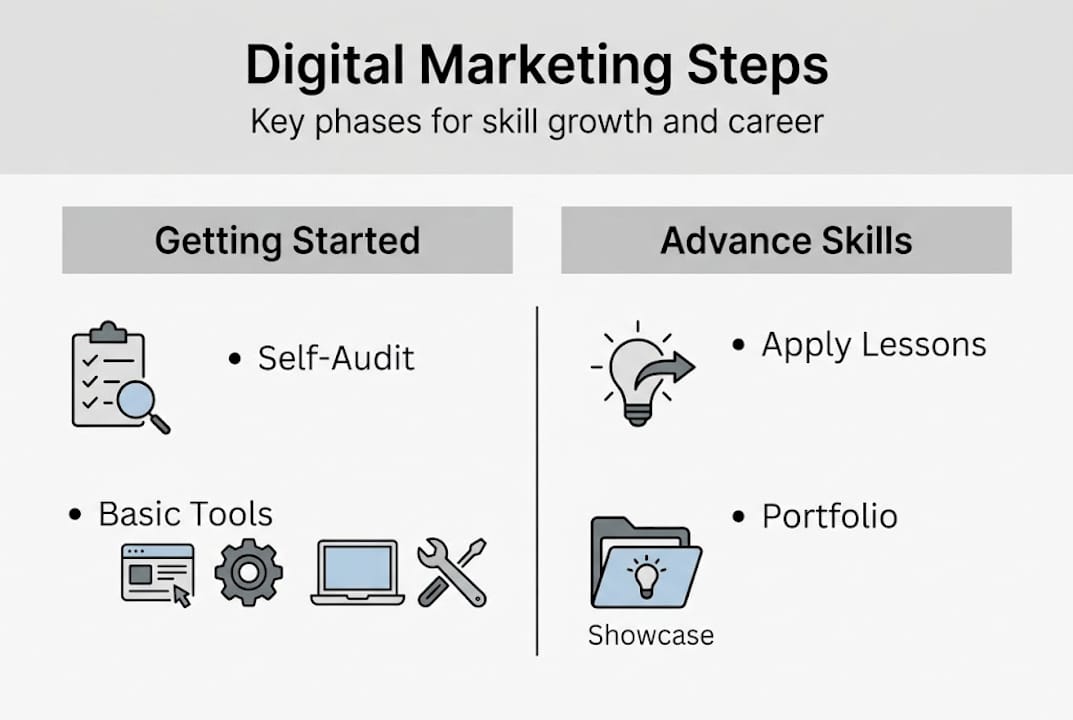
Before you enrol in any accredited digital marketing course, it pays to do a quick self-audit. Not because the entry bar is impossibly high, but because knowing where you stand helps you hit the ground running.
On the technical side, you will need a reliable laptop, a stable internet connection, and comfort with basic productivity tools like Google Docs, spreadsheets, and email. Most online learning platforms are browser-based, so specialist software is rarely required upfront.

Beyond hardware, soft skills matter enormously. Adaptability, communication, and genuine curiosity are as important as knowing how to run an SEO audit. Digital marketing evolves fast, and the ability to learn, unlearn, and relearn is what separates good marketers from great ones. Soft skills research consistently confirms that these traits predict long-term career success across industries, not just marketing.
Here is a practical checklist before you enrol:
Technical requirements:
- Laptop or desktop (Windows or Mac, updated OS)
- Reliable broadband connection
- Google account and familiarity with basic apps
- Basic understanding of social media platforms
Soft skills to develop:
- Written and verbal communication
- Adaptability to new tools and platforms
- Analytical thinking and curiosity
- Time management for self-paced study
| Skill area | Why it matters | How to build it |
|---|---|---|
| Communication | Writing copy, briefing teams | Blogging, online writing courses |
| Adaptability | Keeping up with platform changes | Follow industry news daily |
| Analytical thinking | Reading campaign data | Practice with free Google Analytics |
| Digital literacy | Using marketing tools confidently | Free platform tutorials |
Foundational marketing knowledge is also helpful but not mandatory. If you understand the basics of audience targeting and value propositions, you will absorb course content faster. You can build interpersonal skill development habits before you even log into the Student Portal for the first time.
Pro Tip: Join two or three active digital marketing communities on LinkedIn or Reddit before you enrol. Spend a few weeks observing real conversations. You will quickly learn which topics matter most to practitioners and which skills employers are actively seeking.
Step-by-step: Building your digital marketing expertise with accredited online courses
Once you are prepared, the learning journey becomes much more manageable when broken into clear stages. Here is the process that works:
- Choose your course based on your career goal, budget, and available time. Cross-reference online course reviews to verify quality and employer recognition before committing.
- Enrol and set your schedule. Self-paced does not mean unstructured. Block study time in your calendar like a work commitment. Use the enrol now page to get started with CTDI.
- Follow the learning path sequentially. Resist the urge to skip ahead. Each module builds on the last, and gaps in foundational knowledge create problems later.
- Complete every hands-on project. This is non-negotiable. Projects are where theory becomes skill, and they form the backbone of your portfolio.
- Earn your certification and document it properly on LinkedIn, your CV, and your personal website.
- Build your showcase portfolio using real project outputs, campaign screenshots, and measurable results.
The return on this investment is well documented. Digital marketing training boosts business revenue by 113 to 241%, engagement by 148 to 290%, and productivity by 20.2%. These are not abstract numbers. They reflect what happens when structured learning is applied to real work.
"The difference between a marketer with a certificate and a marketer with a portfolio is the difference between someone who studied swimming and someone who has actually been in the water."
Access CTDI student resources throughout your studies to track your progress and connect with support when you need it.
Pro Tip: Apply each new skill to a side project or volunteer role as you learn it. Even managing social media for a local community group gives you real data, real results, and a genuine story to tell in interviews.
Common pitfalls, troubleshooting, and measuring your progress
Even motivated learners run into obstacles. Knowing what to expect makes them easier to navigate.
The most common trap is paralysis by analysis. With so many courses, platforms, and specialisations available, some learners spend more time researching options than actually studying. Structure fixes this. Once you commit to an accredited pathway, the curriculum makes your decisions for you.
A close second is what practitioners call "shiny object syndrome": jumping between free tutorials every time a new trend appears. Social commerce this week, AI prompting the next, short-form video the week after. Without a structured end goal, you accumulate surface-level awareness instead of deployable skills.
Here is how to measure whether your learning is actually working:
- Certifications earned: A concrete, dated record of completed study
- Portfolio projects completed: Tangible evidence of applied skills
- Campaign KPIs: Click-through rates, conversion rates, cost per acquisition in real or practice campaigns
- Job outcomes: Interviews secured, roles gained, salary increases achieved
- Confidence scores: Self-assessed ability before and after each module
The numbers back this up. Digital marketing training increases owner confidence by 112 to 128%, and email marketing alone delivers an ROI of $36 for every $1 spent. These benchmarks give you a baseline to measure against.
Review career growth strategies regularly as you progress, and stay informed about AI's impact on marketing jobs so your skills remain relevant. A marketing training study confirms that structured programmes consistently outperform self-directed learning for measurable skill outcomes.
Watch out for these common mistakes:
- Skipping assessments or projects to save time
- Treating certification as the finish line rather than the starting point
- Ignoring analytics and data in favour of creative work only
- Failing to update your portfolio after completing new projects
Verifying your skills: Portfolio building, certifications, and career outcomes
Completing a course is one thing. Turning that completion into career advantage requires deliberate action.
Your portfolio is your most powerful asset. It shows employers not just what you know, but what you can do. A strong digital marketing portfolio includes campaign strategy documents, content samples, analytics reports with commentary, and before-and-after results from any projects you have managed.
Here is a step-by-step approach to building yours:
- Collect outputs as you go. Do not wait until you finish the course. Save every project file, screenshot, and result from day one.
- Contextualise each piece. Add a brief explanation of the objective, your approach, and the result. Numbers make this compelling.
- Present it professionally. Use a simple website (Google Sites or WordPress) or a PDF document. Clean and clear beats flashy every time.
- Seek feedback. Share your portfolio with a mentor, a peer, or a professional in the field before using it in applications.
- Update it quarterly. A portfolio that stops in 2024 signals a learner who stopped growing.
When it comes to certifications valued in Australia, nationally recognised qualifications carry the most weight with domestic employers. Industry credentials from Google and HubSpot are respected globally. Google's programme has 1.3 million enrolled learners and reports a median entry-level salary of $71,000, while Udacity's programme is consistently rated for its hands-on depth.
| Certification | Recognition | Median salary outcome | Portfolio component |
|---|---|---|---|
| Google Digital Marketing | Global industry | ~$71k entry-level | Yes |
| HubSpot Academy | Global industry | Varies | Limited |
| Udacity Nanodegree | Global industry | Competitive | Strong |
| CTDI Advanced Diploma | Nationally recognised (AUS) | Competitive | Integrated |
Explore your digital marketing certification options and check the latest career insights to align your portfolio with what Australian employers are actively seeking right now.
What most digital marketing learners miss: Continuous adaptation beats memorisation
Here is an uncomfortable truth: the marketers who plateau are almost always the ones who treated their certificate as the destination. The ones who keep growing treat it as a starting point.
Continuous learning is essential precisely because digital marketing does not stand still. AI tools are reshaping content creation, paid media, and audience targeting at a pace that no single qualification can fully anticipate. What you learn today will need updating within 18 months. That is not a flaw in your education. It is the nature of the industry.
The marketers we see succeed long-term are not the ones with the most certificates. They are the ones who have built a habit of experimentation, who measure everything, and who actively seek out what they do not yet know. They read about AI evolution in digital marketing not because they have to, but because they are genuinely curious.
Measuring your own progress matters more than any external validation. Track your campaign results, revisit your learning goals quarterly, and be honest about where your gaps are.
Pro Tip: Schedule a quarterly skill audit. Review your portfolio, identify one area where your knowledge has become outdated, and spend 30 minutes finding one high-quality resource to address it. Small, consistent updates compound into significant expertise over time.
Ready to advance your digital marketing career?
You now have a clear picture of the learning landscape, the preparation required, and the steps to turn study into real career outcomes. The next move is yours.
CTDI offers the advanced diploma of digital marketing, a nationally recognised qualification designed for working professionals who want structured, expert-led training they can complete entirely online. Whether you are starting from scratch or formalising years of practical experience, CTDI's self-paced format fits around your life. Explore all CTDI online qualifications and take the first concrete step toward a credentialled career in digital marketing. Enrol now today and start building skills that employers recognise.
Frequently asked questions
How long does it take to complete a digital marketing course online?
Most leading courses range from around 5 hours to 6 months, depending on the programme. HubSpot Academy is free and takes roughly 5 hours, while Google's certificate runs about 6 months at $49 per month.
Is it better to start with free or paid digital marketing courses?
Free courses are ideal for building foundational awareness, but free certifications typically lack the hands-on projects needed for employment. Once you have the basics, investing in a structured paid programme delivers significantly better career outcomes.
What is the typical return on investment for digital marketing training?
Digital marketing training has been shown to boost business revenue by 113 to 241% and productivity by over 20%. These gains reflect structured, applied learning rather than passive consumption of free content.
Do employers value online certifications from Google or Udacity?
Yes, particularly when paired with a project portfolio. Google's programme reports 1.3 million enrolled learners and a median entry-level salary of $71,000, which signals strong employer recognition.
How can I measure my skill growth during digital marketing studies?
Track certifications completed, portfolio projects finished, and real campaign metrics over time. Continuous learning habits and regular self-assessment are more reliable indicators of growth than course completion alone.
Recommended
- Advanced Diploma Digital Marketing Australia | AI-Powered Marketing Career | CTDI — Canterbury Training and Development Institute
- Career Insights Blog | AI Jobs, Digital Marketing & Green Careers Australia | CTDI — Canterbury Training and Development Institute
- CTDI - Canterbury Training & Development Institute | Online Qualifications
- What Will Happen to Digital Marketing Jobs in the Age of AI? | CTDI — Canterbury Training and Development Institute