

Australia's vocational education sector is undergoing a quiet revolution. More than half of all VET enrolments now include an online component, and the online education market is projected to expand rapidly as flexible pathways replace the assumption that upskilling requires a classroom seat. Whether you're pivoting into artificial intelligence, building a career in digital marketing, or chasing a role in environmental management, the question is no longer whether online training works. It's how to choose the right model, avoid the common traps, and make the most of a qualification that can genuinely change your career trajectory.
Table of Contents
- Understanding the impact of online education in vocational training
- Benefits and opportunities: Why students choose online VET
- Challenges and limitations: What to watch out for
- Blended and advanced models: The future of online vocational education
- Our perspective: What actually matters for future-ready online learning
- Ready to take your next career step?
- Frequently asked questions
Key Takeaways
| Point | Details |
|---|---|
| Flexible upskilling | Online education enables students to gain new skills in areas like AI and sustainability without sacrificing work or life commitments. |
| Future-focused learning | Vocational online courses in Australia align with emerging job markets and global qualification standards. |
| Value of blended models | Blended learning approaches offer higher completion rates and better engagement than pure online study. |
| Tackle challenges | Students can improve their success by using support networks, workplace integration, and selecting the right learning model. |
Understanding the impact of online education in vocational training
Online education has shifted from a convenient alternative to a mainstream pathway for vocational students across Australia and internationally. The digital education market report confirms that demand is accelerating, particularly in sectors where skills gaps are widest and employer expectations are evolving fastest.
Three industries stand out. Artificial intelligence is reshaping every workplace, and employers are actively seeking workers who understand how to apply AI tools practically. Digital marketing continues to grow as businesses of every size compete for online visibility. Environmental and sustainability management is expanding in response to regulatory pressure and genuine corporate commitment to reducing ecological impact. Each of these fields rewards practical, current knowledge over theoretical credentials, which is exactly what well-designed vocational training delivers.
The core appeal of online VET is straightforward. Upskilling without disrupting your existing work or family commitments is possible in a way that campus attendance rarely allows. You study when it suits you, at a pace that fits your life, without relocating or taking extended leave.
Here's what makes online vocational training genuinely valuable in 2026:
- Accessibility: Students in regional and remote areas access the same quality training as those in major cities
- Industry currency: Course content updates faster online than in traditional print-based curricula
- Global reach: International students can gain Australian qualifications without relocating
- Career continuity: You keep earning while you learn, reducing the financial risk of upskilling
- Specialist focus: Niche areas like AI and green careers are easier to find online than through local providers
For anyone considering a sustainable management course or a qualification in a fast-moving technical field, the online format removes barriers that would otherwise make study impractical. That's not a minor convenience. For many students, it's the difference between upskilling and staying stuck.
Benefits and opportunities: Why students choose online VET
The practical benefits of online vocational training go well beyond flexibility. When you study online, you're not just fitting study around your schedule. You're building skills that employers in high-demand industries are actively recruiting for, often without needing to leave your current role to do it.

Consider what flexible upskilling and international collaboration actually means for your career. You can complete a qualification that is recognised across Australia and in many international markets, connect with peers and mentors across time zones, and apply what you're learning to your current job in real time.
Here's how the main study modes compare:
| Feature | Online | Blended | Face-to-face |
|---|---|---|---|
| Schedule flexibility | High | Moderate | Low |
| Hands-on practice | Limited | Strong | Strong |
| Cost | Lower | Moderate | Higher |
| Geographic access | Unrestricted | Partial | Local only |
| Peer interaction | Asynchronous | Mixed | Direct |
| Employer recognition | Growing | Established | Established |
For students targeting roles where earning more with AI skills is a realistic goal, the online format means you can start applying new knowledge immediately. The same applies to a digital marketing diploma, where campaign management and analytics skills translate directly into workplace performance from week one.
To get the most from your online VET experience, follow these steps:
- Set a weekly study schedule and treat it like a work commitment
- Engage actively in discussion forums and peer activities
- Seek out courses with workplace integration or real-world projects
- Connect with your trainer regularly, not just when you're stuck
- Use employer support programmes where available to fund or validate your study
Pro Tip: Students who engage with their online learning community at least three times per week consistently report higher satisfaction and better completion rates than those who study in isolation.
Challenges and limitations: What to watch out for
Online vocational training is not without its difficulties. Understanding them before you enrol is the best way to avoid becoming a dropout statistic.
Completion rates are the most cited concern. Online-only VET completion rates are measurably lower than blended or face-to-face equivalents, and pure online delivery can lead to isolation and digital access gaps for some student cohorts. That's a real finding, not a scare tactic.
Here's a summary of the main challenges and what they mean in practice:
| Challenge | Impact | Mitigation |
|---|---|---|
| Isolation | Lower motivation, higher dropout | Active community participation |
| Tech access gaps | Unequal learning experience | Provider tech support, device loans |
| Self-discipline required | Procrastination risk | Structured schedules, accountability |
| Limited hands-on practice | Skills gaps in practical fields | Blended models, workplace projects |
| Assessment integrity | Credential credibility concerns | Reputable, accredited providers only |
Isolation is worth taking seriously. When you study purely online without structured interaction, motivation drops. The absence of a physical campus removes the informal conversations, peer encouragement, and visible progress that keep students engaged. This is not a personality flaw. It's a design problem with courses that treat online delivery as a content dump rather than a learning experience.
Tech barriers are also real. Not every student has reliable broadband, a suitable device, or a quiet space to study. Providers who ignore these realities set students up to struggle.
"Industry-aligned blended models are the most effective approach for vocational education outcomes, particularly where practical skills are central to the qualification." PMC blended education research
Pro Tip: Before enrolling, ask your provider directly about student support services, tech assistance, and how the course builds in human interaction. A vague answer is a warning sign.
The good news is that these challenges are solvable. Providers who build in mentorship, peer cohorts, and workplace integration through academic partnerships consistently outperform those who rely on self-directed study alone.
Blended and advanced models: The future of online vocational education
Blended learning is not a compromise between online and face-to-face study. It's a deliberate design choice that combines the best of both worlds, and the evidence strongly supports it.
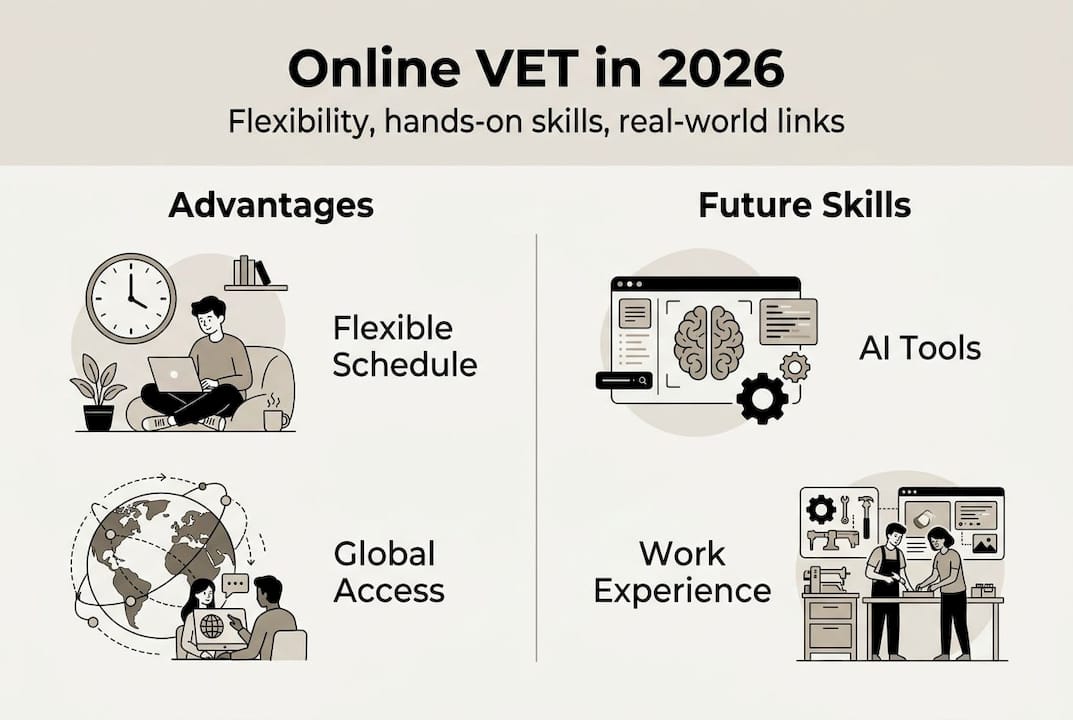
Blended learning outperforms pure online for VET outcomes, particularly in non-STEM fields and smaller class settings. Students in blended programmes complete at higher rates, report stronger engagement, and develop more transferable practical skills than those in purely online cohorts.
What makes a blended model work in practice:
- Structured online modules that deliver theory and knowledge at the student's pace
- Live sessions with trainers and peers for discussion, Q&A, and collaborative problem-solving
- Workplace or simulation components that build hands-on competency
- AI-personalised pathways that adapt content difficulty and sequencing to individual progress
- Regular feedback loops between students and trainers, not just automated quiz scores
AI-personalised learning is emerging as a genuine game-changer. Rather than every student following an identical sequence, adaptive platforms identify where you're strong and where you need more support, then adjust accordingly. For a diploma of AI, this kind of intelligent course design is not just appropriate. It's a demonstration of the technology in action.
The most forward-thinking providers are also integrating work-integrated training directly into their course structures. This means students complete real projects for real employers during their qualification, not after it. The result is a graduate who arrives job-ready rather than job-adjacent.
For students in 2026, the question to ask any provider is simple: how does your course blend online flexibility with genuine practical experience? The answer will tell you everything about whether the qualification will actually serve your career.
Our perspective: What actually matters for future-ready online learning
Here's the uncomfortable truth that most online education marketing glosses over: technology is not the point. Platforms, AI tools, and sleek interfaces matter far less than whether a course genuinely connects students to trainers, peers, and real-world application.
We've seen students thrive in simple, well-supported online environments and struggle in technically sophisticated platforms that offered no human connection. The pattern is consistent. What predicts completion and career outcomes is not the sophistication of the learning management system. It's the quality of the relationships and the relevance of the tasks.
Conventional wisdom says to look for the most feature-rich platform. We'd say look for the most engaged trainer community and the clearest pathway from study to employment. For students considering environmental science careers or roles in AI and digital marketing, scrutinise the course delivery model as carefully as you scrutinise the qualification itself. Promises are easy. Structured support, industry-aligned projects, and genuine mentorship are what actually move the needle.
Ready to take your next career step?
If you've been weighing up your options, the evidence points in one direction: well-designed online vocational training, built around blended delivery and real industry connections, delivers genuine career outcomes in 2026's job market.
At CTDI, our nationally recognised qualifications are built specifically for students who need flexibility without sacrificing quality. Whether you want to enrol in an online diploma, explore our environmentally-focused courses, or discover what our digital marketing programme can do for your career, our team is ready to help you take the next step. Explore our full course range and find the qualification that fits your goals.
Frequently asked questions
Is online vocational training in Australia recognised internationally?
Yes, most accredited Australian online VET qualifications are recognised globally, particularly in fast-growing fields like AI and sustainability. Australian online education supports upskilling for both domestic and international students seeking career advancement.
What is the main difference between pure online and blended learning modes?
Blended learning combines online study with practical, hands-on experience, which consistently improves both engagement and completion compared to purely online delivery. Blended models outperform pure online approaches, especially in vocational and skills-based qualifications.
How can I boost my chances of completing an online VET course?
Choose courses that include workplace integration, mentorship, and structured peer interaction rather than self-directed study alone. Completion rates improve significantly when hands-on elements and industry-aligned support are built into the course design.
Do online VET qualifications really help with immediate job outcomes?
Yes, particularly in sectors like AI, digital marketing, and environmental management where employers actively seek current, practical skills. Online VET qualifications support employability and upskilling in industries where demand is outpacing supply of qualified workers.
Recommended
- Enrol Now — Online Diplomas in AI, Marketing & Sustainability | CTDI — Canterbury Training and Development Institute
- Certificate IV Environmental Sustainability Australia | Green Career Online | CTDI — Canterbury Training and Development Institute
- CTDI - Canterbury Training & Development Institute | Online Qualifications
- What Will Happen to Digital Marketing Jobs in the Age of AI? | CTDI — Canterbury Training and Development Institute