

TL;DR:
- Building foundational assets like a website, social profiles, and email list is essential before campaigns.
- Focus on specific goals, target audience, and channels to create effective, channel-specific campaigns.
- Regularly measure, analyze, and iterate campaigns based on industry benchmarks to improve results.
Digital marketing can feel like standing at the edge of a massive ocean with no map. There are hundreds of channels, tools, platforms, and strategies competing for your attention, and every expert seems to offer a different opinion on where to start. Whether you are a fresh-faced student, a seasoned professional looking to pivot, or someone completely new to the industry, the sheer volume of information can stop you before you even begin. This guide cuts through the noise and gives you a clear, practical pathway from zero knowledge to confident execution, helping you build real skills that translate directly into career opportunities.
Table of Contents
- Get your digital marketing foundation sorted
- Plan and launch your campaigns across channels
- Monitor, measure, and learn from your results
- Iterate, optimise, and adapt for ongoing success
- What most digital marketing guides overlook: Real learning is iterative
- Grow your digital marketing skills with recognised qualifications
- Frequently asked questions
Key Takeaways
| Point | Details |
|---|---|
| Build your digital foundation | Start with core assets like your website, email list, and social profiles before any campaign. |
| One clear goal per campaign | Define campaign objectives to match each channel and measure what actually matters. |
| Measure and adapt regularly | Review your marketing outcomes on a schedule and use empirical benchmarks for improvement. |
| Continuous optimisation wins | Iterate your strategies and learn from case studies to refine your skills and results. |
| Formal study accelerates progress | Combine hands-on practice with recognised qualifications to fast-track your digital marketing career. |
Get your digital marketing foundation sorted
Before you run a single campaign or write a single post, you need to build your digital marketing home base. Think of it like setting up a kitchen before you cook. Without the right equipment and ingredients in place, even the best recipe will fall apart. Google's framework for digital marketing recommends that you operationalise digital marketing by first establishing your assets and foundational presence before moving into active promotion.
Your home base is made up of the owned digital properties that represent you or your brand online. This includes your website, your social media profiles, your email list, and your content library. Each of these assets plays a different role. Your website is the hub where everything points. Your social profiles create reach and community. Your email list gives you direct, algorithm-free access to your audience. And your content library is the fuel that powers all of it.
Understanding the digital marketing learning process from the beginning makes a significant difference in how quickly you can put these foundations to work. Many beginners skip the foundation stage and jump straight into running ads or posting on social media, then wonder why nothing sticks. Without a proper base, your campaigns have nowhere to land and no way to convert interest into action.
Here is a comparison of free versus paid tools to help you set up your core digital assets:
| Asset type | Free tools | Paid tools |
|---|---|---|
| Website | WordPress.com, Wix (free plan) | Shopify, Squarespace, WordPress.org with hosting |
| Email marketing | Mailchimp (free tier), Brevo | ActiveCampaign, Klaviyo, HubSpot |
| Social scheduling | Buffer (free plan), Later | Hootsuite, Sprout Social |
| SEO research | Google Search Console, Ubersuggest | Ahrefs, SEMrush, Moz |
| Analytics | Google Analytics 4, Meta Insights | Tableau, Databox, AgencyAnalytics |
Starting with free tools is completely fine, and in many cases, they are more than enough for the early stages of your journey. As you grow, you can layer in paid solutions that match your specific needs. For more background on how online learning platforms can accelerate this kind of practical setup, empowering vocational students through structured training gives you a shortcut that self-study alone rarely provides.
Must-have assets before launching campaigns:
- A live website or landing page with clear calls to action
- At least two active social media profiles relevant to your target audience
- An email capture form connected to an email marketing platform
- A basic content plan with at least four weeks of topics ready
- Google Analytics 4 installed and configured on your website
- A Google Business Profile if you are promoting a local business
Pro Tip: Resist the urge to be everywhere at once. Spreading yourself across eight platforms when you are starting out dilutes your energy and your results. Pick two channels, master them, and then expand. Quality of presence always beats quantity of platforms.
According to marketing strategy insights, brands that try to maintain too many channels without a clear strategy often end up with inconsistent messaging and poor audience engagement. Focus beats breadth every single time in the early stages of your digital marketing journey.
Plan and launch your campaigns across channels
With your assets in place, it is time to get practical about launching campaigns across different channels. A campaign is simply a coordinated set of marketing activities designed to achieve a specific goal during a defined period. The key word there is specific. Vague campaigns produce vague results.

Google's guidance for effective digital campaigns emphasises creating distinct campaigns for each channel rather than pushing the same message everywhere and hoping it lands. Each channel has its own audience expectations, content formats, and performance benchmarks. What works on LinkedIn will not necessarily perform on Instagram, and what converts in an email sequence might completely flop as a paid ad.
Here is a step-by-step process for planning and launching your first campaign:
- Define your single campaign goal. Are you building brand awareness, generating leads, or driving direct sales? Choose one objective and stick to it.
- Identify your target audience. Use data from your existing assets, such as your website analytics or email subscriber demographics, to build a clear picture of who you are reaching.
- Select your primary channel. Based on where your audience spends time and what your goal is, choose the channel that gives you the best chance of success.
- Craft your core message. Write a simple, clear message that speaks directly to your audience's needs or pain points. Test it on someone outside your industry before publishing.
- Create your content assets. Build the actual content, whether that is email copy, social graphics, a blog post, or an ad creative, aligned to your channel's best-practice formats.
- Set your budget and timeline. Even with zero paid budget, you have a time budget. Decide how many hours per week you will invest and for how long.
- Launch and document your starting point. Record your baseline metrics before you start so you have something meaningful to compare your results to later.
- Schedule a review date. Set a specific date to review performance, not just a vague intention to check in at some point.
If you are interested in building these skills at a deeper, more structured level, the advanced diploma in digital marketing covers campaign strategy across all major channels with practical, real-world applications built into the curriculum.
Here is a snapshot of expected performance benchmarks across key channels for 2026, based on current industry benchmark data:
| Channel | Average open or click rate | Average conversion rate | Typical cost per result |
|---|---|---|---|
| Email marketing | 36-40% open rate | 2-5% click-to-conversion | Near zero (organic) |
| Google Ads (search) | 3-6% click-through rate | 4-8% conversion rate | $2 to $15+ per click |
| Social media ads | 0.9-1.5% click-through rate | 1-3% conversion rate | $0.50 to $3.50 per click |
| Organic social media | 1-5% engagement rate | 0.5-2% conversion rate | Time only |
| SEO content | Variable (position-dependent) | 2-6% conversion rate | Time and content costs |
These numbers give you realistic expectations rather than best-case scenarios. Setting targets based on actual 2026 marketing benchmarks rather than aspirational guesses will save you a lot of frustration. If you are responsible for upskilling your team or building internal capability, these benchmarks are equally useful for setting realistic expectations across departments.
Pro Tip: Run one campaign with one clear goal before you try to juggle multiple campaigns simultaneously. Learning is far faster when you can isolate variables and understand what is actually driving your results.
Monitor, measure, and learn from your results
Once your campaigns are running, measuring performance becomes the difference between success and wasted spend. This is where a lot of marketers, especially beginners, go wrong. They either measure everything and drown in data, or they measure nothing and have no idea what is working.
Measurement challenges and right metrics are among the top concerns for marketing leaders globally. The advice from industry analysts is consistent: build dashboards that track a small number of meaningful metrics rather than every data point your platform offers. A focused dashboard tells a clear story. An overloaded one tells no story at all.
"Don't chase vanity metrics. Follower counts and page views feel good but rarely correlate with business outcomes. Track what moves the needle: conversions, revenue, retention, and return on investment."
This is one of the most important mindset shifts you will make as a digital marketer. It is tempting to celebrate 10,000 impressions or 500 new followers, but these numbers mean nothing if nobody is buying, subscribing, or taking the action you actually need them to take.
Metrics worth prioritising:
- Conversion rate (the percentage of visitors who take your desired action)
- Cost per acquisition (how much you spend to get one paying customer or lead)
- Email click-to-open rate (a more meaningful engagement signal than open rate alone)
- Return on ad spend (revenue generated for every dollar spent on paid campaigns)
- Customer lifetime value (total revenue a customer generates over their relationship with you)
- Organic search ranking improvements over time
Metrics that can mislead you:
- Total page views without context (traffic without conversions is just noise)
- Social media follower counts (vanity metric unless followers are converting)
- Email open rates in isolation (affected by privacy tools and can be unreliable)
- Impressions and reach (awareness without engagement rarely drives results)
- Bounce rate (contextually misleading depending on page purpose)
Good benchmarking in digital marketing means comparing your performance against industry averages rather than just comparing this month to last month. For example, if your email open rate is 28% and the industry average is 38%, that gap tells you something important about either your subject lines, your list quality, or both. Benchmarks give your data meaning. Without them, a 3% conversion rate could look either brilliant or terrible depending on your industry.
Understanding how digital marketing in the AI age is reshaping measurement is also worth exploring. AI-powered analytics tools are making it faster and easier to surface meaningful patterns in your data, but only if you know which questions to ask of that data in the first place.
Pro Tip: Set a fixed review schedule, such as every Monday morning or on the first of each month, rather than checking your metrics randomly throughout the week. Regular, scheduled reviews help you spot genuine trends rather than reacting to daily fluctuations that may mean nothing at all.
Iterate, optimise, and adapt for ongoing success
Regular monitoring sets you up for the next crucial step: learning from your data and making meaningful changes. This is where digital marketing becomes genuinely exciting, because there is always something you can test, tweak, or improve.
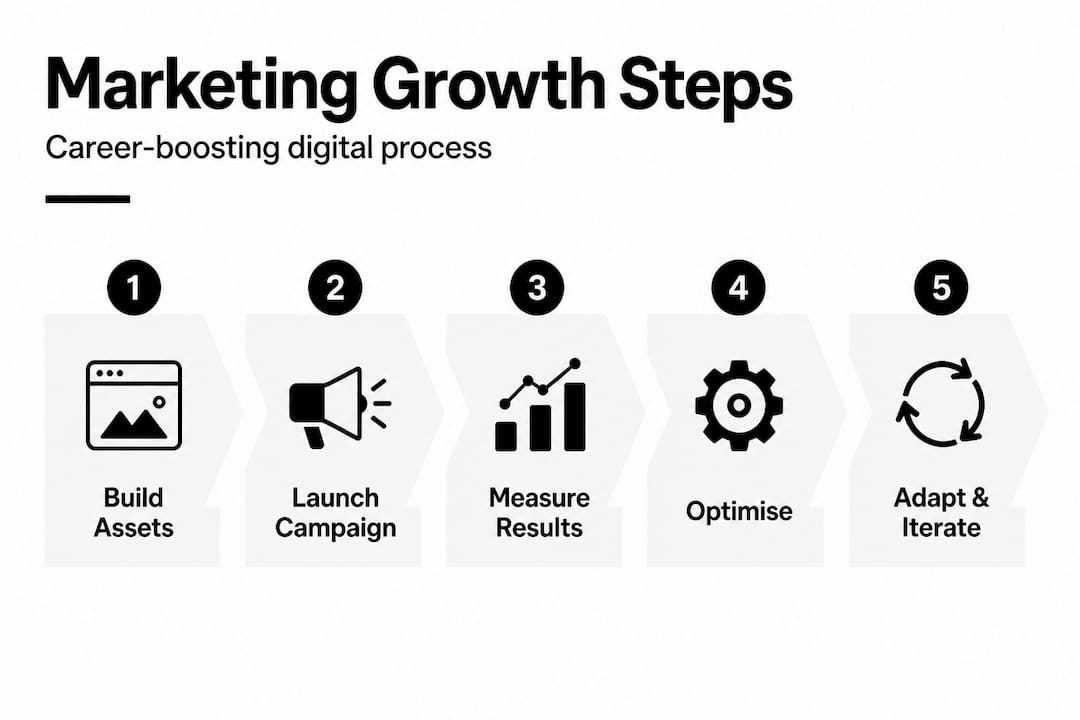
Google's four-stage model for digital marketing operationalisation ends with iteration and conversion rate optimisation. This is not an afterthought. It is the engine that drives compounding results over time. Every iteration you make based on real data is an improvement that builds on your previous work rather than starting from scratch.
Empirical learning means using real examples, actual benchmark comparisons, and tested hypotheses to guide your next moves. Benchmark-driven iteration is what separates marketers who plateau from those who keep growing. When you review your results against industry benchmarks and case studies from comparable businesses, you can identify exactly where the gap lies and what you need to change.
Quick ways to adapt your campaigns, assets, and learning:
- A/B test your subject lines by sending two versions of the same email to small segments of your list before rolling out the winner to everyone
- Rotate your ad creative every two to three weeks to prevent audience fatigue and maintain click-through rates
- Rewrite underperforming landing pages based on where users are dropping off, using tools like Hotjar or Microsoft Clarity to see heatmaps
- Update old content by adding new data, refreshing examples, and improving calls to action to boost organic search rankings without creating brand new content
- Repurpose high-performing content into different formats, turning a popular blog post into a video, an email sequence, or a social media carousel
- Survey your audience directly to understand what content they want, what problems they are still facing, and what objections are stopping them from converting
The digital marketing process is genuinely cyclical. You plan, launch, measure, iterate, and then plan again with more information than you had before. Each cycle makes you a better, more data-informed marketer. This is also why digital marketing skills developed through structured training tend to compound faster. Formal learning gives you the frameworks to interpret your results correctly, not just react to them.
Google's optimisation advice consistently reinforces that optimisation is not a one-time event. It is a habit. The marketers who build that habit early, even when their campaigns are small, develop an instinct for improvement that becomes a genuine competitive advantage as their responsibilities grow.
Pro Tip: Celebrate learning even when results are disappointing. A campaign that did not convert as expected but taught you something specific about your audience or messaging is never a failure. It is a data point that makes your next campaign sharper.
What most digital marketing guides overlook: Real learning is iterative
Here is something most step-by-step guides will not tell you. Following a framework perfectly is not what makes a great digital marketer. What actually separates the mediocre from the exceptional is the willingness to fail, analyse, adjust, and try again without losing momentum or confidence.
Every successful marketer you admire has a graveyard of campaigns that bombed, strategies that missed the mark, and budgets that produced almost nothing. The difference is not that they avoided failure. It is that they extracted lessons from it and kept moving. This is empirical learning in practice, and it is exactly what review and iteration benchmarks are designed to support.
The uncomfortable truth is that digital marketing mastery is not something you achieve after completing a course or reading a guide. It is something you build through repeated exposure to real problems, real data, and real consequences. No amount of passive learning replaces the experience of running an actual campaign and watching it perform differently from what you expected.
"Success in digital marketing is built one iteration at a time."
This is not just motivational language. It is a structural truth about how this field works. The platforms change. The algorithms shift. Audience behaviours evolve. What worked brilliantly in 2024 might underperform in 2026, and the marketer who keeps iterating based on current data will always outperform the one relying on old playbooks.
What we find, working with vocational learners across Australia, is that the students who progress fastest are not necessarily the most technically gifted. They are the ones who treat every result as information rather than judgement. They are genuinely curious about why something performed the way it did. They invest in benchmark-driven strategy rather than gut instinct, and they build the habit of scheduled review before they ever feel pressure to report on results.
If you take one thing from this guide, let it be this: the process of digital marketing is the practice of getting progressively less wrong. Every iteration gets you closer. That is not a consolation prize. That is the actual pathway to expertise.
Grow your digital marketing skills with recognised qualifications
Practical experience and formal study are not opposites. They are partners. The step-by-step framework in this guide gives you a map, but structured learning gives you the deeper understanding you need to adapt that map when conditions change.
At CTDI, we offer flexible, 100% online vocational qualifications designed specifically for people who want to enter or advance in digital marketing, AI, and related fields. Our courses are built by industry practitioners and aligned to real employer expectations, meaning you are not just learning theory but developing the practical capabilities that actually get people hired and promoted. If you are ready to take the next step, you can enrol in online diplomas and start at your own pace. For those ready for a serious career transformation, the advanced digital marketing diploma provides a nationally recognised pathway that combines strategy, analytics, campaign management, and emerging technology in one comprehensive programme.
Frequently asked questions
What are the absolute essentials to start digital marketing?
A website, social profiles, and an email list are the must-have assets for any beginner. Without these foundations in place, campaigns have nowhere to land and no way to convert interest into action.
How do I pick the best digital marketing channel for my goals?
Choose channels where your target audience spends time and match your campaign type to each channel's strengths. Creating campaigns per channel rather than blasting the same message everywhere leads to far better results.
Which metrics should I track to see if my campaign works?
Focus on conversion rates, cost per acquisition, and revenue impact rather than follower counts or impressions. Avoiding vanity metrics in favour of outcome-based measurement is what separates effective marketers from busy ones.
How often should I review digital marketing performance?
Set a fixed review schedule, weekly or monthly, and use industry benchmarks for comparison rather than relying solely on your own historical data. Regular, scheduled reviews are far more useful than ad hoc checks.
Is formal study necessary for a digital marketing career?
Formal qualifications help you build a structured, industry-aligned knowledge base that accelerates your practical experience. Real-world application and structured vocational training work best when they reinforce each other rather than replace one another.
Recommended
- Mastering the digital marketing learning process: career growth — Canterbury Training and Development Institute
- Advanced Diploma Digital Marketing Australia | AI-Powered Marketing Career | CTDI — Canterbury Training and Development Institute
- Career Insights Blog | AI Jobs, Digital Marketing & Green Careers Australia | CTDI — Canterbury Training and Development Institute
- How online education empowers vocational students in 2026 — Canterbury Training and Development Institute
- Learn Chinese Language to Propel Your Career Forward - Linda Mandarin