

TL;DR:
- Investing in strategic training enhances retention, productivity, and employee satisfaction.
- Effective training combines formal learning with mentoring and aligns with career development.
- Measuring training impact through performance and retention data demonstrates tangible business value.
Corporate training is widely misunderstood. Many organisations still treat it as a compliance checkbox, something you do because you must, not because it moves the needle on business performance. Yet training and professional development are explicitly linked to business outcomes and career advancement for employees across Australia. The evidence is clear: companies that invest deliberately in learning see measurable gains in retention, productivity, and employee satisfaction. This guide is written for corporate training managers and HR professionals who want to move beyond tick-box thinking and understand how training functions as a genuine strategic lever. We cover the business case, the types of training that matter most, what makes programmes effective, and how to measure real impact.
Table of Contents
- How training propels business outcomes and employee careers
- Key types of corporate training: From compliance to career advancement
- Making training effective: What works in Australian corporates
- Overcoming challenges: Barriers and solutions in corporate training
- Mapping training success: Measuring impact and driving continuous growth
- Why traditional approaches to training hold businesses back
- Discover your next steps with expert-supported corporate training
- Frequently asked questions
Key Takeaways
| Point | Details |
|---|---|
| Training boosts retention | Australian research confirms that effective training programs reduce employee turnover and foster loyalty. |
| Drives career development | Professional development and mentoring lead to better job satisfaction and career progression for employees. |
| Strategic business value | Targeted learning solutions align with business needs and help achieve organisational goals. |
| Employer investment pays off | Most Australian employers fully sponsor staff training for measurable improvements in retention and productivity. |
| Continuous learning matters | Treating training as an ongoing strategy, not a one-off event, is vital for long-term corporate success. |
How training propels business outcomes and employee careers
With misconceptions set aside, let's look more closely at how training tangibly affects both employees and the business.
When organisations treat training as a strategic function rather than an administrative duty, the results show up quickly in the data. Training is linked to staff retention, job satisfaction, productivity, and quality of output. These are not soft, feel-good metrics. They are the exact levers that determine whether a business can scale, compete, and retain the talent it has worked hard to recruit.
Consider retention first. Replacing a mid-level employee costs between 50% and 200% of their annual salary when you factor in recruitment fees, onboarding time, and lost productivity during the transition. Training reduces that risk significantly. Australian data from the Learning That Works Report shows that employees who participate in work-related training earn approximately $2,400 more annually and are 40% less likely to leave their employer. That is a powerful combination: you keep your people longer and they earn more, which means they feel genuinely valued.
"When employees see that their employer invests in their growth, they invest back in the organisation. Training is not a cost. It is a retention strategy disguised as a learning programme."
The productivity link is equally compelling. Employees who receive targeted skills training complete tasks faster, make fewer errors, and require less supervision over time. For a team of twenty people, even a modest 10% productivity gain translates into the equivalent of two additional full-time staff members without the associated payroll cost. Training managers who frame investment in these terms tend to win budget approval far more easily than those who present training as a wellbeing initiative.
Here is a summary of the key business outcomes linked to structured training in Australian organisations:
| Outcome | Impact of training | Why it matters |
|---|---|---|
| Staff retention | 40% less likely to leave | Reduces recruitment and onboarding costs |
| Annual income | ~$2,400 higher for trained staff | Reflects productivity and skill premium |
| Job satisfaction | Measurably higher | Drives engagement and discretionary effort |
| Productivity | Increases with targeted skills training | Directly improves output quality and speed |
| Quality of work | Fewer errors, higher standards | Reduces rework and customer complaints |
Professional development plans are the structural tool that connects training to career growth. When an employee can see a clear pathway from their current role to a more senior position, and when training is mapped explicitly to each step of that pathway, engagement with learning increases dramatically. Corporate training managers who build these plans in collaboration with line managers create a shared language between HR, operations, and individual employees.

Effective corporate training partnerships can also extend the reach of internal L&D teams, bringing in specialist expertise for areas like digital skills, leadership development, or compliance-heavy sectors. This is particularly valuable for mid-sized organisations that cannot afford large internal training departments but still need to deliver consistent, high-quality learning across diverse teams.
The business case for training is not theoretical. It is built on measurable outcomes that every training manager can point to when defending their budget, designing their programmes, or reporting to the executive team.
Key types of corporate training: From compliance to career advancement
Understanding impact means knowing what types of training matter most. Next we break down the core categories and their importance.
Not all training is created equal, and understanding the distinctions between categories helps you allocate resources where they will have the greatest effect. For L&D in Australian corporates, training's role is both strategic, building capability aligned to business direction, and operational, covering job-specific skills, onboarding, and compliance. The best training programmes do both simultaneously.
Here are the primary categories you need to understand:
- Compliance training: Mandatory programmes covering workplace health and safety, anti-discrimination, privacy, and industry-specific regulations. These are non-negotiable and must be kept current as legislation changes.
- Job-specific skills training: Technical upskilling directly tied to an employee's role. This might include software proficiency, data analysis, project management methodologies, or industry-specific certifications.
- Onboarding programmes: Structured learning for new employees that covers company culture, processes, systems, and role expectations. Strong onboarding reduces time-to-productivity by weeks.
- Leadership and management development: Programmes that prepare high-potential employees for supervisory and executive roles. This is where succession planning and training intersect most directly.
- Soft skills and communication: Increasingly critical as workplaces become more diverse and collaborative. Includes conflict resolution, negotiation, presentation skills, and emotional intelligence.
- Mentoring and coaching: One-on-one or small group learning that transfers tacit knowledge from experienced employees to newer ones. This category is growing rapidly in Australian organisations.
The comparison below illustrates how these training types differ in purpose, delivery, and outcome:
| Training type | Primary purpose | Typical delivery | Key outcome |
|---|---|---|---|
| Compliance | Meet legal obligations | Online modules, workshops | Risk reduction |
| Job-specific skills | Improve role performance | Hands-on, blended | Higher productivity |
| Onboarding | Integrate new staff | Structured programme | Faster time-to-value |
| Leadership development | Build future leaders | Coaching, mentoring, courses | Succession readiness |
| Soft skills | Improve collaboration | Workshops, role-play | Team cohesion |
| Mentoring and coaching | Transfer knowledge | One-on-one sessions | Career advancement |
Strategic L&D blends immediate operational needs with future capability building. A compliance-only approach leaves enormous value on the table. Similarly, focusing exclusively on leadership development while neglecting frontline skills creates a capability gap that shows up in customer experience and operational efficiency.
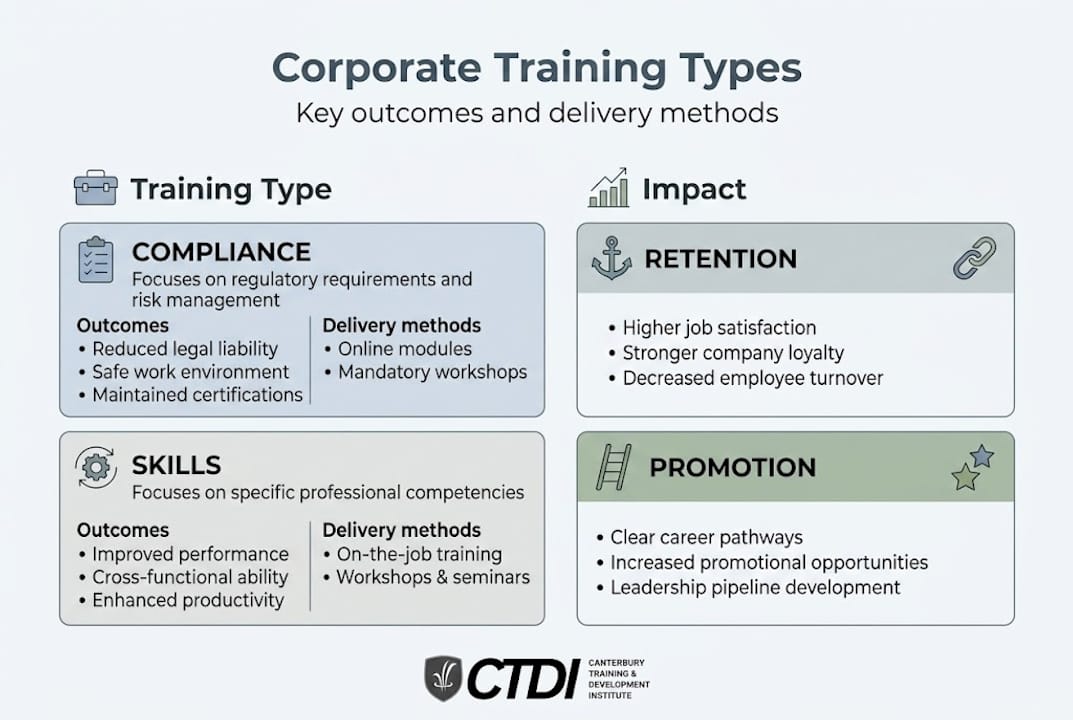
Mentoring and coaching deserve special attention because they are often underutilised despite being highly cost-effective. Pairing a junior employee with a senior colleague who has relevant experience accelerates skill development in ways that formal courses simply cannot replicate. It also builds internal networks, improves cross-team communication, and gives senior employees a sense of purpose and legacy.
Organisations that want to see how corporate sector training partners structure their learning frameworks can gain useful insights into how blended approaches are being applied across industries. The pattern is consistent: the most effective programmes combine structured formal learning with informal, relationship-based development.
Pro Tip: Combining formal qualifications, such as online diploma enrolments in nationally recognised courses, with internal mentoring programmes delivers the highest levels of employee engagement and skill retention. Formal learning provides the framework; mentoring makes it stick.
Making training effective: What works in Australian corporates
Now that you know what training exists, here's how to make it truly impactful for your teams.
Knowing the categories of training is one thing. Making training genuinely effective is another challenge entirely. The difference between a programme that changes behaviour and one that employees forget by Friday comes down to design, relevance, and follow-through.
Here is a practical framework for building training that actually works:
- Conduct a skills audit before you design anything. Map current capabilities against future business requirements. This tells you where the gaps are and prevents you from investing in training that employees do not actually need.
- Build individual professional development plans. Work with line managers and employees to create personalised learning pathways. When training feels relevant to an individual's career goals, engagement increases significantly.
- Use mentoring and coaching as the connective tissue. Mentoring, coaching, and shadowing are effective, affordable, and can increase job satisfaction and lower turnover. They also transfer tacit knowledge that formal programmes often miss.
- Measure what matters. Track participation rates, satisfaction scores, post-training performance assessments, and longer-term business metrics like retention and promotion rates. Without measurement, you cannot demonstrate value or improve over time.
- Integrate learning into daily work. Training that happens only in dedicated sessions is easy to deprioritise. Embedding micro-learning, peer discussions, and on-the-job practice into regular workflows makes learning a habit rather than an event.
- Review and iterate. Use feedback from participants and managers to refine programmes continuously. What worked for last year's cohort may not suit a team with different experience levels or role requirements.
The investment case is well supported. Employers sponsored 86% of work-related training in Australia since 2020, which signals that organisations recognise the value even when the economic environment is challenging. The question is not whether to invest, but how to invest wisely.
"The most effective training programmes are not the most expensive ones. They are the ones designed with the clearest understanding of what the business needs and what the employee wants to achieve."
Understanding training and salary outcomes can also help you make the case internally for investing in specific programmes. When employees can see that completing a qualification leads to a measurable income increase, motivation to engage with training rises sharply.
For organisations operating in sectors where regulatory and environmental requirements are evolving rapidly, programmes like a sustainable management course can address both compliance needs and strategic capability building simultaneously. This dual-purpose approach is exactly the kind of efficient investment that training managers should be looking for.
Pro Tip: Securing visible leadership buy-in is the single most effective thing you can do to improve training participation rates. When senior leaders talk about their own learning experiences and actively encourage team members to complete programmes, participation increases and the stigma around "taking time for training" disappears.
Overcoming challenges: Barriers and solutions in corporate training
Implementing training isn't always smooth. Here's how organisations are meeting the most common challenges.
Even the best-designed training programme will struggle if it runs into organisational barriers. Understanding what those barriers are, and having evidence-based strategies to address them, is a core competency for any training manager.
The most common barriers in Australian corporate settings include:
- Cost and budget constraints: Training budgets are often the first to be cut during financial pressure. The solution is to build a clear ROI case before the pressure arrives, not after.
- Time away from work: Employees and managers resist training that pulls people off the floor or out of client-facing roles. Hybrid and online options reduce this friction significantly.
- Low engagement and buy-in: If employees do not see the relevance of training to their own goals, they will go through the motions without genuine learning. Personalised pathways and clear career links solve this.
- Rapid digital change: Technology is evolving faster than many training programmes can keep up. Modular, updatable learning content is more sustainable than large, static courses.
- Diverse workforce needs: A multigenerational workforce with varying levels of digital literacy and different learning preferences requires flexible delivery options, not a one-size-fits-all approach.
Employers in Australia fully sponsor the majority of work-related training to address participation barriers, which removes the financial obstacle for most employees. But sponsorship alone does not guarantee engagement. The design and delivery of training must also remove the time and relevance barriers.
"Removing the cost barrier is necessary but not sufficient. Employees also need to believe that the training will genuinely help them do their job better or advance their career. That belief comes from relevance, not from obligation."
Creative strategies that are working well in Australian organisations right now include:
- Peer learning circles: Small groups of employees who meet regularly to share knowledge, discuss challenges, and hold each other accountable for applying new skills.
- Micro-learning modules: Short, focused learning units of five to fifteen minutes that can be completed between tasks or during commutes. These are particularly effective for compliance updates and technical refreshers.
- Linking training to performance appraisal: When completing specific learning objectives is part of an employee's performance review, the conversation about training shifts from optional to expected.
- Recognition and celebration: Publicly acknowledging employees who complete qualifications or reach learning milestones creates positive social proof and encourages others to participate.
For organisations navigating the intersection of regulatory change and workforce capability, programmes in areas like environmental sustainability training offer a practical way to address both compliance requirements and genuine skills development in one structured pathway.
Mapping training success: Measuring impact and driving continuous growth
For training to drive results long-term, monitoring and refinement are essential. Here's how to get it right.
Measurement is where many corporate training programmes fall short. It is not enough to track how many employees completed a course. You need to understand whether the training changed behaviour, improved performance, and contributed to business outcomes. Australian organisations report clear links between training, higher productivity, retention, and business success, but capturing those links in your own organisation requires a deliberate measurement strategy.
Here is a practical measurement framework:
- Participation and completion rates: The baseline. Are employees actually engaging with the programme?
- Satisfaction and relevance scores: Post-training surveys that assess whether employees found the content useful and applicable to their roles.
- Post-training performance assessments: Structured evaluations that test whether employees can apply what they learned in real work scenarios.
- Retention statistics: Track whether trained employees stay longer than untrained counterparts over a 12 to 24 month period.
- Promotion and progression rates: Are employees who complete development programmes advancing into more senior roles at higher rates?
The table below shows how these metrics connect to business outcomes:
| Metric | What it measures | Business outcome |
|---|---|---|
| Completion rate | Engagement with training | Programme reach and accessibility |
| Satisfaction score | Perceived relevance and quality | Likelihood of behaviour change |
| Performance assessment | Skill application post-training | Direct productivity impact |
| Retention rate | Long-term loyalty of trained staff | Reduced recruitment costs |
| Promotion rate | Career advancement of trained employees | Succession pipeline strength |
Data-driven feedback systems close the loop between training design and business impact. When you can show that employees who completed a specific programme were promoted at twice the rate of those who did not, you have a compelling case for continued investment. Understanding the ROI of upskilling in concrete terms transforms the training conversation from a cost discussion to a strategic investment discussion.
The cultural dimension matters just as much as the data. Leaders who champion ongoing learning, who talk openly about their own development, and who allocate protected time for training, create environments where continuous growth becomes the norm rather than the exception.
Why traditional approaches to training hold businesses back
Here is an uncomfortable truth that most training conversations avoid: the biggest risk in corporate L&D is not investing too little. It is investing in the wrong model entirely.
The traditional approach treats training as an event. You send employees to a workshop, they sit through a day of content, they receive a certificate, and then they return to their desks and carry on exactly as before. This model feels productive because it generates activity. But activity is not the same as capability change.
Organisations that genuinely outperform their peers on talent retention and workforce agility treat learning as a continuous process embedded in the daily rhythm of work. They do not wait for a skills gap to become a crisis before they respond. They build partnership approaches with training providers, industry bodies, and internal champions who keep capability development moving forward consistently.
The most progressive HR and training leaders we see in Australian corporates are challenging a deeply held assumption: that training is something you do to employees rather than something you build with them. When employees co-design their learning pathways, choose from a menu of relevant options, and receive coaching to apply new skills in real time, the outcomes are categorically different from what a mandated annual training day produces.
The shift from event-based training to a genuine learning culture is not easy. It requires leadership commitment, adequate resourcing, and a willingness to measure outcomes honestly rather than just counting completions. But the organisations that make this shift do not just improve their training metrics. They build the kind of adaptive, engaged workforce that can respond to market changes, technological disruption, and competitive pressure with confidence.
Discover your next steps with expert-supported corporate training
Ready to put effective training into action?
At CTDI, we work with organisations across Australia to build training strategies that go well beyond compliance. Whether you are looking to upskill entire teams, create structured career pathways, or access nationally recognised qualifications that align with your business goals, we have the expertise and the programmes to support you.
Our corporate training solutions are designed for organisations that want measurable outcomes, not just completed modules. We partner with training managers and HR teams to tailor learning pathways that connect directly to workforce capability gaps and business strategy. From digital skills and AI to environmental management, our courses are delivered 100% online, making it easy for your teams to learn without disrupting operations. Explore our full range of programmes and enrol in online diplomas that your employees can complete at their own pace, with expert support at every step.
Frequently asked questions
What are the main benefits of training for Australian corporates?
Training increases staff retention, job satisfaction, and productivity, while helping organisations attract and keep skilled employees in a competitive labour market.
How much do Australian employers invest in training?
Employers sponsor 86% of work-related training in Australia since 2020, making employer-funded learning the dominant model for workforce development.
Which types of training deliver the best results for employees?
A mix of formal learning and informal mentoring, coaching, and shadowing leads to the highest levels of satisfaction and retention compared to formal-only approaches.
What is the impact of work-related training on income and job changes?
Australian employees with recent training earn over $2,400 more annually and are 40% less likely to change employers, making training one of the most effective retention tools available.
How can organisations measure the impact of corporate training?
Track job performance, retention rates, satisfaction scores, and promotion rates over time to build a clear picture of how training is contributing to business outcomes.
Recommended
- Certificate IV Environmental Sustainability Australia | Green Career Online | CTDI — Canterbury Training and Development Institute
- How Learning AI Could Earn Australians $11,000 More Per Year | CTDI — Canterbury Training and Development Institute
- Why Environmental Scientist Is One of the Fastest-Growing Careers in Australia | CTDI — Canterbury Training and Development Institute
- Corporate Training Partnerships Australia | Upskill Your Team | CTDI — Canterbury Training and Development Institute