

TL;DR:
- Vocational courses have higher employment rates and are designed around industry needs.
- Online formats provide flexible, internationally recognized qualifications suitable for various students.
- Continuous upskilling is essential for maintaining long-term career advantages.
Many students assume that choosing a vocational path locks them into a narrow lane, trading breadth for a pay cheque. That assumption is costing people real opportunities. A meta-analysis of vocational outcomes found that accredited career-focused courses produce employment rates 4.8 percentage points higher than general education and a striking 11.7 percentage points higher than no post-secondary education at all. This guide cuts through the confusion, examines the genuine advantages and honest drawbacks, and gives you a clear framework for deciding whether a career-focused qualification is the right move for your situation.
Table of Contents
- Career-focused courses explained: What sets them apart?
- Why career-focused courses lead to higher employability
- Flexible online formats and global recognition
- Potential drawbacks and expert nuances
- Why the conventional wisdom about career-focused study needs a rethink
- Explore accredited, flexible career courses at CTDI
- Frequently asked questions
Key Takeaways
| Point | Details |
|---|---|
| Higher employability | Career-focused courses increase your chances of landing a job compared to general education. |
| Flexible and accessible | Online formats allow both working adults and international students to study without geographic barriers. |
| Globally recognised credentials | Australian vocational qualifications can support migration and PR opportunities internationally. |
| Balanced pathways | Choosing vocational courses later and combining ongoing learning helps with long-term career adaptability. |
Career-focused courses explained: What sets them apart?
The difference between vocational education and general education is not about quality. It is about purpose. General education, such as a Bachelor of Arts or a broad science degree, equips students with theoretical foundations across multiple disciplines. Career-focused courses, by contrast, are built around specific occupational outcomes. Every unit, every assessment, and every skill module ties directly back to what employers in a target industry actually need.
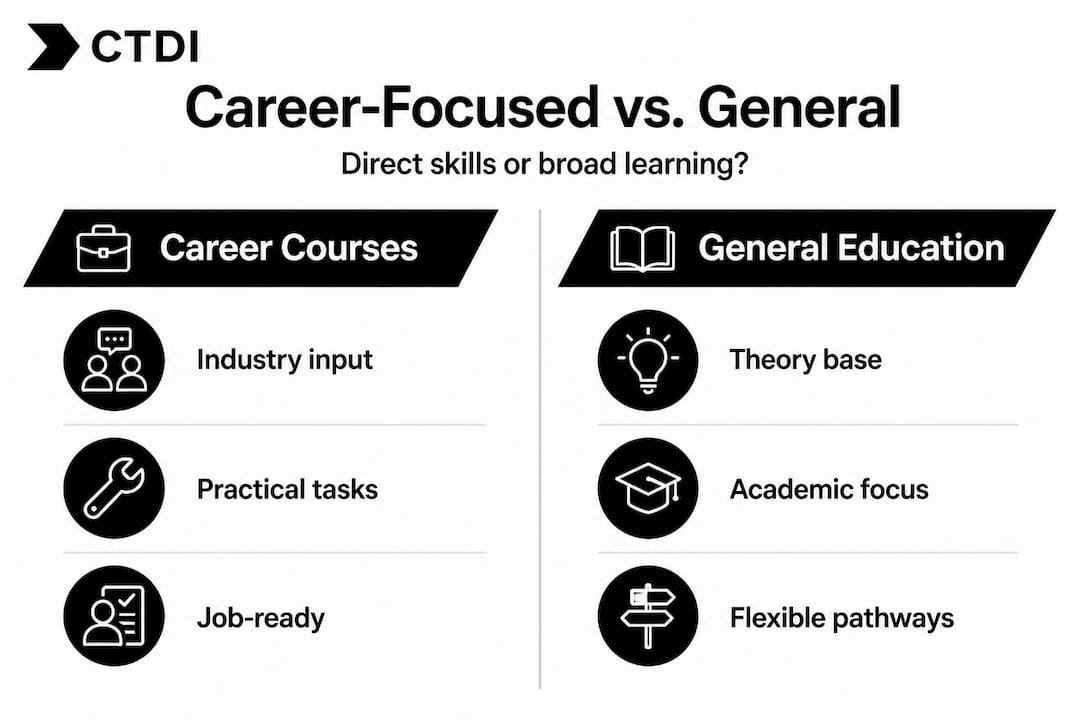
In Australia, these qualifications sit within the nationally recognised framework of Vocational Education and Training (VET). Courses range from Certificate II through to Advanced Diploma level, covering industries as varied as environmental management, digital marketing, artificial intelligence, community services, and business administration. The design process itself is distinctive: industry bodies and employers help shape course content, which means graduates are trained to the current standard the workforce expects, not a standard set five years ago by academics who may have left industry long ago.
Who benefits most from this pathway? The answer is broader than people think.
Career changers who want to pivot without spending three or four years in a full-time university programme find vocational courses the most direct route. A marketing professional moving into AI operations, for example, can complete a focused qualification in months rather than years.
School leavers who know their preferred field and want to start earning sooner than a university degree allows are excellent candidates. Rather than spending two years on electives unrelated to their goals, they move straight into role-relevant learning.
Working adults who need to upskill while keeping their current job are perhaps the largest group. Flexible online formats suit working adults, domestic and international students balancing jobs or visa conditions, because the study happens around your life rather than demanding you reshape your life around study.
International students who want an Australian qualification that is portable across borders and supports migration pathways find particular value in accredited vocational programmes, something explored in more depth in the sections below.
| Feature | Career-focused (VET) | General education (university) |
|---|---|---|
| Primary goal | Specific occupational outcomes | Broad academic foundations |
| Duration | 6 months to 2 years | 3 to 4 years typical |
| Delivery | Online, self-paced, workplace-based | Lectures, tutorials, on-campus |
| Industry input | High, employers co-design content | Moderate, academic-led |
| Entry requirements | Generally lower | HSC/Year 12, ATAR often required |
| Cost | Usually lower | Can be significantly higher |
| Employment focus | Immediate job-readiness | Graduate-level positions over time |
Key advantages at a glance:
- Shorter time to qualification and employment
- Practical assessments that mirror real workplace tasks
- Lower upfront financial commitment compared to university degrees
- Recognised nationally across all Australian states and territories
- Pathway options through academic articulation partnerships that allow credit into university programmes if you later decide to pursue higher education
If you are ready to start, exploring online diplomas enrolment is a natural first step to understanding what is currently available and which programmes align with your goals.
Why career-focused courses lead to higher employability
Numbers matter when you are making a significant life decision. The research on vocational education outcomes is more compelling than most people realise, and yet it is underreported in mainstream career advice.
The same meta-analysis cited above draws on a large body of international data and consistently shows that accredited vocational completers outperform both general education graduates and those without post-secondary qualifications in employment rate terms immediately after graduation. The 4.8 percentage point advantage over general education graduates may sound modest in isolation, but when you translate that into actual job-seeking timelines, it represents months less of unemployment and a faster return on your educational investment.
Why does this happen? Three mechanisms explain the gap.
First, industry alignment. Vocational courses are not designed in isolation. Employers sit on advisory panels that inform curriculum. This means the skills you practise in assessments are the skills hiring managers are already looking for. There is no translation layer between what you learned and what the job requires.
Second, demonstrable practical output. Many vocational students produce real work during their studies: marketing campaigns, data analysis reports, sustainability audits, project plans. This gives graduates a portfolio that general education students often lack at the point of graduation. Employers can see evidence of capability rather than taking it on faith.
Third, credentialling in high-demand niches. Certain industries have specific skill shortages, and a targeted qualification signals exactly the competency employers need. An environmental sustainability qualification, for instance, positions graduates for roles in corporate reporting, environmental compliance, and green infrastructure projects that are growing rapidly as organisations respond to regulatory and investor pressure.
| Qualification type | Employment rate advantage |
|---|---|
| Accredited vocational vs no post-secondary | +11.7 percentage points |
| Accredited vocational vs general education | +4.8 percentage points |
| Vocational with ongoing upskilling | Sustained long-term advantage |
"The practical skills and direct industry relevance of vocational courses create a job-readiness signal that employers respond to immediately. It removes the guesswork from hiring."
Here is a practical scenario. Consider two candidates applying for a digital marketing coordinator role. Candidate A has a general communications degree. Candidate B has an advanced diploma in digital marketing with assessments built around live campaign analytics, SEO audits, and social media strategy. Both are capable. But Candidate B can demonstrate specific outputs on day one. In a competitive market, that difference is decisive.
Interestingly, AI skills and pay rises are now part of this conversation too. Vocational qualifications that integrate artificial intelligence tools into practical workplace contexts are actively commanding salary premiums as employers struggle to find staff who can use these tools productively.
How to maximise your employability outcomes through vocational study:
- Research the job market before you enrol. Look at actual job postings in your preferred field and identify the specific tools, software, certifications, and skills that appear repeatedly. Choose a course that directly addresses that list.
- Prioritise assessments that produce real outputs. Avoid courses where all assessments are theoretical. The goal is a portfolio, not just a certificate.
- Connect with industry during your studies. Many online vocational programmes include industry engagement components. Take these seriously.
- Stack qualifications strategically. A Certificate IV can be followed by a Diploma or Advanced Diploma, building depth and signalling commitment to a field.
- Stay current with continuing education. A qualification is a starting point, not an endpoint. The most employable graduates continue to develop their skills after completing their initial course.
Pro Tip: Before enrolling, ask the training provider for graduate employment statistics or industry partnerships. Reputable institutions can point to concrete outcomes for their alumni, not just general marketing claims.
Flexible online formats and global recognition
Access matters. The most valuable qualification in the world is useless if the format makes it impossible for you to complete it. This is where modern vocational education, particularly online delivery, has changed the landscape for students across the board.
Online vocational courses eliminate the geographic constraint entirely. Whether you are in regional Queensland, metropolitan Melbourne, or studying from overseas before migrating to Australia, the course content and assessment process are identical. You access learning materials through a student portal, complete assessments on your schedule, and communicate with trainers digitally. The self-paced model means you can accelerate when you have more time available and ease off during busy periods at work or home.

For working adults, this is genuinely transformative. Traditional study requires you to restructure your week around lectures and tutorials. Online vocational study restructures around you. A nurse completing a leadership qualification, a warehouse supervisor working toward a business administration diploma, a retail manager upskilling in digital marketing — these are real student profiles who can complete meaningful qualifications without sacrificing current income or stability.
For international students, the advantages extend further. Vocational courses in Australia aid permanent residency pathways, carry global recognition, and build practical skills that translate directly to employment outcomes in Australia or in a home country. Australian VET qualifications are internationally respected because the Australian Qualifications Framework (AQF) is a rigorous national standard that aligns with international frameworks. Employers in the United Kingdom, Canada, New Zealand, and across Southeast Asia recognise Australian vocational credentials.
Furthermore, online flexibility removes geographic barriers and supports non-traditional students who might otherwise be excluded from formal education. Single parents, people with disabilities, fly-in-fly-out workers, and those in remote communities all benefit from delivery models that do not require physical attendance.
Additional benefits of online vocational study:
- Lower cost of living: No relocation required, no campus fees, and no commuting costs add up to significant savings over the life of a qualification.
- Immediate application: Skills learned on Monday can be applied in your workplace on Tuesday. This feedback loop accelerates competency development in a way that classroom-only study cannot replicate.
- Digital literacy as a side benefit: Navigating an online learning environment builds confidence with digital tools that are increasingly required in all modern workplaces.
- Personalised pace: High performers can complete qualifications faster than the nominal duration. Students who need more time can take it without falling behind a cohort.
- Access to recorded content: Unlike live lectures, online course materials are available at any hour, which suits students across different time zones and shift workers with irregular schedules.
Pro Tip: When choosing an online provider, check whether the student portal resources include trainer support, peer forums, and progress tracking. Strong support infrastructure is the difference between completing your qualification and drifting away from it.
Potential drawbacks and expert nuances
Honesty is more useful than enthusiasm. Career-focused courses carry real advantages, but they also come with genuine limitations that are worth understanding before you commit.
Skill obsolescence is the most significant long-term risk. The same research on vocational employment outcomes notes that while short-term employment gains are strong, these advantages can fade over time as industries evolve and the specific technical skills taught in a course become outdated. A graduate who completes a qualification and then stops developing professionally may find their competitive advantage eroding within five to ten years. General education graduates, by contrast, often develop broader analytical and adaptive capabilities that allow them to pivot more fluidly as industries change.
This is not an argument against vocational study. It is an argument for continuous learning. The solution is straightforward: treat your vocational qualification as the first stage of ongoing professional development, not the final destination.
Early specialisation carries its own risks. Research published in the Journal of Human Resources finds that early vocational specialisation at age 14 may harm academic outcomes and limit future flexibility, whereas choosing a vocational path at age 16 or later, when interests are clearer and more stable, tends to produce significantly better results. This finding has direct implications for how we think about advising young people on educational pathways.
For adults already in the workforce, this concern largely does not apply. If you are 25 or older and clear about your career direction, the risk of premature specialisation is minimal. The relevant question is whether the field you are specialising in has a credible medium-term future.
Misalignment with personal interests is a hidden failure mode. Many students enrol in courses based on job market demand rather than genuine interest. The result is often poor completion rates and weak performance. A qualification in a field you find genuinely engaging will always outperform a qualification in a field you chose purely for income, because engagement drives the depth of learning that makes you genuinely good at the work.
Key limitations to weigh before enrolling:
- Career-specific qualifications may not be directly transferable if you change industries entirely
- Some professions require university-level credentials regardless of vocational experience
- Employer recognition varies, with some traditional industries still valuing degrees over diplomas
- Rapid technological change can make specific technical skills obsolete faster in some fields than others
- Without a commitment to ongoing development, the initial employment advantage diminishes over time
"Vocational qualifications deliver strong early-career outcomes, but the graduates who sustain those advantages are the ones who continue to invest in their skills long after graduation."
The smart strategy is to pair a career-focused qualification with a plan for ongoing development. If your initial course is in environmental management, a subsequent green career certificate or specialist short course keeps your skills current and your profile competitive as the sector evolves. The goal is not a single qualification. It is a trajectory.
Why the conventional wisdom about career-focused study needs a rethink
There is a persistent cultural assumption in Australia, and across many developed nations, that university equals prestige and vocational equals settling. This assumption is not only outdated. It is actively harmful.
We have watched this narrative play out in ways that genuinely frustrate us. Talented, capable students talk themselves out of vocational study because a well-meaning parent or teacher frames it as a lesser option. They spend four years completing a degree that does not connect to any clear career outcome, accumulate significant debt or HELP repayment obligations, and then struggle to articulate their value to employers who expected job-ready candidates.
Meanwhile, a student who completed an Advanced Diploma in Digital Marketing or a Diploma of AI is already building a professional track record, earning an income, and developing the practical judgement that comes only from doing real work.
The deeper point is this: the students who do best in career-focused programmes are not the ones who chose vocational study because they had no other options. They are the ones who chose it deliberately, because they understood that practical credentialling in a high-demand field is a strategic advantage, not a compromise.
That said, we also want to be clear that adaptability is the real long-term asset. A vocational qualification gets you into the room. What keeps you in the room, and eventually at the head of the table, is a genuine commitment to continuing to learn, to observing how your industry is changing, and to proactively adding to your skill set rather than relying on a single credential indefinitely.
The students we see succeed consistently share a common pattern. They enrol with a specific outcome in mind. They engage seriously with the practical components of their course. And they treat graduation not as the end of the journey but as the point where the real professional development begins. If you are ready to make that kind of deliberate choice, exploring enrolment insights is a meaningful first step toward understanding what is possible.
The conventional wisdom says vocational is a backup plan. Our experience says it is one of the most powerful first moves you can make, provided you make it with clear eyes and a commitment to what comes after.
Explore accredited, flexible career courses at CTDI
Understanding the landscape is the first step. Taking action on it is where real career momentum begins. At Canterbury Training and Development Institute (CTDI), our nationally accredited courses are built to do exactly what this guide describes: equip you with practical, industry-relevant skills in a flexible online format that fits around your actual life.
Whether you are a domestic student looking to change careers, an international student pursuing an Australian qualification that supports your migration goals, or a working professional who needs to upskill without stepping away from your current role, CTDI has a pathway designed for your situation. You can enrol in career-focused online courses across fields including sustainability, AI, and digital marketing, all delivered by industry practitioners who bring current, real-world knowledge into every unit. Explore qualifications like the advanced digital marketing diploma or an AI qualification online to see what aligns with your goals and next career move.
Frequently asked questions
Are career-focused courses recognised internationally for migration or PR?
Yes, many accredited vocational courses in Australia are globally recognised and can actively support visa and permanent residency pathways, with Australian VET qualifications aiding PR applications and providing practical skills valued by employers internationally.
How flexible are online career-focused courses for working adults?
Online vocational courses are specifically designed to suit working adults, with self-paced delivery that accommodates jobs, family commitments, and visa conditions. Flexible online formats mean you study on your schedule, not a fixed timetable set by an institution.
Does early specialisation in vocational fields affect my future study options?
Specialising too early, particularly around age 14, may limit academic outcomes and future flexibility according to recent research, but specialising at 16 or older when your interests are established tends to produce significantly better educational and employment results.
Do vocational courses guarantee long-term job security?
Short-term employment outcomes are strong, but long-term security depends on continuous skill development. Research shows employment gains can fade over time if graduates do not invest in further learning as their industry evolves, making ongoing professional development essential beyond any initial qualification.
Recommended
- CTDI - Canterbury Training & Development Institute | Online Qualifications
- Enrol Now — Online Diplomas in AI, Marketing & Sustainability | CTDI — Canterbury Training and Development Institute
- Certificate IV Environmental Sustainability Australia | Green Career Online | CTDI — Canterbury Training and Development Institute
- How Learning AI Could Earn Australians $11,000 More Per Year | CTDI — Canterbury Training and Development Institute