

TL;DR:
- Certification objectively verifies current skills using recognized standards, boosting career prospects.
- Most employers now prioritize and require certifications, which significantly enhance salary and job security.
Certification is the objective, third-party validation of professional skills and knowledge that employers, regulators, and industry bodies use as a trusted benchmark for competence. It is distinct from a degree in one critical way: it proves applied, current mastery within a recognised standard, not just academic exposure to a subject. Why certification matters has become one of the most searched questions among professionals navigating competitive job markets, remote hiring, and rapid technological change. The data backs the urgency. 92% of organisations now require or prioritise professional certification as part of their workforce strategy in 2026.
How does certification deliver career advantages for professionals?
Certification opens doors that qualifications alone cannot. Employers use certifications as objective filters during hiring, particularly when reviewing large or geographically diverse applicant pools. A certified candidate signals job readiness from day one, which reduces onboarding risk and shortens time to productivity.

The salary impact is concrete. Top-tier certifications can increase annual salaries by 15%–40% in high-demand fields. An AWS Solutions Architect certification, for example, may add more than $20,000 to annual salary. That figure represents a return on investment most short courses and workshops cannot match.
The benefits of professional certification extend well beyond the initial hire. Certified professionals in fields like IT, healthcare, and project management report stronger career mobility and greater job security over time. A project manager holding a recognised credential such as PMP, or a nurse with a specialist clinical certification, carries proof of structured, verifiable competence that generalist experience cannot replicate. Certification also creates a framework for ongoing professional development, since many programmes require renewal and continuing education to maintain standing.
Certification value for career growth compounds when professionals stack complementary credentials. A digital marketer who holds certifications in both data analytics and content strategy, for instance, becomes a far more attractive candidate than one with a single credential. The combination signals breadth and depth simultaneously.
- Research employer demand before committing. Check how frequently a certification appears in job postings for your target role.
- Compare salary data before and after certification in your field to estimate realistic returns.
- Look for certifications tied to recognised industry bodies or regulatory frameworks, not just private training providers.
- Stack credentials deliberately. Choose certifications that complement each other rather than overlap.
- Factor in renewal requirements. A certification that lapses signals neglect, not growth.
Pro Tip: Before enrolling in any certification programme, search your target job title on major job boards and count how often the credential appears in listings. If it shows up in fewer than 30% of relevant postings, the market signal is weak.
Why do organisations value certification as a strategic workforce tool?
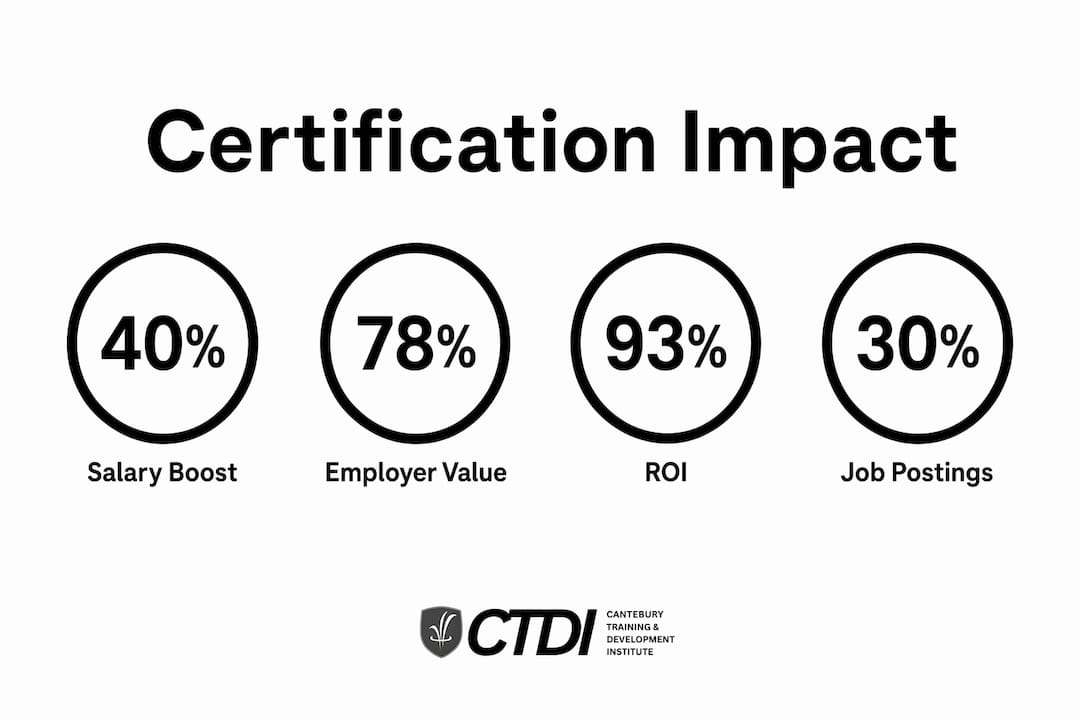
Organisations treat certification as a workforce investment, not a perk. 78% of employers identify professional certification as their leading strategy for upskilling staff in 2026. That figure reflects a fundamental shift in how businesses close skills gaps, particularly in technology, sustainability, and compliance-heavy industries.
The business case is reinforced by risk. 60% of organisations with IT skills gaps reported significant negative business impact the previous year. Certification reduces that exposure by ensuring staff operate to a defined, verifiable standard. It also reduces the cost of supervision, since certified employees require less oversight to perform complex tasks correctly.
Organisational certifications like ISO standards serve a different but equally powerful function. ISO certification functions as independent assurance that signals operational consistency and risk management, and it reduces buyer oversight costs. Supplier approval timelines drop by approximately 40% when ISO certification is in place. That acceleration translates directly into faster contracts, lower procurement friction, and stronger commercial relationships.
Certification has evolved from a compliance requirement into a commercial trust signal that enhances market positioning. ISO certification now functions as a commercial shorthand for organisational credibility. Buyers, partners, and regulators all use it as a proxy for due diligence.
The organisational advantages of certification programmes fall into four clear categories:
- Talent attraction. Certified training pathways attract professionals who prioritise growth, signalling that the organisation invests in its people.
- Employee retention. Staff who receive employer-supported certification are more likely to stay, since the investment creates mutual commitment.
- Operational efficiency. Certified teams work to consistent standards, which reduces errors, rework, and compliance failures.
- Market credibility. Organisational certifications like ISO reduce supplier risk, speed approvals, and build trust with customers and partners.
Pro Tip: Organisations get the most from certification when it sits inside a broader workforce strategy. Pair certification with mentoring, internal mobility pathways, and performance frameworks to convert credentials into lasting capability.
Explore workplace upskilling examples that show how leading organisations embed certification into their talent development plans.
How does certification compare with formal degrees?
Degrees and certifications serve different purposes, and the most competitive professionals understand how to use both. A degree covers broad academic knowledge across a discipline. A certification demonstrates applied, current competence in a specific skill or domain. Neither replaces the other, but they are not equal in every hiring context.
Employers increasingly require certifications as objective proof of competence, particularly in remote hiring environments where face-to-face assessment is not possible. A degree from a reputable university carries prestige, but it does not tell a hiring manager whether a candidate can configure a cloud environment, run a compliance audit, or execute a digital marketing campaign today. A certification does.
The table below shows how the two credentials differ across key dimensions relevant to hiring and career development.
| Dimension | Formal degree | Professional certification |
|---|---|---|
| Knowledge type | Broad, theoretical | Applied, domain-specific |
| Currency | Fixed at graduation | Maintained through renewal |
| Time to obtain | 3–4 years typically | Weeks to months |
| Employer signal | Academic foundation | Job-ready competence |
| Cost | High | Low to moderate |
| Verifiability | Transcript required | Digital badge or registry |
Holding both a degree and relevant certifications produces the strongest professional profile. The degree provides credibility and foundational knowledge. The certification proves the candidate has kept pace with current tools, standards, and practices. In rapidly evolving fields like artificial intelligence, cybersecurity, and environmental management, a degree that is five years old without supporting certifications can actually work against a candidate. Certified professionals stand out in geographically diverse applicant pools precisely because their credentials are standardised and independently verified.
The significance of obtaining certification grows further when professionals operate across borders or industries. A certification issued by a recognised body carries the same meaning in Sydney as it does in Singapore or London. A degree from a regional university may not.
What practical steps should you take when choosing a certification?
Choosing the right certification requires research, not guesswork. The market value of a certification is driven primarily by employer demand metrics rather than training quality alone. A credential that appears in at least 30% of job postings for your target role reliably signals market value. Below that threshold, the return on investment becomes uncertain.
Calculating certification ROI means comparing salary premiums against total investment, including time, fees, and the opportunity cost of study. A certification that costs $1,500 and adds $8,000 to annual salary pays for itself within three months. One that costs the same but produces no measurable salary lift or hiring advantage is a poor investment regardless of the course quality.
- Research before you commit. Check job boards, LinkedIn, and industry salary surveys to confirm employer demand for the credential you are considering.
- Prioritise recognised bodies. Certifications tied to established industry bodies, regulatory frameworks, or accredited training organisations carry more weight than those from unknown providers.
- Present certifications clearly on your resume. Include the certification name, issuing body, date obtained, and renewal date if applicable. Hiring managers scan for these details quickly.
- Maintain currency through renewal. Continuous certification renewal demonstrates commitment to current skills and ongoing professional growth. Many programmes require periodic renewal to maintain employer trust.
- Stack complementary certifications. A cybersecurity professional who adds a governance or risk management credential compounds their value. Each additional credential should open a new door, not repeat an existing one.
The role of industry accreditation in career growth is well documented. Accredited credentials from nationally recognised bodies carry the most weight with Australian employers and provide the clearest pathway to salary advancement. For professionals considering certifications in emerging fields, resources covering upskilling tips for 2026 offer practical frameworks for prioritising credentials that align with current market demand.
Pro Tip: Do not chase certifications for status. Choose credentials that solve a specific problem for your next employer or client. The question to ask is: "Does this certification make me easier to hire or promote?" If the answer is not clearly yes, keep researching.
Key takeaways
Professional certification is the most direct, verifiable signal of applied competence that employers, clients, and regulators use to assess job readiness and organisational credibility in 2026.
| Point | Details |
|---|---|
| Employer demand is high | 92% of organisations require or prioritise certification as part of their workforce strategy. |
| Salary impact is real | Top certifications increase annual salaries by 15%–40% in high-demand fields. |
| Organisations use certification strategically | 78% of employers identify certification as their leading upskilling strategy in 2026. |
| Degrees and certifications complement each other | Degrees signal academic foundation; certifications prove current, applied competence. |
| Choose certifications by market demand | Prioritise credentials that appear in at least 30% of job postings for your target role. |
Why I think most professionals underestimate certification
Most professionals treat certification as a box to tick before a job application. That framing misses the point entirely. The real value of a certification is not the credential itself. It is the structured learning, the updated mental model, and the community of practitioners you gain access to in the process.
I have watched professionals with impressive degrees get passed over for roles because they could not demonstrate current, applied knowledge. The hiring manager did not doubt their intelligence. They doubted their readiness. A relevant certification resolves that doubt in seconds. It tells the room that you have done the work recently, under a recognised standard, and that someone independent has verified it.
The professionals who benefit most from certification are not the ones who collect credentials. They are the ones who choose deliberately, renew consistently, and use the learning process to stay connected to where their industry is heading. Cybersecurity is a clear example. Cybersecurity certifications have become strategic controls for organisational governance and risk mitigation. That is not marketing language. That is the reality of how boards and CISOs now think about workforce credentialling.
My honest view is that the professionals who treat certification as a career-long practice, rather than a one-time event, are the ones who remain relevant through every technology shift and economic cycle. The credential expires. The habit of learning does not.
— Sam
Nationally recognised diplomas that build real credentials
Professionals who understand the importance of certification need a training provider that delivers credentials employers actually recognise. Edu, the Canterbury Training and Development Institute, offers nationally recognised diploma programmes in artificial intelligence, digital marketing, and environmental management, all delivered 100% online and designed by industry experts.

Courses are self-paced, which means you study around your existing work commitments without sacrificing depth or quality. Each programme is built to align with current employer demand, so the credential you earn carries genuine weight in the Australian job market. Whether you are building your first professional credential or adding a specialist qualification to an existing degree, Edu provides the accredited pathway to get there. Enrol now and take the next step toward a credential that opens doors.
FAQ
Why does certification matter more than experience alone?
Certification provides independently verified proof of competence that experience cannot replicate on its own. Employers use certifications as objective filters, particularly in remote hiring where direct assessment is not possible.
Do employers actually value professional certification?
93% of employers report a positive return on investment from hiring certified IT employees. Certification is now a standard requirement across technology, healthcare, project management, and environmental fields.
How do I choose the right certification for my career?
Prioritise certifications that appear in at least 30% of job postings for your target role, as this threshold reliably signals market value. Research salary premiums and total investment costs before committing.
How often should I renew my certifications?
Renewal frequency depends on the issuing body, but most recognised programmes require renewal every two to three years. Keeping certifications current signals ongoing professional growth and maintains employer trust.
Is a certification more valuable than a degree?
Certifications and degrees serve different purposes and work best together. A degree provides academic foundation, while a certification proves current, applied competence in a specific domain relevant to today's job market.