

TL;DR:
- Professional development offers a 4.53x return on investment and significantly boosts income and career growth.
- Effective PD involves deliberate, ongoing, and practical learning tailored to individual career goals and industry demands.
- Accredited online vocational courses are highly recommended for their recognition, flexibility, and industry relevance.
Most professionals dramatically underestimate what targeted upskilling actually does to their earnings and career trajectory. Learning and development investments yield a 4.53x ROI, 24% higher profit margins, and 218% higher income per employee, yet many people still treat professional development as an optional extra they'll get around to someday. That "someday" mindset is quietly costing careers. This article breaks down exactly what professional development is, why the evidence for it is so striking, how to pick the right approach, what traps to sidestep, and what actionable steps you can take this week to start seeing real results. Whether you're a working professional chasing a promotion or a student building your first career, this guide gives you the full picture.
Table of Contents
- What is professional development and why does it matter?
- The real-world impact: from skills to salaries and satisfaction
- How to choose the right professional development approach
- Pitfalls and how to ensure lasting professional development success
- A fresh perspective: what most professional development guides won't tell you
- Take the next step with recognised professional development
- Frequently asked questions
Key Takeaways
| Point | Details |
|---|---|
| Career and income boost | Investing in professional development leads to higher income, job satisfaction, and faster career advancement. |
| Choose wisely | Accredited, flexible online courses are most effective for acquiring relevant industry skills. |
| Personalisation matters | Tailoring your development plan and applying what you learn maximises long-term success. |
| Avoid one-size-fits-all | Generic training offers less impact—seek programs aligned to your goals and skills gaps. |
What is professional development and why does it matter?
Professional development, often shortened to PD, is the intentional and ongoing process of building, updating, or expanding your skills and knowledge to improve your work performance. Notice the word "intentional." Accidentally picking things up on the job does count for something, but deliberate, structured learning is what separates professionals who plateau from those who keep climbing.
PD isn't limited to formal qualifications. It spans a wide spectrum: accredited vocational courses, short workshops, online certificates, mentorship relationships, industry conferences, reading, peer coaching, and even structured self-reflection. What unites all of these is that they are purposeful. You're investing time and often money because you want a specific outcome: a new capability, a promotion, a career change, or simply to stay relevant in a fast-moving industry.
Why it matters more now than ever
The pace of change in most industries has accelerated sharply. Skills that were cutting-edge five years ago are now baseline expectations. Artificial intelligence alone is reshaping roles across finance, marketing, healthcare, logistics, and environmental management. Professionals who aren't actively updating their skills risk becoming redundant, not because they're bad at their jobs, but because their jobs are transforming around them.
The numbers back this up. Companies that offer strong professional development programmes have 34% higher retention rates, which tells you that employees notice and respond when employers invest in their growth. And from the individual's side, 94% of employees say they would stay at a company longer if it invested in their career development, while 63% of professionals actively pursue PD each year specifically to improve their job skills.
"Professional development is not a one-time event. It is the ongoing practice of building the skills that keep you employable, adaptable, and ahead of change."
Top reasons professionals pursue PD
Here's what consistently drives people to invest in their own development:
- Career growth: Moving into senior roles, team leadership, or specialist positions that were previously out of reach.
- Adaptability: Staying current when industries shift, technologies change, or new regulations are introduced.
- Increased earning potential: Gaining qualifications and skills that justify higher salaries and better negotiating positions.
- Job security: Remaining valuable to your employer and attractive to others in the market.
- Personal fulfilment: Learning new things is intrinsically rewarding. Many professionals report higher job satisfaction simply from the act of growing.
If you're ready to act on any of these motivations, you can enrol in online diplomas that are purpose-built around exactly these outcomes.
One thing worth noting: PD is not just for people who feel stuck. High performers pursue it precisely because they want to stay ahead, not catch up. The professionals who commit to ongoing learning early are often the same ones who look back and say their career felt easy, because they were always prepared for the next opportunity.
The real-world impact: from skills to salaries and satisfaction
Understanding what PD is and believing it matters intellectually is one thing. Seeing what it actually does to real careers and real organisations is another. Let's look at the evidence in concrete terms.
"L&D investments consistently yield 4.53x ROI, 24% higher profit margins, and 218% higher income per employee. These are not aspirational figures. They are empirical benchmarks drawn from organisations that take learning seriously."
The multiplier effect here is striking. A 218% income difference between employees at learning-focused organisations versus those that neglect development is not a rounding error. It's a career-defining gap.
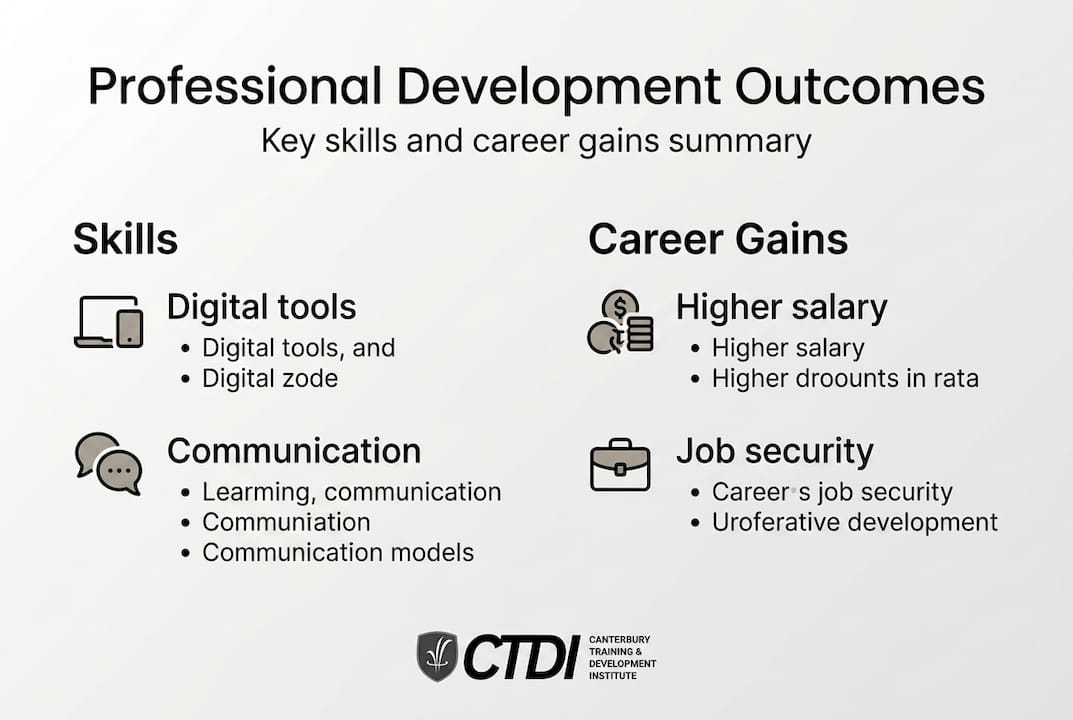
Summary of key PD outcomes by metric
| Metric | Impact linked to effective PD |
|---|---|
| Return on investment | 4.53x ROI on L&D spending |
| Profit margin increase | 24% higher than non-investing peers |
| Income per employee | 218% higher at learning-focused firms |
| Staff retention | 34% higher at PD-active companies |
| Employee loyalty intent | 94% stay longer when development is offered |
These aren't soft, feel-good statistics. They're the kind of numbers that belong in a business case or a salary negotiation conversation.
The three biggest individual gains from PD, in order
-
Higher salaries. Professionals who gain accredited qualifications and industry-recognised skills consistently earn more. Upskilling signals to employers that you're committed, capable, and worth investing in. It also gives you concrete evidence to point to when asking for a pay rise.
-
Faster promotion. Completing relevant training and applying it visibly in your role puts you at the front of the queue when opportunities arise. Managers promote people who demonstrate initiative and capability. PD is one of the clearest ways to show both.
-
Greater workplace satisfaction. This one often surprises people. Competence is deeply satisfying. When you know what you're doing and feel confident in your abilities, work becomes less stressful and more engaging. PD that builds genuine skills (not just certificates to hang on a wall) generates this effect reliably.
A scenario worth considering
Think about a marketing coordinator who notices that digital skills are reshaping their industry. They enrol in digital marketing courses covering SEO, paid media, data analytics, and content strategy. Within twelve months they can demonstrate measurable results from campaigns they've led, contribute strategically to their team, and credibly apply for a senior role. The qualification didn't hand them the promotion. It gave them the skills that made the promotion inevitable.
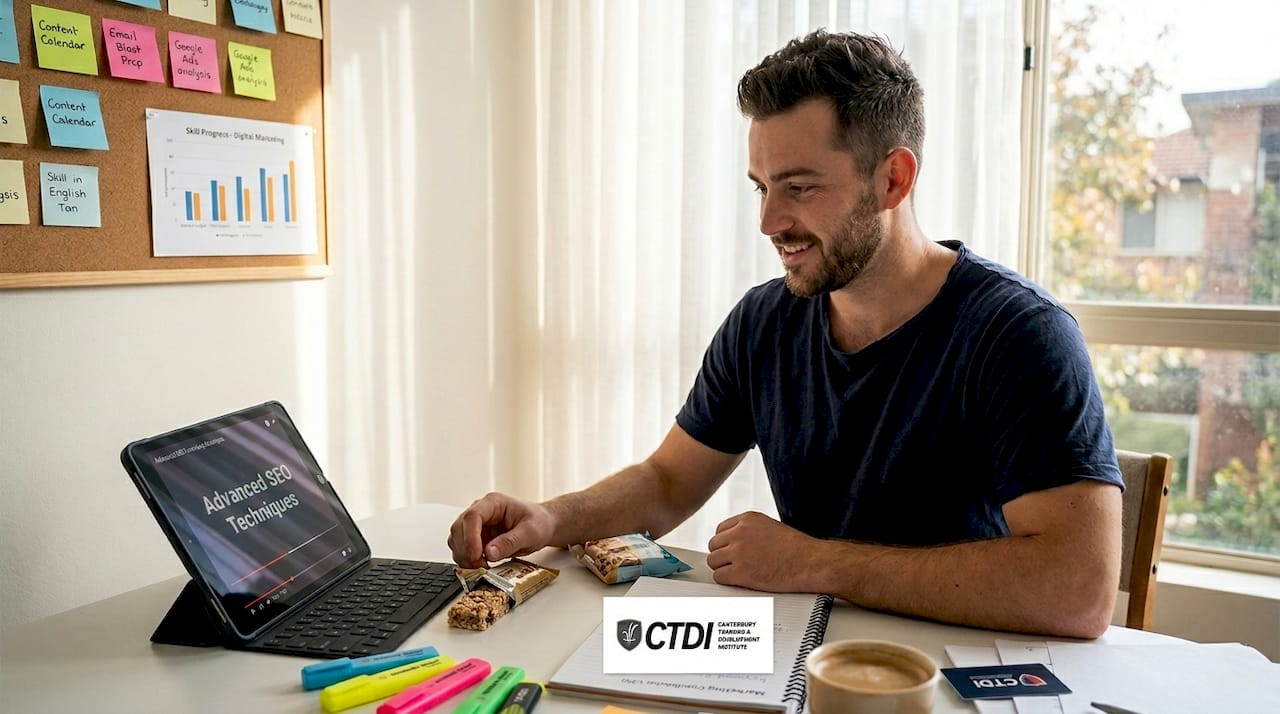
This scenario plays out across industries. The underlying mechanism is always the same: targeted learning builds genuine capability, genuine capability creates visible performance, visible performance drives career outcomes.
How to choose the right professional development approach
Knowing PD is valuable and actually finding the right programme for your specific situation are two different challenges. The market is saturated with options, and not all of them deliver equally.
Common PD delivery formats
The landscape of professional development includes several broad formats, each with distinct strengths:
- Formal accredited courses: Nationally recognised qualifications delivered through registered training organisations. These carry the most weight with employers and provide structured learning pathways.
- Short workshops and seminars: Good for focused skill-building in a specific area. Best used as a complement to formal learning rather than a replacement.
- Mentorship and coaching: Informal but powerful. Learning from someone who has already navigated the path you're on can accelerate your growth significantly.
- Self-directed learning: Podcasts, books, industry publications, YouTube tutorials. Low cost and highly flexible, but requires strong self-discipline and lacks external validation.
- Online vocational courses: Combine the structure and recognition of formal qualifications with the flexibility of digital delivery. This format has grown substantially because it suits working professionals.
Comparing approaches
| Format | Flexibility | Cost | Industry recognition | Practical skills focus |
|---|---|---|---|---|
| Accredited online vocational | High | Moderate | Strong | High |
| Traditional classroom course | Low | High | Strong | Moderate |
| Short workshop | Moderate | Low to moderate | Weak | Moderate |
| Self-directed learning | Very high | Low | Weak | Variable |
| Mentorship | High | Low | None formal | High |
As you can see, accredited online vocational courses occupy a genuinely strong position. They offer flexibility without sacrificing recognition, and vocational education delivers hands-on, industry-relevant skills with better employability outcomes compared to many alternatives.
Why accreditation matters more than you might think
An unaccredited certificate might look impressive on a LinkedIn profile, but when a hiring manager or a promotion panel checks it, the absence of formal recognition can actually work against you. Nationally recognised qualifications, delivered through registered providers, carry weight because they meet standards set by industry and regulatory bodies. Employers trust them.
For professionals in fields like environmental management, digital marketing, or business administration, holding an environmental sustainability certificate or an advanced diploma tells a very specific story: you didn't just read about the topic; you completed a structured, assessed programme that an industry body has endorsed.
What to look for when choosing a programme
- Does it align with where you want your career to go in the next two to three years?
- Is it delivered by a registered training organisation with a track record?
- Does the curriculum reflect what's actually happening in the industry right now?
- Can you complete it while working?
- Does it include practical assessment, not just theory?
Pro Tip: Always check whether a qualification is listed on a national qualifications framework. In Australia, look for programmes registered on the National Register of Vocational Education and Training. Industry-recognised programmes from registered providers give you the maximum career leverage for your investment.
Pitfalls and how to ensure lasting professional development success
Even with the best intentions, professional development can fail. Understanding why it fails is just as important as understanding why it works.
"PD fails when it is one-size-fits-all, lacking in relevance, short on practice time, and not followed up. Effective PD is sustained, focused, and applied to real situations."
This is the professional development trap that organisations and individuals fall into repeatedly: they confuse activity with progress. Attending a training day is not the same as developing a skill. Completing a module is not the same as being able to apply the concept in a real workplace context.
The most common pitfalls
Generic programmes. A course designed for everyone rarely serves anyone particularly well. If the content doesn't connect to your specific role, industry, or career goals, it won't stick. You'll absorb it temporarily for an assessment and forget it by the following week.
Cognitive overload. Trying to learn too much too fast is counterproductive. The brain needs time to consolidate new information. Cramming multiple qualifications or a dozen short courses into a short period leads to shallow learning across the board.
No practice or follow-up. This is the biggest single failure point. Learning something conceptually and then never applying it means it disappears. Skills are built through repetition and application, not exposure alone.
Misalignment with daily work. When learning has no connection to what you do every day, transfer is minimal. The most effective PD integrates directly into your professional context.
Strategies to make your PD actually work
-
Tailor your choice to your actual role and career stage. Don't pick a programme because it's popular. Ask yourself: will this directly improve something I need to do better right now, or open a door I specifically want to walk through?
-
Apply learning immediately. Within days of completing each module or workshop, find a way to use what you've learnt in a real situation. Even a small application is infinitely better than none.
-
Seek feedback actively. Ask your manager, a mentor, or a trusted colleague to evaluate how your new skills are showing up in practice. External feedback accelerates progress and reveals blind spots.
-
Blend theory with practice. Look for programmes that include case studies, practical assessments, or project-based work. Theory without application is a poor investment.
-
Review and iterate. Every few months, revisit your PD goals. Have your circumstances changed? Are the skills you're developing still aligned with where you're heading? Adjust accordingly.
Pro Tip: Practise the 70-20-10 model in your learning plan. Aim for 70% of your development to come from experiential, on-the-job learning, 20% from informal learning such as mentorship and peer discussion, and 10% from formal structured training. This ratio reflects how adults actually learn most effectively and ensures your formal study has a practical foundation to build on. Exploring academic articulation partnerships can also help you map formal qualifications into a broader learning journey.
A fresh perspective: what most professional development guides won't tell you
Here's something the enthusiastic PD literature rarely acknowledges: more learning does not automatically mean more progress. We've seen the ROI statistics, and they are real. But those averages hide significant variation. The benefits of professional development are not distributed equally.
Research on career advancement pathways shows that certain groups, including women and graduates from underrepresented backgrounds, often see lower returns from the same PD investments compared to their peers. This isn't an argument against pursuing development. It's an argument for being clear-eyed about the systemic factors that shape how learning translates into career outcomes, and for advocating within your organisation for equitable development practices.
There's also the credential treadmill problem. Some professionals accumulate qualifications the way others collect subscriptions: constantly adding, rarely pausing to ask whether any of it is making a real difference. The evidence on what actually works points consistently toward sustained, applied, contextually relevant learning over one-off programmes, regardless of how prestigious those programmes look on paper.
What actually moves the dial? Applying what you learn within days. Reflecting on what changed in your performance. Getting honest feedback. Embedding new practices into your regular work until they become automatic. That process is slower, less Instagram-worthy than a new certificate, and far more effective.
Our experience at CTDI tells us that students who get the most from their qualifications are those who engage with their coursework as practitioners, not passengers. They treat each assessment as a chance to solve a real problem from their work context. They ask "how does this apply to my situation?" rather than "what do I need to write to pass?" That mindset shift, more than any particular programme, is what produces lasting career transformation. You can explore academic partnerships and progression pathways that support exactly this kind of strategic, applied approach to learning.
Take the next step with recognised professional development
The case for formal, accredited development is clear: better salaries, faster promotion, stronger job security, and measurable returns for you and your employer. The next step is finding a learning partner whose qualifications are built around real industry needs and delivered in a format that fits your life.
At Canterbury Training and Development Institute, every course is designed by industry experts, delivered 100% online at your own pace, and nationally recognised across Australia. Whether you're ready to enrol in online diplomas right now, or want to explore options like the advanced digital marketing diploma, you'll find qualifications that are genuinely relevant to where the job market is heading. Browse CTDI's full range of online qualifications and take the kind of deliberate, strategic step toward your career that actually produces results.
Frequently asked questions
What are the main benefits of professional development?
Professional development builds your skills, lifts job satisfaction, increases earning potential, and makes you more employable, with research showing companies that offer PD have 34% higher retention rates.
Is professional development worth it financially?
Yes, the data is compelling: L&D investment consistently delivers a 4.53x return and is linked to 218% higher income per employee at organisations that prioritise learning.
How do I pick the right professional development course?
Choose accredited online or vocational courses that align with your specific career goals, offer practical and industry-relevant assessment, and are delivered by a registered training organisation, since vocational education consistently outperforms generic alternatives on employability.
Why do some professional development programmes fail?
Generic, one-size-fits-all programmes fail because they lack real-world relevance and follow-up; effective PD is tailored, sustained over time, and deliberately applied in your day-to-day work context.
Recommended
- CTDI - Canterbury Training & Development Institute | Online Qualifications
- Rewards & Perks — Canterbury Training and Development Institute
- How Learning AI Could Earn Australians $11,000 More Per Year | CTDI — Canterbury Training and Development Institute
- Why Environmental Scientist Is One of the Fastest-Growing Careers in Australia | CTDI — Canterbury Training and Development Institute