

Marketers who master strategic thinking, creative direction, AI literacy, prompt engineering, orchestration, ethics and data analysis will out-earn and outlast those who don't, according to Salesforce's agentic AI research. The good news: these are learnable in weeks, not years. Start with a small prompt-driven microproject this week, or enrol in a structured course through a provider like Canterbury Training & Development Institute.
TL;DR:
- Marketers need to develop strategic thinking skills by creating campaign directions independently before leveraging AI tools for testing.
- Prompt engineering requires building reusable, well-structured prompts with explicit constraints and brand context to ensure consistent, on-brand output.
- AI literacy involves understanding AI strengths like drafting and summarizing versus faking facts or nuances through quick comparative testing.
- Building cross-functional orchestration skills enables marketers to connect automation with strategy, improving campaign optimization and prediction accuracy.
- Formal training through industry-designed diplomas in AI and digital marketing ensures practical, job-ready skills in ethical judgment, data analysis, and AI application.
Table of Contents
- The essential AI skills for marketers — actionable list
- How to learn and practise these skills
- Prompt engineering: 10 best practices for marketers
- Which AI tools fit which marketing job
- Ethics, bias and the changing marketer role
- Prioritising skill growth by career stage
- Turn these skills into an accredited qualification
- Sources
The essential AI skills for marketers — actionable list
Agentic AI, the kind that plans, acts and adjusts campaigns with minimal hand holding, has changed what "good at marketing" means. Salesforce's research on agentic AI marketing skills names five core capabilities marketers need now: strategic thinking, creative direction, AI literacy, ethical judgement, and orchestration. Add prompt engineering and data analytics, and you have a working skill map for 2026.
-
Strategic thinking. AI can generate a hundred campaign angles in a minute, but it can't decide which one fits your brand's next quarter. Practise it by taking a real campaign brief and writing three strategic directions before you touch a single AI tool, then use the tool only to pressure test your choice.
-
Creative direction. Someone still has to say "no, that tone is wrong" or "this visual doesn't match our positioning." Run a one-hour exercise: generate five ad concepts with a generative model, then rewrite the brief twice to see how much the output shifts.
-
AI literacy. This means knowing what a large language model actually does well (drafting, summarising, pattern spotting) versus what it fakes convincingly (facts, nuance, brand memory). Spend an afternoon testing the same prompt across two different tools and comparing where each one breaks down.
-
Prompt engineering. Specific, well-structured prompts consistently outperform vague ones, based on Klaviyo's practitioner research. Build one reusable prompt template for a task you do weekly, an email subject line sprint, a social caption batch, and refine it over five uses.
-
Orchestration. With agentic systems now capable of running bid adjustments or segment tests on their own, someone needs to sit above the automation and connect it to strategy. Try a one-hour predictive-lead-scoring experiment: feed a model your last quarter's conversion data and check its scoring against what actually happened.
-
Ethical judgement. Bias, misinformation and brand safety don't disappear because AI is fast. Build a five-minute checklist you run before anything goes live: check the claim, check the tone, check who might be excluded.
-
Data analytics. Every skill above is only as good as the data feeding it. Practise pulling one campaign's raw numbers into a simple dashboard and writing a three-sentence takeaway, no tool required, just judgement.
Pro Tip: Turn each microproject into a shared team ritual, not a solo exercise. Run the same one-hour experiment across three team members and compare outputs; the gaps reveal exactly where your team's prompts or judgement need work.
How to learn and practise these skills
You don't need a semester to get functional. A staged approach works better than trying to absorb everything at once.
- Weeks 1 to 4: Pick one skill from the list above and run its microproject twice. Document what changed between attempt one and attempt two.
- Month 1 to 3: Layer in a second and third skill, and start connecting them. Try running a prompt-driven content sprint that also requires a data check before publishing.
- Course selection: Look for programs with graded labs, not just video lectures. Coursera's generative AI for digital marketing specialisation is built around hands-on practice rather than passive watching, and that structure speeds up how fast a skill becomes usable on the job.
- Portfolio evidence: Save before-and-after versions of your prompts, campaign briefs, and results. A portfolio that shows "here's my rough draft, here's what I changed, here's why" carries more weight with hiring managers than a certificate alone.
- Audit any course you're considering by asking: does it include real briefs, real data, and a graded output? If it's all theory, skip it.
For a broader look at how these skills translate into career outcomes, CanterburyTDI's guide on essential AI skills for students breaks down specific entry points by experience level.
Prompt engineering: 10 best practices for marketers
Prompt engineering is closer to a communication skill than a coding task, and specificity is what separates a usable draft from a wasted attempt. Klaviyo's prompt engineering research lays out the fundamentals; here's a working checklist.
- Open with the role and hook: "You're a retention copywriter writing a win-back email."
- Ground every prompt in real data, not assumptions, feed it your actual campaign metrics or CRM segments.
- Attach a brand context block covering audience, tone, and a short "do not" list.
- Build reusable templates for repeat tasks rather than starting fresh each time.
- Use shared memory or saved prompts so your whole team works from the same baseline.
- Ask for three variations, not one, to force genuine iteration.
- Set explicit constraints (word count, banned phrases, required CTA).
- Request the model's reasoning, not just the output, to catch faulty logic early.
- Run a human evaluation step before anything ships, no exceptions.
- Flag anywhere the output states a fact and verify it independently.
Pro Tip: Keep your brand context block as a single saved document that every team member pastes into every prompt. It's the fastest way to stop AI-generated content from drifting off-brand across five different people using five different phrasings.
Which AI tools fit which marketing job
Matching the tool category to the task matters more than chasing the newest release. Three broad categories cover most marketing needs.
- Generative models handle drafting and iteration: ad copy, email variants, social captions. They need a clear brief and brand context, and their output always needs a human pass before publishing.
- Predictive machine learning handles scoring and forecasting: lead scoring, churn prediction, budget allocation. These need clean historical data to be worth anything.
- Agentic systems run continuous optimisation: adjusting bids, testing segments, triggering follow-ups. Around 75% of marketing organisations already use at least one form of AI, per Salesforce, and agentic tools are the fastest-growing slice of that.
Before any tool goes into production, check its data integration requirements (does it need API access to your CMS or CRM?) and run a verification pass on its first month of outputs. Databricks' comparison of agentic versus generative AI is a useful primer for understanding which category you actually need before you shop for one.
Ethics, bias and the changing marketer role
Some decisions can't be delegated. Brand voice calls, anything touching sensitive audiences, and final approval on claims need a human in the loop, no exceptions. Run a quick bias check on any AI-generated audience segment: does it quietly exclude a group your brand serves?
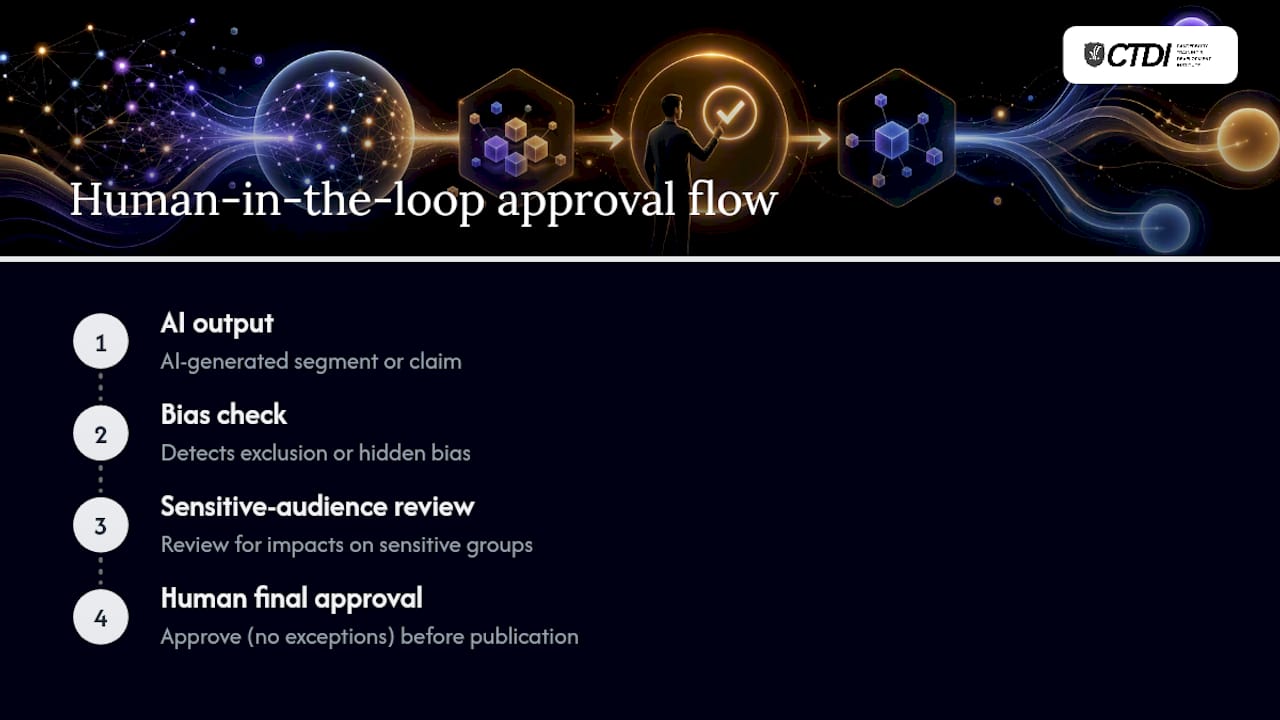
Salesforce's research on AI maturity found that only a small share of marketing organisations describe their AI use as genuinely mature, which tells you governance is still catching up to adoption. Job descriptions are shifting accordingly: fewer "content writer" roles, more "AI orchestrator" and "campaign governance lead" titles, with KPIs built around output quality and oversight, not just volume.
Prioritising skill growth by career stage
Early-career marketers should master prompt templates and run measurable microprojects, small, documented wins build a portfolio fast. Mid-career professionals ought to take ownership of orchestration: connecting tools, owning the measurement layer, proving ROI. Senior marketers need to focus on governance and cross-functional orchestration, because augmenting your team with AI beats replacing it, but only if someone senior is steering that partnership deliberately.
— Sam
Turn these skills into an accredited qualification
Reading a list of skills is one thing. Having a recognised qualification that proves you can apply them is what actually moves a resume to the top of the pile. CanterburyTDI's online diploma programs in artificial intelligence and digital marketing are built around the exact capabilities covered above, strategic AI application, prompt-based content workflows, data-driven campaign analysis, delivered as self-paced, nationally accredited training you can complete around a full-time job.
The AI diploma maps directly to AI literacy, orchestration and ethical judgement, while the digital marketing diploma builds out creative direction, data analytics and campaign strategy. Course content is designed by industry practitioners, not just academics, which matters when the goal is job-ready skill, not theory. Teams looking to upskill multiple staff at once can explore corporate training partnerships built for exactly that. For agencies wanting a sharper look at maintaining output quality once AI enters the workflow, BizDev Strategy's guide to AI content creation is a solid companion read.
If you're ready to formalise the skills you're already practising, enrol now and start your diploma.
Sources
- 5 Agentic AI marketing skills you need right now | Salesforce
- Prompt engineering best practices | Klaviyo blog