

TL;DR:
- Australian government agencies should choose AQF-mapped online AI training programs with mandatory capstones for workforce development. It is essential to match course levels to roles and verify assessments, assessor credentials, and accreditation to ensure program quality. Credible providers like CTDI offer flexible, recognized courses with real workplace assessments that support workforce planning and audits.
Australian government agencies that need nationally accredited AI training should go straight to AQF-mapped vocational programs, delivered 100% online, with a mandatory capstone or workplace project and options for custom cohort delivery. That combination satisfies procurement requirements, supports audit trails, and gives staff credentials that transfer to higher study or promotion decisions. Microcredentials suit a quick capability uplift; a Diploma or Advanced Diploma builds the depth that policy and data roles genuinely need.
Before you contact a provider, work through this checklist:
- Confirm the AQF level required for each target role group
- Request custom cohort options and bulk enrolment pricing
- Verify that capstone or workplace assessment is mandatory, not optional
- Check RPL availability for experienced staff
- Confirm SCORM/LMS compatibility with your IT team before awarding access
Table of Contents
- Which AI training programs suit different government roles?
- What should a quality AI program teach government staff?
- How do you procure AI training for agency staff?
- How are credible programs delivered and assessed?
- What trust signals should agencies demand from providers?
- How does CTDI meet agency needs for accredited AI training?
- Key takeaways
- What actually matters when procuring public-sector AI training
- Ready to brief CTDI on your agency's training needs?
- Useful sources for your tender pack
Which AI training programs suit different government roles?
Not every public servant needs the same credential. Matching the AQF level to the role is the fastest way to avoid over-engineering a procurement and under-delivering on outcomes.
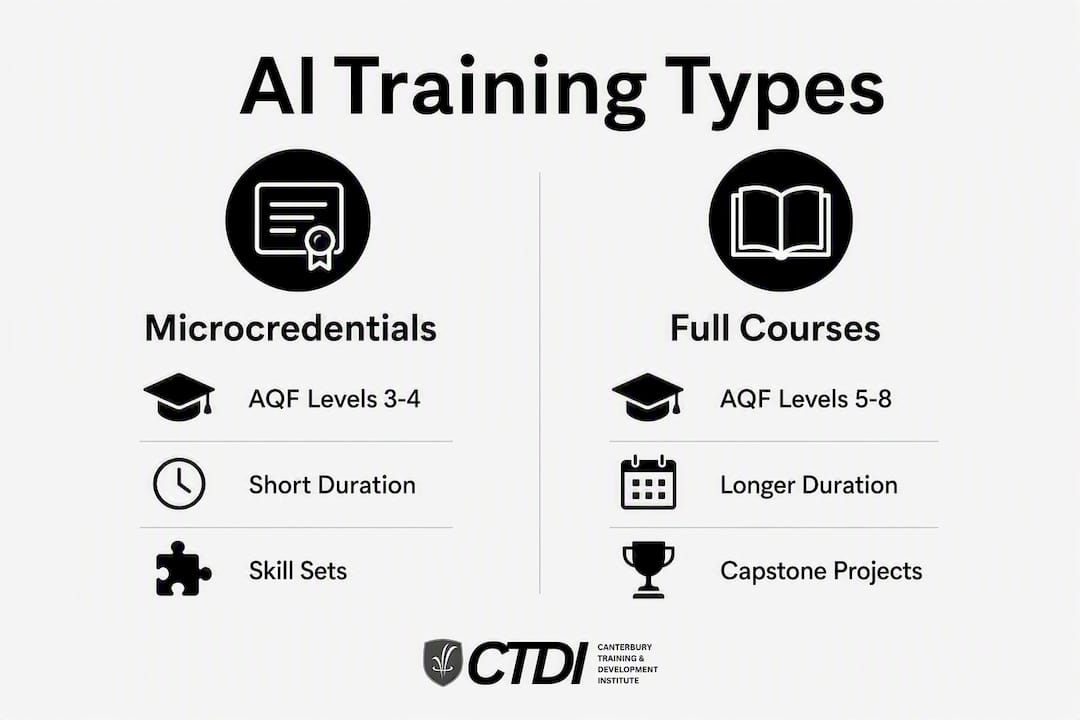
- Frontline and administrative staff: Microcredentials or short skill sets (AQF 3–4) covering AI literacy, prompt techniques and responsible data use. Low time commitment, fast to deploy.
- Policy advisers and program managers: Certificate IV or Diploma (AQF 4–5) covering AI governance, ethics, bias mitigation and procurement-aware implementation.
- Data analysts and IT staff: Diploma or Advanced Diploma (AQF 5–6) with machine learning literacy, data stewardship and applied analytics units.
- Senior executives and SES-equivalent staff: Leadership-focused cohorts, often short and intensive, covering AI strategy, governance frameworks and workforce transformation.
| Course type | AQF level | Typical duration | Delivery shape |
|---|---|---|---|
| Microcredential / skill set | 3–4 | 2–6 weeks | Self-paced online |
| Certificate III–IV | 3–4 | 6 weeks | Self-paced or cohort |
| Diploma | 5 | — | Self-paced or cohort |
| Advanced Diploma | 6 | 24 weeks | Self-paced or cohort |
AQF mapping matters beyond the credential itself. It enables credit transfer between registered providers, supports promotion decisions, and gives HR a defensible basis for classifying the training in workforce plans.
What should a quality AI program teach government staff?
Government AI training must focus on applying AI safely in public contexts. Privacy, bias mitigation and public trust are not optional modules — they are the core of what separates a public-sector program from a generic corporate one.
Core competencies every agency program should cover:
- AI governance and policy frameworks relevant to Australian public administration
- Ethics and public trust, including transparency obligations
- Privacy and data stewardship under Australian Privacy Principles
- Bias identification and mitigation in automated decision-making
- Procurement-aware implementation (how to evaluate and contract AI systems)
- Basic machine learning literacy for non-technical staff
- Applied prompt engineering for public service tasks
Specialised tracks that AI training series for government commonly include: acquisition and contracting, AI auditing, HR classification, and frontline service automation. These role-specific electives are what turn a generic course into something staff actually use on Monday morning.
Real-world application is where programs either earn their fee or expose their limits. Capstones and agency-relevant projects move participants from conceptual knowledge to workplace impact. An acceptable capstone output might be a documented AI use-case assessment for a real agency process, complete with a risk register and an implementation recommendation.
Pro Tip: When drafting learning outcomes for your RFT, map each outcome directly to an AQF unit descriptor and a measurable procurement KPI — for example, "staff can identify and document bias risks in a proposed AI system" rather than "staff understand AI ethics." Mapped outcomes make vendor evaluation and post-training audits straightforward.
How do you procure AI training for agency staff?
- Define competency gaps using a skills audit across target role groups before approaching any provider.
- Select the appropriate AQF level for each cohort based on the role mapping above.
- Require capstone or workplace assessment as a non-negotiable contract term, not a nice-to-have.
- Confirm student support and RPL pathways so experienced staff are not forced to repeat prior learning.
- Request a capability statement that includes AQF mapping, sample unit learning outcomes, assessor credentials, and evidence of previous government work.
Questions to put to every vendor in your tender or RFT:
- Which nationally recognised qualification does this program lead to, and what is its AQF level?
- Can you provide sample capstone briefs and examples of acceptable evidence?
- What are your assessors' qualifications and industry experience?
- Do you offer bulk enrolment pricing and custom cohort scheduling?
- Is the platform SCORM-compatible? Which LMS environments have you tested?
On cost: intensive government AI bootcamps can reach approximately AUD 5,000 per participant, with the agency typically covering the fee for cohort enrolment. At the other end, leadership-level cohorts targeting senior executives are sometimes offered at no cost to eligible participants. Most vocational diploma programs sit between these points. Build a per-head cost and a total cohort cost into your budget submission from the start.
Timeline to plan for: allow four to eight weeks for procurement and contracting, then add the delivery period (two to fifty-two weeks depending on AQF level), plus four to six weeks for assessment, credentialing and reporting.

How are credible programs delivered and assessed?
Common delivery modes include 100% online self-paced study, facilitated cohort sessions, blended virtual workshops, and one-on-one mentoring. The mode matters less than whether assessment is genuinely mapped to AQF unit outcomes and verified by a qualified assessor.
Assessment types to require in your contract:
- Capstone or workplace project with documented evidence of agency impact
- Module assessments mapped to specific AQF unit performance criteria
- Assessor verification by a qualified vocational practitioner
- RPL pathway with a clear evidence portfolio process for experienced staff
SCORM packages are standard in many government training workflows. Confirm LMS compatibility with your IT team before awarding access — staff attempting to open agency learning files on personal devices without the right LMS configuration is a common and avoidable problem.
Example capstone brief: "Identify one process in your work unit that could be improved using an AI tool. Document the current process, assess the AI option against privacy and bias criteria, and produce a one-page implementation recommendation with a risk register. Present findings to your supervisor." This brief is specific, verifiable, and directly tied to the participant's daily role — exactly what a qualified assessor can evaluate against AQF unit outcomes.
What trust signals should agencies demand from providers?
Accreditation is the floor, not the ceiling. A nationally recognised qualification on the Australian Qualifications Framework tells you the provider has met minimum standards. What separates a strong provider from a compliant one is the evidence layer on top of that.
Trust signals to require:
- Nationally recognised accreditation with a clear AQF level stated on all marketing and enrolment materials
- Mapped unit learning outcomes published for each module, not just a course overview
- Qualified assessors with documented industry experience in AI or related fields
- Industry practitioner guest lecturers or subject matter contributors
- Verifiable capstone outcomes with examples of past student work available on request
- Clear student support structures: dedicated contact, academic support, and escalation paths
- Documented pathways to higher study or credit transfer
RAIL certification and similar public-sector programmes offer modular, verifiable credentials specifically mapped to responsible AI adoption in government — worth including in your evaluation framework as a benchmark for curriculum design.
AI+ Government Fundamentals and comparable credentials demonstrate that governance, data management and implementation can be assessed as an integrated set of competencies, not just siloed modules. Use these as reference points when evaluating vendor curriculum maps.
Intensive bootcamps can cost around AUD 5,000 per participant, while some executive leadership cohorts carry no fee at all. Knowing that range helps procurement officers push back on pricing that sits outside it without justification.
How does CTDI meet agency needs for accredited AI training?
Canterbury Training & Development Institute (CTDI) offers nationally recognised, AQF-mapped AI courses delivered 100% online in a self-paced format designed for working professionals. The Diploma of Artificial Intelligence is built around industry-designed units covering AI governance, ethics, data stewardship and applied implementation — the competencies government agencies consistently require.
What CTDI offers agencies specifically:
- Nationally accredited qualifications with clear AQF mapping on all course materials
- Flexible online delivery that fits around shift patterns and project cycles
- Capstone and workplace assessment options that produce auditable evidence
- RPL advisory support so experienced staff receive appropriate credit
- Bulk enrolment and custom cohort scheduling for agency procurement
- Documented pathways to higher study and career progression
- Dedicated student support throughout enrolment and assessment
Agency procurement leads can request a capability statement, sample unit learning outcomes, and a tailored cohort quote directly through CTDI's enrolment page.
Key takeaways
AQF-mapped vocational programs with mandatory capstones are the most defensible and career-relevant route for Australian government agencies procuring AI training.
| Point | Details |
|---|---|
| Match AQF level to role | Frontline staff need AQF 3–4 skill sets; policy and data roles need Diploma or Advanced Diploma (AQF 5–6). |
| Capstone is non-negotiable | Require a workplace project as a contract term — it produces auditable evidence and real skill transfer. |
| Cost range is wide | Intensive bootcamps can reach ~AUD 5,000 per participant; some executive cohorts are offered at no cost. |
| Demand mapped outcomes | Require AQF unit descriptors for every module — not a course overview — so audits and promotion decisions are straightforward. |
| CTDI as an accredited option | CTDI's nationally recognised online AI programs include capstone assessment, RPL support and bulk agency enrolment. |
What actually matters when procuring public-sector AI training
The most common mistake I see agencies make is weighting vendor marketing claims over mapped assessment evidence. A provider can describe their program as "government-focused" and list impressive client logos, but if they cannot hand you a document showing which AQF unit each assessment task maps to, the credential will not hold up in a promotion panel or an audit.
The second thing agencies underestimate is the capstone. A well-designed capstone brief forces participants to apply what they have learned to a real problem in their own work unit. That is where the learning actually consolidates. A course that ends with a multiple-choice quiz produces a certificate; a course that ends with a documented AI use-case assessment produces a capable officer.
My practical advice: before you shortlist any provider, ask for two things — a sample capstone brief and the assessor's CV. Those two documents tell you more about program quality than any marketing deck.
Ready to brief CTDI on your agency's training needs?
CTDI gives government agencies a direct path to nationally accredited AI training without the complexity of building a program from scratch. Agencies get AQF-mapped qualifications, flexible online delivery, and assessment that produces real evidence for workforce plans and audit files.
The process is straightforward: request CTDI's agency capability statement, review sample unit learning outcomes, and ask for a tailored cohort quote with bulk pricing and a delivery timeline. Student support is included throughout, and every qualification carries documented pathways to higher study for staff who want to continue building their credentials.
Enrol your team now or contact CTDI to request a capability statement tailored to your agency's role groups and procurement timeline.
Useful sources for your tender pack
These sources are worth attaching to an RFT as evidence of best practice, curriculum benchmarks, or funding models:
- GSA AI Training Series for Government Employees: Demonstrates the role-specific track model (acquisition, leadership, auditing) that a quality vendor curriculum should reflect.
- RAIL Public Sector Certification: Modular, verifiable credentials mapped to responsible AI adoption — useful as a curriculum benchmark and for evaluating ethics and governance coverage.
- AI Government Leadership Program (Partnership for Public Service): Shows the no-cost executive cohort model and the applied use-case project structure agencies should expect at senior levels.
- OPM 2026 AI Training Materials: SCORM-ready packages with LMS guidance — use to set your platform compatibility requirements in the RFT.
- AI+ Government Fundamentals Certification (AI CERTs®): A formal government-facing certification with modular outcomes across governance, data management and implementation — useful as a curriculum comparison point.
This article provides general information about AI training options for government agencies. Procurement officers should verify accreditation status, AQF registration, and pricing directly with providers and through the Australian Skills Quality Authority (ASQA) before committing to a contract.
Recommended
- What is government agency training: a 2026 guide
- Examples of online training programs in 2026 — Canterbury Training and Development Institute
- Enrol Now — Online Diplomas in AI, Marketing & Sustainability | CTDI — Canterbury Training and Development Institute
- Examples of online training programs in 2026