

TL;DR:
- Government agency training develops employee skills through formal and informal learning programs. Most agencies focus on compliance, but effective training links to career growth and performance goals. Combining internal and external trainers, along with centralized tracking and accredited qualifications, improves workforce capability and long-term development.
Government agency training is the structured process through which public sector employees gain the skills, knowledge, and qualifications needed to perform their roles and advance their careers. About 84% of public sector agencies offer employee training in 2026, reflecting how central workforce development has become to government operations. Specialised bodies like the Federal Law Enforcement Training Centers and the National Association of Attorneys General demonstrate the breadth of what government training covers, from law enforcement to legal practice. Understanding what is government agency training, and how it works in practice, is the first step toward using it to build a meaningful public sector career.
What is government agency training and how is it defined?
Government agency training is the formal and informal learning activity that public sector organisations deliver to build employee capability. The industry term for this broader effort is public sector workforce development, which covers everything from mandatory compliance programmes to voluntary professional growth. These two categories are legally and practically distinct. Formal training is often regulated under specific legislative codes, while informal professional development sits alongside it as a complementary but separate activity.

Conflating the two is a common mistake. An agency that counts compliance tick-boxes as its entire training offer is not developing its workforce. It is simply meeting a legal minimum. True government workforce development connects learning to performance goals, career pathways, and organisational succession planning.
The scale of government investment in this area is significant. The UK government launched a £2.5 billion package creating 300,000 new work experience and training placements. That level of spending signals that governments worldwide treat workforce training as a core public service function, not an optional extra.
What types of agency training exist across government?
Government training programmes span a wide range of formats, delivery channels, and qualification levels. The right type depends on the agency's mandate, the employee's role, and the career outcome being targeted.
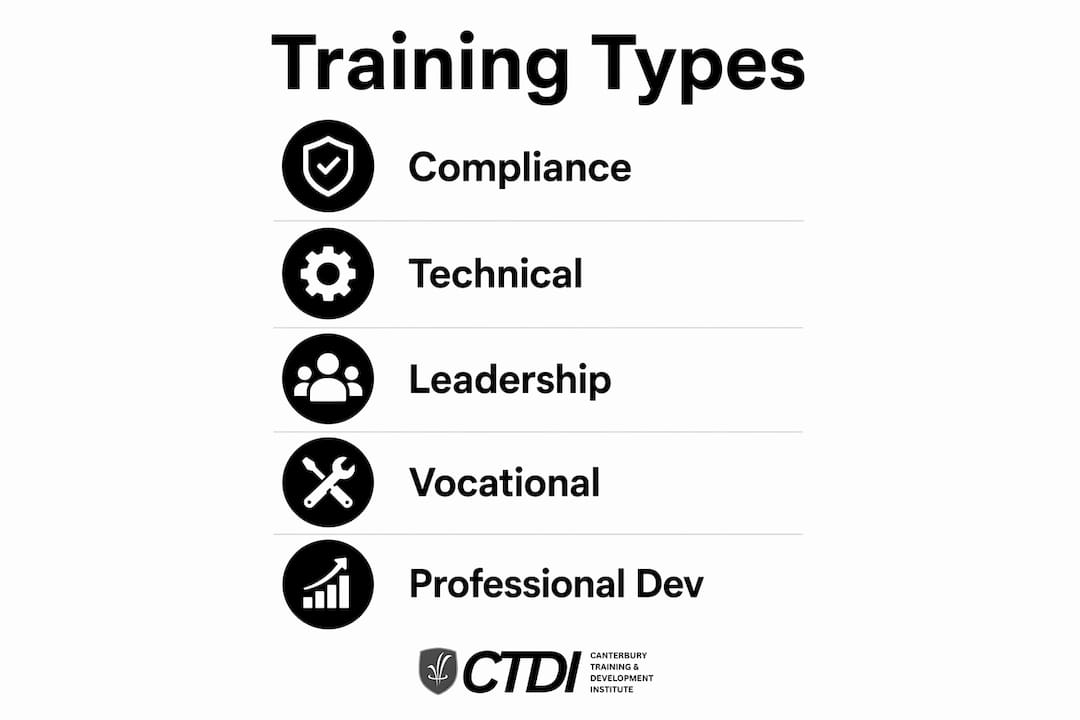
The main categories include:
- Compliance and regulatory training. Mandatory programmes covering workplace health and safety, anti-corruption, privacy obligations, and legislative requirements. These are non-negotiable and often legally prescribed.
- Technical and vocational training. Job-specific skills development, ranging from certificate-level programmes to advanced diplomas. These build the practical competencies needed for specialist roles.
- Leadership and management development. Programmes designed to prepare employees for supervisory and executive positions. These typically draw on external expertise and structured mentoring.
- Apprenticeships and work-based learning. Federally and state-funded pathways that combine on-the-job experience with formal study. California's Employment Training Panel, for example, approved 287 projects with $83 million in funding in fiscal year 2025–26, benefiting over 72,000 trainees.
- Informal and peer learning. Knowledge-sharing sessions, communities of practice, and mentoring arrangements. These are often the most effective forms of learning but the least formally recognised.
Specialised government training centres add another layer. The Federal Law Enforcement Training Centers supports 105 federal agencies, providing standardised content and facilities across multiple programme locations. That model, a centralised hub serving many agencies, is one approach governments use to achieve consistency at scale.
The qualification level matters for career progression. Certificate programmes build entry-level competency. Diplomas and advanced diplomas signal readiness for senior roles. Knowing which level aligns with your career target helps you choose the right programme rather than defaulting to whatever your agency happens to offer.
| Training type | Typical format | Career outcome |
|---|---|---|
| Compliance training | Online modules, workshops | Meets legal requirements |
| Technical/vocational | Certificate to diploma | Specialist role readiness |
| Leadership development | Facilitated programmes, coaching | Management and executive roles |
| Apprenticeships | Work-based plus formal study | Trade and technical careers |
| Peer and informal learning | Mentoring, communities of practice | Knowledge transfer, retention |
Pro Tip: Check whether your agency's training programmes are nationally accredited. Accredited qualifications transfer between employers and jurisdictions, giving you far more career flexibility than internal-only certificates.
What are the benefits and challenges of government training?
The benefits of government training are real and well-documented. Employees who complete structured development programmes build stronger technical skills, qualify for promotion, and contribute more effectively to their teams. At the organisational level, training linked to performance goals and succession planning builds the long-term capability that agencies need to serve the public well.
Career advancement is the most tangible personal benefit. Completing a diploma or leadership programme creates a documented record of capability that hiring managers and promotion panels can assess. For professionals researching career development strategies, government training is one of the clearest pathways to moving up within a public sector organisation.
The challenges, though, are equally real. The most common problems include:
- Siloed delivery. Training is managed separately across departments, with no shared view of what employees have completed or what gaps remain.
- Compliance-only focus. Agencies treat training as a legal obligation rather than a development investment. The result is a workforce that meets minimum standards but lacks the skills to adapt to change.
- Tracking failures. Many agencies rely on spreadsheets and lack a unified training completion system. Employees cannot easily prove their qualifications when applying for promotions.
- Instructional design gaps. Subject matter experts often lead training sessions without formal teaching skills. The result is content-heavy, disengaging sessions that fail to produce lasting behaviour change.
- No link to performance. Training programmes that exist independently of performance reviews and career planning have little measurable impact on workforce capability.
NEOGOV's Public Sector HR Trends 2026 report identifies training as the number one area needing efficiency improvements across government agencies. That finding reflects a sector-wide recognition that the current approach is not working well enough.
Pro Tip: Before enrolling in any government training programme, ask your manager how completion will be recorded and whether it will appear in your formal performance review. If the answer is unclear, the programme may not support your career advancement as directly as you need.
Internal vs external trainers: what works best for government?
The choice between internal and external trainers is one of the most consequential decisions in designing a government training programme. Both have clear strengths. The mistake is using one when the situation calls for the other.
Internal trainers hold deep knowledge of agency-specific processes, culture, and regulatory context. They are the right choice for onboarding, compliance training, and any programme that requires understanding of how a particular agency operates. They are cost-effective and available without procurement delays.
External trainers bring independence, specialist expertise, and exposure to practices from outside the agency. They are the right choice for leadership development and specialised certifications where the agency lacks internal capability. An external facilitator running a management development programme brings credibility and a broader perspective that internal staff cannot replicate.
The most common failure mode is assigning subject matter experts to deliver training without giving them instructional design support. A policy expert who knows their field deeply may still produce a disengaging training session if they lack the skills to structure content for adult learners. Content knowledge and teaching skill are different capabilities. Agencies that conflate them produce training that employees sit through rather than learn from.
The guide on the role of trainers in student support outlines how effective trainers combine subject knowledge with structured facilitation techniques. That combination is what separates training that changes behaviour from training that fills a calendar slot.
The best government training programmes use both approaches deliberately. Internal trainers handle context-specific content. External specialists handle leadership, change management, and advanced technical certifications. Neither approach alone covers the full range of development needs a government workforce requires.
Pro Tip: If your agency uses subject matter experts as trainers, advocate for pairing them with an instructional designer. Even a single session with a design professional can transform a content dump into a structured learning experience.
How to implement effective government training for career advancement
Effective implementation is where most government training programmes either succeed or fail. The content can be excellent. The delivery can be well-resourced. But without a clear connection to performance goals and career pathways, the impact disappears.
Follow these steps to build a training programme that actually moves careers forward:
-
Map training to performance goals. Every programme should connect directly to a measurable performance outcome. If you cannot explain how a training activity improves a specific capability that the agency needs, it should not be on the calendar.
-
Centralise your tracking system. Agencies that rely on decentralised tracking cannot make strategic decisions about workforce capability. A learning management system (LMS) gives employees a single record of their completions and gives managers a clear view of team capability gaps.
-
Separate compliance from development. Compliance training meets legal requirements. Development training builds careers. Treat them as separate programmes with separate budgets, separate tracking, and separate conversations with employees.
-
Incorporate mentoring alongside formal training. Expert Deadra Welcome argues that training must go beyond events to become a strategic learning culture. Peer mentoring and knowledge-sharing sessions build capability in ways that formal programmes alone cannot achieve.
-
Align training with succession planning. Identify the roles your agency will need to fill in the next three to five years. Build training pathways that prepare current employees for those roles. This turns training from a reactive activity into a forward-looking workforce strategy.
-
Use accredited qualifications where possible. Nationally recognised qualifications give employees portable credentials. They also give agencies confidence that the training meets an external standard. For professionals researching workforce development in 2026, accreditation is the clearest signal of training quality.
-
Review and adjust regularly. Training needs change as agency priorities shift. Build a review cycle into your programme calendar so that content stays current and relevant to the roles employees actually hold.
Key takeaways
Government agency training works best when it connects directly to performance goals, uses accredited qualifications, and separates compliance requirements from genuine career development.
| Point | Details |
|---|---|
| Define training clearly | Distinguish compliance training from professional development to avoid treating legal minimums as full workforce development. |
| Use both trainer types | Pair internal trainers for agency-specific content with external specialists for leadership and advanced certifications. |
| Centralise tracking | Implement a learning management system so employees can prove qualifications and managers can identify capability gaps. |
| Link training to careers | Connect every programme to a performance goal or career pathway to ensure training produces measurable outcomes. |
| Choose accredited programmes | Nationally recognised qualifications transfer between roles and jurisdictions, giving employees lasting career value. |
Why most government training misses the point
The uncomfortable truth I've found after years of watching public sector training programmes is that most agencies design training for the organisation's protection, not the employee's growth. Compliance programmes exist because legislation requires them. Mandatory inductions exist because HR needs a record. The employee's actual career development is often an afterthought.
That is a structural problem, not a motivation problem. Government employees are generally willing to learn. The issue is that the systems around them, fragmented tracking, no link to performance reviews, subject matter experts delivering content-heavy sessions, make it hard for training to produce real change.
The agencies that get this right share one characteristic: they treat training as a conversation about the future, not a record of the past. They ask what capability the organisation will need in five years and build learning pathways toward that goal. They give employees a clear line of sight between a training programme and a promotion opportunity.
Blended learning approaches, combining online study with workplace mentoring and formal assessment, are the most effective format I've seen for government contexts. They accommodate shift work, geographic spread, and the reality that government employees rarely have uninterrupted blocks of time for face-to-face training. Online diplomas and certificate programmes that employees can complete at their own pace are particularly well-suited to the public sector workforce.
The future of government workforce development is not more training. It is better-connected training. Programmes that feed into performance systems, succession plans, and career conversations will outlast the compliance-only approach that currently dominates the sector.
— Sam
Advance your career with Edu's online programmes
Government professionals who want nationally recognised qualifications without disrupting their work schedule will find Edu's online courses well-suited to their needs. The Canterbury Training and Development Institute offers self-paced diplomas in areas including AI, digital marketing, and environmental management, all designed by industry experts and delivered entirely online.

Courses are built for working professionals who need flexibility. Expert trainer support and structured student services mean you are not studying alone. Whether you are building toward a specialist role or preparing for a management position, enrol in a diploma that gives you a credential your agency and future employers will recognise. The HR managers' guide to online staff training is also worth reading if you are planning training for your team.
FAQ
What is government agency training?
Government agency training is the structured learning activity that public sector organisations deliver to build employee skills, meet compliance requirements, and support career advancement. It covers everything from mandatory regulatory programmes to voluntary professional development and leadership qualifications.
What are the main types of agency training in government?
The main types include compliance and regulatory training, technical and vocational programmes, leadership development, apprenticeships, and informal peer learning. Each type serves a different purpose and targets a different stage of an employee's career.
What are the benefits of government training for career advancement?
Government training builds documented, transferable skills that support promotion applications and role changes. Nationally accredited qualifications are particularly valuable because they are recognised across agencies and jurisdictions.
Why do government training programmes often fail?
Training programmes fail most often because they are not linked to performance goals or career pathways, tracking is fragmented across departments, and compliance training is mistaken for comprehensive workforce development.
How do I choose between internal and external government trainers?
Use internal trainers for agency-specific content and compliance programmes. Use external trainers for leadership development and specialised certifications where the agency lacks in-house expertise. Combining both approaches produces the strongest outcomes.