

TL;DR:
- Online training significantly boosts knowledge retention from 8–10% to 25–60% while reducing training time by up to 60%.
- Employers are shifting towards industry-recognized online credentials due to misalignment with traditional degrees and cost efficiency.
- Personalized AI-driven platforms and blended learning models enhance skill development, especially for practical and technical competencies.
Most professionals assume the biggest gap between online and classroom training is convenience. The real gap is in your brain. Online training improves knowledge retention from the 8–10% typical of traditional formats up to 25–60%, while cutting training time by 40–60%. The role of online courses in workforce development has shifted from a supplementary option to a core strategy for employers and individuals who need skills that actually stick. This article breaks down what the research says, what employers are actually doing, and how you can use digital learning to get ahead.
Table of Contents
- Key takeaways
- The role of online courses in workforce development
- What employers actually think about online training
- Technology shaping workforce training today
- How to leverage online courses for career growth
- Online learning vs traditional training compared
- My honest take on digital learning for your career
- Start your next career step with CTDI
- FAQ
Key takeaways
| Point | Details |
|---|---|
| Retention rates are far higher online | E-learning can push retention to 25–60%, compared to 8–10% with traditional classroom training. |
| Employers are moving toward certifications | 67% of employers find undergraduate degrees misaligned with job needs, driving a shift to industry-recognised online credentials. |
| Structure determines your success | Self-directed courses without deadlines or cohort support have completion rates below 15%. Choose programmes with built-in accountability. |
| AI is personalising the experience | AI-driven platforms now recommend skills based on your career stage, making workforce training more targeted and effective. |
| Blended learning wins for practical skills | For competencies requiring physical practice, combining online content with supervised hands-on components delivers the best outcomes. |
The role of online courses in workforce development
The way skills are built for work has changed dramatically. A decade ago, most organisations relied on scheduled classroom sessions, printed workbooks, and the occasional conference. Now, the importance of digital learning in workforce contexts is being measured in hard numbers, and those numbers are difficult to argue with.
Online learning does not just save time. It changes how well people remember what they learn. The difference between an 8% retention rate and a 60% retention rate is not trivial. It is the difference between a training investment that evaporates by Monday morning and one that translates into genuine on-the-job behaviour change. That is why the shift toward e-learning is accelerating across industries, from healthcare and construction to marketing and environmental management.
The impact of e-learning on jobs is becoming more visible too. Workers who complete recognised online credentials are moving into roles faster, getting promoted sooner, and reporting higher confidence in applying new skills. And unlike traditional training that requires everyone to stop work on the same day, online formats let people learn around shift patterns, family commitments, and geographic constraints.
Three formats that matter most
Online courses are not a single thing. Understanding the formats helps you choose the right one for your goals.
Synchronous learning brings participants together at a set time via video conferencing, live Q&A, and real-time discussion. It suits learners who prefer social accountability and immediate feedback from trainers.
Asynchronous learning lets you study at your own pace, accessing pre-recorded content, readings, and assessments on your own schedule. This is the dominant model for working professionals in Australia who cannot commit to fixed class times.
Microlearning delivers content in short, focused bursts, typically five to fifteen minutes per module. Short, focused content reduces cognitive overload and allows learners to apply knowledge immediately within their work environment, which makes it particularly effective for busy professionals who cannot afford to step away from their roles for extended periods.
Pro Tip: When comparing online courses, look for programmes that combine asynchronous flexibility with at least some cohort or instructor interaction. The social element does more for completion rates and knowledge application than most learners realise.
Retention evidence you can act on
A systematic review of 171 studies comparing online professional learning to face-to-face instruction found a statistically significant advantage for online delivery, with an effect size of g=0.45. That is not a marginal difference. It means online learners consistently outperformed classroom learners on knowledge and skill assessments across a broad range of professions and subject areas.
The mechanism behind this is worth understanding. Online courses allow learners to pause, review, and revisit content as many times as they need. Classroom training does not. When a concept does not click on the first explanation, an online learner can rewatch. A classroom learner has to either ask (which many people avoid doing) or move on with a gap in their understanding.
| Delivery format | Retention rate | Time to complete | Best suited for |
|---|---|---|---|
| Traditional classroom | 8–10% | Fixed schedule | Hands-on and social learning |
| Self-paced online | 25–60% | Flexible | Knowledge and theory-based skills |
| Microlearning | High, immediate | 5–15 min modules | Busy professionals, just-in-time skills |
| Blended (online + in-person) | High | Structured hybrid | Technical and practical competencies |
What employers actually think about online training
Here is something that should change how you approach your own professional development. 67% of employers now believe undergraduate degrees are misaligned with the skills their roles actually demand. That figure represents a profound shift in how organisations think about credentials and capability.
This employer scepticism toward traditional degrees is not just a critique of universities. It is an opportunity for people willing to build skills through targeted, accredited online courses. Employers who feel let down by degree programmes are actively partnering with online learning providers to create B2B upskilling pathways. They are investing in platforms that deliver specific, measurable competencies rather than waiting for the education system to catch up.
The business case for employers is straightforward:
- Cost-effectiveness. Online training eliminates venue hire, travel costs, printed materials, and the lost productivity of pulling entire teams off-site for multi-day workshops.
- Scalability. A standardised course on an LMS can be rolled out to fifty employees or five thousand with the same resource investment.
- Speed. When a regulation changes or a new tool is adopted, online content can be updated and redistributed across the workforce within days rather than months.
- Measurable outcomes. Learning management systems track completion, assessment scores, and time-on-task, giving managers real data on training effectiveness.
The human side of this equation matters too. 80% of employees say that access to upskilling opportunities increases their job satisfaction. Organisations that invest in online learning are not just improving workforce capability. They are building loyalty and reducing the costly churn that comes when people feel stagnant in their roles.
Technology shaping workforce training today
The most consequential shift in online learning right now is not a new platform or a slicker interface. It is the integration of artificial intelligence into how learning content is selected, sequenced, and delivered to individual learners.

Josh Bersin's analysis of 2025 trends describes a future where AI-driven platforms function like career-long learning companions, surfacing targeted skill recommendations based on a worker's current role, performance data, and where they want to go next. The transition from static course libraries to personalised, just-in-time learning experiences is already underway in large enterprises, and it is filtering down to individual professionals through consumer platforms.
Here is what this technology shift looks like in practice:
- AI-powered skill gap analysis. Platforms assess what you already know and what you need to learn, then sequence content accordingly rather than delivering the same course to every learner regardless of prior knowledge.
- Just-in-time recommendations. Instead of completing a full qualification before applying knowledge, workers receive micro-content relevant to the task they are currently working on, embedded directly into their workflow.
- Simulation-based training. For roles requiring decision-making under pressure, such as emergency response, surgical procedures, or financial advising, e-simulations allow learners to practise in realistic scenarios without real-world consequences.
- Blended delivery integration. Combining eLearning, virtual instructor-led training, and simulations produces the strongest outcomes when the goal involves both knowledge and practical application.
Pro Tip: If you are exploring platforms for your own development, look for ones that offer a skills profile or competency assessment at the start. Programmes that personalise your learning path from day one are far more efficient than ones that treat all learners as identical.
The role of microlearning deserves emphasis here. When a professional has fifteen minutes between meetings, a traditional course chapter is not accessible. A focused microlearning module on a specific sub-skill is. This shift from learning-as-an-event to learning-as-a-habit is one of the most significant changes in how the importance of digital learning in workforce settings is being applied by high-performing organisations.
How to leverage online courses for career growth
Understanding how online courses improve workforce outcomes is one thing. Knowing how to extract that value for your own career is another. These steps give you a practical framework.
-
Map your skill gaps to job market demand. Before enrolling in anything, spend time researching the roles you want and the skills those roles consistently require. Job ads, LinkedIn data, and industry association reports are good starting points. Your learning investment should be directed by what the market is actually rewarding.
-
Prioritise accredited, industry-relevant qualifications. Not all online courses carry equal weight with employers. In Australia, nationally recognised qualifications delivered by registered training organisations carry regulatory credibility. Digital certifications from industry-recognised providers signal to employers that you have met a defined standard, not just watched a series of videos.
-
Build a stacked learning path. Stacking formal qualifications with targeted online certificates is the approach that consistently outperforms either alone. A diploma or degree provides foundational credibility. Online certificates in specific tools, methodologies, or emerging areas fill the gaps that formal education cannot keep pace with.
-
Choose structure over flexibility when possible. This is where many learners go wrong. Completion rates below 15% are the norm for self-directed online courses without accountability structures. Select programmes with deadlines, graded assessments, trainer interaction, or cohort elements. The friction of a deadline is actually what drives learning.
-
Engage with your cohort and trainers actively. Online learning has a reputation for being isolating, but that is usually a result of passive consumption rather than genuine participation. Discussion forums, peer feedback activities, and direct questions to trainers all accelerate learning. Expert trainers are often underutilised by online learners who treat the content as self-sufficient when the real value is in the dialogue.
-
Revisit and apply. The retention advantage of online learning only materialises when you apply content within your actual work context. After each module, identify one specific thing you will do differently in your role. This bridges the gap between information and competence.
The broader point here is that online learning for career growth requires intentionality. It is not passive. The learners who grow their careers through online study treat their courses the way high performers treat any skill development: with structure, reflection, and a clear link to where they want to go.
Online learning vs traditional training compared
Both formats have genuine strengths. The question is not which is better in the abstract, but which is right for your situation and what combination delivers the outcomes you need.
| Feature | Online learning | Traditional classroom |
|---|---|---|
| Time efficiency | 40–60% faster to complete | Fixed session length regardless of prior knowledge |
| Cost | Lower overall; no travel or venue costs | Higher due to physical logistics |
| Flexibility | Study any time, any location | Requires scheduled attendance |
| Social learning | Limited without cohort design | Strong; peer interaction is built in |
| Practical skills | Requires hybrid or simulation components | Well-suited for hands-on competencies |
| Scalability | Highly scalable for large organisations | Limited by room size and facilitator availability |
| Measurable outcomes | Strong via LMS tracking | Depends on assessment design |
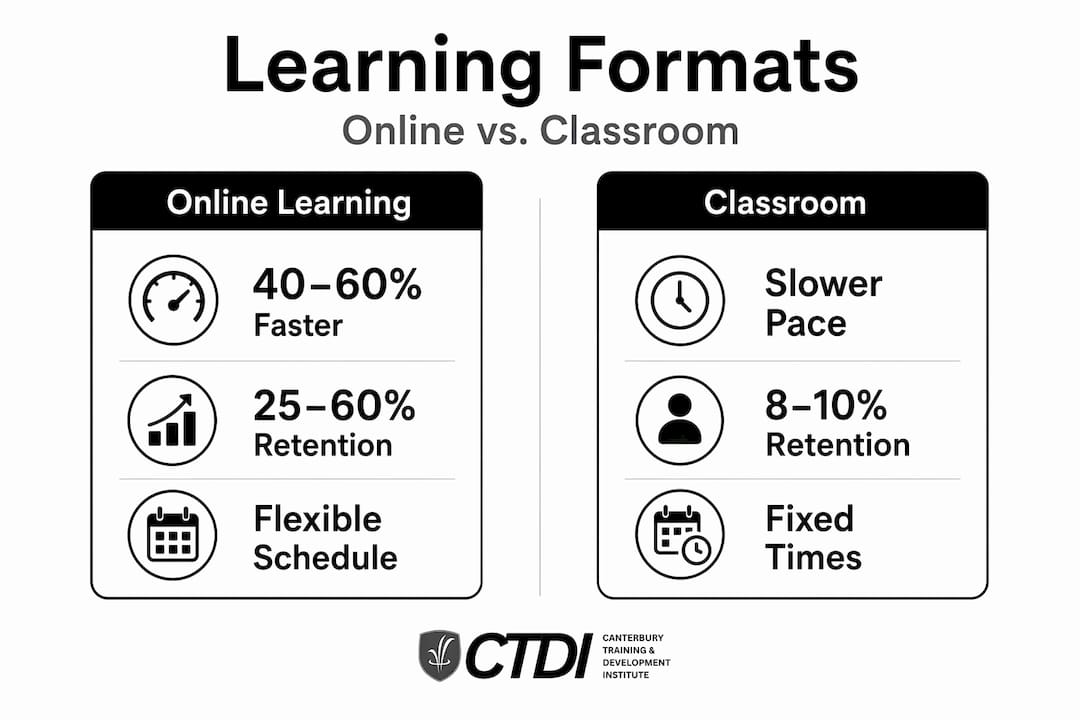
Hybrid learning models are the most effective approach for trades, healthcare, and any field where physical competency must be demonstrated. Online content handles the theory and foundational knowledge, while supervised in-person sessions develop the muscle memory and judgement that screens cannot replicate.
For knowledge-intensive roles in marketing, data analysis, project management, sustainability, and technology, online-only delivery is often sufficient and frequently superior to classroom alternatives. The online learning vs classroom debate is, in most cases, a false binary. The real answer depends on what skill you are building and how that skill needs to be demonstrated in your workplace.
My honest take on digital learning for your career
I have spent years observing how professionals engage with online learning, and the pattern I keep seeing is this: people who treat online courses as a box-ticking exercise get box-ticking results. People who treat them as a genuine investment in capability get genuine results. The technology is not the variable. The intention is.
What I have found genuinely exciting in recent years is the shift toward AI-personalised pathways. For the first time, a warehouse manager and a marketing coordinator can start the same platform and have completely different, appropriate learning experiences. That has never been possible with classroom training at scale. It changes the value proposition of online learning from "accessible but generic" to "accessible and tailored," which is where the real impact on careers and workforce performance lives.
The myth I push back on hardest is the idea that online learning is somehow less rigorous than in-person education. A well-designed online programme with expert trainers, graded assessments, industry-relevant case studies, and structured cohort interaction is more rigorous than a mediocre classroom course where attendance is the primary metric. The delivery channel is less important than the design quality and the learner's engagement with it.
My advice to anyone who is sitting on the fence about committing to online study is this: start with a structured, accredited course rather than a self-paced library subscription. The accountability matters more than the content variety. One completed qualification that required genuine effort will do more for your career than ten half-finished courses you abandoned when things got busy.
The future of workforce development is not a debate between digital and physical. It is about building systems that integrate learning into daily professional life rather than treating it as an interruption to work.
— Sam
Start your next career step with CTDI
If you are ready to put these principles into practice, Canterbury Training and Development Institute (CTDI) offers nationally recognised online diplomas and certificates built for working Australians who need flexibility without sacrificing quality.
CTDI's programmes in AI, digital marketing, and environmental sustainability management are designed by industry practitioners and delivered 100% online, with self-paced study options that fit around your existing commitments. Each course includes structured assessments, access to expert trainers, and clear pathways to in-demand roles. Whether you are upskilling in your current field or pivoting to a growing industry, you can explore accredited online diplomas across multiple disciplines. For professionals targeting a high-demand career in digital marketing, the Advanced Diploma of Digital Marketing is a strong starting point built around the skills employers are actively recruiting for right now.
FAQ
What is the role of online courses in workforce development?
Online courses build targeted, job-relevant skills at scale, allowing individuals and organisations to respond quickly to shifting industry demands. They offer higher knowledge retention than traditional training and can be completed without disrupting work schedules.
How do online courses improve workforce skills compared to classroom training?
Research shows online learning raises retention rates to 25–60%, compared to 8–10% for traditional formats, and a meta-analysis of 171 studies found online professional learning significantly outperforms face-to-face instruction in both knowledge and skill acquisition.
Why do employers value online certifications?
67% of employers consider undergraduate degrees misaligned with workplace needs, making industry-recognised online certifications increasingly credible. Employers value them for targeting specific competencies that formal degrees often do not address.
What makes an online course worth completing?
Courses with structured deadlines, graded assessments, trainer access, and cohort interaction produce far better completion and learning outcomes. Self-directed courses without these elements typically see completion rates below 15%.
Are online courses suitable for all types of workforce training?
Online courses are highly effective for knowledge-based and theory-heavy skills. For competencies requiring physical practice, such as trades or clinical procedures, blended models combining online content with supervised in-person training deliver the best results.
Recommended
- Top online courses in high-demand fields for 2026
- How online education empowers vocational students in 2026
- How online education empowers vocational students in 2026 — Canterbury Training and Development Institute
- Top online courses in high-demand fields for 2026 — Canterbury Training and Development Institute