

TL;DR:
- Vocational training provides practical, skill-based education aimed at preparing individuals for specific careers through hands-on experience. It offers shorter, cost-effective pathways to employment with industry-recognized credentials, especially in trades, healthcare, and IT. Choosing an accredited program with sufficient practical hours and industry connections maximizes employability and career success.
Vocational training is practical, skill-based education designed to prepare you for a specific occupation through hands-on experience and industry-relevant instruction. Known formally as vocational education and training (VET), it covers sectors from construction and healthcare to IT and hospitality. Unlike a university degree, which builds broad academic knowledge, VET focuses on competency-based learning tied directly to job performance. Programs typically require 160–200 clinical or lab hours for health certifications, and they use real workplace tasks as the measure of success. If you want a clear path from study to employment, vocational training is built for exactly that.
What is vocational training and how does it work?
Vocational training is career-focused education that prioritises hands-on skill mastery over academic theory. The goal is to prepare you for a defined occupation, whether that is welding, HVAC installation, medical coding, or network administration. Rather than earning credit hours through essays and exams, you demonstrate competency by completing real tasks to an industry standard.

The structure of most vocational programmes follows four phases: occupational analysis, foundational instruction, hands-on skill practice, and formal assessment. Assessment leads to a certificate, licence, or industry credential that employers recognise. This work-integrated learning model is what separates VET from general education. You are not studying about a job. You are practising it under supervision before you are hired.
In Australia, the VET sector is governed by the Australian Skills Quality Authority (ASQA), which registers training organisations and accredits qualifications on the Australian Qualifications Framework (AQF). This means your credential carries national recognition and, in many cases, portability across states and territories.
What types of vocational training programs are available?
Vocational programmes vary widely in length, format, and purpose. Understanding the differences helps you match a programme to your career goal and your current life situation.
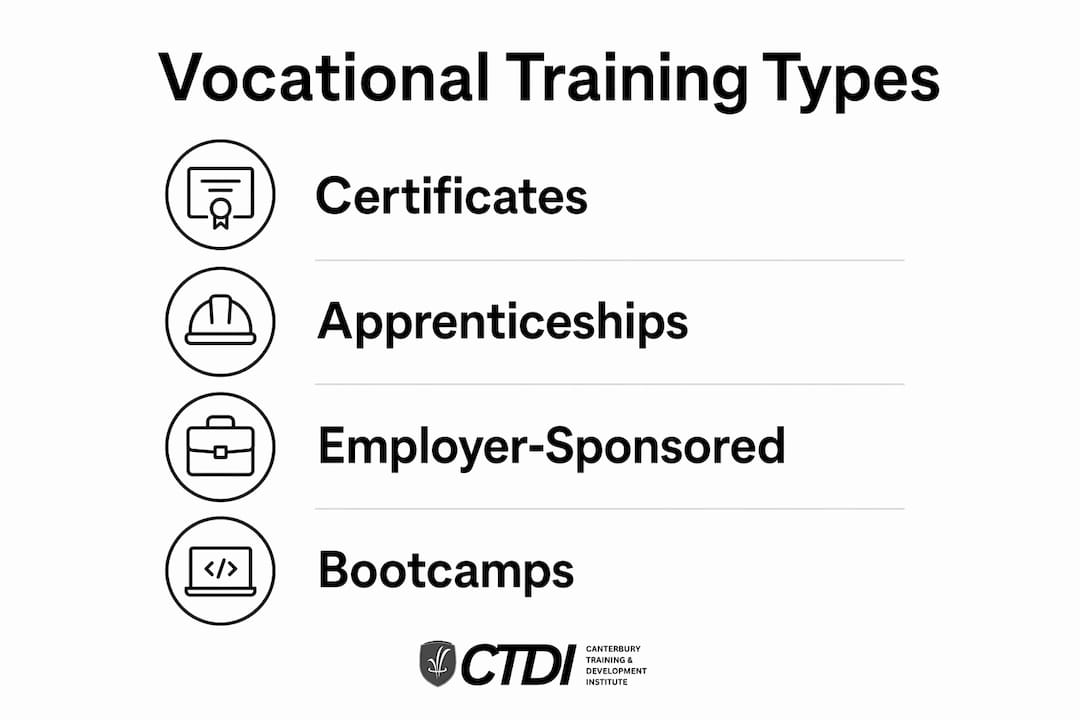
Pre-employment certificates and diplomas
These are the most common entry points. They run from a few months to two years and are delivered by registered training organisations (RTOs) like TAFE institutes or private providers. They suit people entering a field for the first time or formalising skills they already have on the job.
Apprenticeships and traineeships
Apprenticeships combine paid on-the-job training with structured classroom instruction under government registration. They are the standard pathway into licensed trades such as electrical work, plumbing, and carpentry. Traineeships follow the same model but apply to service industries like retail, business administration, and aged care.
Employer-sponsored training
Many organisations fund VET programmes for their existing workforce. This model suits career changers who are already employed and want to upskill without leaving their role. The employer covers costs; the employee gains a recognised credential.
Short-cycle bootcamps
Bootcamps run under 600 hours and focus on a narrow skill set, such as coding fundamentals or digital marketing basics. They offer fast entry to a field but lack institutional recognition required for licensed roles. They work best as a supplement to a longer qualification, not a replacement.
Here is a quick comparison of the main programme types:
| Programme type | Typical length | Best suited for |
|---|---|---|
| Certificate or diploma | 6 months to 2 years | Career starters and changers |
| Apprenticeship or traineeship | 1 to 4 years | Licensed trades and services |
| Employer-sponsored training | Varies | Upskilling in current role |
| Short-cycle bootcamp | Under 600 hours | Supplementary skill building |
Pro Tip: If your target occupation requires a government licence to practise, such as electrical work or nursing support, confirm the programme meets the minimum hours and registration requirements before you enrol. A bootcamp will not satisfy those requirements.
Long-cycle programmes of 1,600 hours or more align with licensure requirements and are the correct choice when your occupation mandates it. Short-cycle programmes under 600 hours may not qualify for government funding but can get you into a new field faster when licensure is not required.
What are the benefits of vocational training?
The benefits of vocational training are most visible when you compare them against the alternatives: a three or four-year university degree, or no formal qualification at all.
Faster entry to the workforce. Most VET programmes take one to two years. You gain a recognised credential and start earning sooner than a degree pathway allows.
Lower total cost. Tuition fees for vocational programmes are generally lower than university fees. Government subsidies and apprenticeship wages reduce out-of-pocket costs further for eligible students.
Direct employer demand. Hiring managers often weigh practical experience over academic achievement. A graduate who has completed 200 supervised clinical hours is more job-ready than one who has only studied theory.
Accredited credentials open doors. Programmes registered with ASQA and listed on the AQF are recognised by employers nationally. Accreditation also makes you eligible for government funding schemes like the Australian Government's JobTrainer Fund and state-based subsidies.
Work-integrated learning builds real confidence. Practising skills in live or simulated environments before your first day on the job removes the gap between knowing something and being able to do it under pressure.
"Employment readiness, not just completion, is the main metric that matters. Programs featuring supervised work in live or simulated environments are most valued by employers." — National Training Authority
Vocational training also suits people who learn by doing rather than by reading. If sitting in lectures for three years sounds like the wrong fit for how your brain works, VET is designed around your learning style, not against it. You can read more about how accredited courses in Australia translate directly into career outcomes.
How to choose the right vocational training program
Choosing the wrong programme is a costly mistake. The right framework for evaluation covers four areas: accreditation, practical hours, ROI, and red flags.
1. Verify accreditation status
Check that the provider is registered with ASQA on the National Register of VET (training.gov.au). Confirm the qualification is listed on the AQF. Accreditation is crucial for employer recognition and eligibility for government funding. A provider that cannot show you their RTO registration number is not worth your time or money.
2. Assess practical training hours
Ask specifically how many hours are spent in supervised practice versus self-directed study. Healthcare programmes, for example, require 160–200 clinical hours as a minimum. A programme that promises a nursing support qualification in eight weeks with no placement hours is not meeting industry standards.
3. Calculate your real ROI
ROI is not just tuition fees. It includes tools and equipment, transport, and the income you forgo while studying. A $5,000 full-time 12-month programme may deliver worse ROI than a $15,000 self-paced course that lets you keep working. Compare total costs against the average starting salary in your target role using data from the Australian Government's Job Outlook tool.
| Cost factor | Full-time programme | Self-paced programme |
|---|---|---|
| Tuition | Lower upfront | Higher upfront |
| Lost income | High (cannot work full-time) | Low (study around work) |
| Time to completion | Faster | Longer |
| Total ROI | Depends on salary uplift | Often higher for earners |
4. Watch for red flags
Ignore claims like "top-rated" or "industry-leading" unless backed by verifiable data such as student completion rates, employment outcomes, or ASQA audit results. Choosing the wrong institution can render your qualification ineffective. Prioritise providers with strong industry partnerships and documented work placement programmes.
Pro Tip: Ask the provider directly: "What percentage of your graduates are employed in their field within six months of completing?" If they cannot answer with data, that tells you everything.
5. Check industry credential requirements
Many high-value credentials in IT, project management, and digital fields lack formal academic accreditation but are essential for job placement. CompTIA certifications, for example, are not AQF-listed but are widely required by Australian IT employers. Know whether your target role demands an AQF credential, an industry certification, or both.
What career paths benefit most from vocational training?
Vocational training suits roles where a credential or licence is required to practise, and where employers value demonstrated skill over academic background. The sectors below represent the strongest demand in Australia right now.
Construction and trades. Electricians, plumbers, carpenters, and concreters all require apprenticeships and trade licences. The construction sector consistently reports skills shortages, and vocational training suits these roles precisely because licensure mandates structured, supervised training.
Healthcare and community services. Certificate III and IV programmes in aged care, disability support, and nursing support are among the highest-enrolment VET qualifications in Australia. Demand is driven by an ageing population and the expansion of the National Disability Insurance Scheme (NDIS).
Information technology. Diploma-level VET programmes in network engineering, cybersecurity, and IT support provide a faster pathway into the sector than a three-year computer science degree. Many employers in this space actively recruit VET graduates for technical support and junior infrastructure roles.
Automotive and manufacturing. Automotive technicians, CNC machinists, and advanced manufacturing operators all enter through apprenticeships or certificate programmes. Emerging areas like electric vehicle servicing are creating new VET pathways as the industry transitions.
Renewable energy and sustainability. Solar panel installation, battery storage systems, and energy auditing are among the fastest-growing vocational fields in Australia. The federal government's clean energy transition is driving demand for qualified tradespeople in these areas, and new VET qualifications are being developed to match.
Hospitality and tourism. Certificate III in Commercial Cookery remains one of the most popular VET qualifications nationally. The hospitality sector relies heavily on VET graduates, and the pathway from certificate to head chef to business owner is well-established.
Explore the top vocational courses for career growth to see which fields are producing the strongest employment outcomes right now.
Key takeaways
Vocational training delivers the fastest, most cost-effective path to employment in skilled occupations when you choose an accredited programme with genuine work-integrated learning.
| Point | Details |
|---|---|
| VET is competency-based | Success is measured by demonstrated skill, not credit hours or exam scores. |
| Accreditation determines value | Only ASQA-registered providers on the AQF deliver nationally recognised credentials. |
| ROI includes lost income | Calculate total cost including foregone wages, not just tuition fees. |
| Programme length signals outcomes | Short-cycle programmes under 600 hours rarely satisfy licensure requirements. |
| Industry credentials matter too | Some roles require industry certifications alongside or instead of AQF qualifications. |
Why I think most people underestimate vocational training
People come to me after spending three years and $40,000 on a degree that did not get them hired. Then they discover a 12-month VET diploma would have put them in the same role, with more practical experience, at a fraction of the cost. That gap between perception and reality is the most persistent problem in Australian education decision-making.
The status attached to university degrees is real, but it is not universal. In construction, healthcare, IT infrastructure, and advanced manufacturing, a VET credential with solid work placement hours is more valuable to an employer than a bachelor's degree with no practical component. I have seen this play out repeatedly, and the data from the National Training Authority backs it up: hiring managers prioritise practical experience over academic achievement in these fields.
The mistake I see most often is choosing a provider based on marketing rather than outcomes. A polished website and a low price point are not evidence of quality. Ask for employment outcome data. Ask which employers the provider has formal partnerships with. Ask whether the work placement is guaranteed or just "facilitated." Those three questions will separate serious providers from the rest.
One more thing worth saying: vocational training is not a consolation prize for people who could not get into university. It is a deliberate choice made by people who want to work in a specific field and want to get there efficiently. The online VET model has made this even more accessible, allowing you to study around work and family commitments without sacrificing the quality of your credential.
The sector is also evolving fast. Renewable energy, AI operations, and digital marketing are producing new VET qualifications every year. If you are choosing a programme in 2026, look for one that reflects where the industry is heading, not just where it has been.
— Sam
Start your vocational training with Edu
Edu, the Canterbury Training and Development Institute (CTDI), offers nationally accredited online diplomas in AI, digital marketing, and environmental management, designed by industry experts for career-focused learners across Australia. Every programme is delivered 100% online and self-paced, so you can study without leaving your current role. CTDI's courses are built around practical, industry-relevant skills that employers recognise and value.
Whether you are entering a new field or building on existing experience, CTDI provides the accredited pathway and the expert support to get you there. Organisations looking to upskill their teams can also explore corporate training partnerships tailored to workforce needs. Ready to take the next step? Enrol now and find the right diploma for your career goals.
FAQ
What is the difference between vocational training and a university degree?
Vocational training focuses on practical, occupation-specific skills assessed through demonstrated competency, while a university degree builds broad academic knowledge assessed through exams and assignments. VET programmes typically take one to two years; degrees take three to four years.
Is vocational training recognised by Australian employers?
Yes, provided the programme is delivered by an ASQA-registered RTO and the qualification is listed on the Australian Qualifications Framework. Accredited VET credentials carry national recognition and are required for many licensed occupations.
How long does vocational training take in Australia?
Programme length ranges from a few months for short certificates to four years for trade apprenticeships. Most diploma-level programmes take one to two years, and self-paced online options allow you to complete faster or slower depending on your schedule.
How do I know if a vocational training provider is legitimate?
Search the provider's RTO registration number on training.gov.au, which is the National Register of VET in Australia. Confirm the specific qualification you want is listed and currently active. Providers without a valid RTO registration are not authorised to issue nationally recognised credentials.
What is the ROI of vocational training compared to other study options?
ROI depends on total costs including tuition, tools, and lost income during study, compared against the starting salary in your target role. Self-paced programmes that allow you to keep working often deliver higher ROI than full-time study, even when the sticker price is higher.