

TL;DR:
- Career-focused training is a comprehensive approach to education designed to develop job-specific skills through structured work-based learning at various education levels. It emphasizes occupational alignment, practical experience, and lifelong professional development, helping learners adapt to industry changes. Choosing the right programme involves assessing workplace relevance, supervision, accreditation, and clear progression pathways to maximize career outcomes.
Most people assume career-focused training means a short course you complete in a few weeks, tick a box, and move on. That framing sells it far too short. What is career-focused training, really? It is a broad, structured approach to education and professional development built entirely around helping you perform a specific job well, and keep performing it well as the work evolves. It spans secondary school, post-secondary diplomas, tertiary qualifications, and ongoing workplace learning. This guide covers what it actually involves, how it compares to other education types, and how to choose the right programme for where you want to go.
Table of Contents
- Key takeaways
- What career-focused training actually means
- How work-based learning fits into the picture
- The real benefits of career training
- Career-focused vs traditional education vs vocational training
- How to choose the right training programme
- My take on career-focused training's real value
- Start your career-focused training with CTDI
- FAQ
Key takeaways
| Point | Details |
|---|---|
| More than short courses | Career-focused training spans multiple education levels and includes lifelong professional development, not just entry-level certificates. |
| Work-based learning matters | Structured internships, apprenticeships, and practicums are core components that improve employment outcomes and earnings. |
| Benefits go beyond skills | Learners gain technical capability, professional networks, and stronger signals to employers, all of which lift career prospects. |
| Structure determines quality | The best programmes align learning goals with workplace competencies and include supervision, feedback, and formal assessment. |
| Flexible delivery is available | Online and self-paced formats make career-focused study accessible without needing to leave your current job. |
What career-focused training actually means
The formal term used by international education bodies is Technical and Vocational Education and Training, widely known as TVET. UNESCO defines TVET as occupational education designed to equip learners with job-relevant skills and employability outcomes, rather than broad academic exploration. When people talk about career-focused training, career-focused education, or vocational training, they are broadly describing the same territory.
What surprises many people is the scope. This is not limited to trade skills or entry-level certificates. Career-focused training spans secondary, post-secondary, and tertiary education, meaning you can engage with it at almost any stage of your working life. A school-based vocational elective, a Certificate IV in digital marketing, and an advanced diploma in sustainability management all fall within the same educational framework.
The core features that define any career-focused programme include:
- Occupational alignment: Training is built around the tasks, responsibilities, and competencies of a specific job or industry, not general academic theory.
- Work-based learning: Formats such as apprenticeships, internships, and practicums give learners real-world exposure alongside classroom instruction.
- Qualification pathways: Programmes typically lead to recognised certificates, diplomas, or degrees with clear links to employment.
- Continuing development: UNESCO frames TVET as a lifelong learning system, including professional development and skill updates well beyond initial qualification.
"Technical and vocational education and training encompasses education, training and skills development relating to a wide range of occupational fields, production, services and livelihoods." — UNESCO Recommendation concerning TVET
That last point is worth sitting with. Career-focused training is not a destination you reach once and leave behind. It is a framework you return to throughout your working life as industries shift, technologies change, and new roles emerge.
How work-based learning fits into the picture
Work-based learning is where career-focused training gets genuinely interesting, and where it separates itself from classroom-only study.
The defining feature of structured work-based learning is intentionality. Simply getting a job does not count. What distinguishes a learning placement from general employment is the presence of explicit learning goals, professional supervision, and formal assessment. Quality work-based learning requires planned instruction, structured feedback, and a clear framework for measuring skill acquisition.
The main formats you will encounter include:
- Apprenticeships: Multi-year programmes combining on-the-job training with formal study, common in trades and technical fields. You earn while you learn, and qualifications are nationally recognised.
- Internships: Fixed-term placements, often part of a post-secondary programme, where you apply academic knowledge in a real workplace under supervision.
- Practicums: Common in fields such as education, health, and social services, where clinical or hands-on placement is a mandatory part of qualifying.
- Work-study arrangements: Part-time employment aligned with your area of study, typically coordinated through your training provider to meet learning outcomes.
- Cooperative education (co-op): Alternating blocks of academic study and paid work in your field, common in engineering and business programmes.
Each format serves a different purpose, but all share the same requirement: structured learning does not happen automatically just because you are in a workplace. The supervision and goal-setting are non-negotiable.
The career payoff from getting this right is significant. Paid internships correlate strongly with higher earnings and better employment outcomes, partly through skills development but also through networking and the signal they send to future employers. A well-structured placement tells a hiring manager something about your motivation, reliability, and ability to perform under professional expectations. That signal is hard to manufacture any other way.
Pro Tip: When evaluating a training programme, ask specifically how work placements are supervised and assessed. If the provider cannot explain what structured feedback looks like during your placement, the experience may be valuable but it will not deliver the full career benefit it could.
For more on how online career growth works, including flexible delivery models that incorporate practical learning components, it is worth understanding how modern training providers structure these elements.
The real benefits of career training
The most obvious benefit of career development training is skill acquisition. You learn to do the job before you are fully in the job. That is a practical advantage that traditional academic study rarely offers at the same level of specificity.
The benefits worth paying attention to go well beyond the technical, though:
- Employment outcomes: Learners who complete structured career-focused programmes consistently move into employment faster and at higher wage levels than those relying on unstructured pathways.
- Transferable skills: Communication, problem-solving, professional conduct, and teamwork are built into well-designed programmes alongside technical content. These carry across industries and roles.
- Career guidance integration: Career-focused training incorporates counselling and transition support to help learners move smoothly from study into work and between roles over time.
- Adaptability: Because the training is linked to actual job demands, ongoing participation in professional development keeps your skills current as those demands shift.
- Broader economic impact: TVET programmes contribute to inclusive growth by improving organisational competitiveness, supporting entrepreneurship, and strengthening community development.
The importance of career-focused education is perhaps best illustrated by what happens when people take the opposite path: spending years in generalist academic study without workplace exposure, then struggling to articulate practical capability to employers. Career training short-circuits that gap.
One factor that does not get enough attention is career satisfaction. When training is built around a role you actually want to do, and when that training includes real workplace experience, you enter your career with clearer expectations. You know what the work looks and feels like. That reduces early attrition and increases long-term engagement with your field.

Career-focused vs traditional education vs vocational training
These three terms get conflated constantly, and they do not mean the same thing. Understanding the distinctions helps you make a better choice.
| Feature | Career-focused training | Traditional academic education | Vocational training |
|---|---|---|---|
| Primary focus | Occupational competence and job readiness | Academic knowledge and critical thinking | Practical skills for specific trades or roles |
| Qualification types | Certificates, diplomas, advanced diplomas | Bachelor, master, and doctoral degrees | Certificates, trade licences |
| Timeframe | Months to years depending on level | Typically three to five years | Weeks to two years |
| Work-based learning | Core component in most programmes | Optional or elective in many fields | Common in trades and technical programmes |
| Target learners | School leavers, career changers, professionals upskilling | Students pursuing academic or research careers | Learners seeking direct trade or technical employment |
| Flexibility | High, especially in online delivery | Moderate, campus-based delivery is common | Moderate, often tied to physical facilities |
| Ongoing development | Built into the framework as lifelong learning | Continuing education is separate from core degrees | Short refresher courses common but not always integrated |
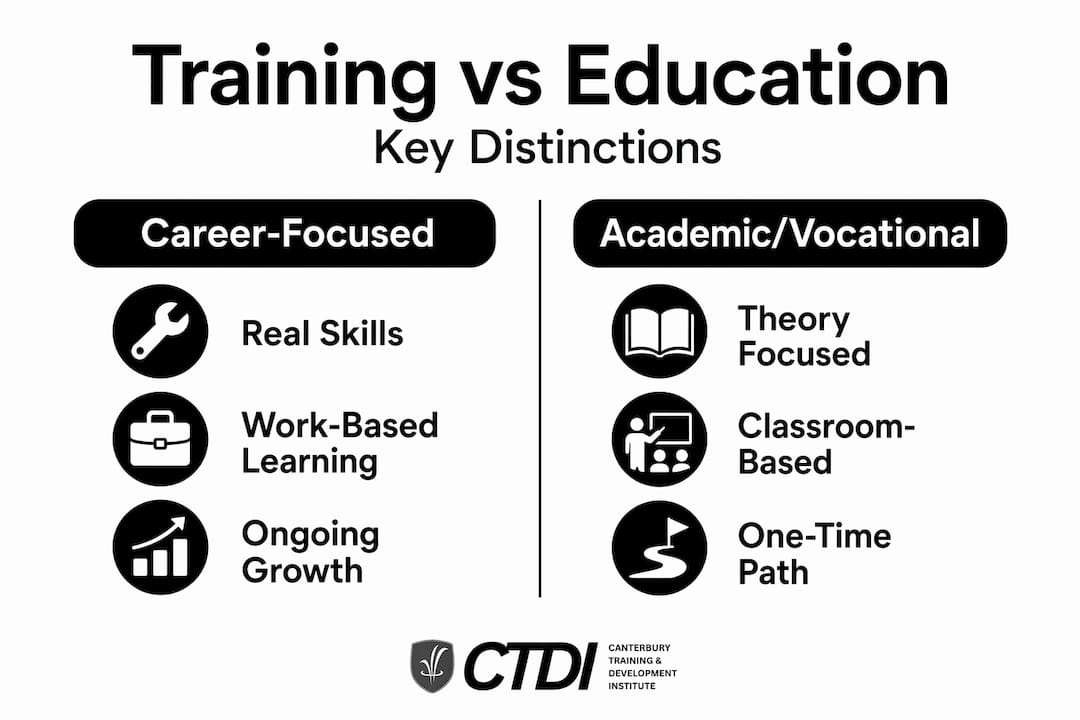
Vocational training focuses on practical skills and job performance rather than theoretical mastery. Career-focused training is a broader category that includes vocational programmes but also post-secondary diplomas, professional development sequences, and structured work-based learning at any stage of a career.
Career and Technical Education programmes provide a useful contrast to traditional academic degrees. They emphasise in-demand skills, hands-on learning, and practical outcomes. The core question is not which path is superior. It is which path aligns with what you actually want to do and what the labour market in your field genuinely values.
How to choose the right training programme
Choosing a career training programme is not just about finding something that sounds relevant. The wrong programme wastes time and money. The right one accelerates everything.
Here is how to evaluate your options honestly:
- Start with the job, not the course. Look at job advertisements for the roles you want and identify what qualifications and skills employers actually ask for. Then find programmes that explicitly develop those competencies, not just ones with similar-sounding titles.
- Check for workplace alignment. Training should align competencies explicitly with real workplace demands. Ask the provider how their curriculum maps to actual job tasks. A good provider can show you this clearly.
- Scrutinise the work-based learning component. Does the programme include supervised placements? Who coordinates them? What are the learning goals and how is your progress assessed during the placement?
- Look at pathways, not just the certificate. Career-focused training often includes multiple stages from initial certification through to advanced qualifications. Choose a programme with clear progression options so your investment compounds over time.
- Assess delivery format. Online and self-paced delivery allows you to study while working, which matters if you are already employed. Online learning unlocks flexibility that campus-based programmes cannot always offer. Confirm that the online format includes proper support, not just videos to watch.
- Verify the provider's track record. Look for nationally recognised accreditation, industry partnerships, and evidence of graduate employment outcomes. Testimonials are useful, but employment data is better.
Pro Tip: Before enrolling, contact the provider and ask directly: "Can you show me where your graduates are working?" A confident, specific answer tells you the programme has real industry connections. A vague or evasive answer tells you something else entirely.
For help understanding the range of vocational course types available and how they align with different career directions, exploring a structured overview can save you considerable research time.
My take on career-focused training's real value
I have spent years watching people navigate the gap between education and employment, and one pattern stands out: the biggest mistake people make is treating career-focused training as a last resort or a lesser option compared to a university degree. That framing is outdated and expensive.
What I have seen work consistently is structured training that combines clear occupational goals with real supervised work experience. Not because the certificate itself opens doors, although it does, but because the combination of practical skill and documented workplace performance creates a profile that employers trust. It signals something a degree alone cannot: that you can do the work, not just understand it.
The other thing I would push back on is the idea that this type of training is something you do once. The most professionally resilient people I have observed treat career development training as a permanent habit. They complete an initial qualification, enter the workforce, identify the next gap, and address it deliberately. That cycle of professional development and skills growth is what separates people who plateau from people who keep advancing.
The common pitfall is choosing a programme based on price or convenience alone, without checking whether the curriculum connects to real job requirements. You can spend six months on a certificate that nobody in your target industry recognises. Checking accreditation and employer recognition upfront costs ten minutes and saves enormous frustration.
If you are weighing your options right now, my strongest advice is to treat this as a research project. Talk to people already working in your target field. Ask what qualifications they actually use. Then find the programme that gets you there with the shortest credible path.
— Sam
Start your career-focused training with CTDI
If you are ready to move from research into action, the Canterbury Training and Development Institute offers nationally recognised, 100% online programmes built specifically around current industry demand. Courses are designed by industry professionals and delivered in self-paced formats, so you can study around your existing commitments without compromising on quality.
Whether you are interested in an Advanced Diploma of Digital Marketing combining AI-powered marketing skills, a Certificate IV in Environmental Sustainability for a green career pathway, or another high-demand field, Edu's programmes include dedicated student support services and clear pathways to further study. Expert trainers guide you through practical, competency-based content aligned with what employers actually look for. If you are ready to take the next step, explore current enrolment options and find the programme that fits your career direction.
FAQ
What is career-focused training in simple terms?
Career-focused training is structured education built around a specific occupation or industry, designed to give you the practical skills and qualifications needed to get hired and perform your job well. It includes formats such as certificates, diplomas, apprenticeships, and work placements.
How is career-focused training different from a university degree?
A university degree prioritises academic knowledge and critical thinking across a broad discipline. Career-focused training prioritises occupational competence, practical skills, and job readiness, typically in less time and with more direct links to specific roles.
What types of work-based learning are included in career training?
Common work-based learning formats include internships, apprenticeships, practicums, and work-study arrangements. Each involves supervised experience in a real workplace with defined learning goals and formal assessment, which distinguishes structured training from simply working a casual job.
Does career-focused training support long-term career growth?
Yes. UNESCO recognises career-focused training as part of a lifelong learning framework, meaning it supports ongoing professional development and skill updates throughout your career, not just at the entry level.
How do I know if a career training programme is worth it?
Check whether the curriculum aligns with real job requirements in your field, whether work placements are supervised and assessed, and whether the provider holds nationally recognised accreditation. Asking for graduate employment data is one of the most reliable indicators of a programme's practical value.