

TL;DR:
- Active trainer presence is the key factor predicting student success, surpassing course content and technology. Trainers design personalized learning experiences, monitor engagement, and proactively support students to improve retention and outcomes. The most effective support occurs when institutions develop structured roles, ongoing trainer development, and coordinated support teams.
Active trainer presence is the single biggest predictor of student success in educational environments, surpassing both course content quality and technology sophistication. The role of trainers in student support extends far beyond delivering lessons. Trainers design learning pathways, monitor engagement, provide personalised feedback, and act as mentors who keep students on track when motivation drops. Canterbury Training and Development Institute (CTDI) recognises this reality across its online vocational programmes, where trainer visibility directly shapes learner confidence and completion rates. Student Success Coaches, athletic trainers, and vocational educators each represent distinct but overlapping expressions of this support function.
What key responsibilities do trainers fulfil in student support?
Trainers carry a broad set of responsibilities that collectively determine whether a student succeeds or withdraws. The most visible duty is content delivery, but the less visible work, including monitoring, mentoring, and proactive outreach, is where the real impact occurs.

Designing and delivering learning experiences
Trainers sequence course content to match learner readiness, not just syllabus requirements. A trainer who front-loads complex theory without scaffolding loses students in week two. Effective trainers use multiple delivery formats, including video walkthroughs, live sessions, written guides, and discussion forums, to reach different learning styles. Workplace trainers blend formal structured modules with mentoring and coaching, forming the learning relationships that make skill acquisition stick.
Providing feedback and competency assessment
Timely, specific feedback is one of the most direct ways trainers support student progress. Generic comments like "good work" do nothing. Trainers who identify exactly where a student's reasoning breaks down, and explain why, accelerate learning far faster than any automated quiz. Competency assessments in vocational education require trainers to judge not just knowledge but applied skill, which demands close observation and professional judgement.
Proactive monitoring and at-risk outreach
Trainers monitor engagement data and proactively reach out to students who disengage for a week or more. This single practice reduces dropout rates more than any course redesign. In online environments, silence from a student is a warning sign, not a neutral signal. Trainers who treat disengagement as an early indicator of withdrawal, rather than a personal choice, catch problems before they become permanent exits.
The core trainer responsibilities in student success include:
- Designing content sequences aligned to learner needs and national standards
- Delivering lessons across video, live, and written formats
- Facilitating discussion forums and peer collaboration
- Providing personalised, competency-based feedback
- Monitoring engagement and conducting proactive check-ins
- Mentoring students through academic and motivational challenges
Pro Tip: Set a calendar reminder to personally contact any student who has not logged in or submitted work within seven days. A single message asking "Is everything okay?" has a measurably higher retention impact than any automated nudge.
How does trainer presence affect student outcomes?
Active trainer presence narrows the pass-rate gap between online and face-to-face learning to 3.1%. When trainers shift to asynchronous-only delivery with no live interaction, that gap widens to 5.8%. That difference represents real students who pass or fail based on whether a trainer shows up in a meaningful way.
The engagement and retention connection
Strong instructor presence improves student engagement, satisfaction, and reduces dropout rates across both vocational and higher education settings. Engagement is not a soft metric. It predicts completion, and completion predicts career outcomes. Trainers who run weekly live Q&A sessions, respond to forum posts within 24 hours, and personalise their feedback create an environment where students feel accountable to someone, not just to a deadline.
Adult learners carry particular burdens into education. Many return to study after years away from formal learning, carrying anxiety about technology, academic writing, and self-worth. Engaged trainers help adult learners overcome these barriers by normalising struggle and providing targeted support before anxiety becomes withdrawal.
What the data shows
| Delivery mode | Pass-rate gap vs face-to-face | Key trainer behaviour |
|---|---|---|
| Synchronous with active trainer | 3.1% | Live sessions, proactive check-ins |
| Asynchronous only | 5.8% | Pre-recorded content, no live contact |
| Blended with mentoring | Narrowest gap | Combines both modes with coaching |
"Trainers bridge the gap that causes programme failures when knowledge does not translate into learner action." — Smile Foundation
Trainers also serve as the connecting link between educational staff, support services, and students' broader lives. A student who feels their trainer genuinely knows them is far less likely to quietly disappear from a course. That relationship is not a bonus. It is the mechanism through which all other support systems become accessible.
How do different trainer roles complement each other?
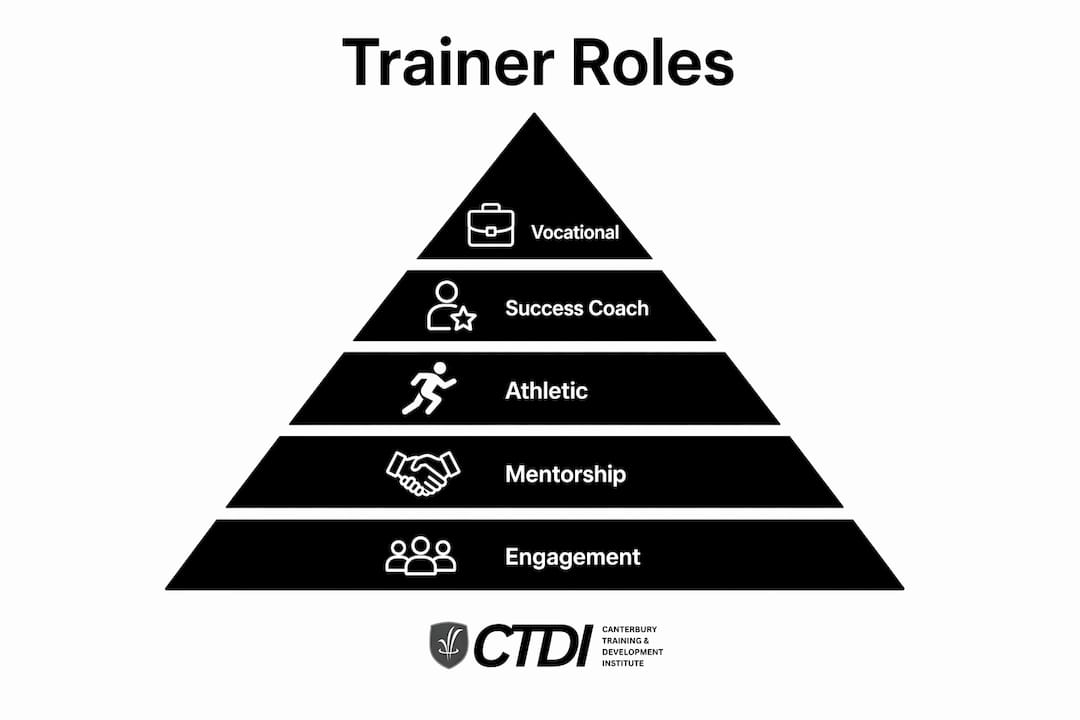
The benefits of trainers for learners multiply when institutions deploy multiple specialised roles rather than expecting one person to do everything. Three distinct roles illustrate how this works in practice.
General vocational trainers
General trainers in vocational education deliver curriculum, assess competency, and provide mentorship within their subject domain. Their authority comes from industry experience, not just academic credentials. A trainer who has actually worked in digital marketing, environmental management, or AI implementation brings credibility that a purely academic instructor cannot replicate. This credibility matters because adult learners constantly ask "will this actually work in the real world?"
Student success coaches
Student success coaches focus specifically on personalised academic and motivational support. They manage caseloads, conduct one-on-one check-ins, and build individual success plans for students at risk of falling behind. This role has grown significantly by 2026 as institutions recognise that academic support and subject instruction are different skills requiring different people. A student success coach does not teach the content. They teach the student how to persist through the content.
Athletic trainers in school settings
Athletic trainers operate at the intersection of healthcare and education. The National Athletic Trainers' Association (NATA) estimates that athletic trainers save an estimated $14.7 million per state annually by reducing emergency visits and supporting student wellbeing onsite. Beyond injury prevention, athletic trainers function as trusted sounding boards for students dealing with personal problems, reducing the load on counsellors and teachers. Their physical presence in schools creates an informal support network that keeps students engaged and attending.
The comparison below shows how each role addresses different but overlapping student needs:
| Trainer type | Primary focus | Student need addressed |
|---|---|---|
| Vocational trainer | Subject delivery and competency | Academic skill and industry knowledge |
| Student success coach | Retention and motivation | Persistence, planning, and confidence |
| Athletic trainer | Physical health and wellbeing | Safety, attendance, and informal support |
Each role addresses a different dimension of the student experience. When these roles coordinate rather than operate in silos, the result is a support ecosystem where no student falls through the gap between services.
What practical approaches maximise trainer-led student support?
Institutions that want to improve student outcomes through trainer support need a structured approach, not a collection of good intentions. The following practices produce measurable results.
-
Invest in trainer professional development. Well-trained educators are directly linked with deeper critical thinking and higher grades among students. Trainers who receive ongoing development in facilitation, feedback, and learner psychology become more effective faster than those left to figure it out alone. Institutions that treat trainer development as a cost rather than an investment consistently underperform on retention metrics.
-
Build proactive engagement into the delivery schedule. Reactive support, where trainers wait for students to ask for help, misses the students who most need intervention. Proactive check-ins, scheduled at weeks two, four, and six of a course, catch disengagement before it becomes dropout. The role of support services in e-learning works best when trainers and student services teams share engagement data and coordinate outreach.
-
Prioritise trust before instruction. Trainers must first build trust and ensure students feel safe and supported before academic learning effectively occurs. This is not a soft principle. It is a practical prerequisite. A student who does not trust their trainer will not ask questions, will not admit confusion, and will quietly disengage rather than seek help.
-
Blend teaching with mentoring and coaching frameworks. Formal instruction alone does not produce skilled graduates. Trainers who incorporate active listening and tailored support into their practice help learners overcome specific obstacles rather than generic ones. This means asking "what specifically is stopping you?" rather than offering generic encouragement.
-
Use synchronous delivery modes strategically. Live sessions do not need to replace self-paced content. They need to supplement it at the moments when students are most likely to disengage. A 30-minute live Q&A after a complex assessment brief does more for retention than three additional video modules.
-
Coordinate trainer roles with broader student services. Trainers who know when to refer a student to a counsellor, a disability support officer, or a financial aid adviser extend their impact beyond their own capacity. Coordination between trainer roles and institutional support teams creates the integrated care model that prevents students from falling through administrative gaps.
Pro Tip: Create a shared engagement dashboard that both trainers and student support staff can access. When a trainer flags a student as at risk, the support team can follow up within 48 hours, doubling the chance of retention without doubling the trainer's workload.
Key takeaways
The trainer's active presence, not the platform or the content, is the defining factor in whether students complete their studies and apply what they learn.
| Point | Details |
|---|---|
| Trainer presence drives outcomes | Synchronous trainer engagement narrows the online-to-face-to-face pass-rate gap to 3.1%. |
| Proactive outreach prevents dropout | Reaching out to disengaged students within seven days is the most effective retention strategy. |
| Specialised roles address different needs | Vocational trainers, student success coaches, and athletic trainers each support distinct but overlapping student needs. |
| Trust precedes learning | Students must feel safe and supported before academic instruction becomes effective. |
| Professional development multiplies impact | Ongoing trainer development directly improves student critical thinking and course completion. |
What I've learned watching trainers make or break student success
Working closely with vocational education over many years, the pattern I keep seeing is this: the course content rarely determines whether a student finishes. The trainer does.
I have watched two students enrol in identical programmes at the same time. One had a trainer who ran weekly live sessions, responded to questions within a day, and sent a personal message when the student went quiet for ten days. The other had a trainer who uploaded pre-recorded videos and marked assessments. The first student graduated. The second withdrew in week seven.
What strikes me most is how little institutions invest in the human infrastructure of education compared to the digital infrastructure. Institutions will spend significant resources on a new learning management system and then give trainers no guidance on how to use it to connect with students. The technology is not the problem. The relationship is the problem.
The expanding scope of trainer responsibilities also concerns me. Trainers are increasingly expected to address mental health, digital literacy, and career coaching alongside their subject expertise. That is a lot to ask of one person. The institutions that handle this well are the ones that build genuine teams around their trainers, including student success coaches and support staff, rather than treating the trainer as the sole point of contact for every student need.
The future of trainer-led support lies in better coordination, not more burden on individual trainers. Institutions that invest in professional development for their trainers and build structured support teams around them will consistently outperform those that rely on individual heroics.
— Sam
Edu's online programmes for educators and training professionals
Edu, the Canterbury Training and Development Institute, offers 100% online diplomas designed for professionals who want to build real capability in their field. For educators and administrators focused on improving learner outcomes, CTDI's programmes in AI, digital marketing, and environmental sustainability provide the industry-grounded skills that translate directly into better training practice.

CTDI courses are self-paced, nationally recognised, and built by industry experts who understand what effective training looks like in practice. Whether you are a trainer looking to upskill or an administrator building a stronger support team, enrol in a CTDI diploma to take the next step. For those specifically interested in digital skills, the Advanced Diploma of Digital Marketing offers a structured pathway into one of Australia's fastest-growing career areas.
FAQ
What is the role of trainers in student support?
Trainers provide instruction, personalised feedback, proactive engagement, and mentorship that collectively determine whether students complete their studies. Active trainer presence is the single biggest predictor of student success, ahead of course content and technology.
How do trainers improve student retention?
Trainers reduce dropout rates by monitoring engagement data and reaching out to students who disengage for a week or more. Synchronous delivery with active trainer involvement narrows the pass-rate gap between online and face-to-face learning to 3.1%.
What is a student success coach and how do they differ from a trainer?
A student success coach focuses specifically on personalised retention support, managing caseloads and building individual academic plans, rather than delivering subject content. Trainers teach the curriculum; student success coaches teach students how to persist through it.
Why does trust matter in trainer-student relationships?
Students must feel safe and supported before academic learning can effectively occur. A student who does not trust their trainer will not admit confusion or ask for help, which leads to quiet disengagement rather than visible struggle.
How does professional development for trainers benefit students?
Well-trained educators are directly linked with deeper critical thinking and higher grades among students. Ongoing trainer development in facilitation, feedback, and learner psychology produces measurable improvements in student outcomes.