

TL;DR:
- Support services in e-learning encompass technical, administrative, pedagogical, and participation systems critical for learner success. They ensure platform reliability, effective engagement, and equity, significantly affecting satisfaction and completion rates. True success in online education depends on integrating these layers seamlessly and prioritizing human and technological support.
Support services in e-learning are defined as the technical, administrative, pedagogical, and participatory systems that enable learners to access, engage with, and succeed in online education. Without them, even the best course content fails to deliver results. Research confirms that system quality and administrative support are the strongest predictors of student satisfaction in online learning environments. For educators, administrators, and learners navigating virtual education in 2026, understanding how these services work together is the difference between a course that retains students and one that loses them before completion.
What is the role of support services in e-learning?
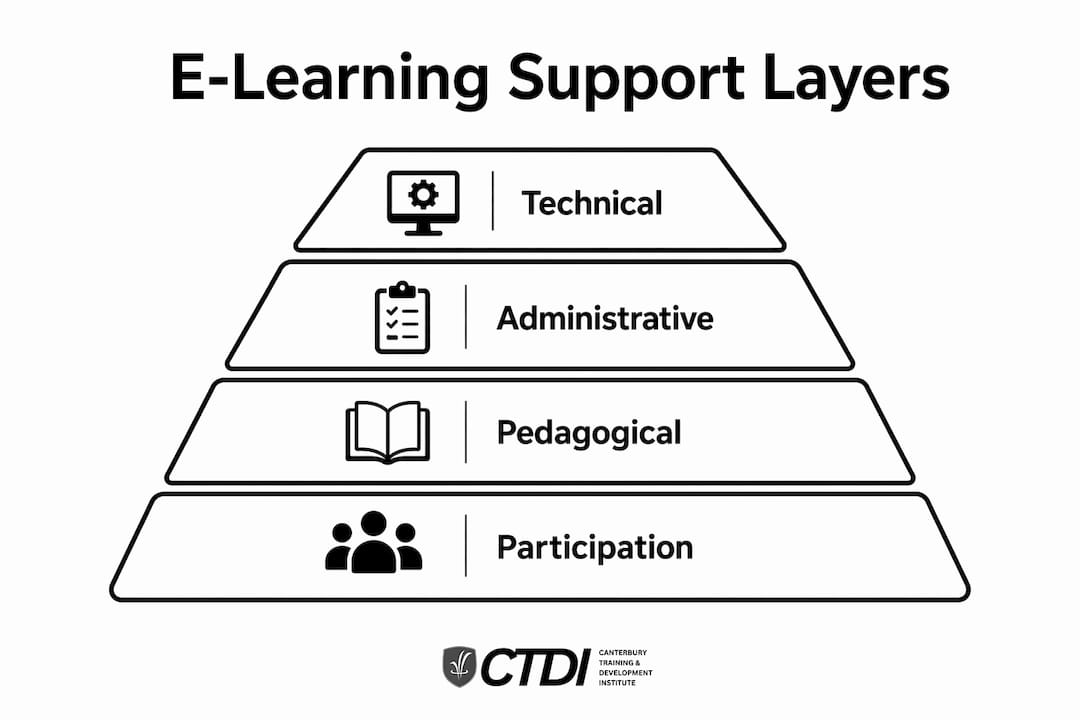
Support services in e-learning span four distinct layers: technical infrastructure, administrative coordination, pedagogical guidance, and participation facilitation. Each layer serves a different function, yet all four must operate together for online education to succeed at scale. The industry term for this integrated model is learner support services, and it encompasses everything from platform troubleshooting to tutor feedback and community outreach.
Technical support keeps the learning environment functional. Administrative support handles enrolment, scheduling, and compliance. Pedagogical support shapes how learners engage with content and receive feedback. Participation support uses proactive strategies to keep learners showing up and completing modules. When any one of these layers is absent or underfunded, learner dissatisfaction follows regardless of how well the course itself is designed.
UNESCO's work across Latin America and the World Bank's research in Ecuador both confirm that distance learning support is treated as fundamental to the right to learn, not a supplementary add-on. This framing matters for administrators who are deciding where to allocate resources. Support services are not a cost centre. They are the infrastructure that makes online education viable.
How does technical and system support affect student satisfaction?
Technical system quality is the single strongest predictor of student satisfaction in e-learning. A 2026 Frontiers systematic review found that system quality effects on student satisfaction carry a standardised effect size of β=0.437, the highest of any support factor measured. This means that before pedagogy, before tutor quality, before course design, the platform must work reliably and consistently.

Administrative support follows closely, with a standardised effect of β=0.352. Together, these two factors function as what researchers call hygiene factors: their absence causes dissatisfaction, but their presence alone does not guarantee satisfaction. Once they are in place, pedagogical supports become the motivators that push satisfaction higher. This layered model has direct implications for how institutions should sequence their support investments.
Virtual education support technicians sit at the centre of this technical layer. Their role, formalised through UNESCO's educational continuity programme in Peru, extends well beyond IT helpdesk functions. These technicians are responsible for instructional quality assurance, platform continuity, and rapid troubleshooting that prevents learners from getting stuck mid-module. When their role is clearly defined and resourced, operational issues are resolved before they escalate into dropout events.
Administrative support complements technical reliability by managing the processes that surround learning. Enrolment accuracy, timetable clarity, assessment scheduling, and compliance documentation all reduce cognitive load for learners. When administrative systems fail, learners spend time chasing information instead of studying. The effect on satisfaction is measurable and direct.
Pro Tip: Design your technical and administrative support workflows as continuous processes rather than reactive ones. Build in pre-enrolment guidance, onboarding checklists, and clear escalation pathways so learners never reach a dead end without a next step.
What pedagogical supports enhance learner engagement online?
Pedagogical support is the motivator layer of e-learning. Once technical and administrative hygiene factors are met, the quality of instructional design, tutor availability, and personalised feedback determines whether learners stay engaged and complete their courses. This is where the role of tutors in e-learning becomes most visible and most consequential.
UNESCO's educational continuity initiative in Peru provides one of the clearest documented examples of pedagogical support at scale. The programme trained over 2,170 teachers and technical support teams in digital skills and time management specifically for non-face-to-face education environments. The outcome was not just improved teacher confidence. It was a measurable improvement in the quality of academic service delivered to students who had no physical classroom to fall back on.
Personalised feedback loops are among the most effective pedagogical tools available in online settings. When learners receive specific, timely responses to their work, they are more likely to correct misconceptions early and persist through difficult content. Tutors who are trained to deliver feedback in asynchronous formats, through recorded video, annotated documents, or structured written responses, replicate much of the relational value of face-to-face teaching.
Common academic support services that institutions should build into their e-learning programmes include:
- Orientation programmes that introduce learners to the platform, assessment expectations, and available support channels before the course begins
- Structured feedback loops where tutors respond to submitted work within defined timeframes
- Peer study groups facilitated through discussion boards or video conferencing tools like Zoom or Microsoft Teams
- Academic counselling for learners experiencing difficulty with workload, comprehension, or motivation
- Digital literacy training that builds learner confidence with the tools and platforms used throughout the course
Each of these services addresses a specific point where learners are most likely to disengage. Orientation reduces early dropout. Feedback reduces confusion. Peer groups reduce isolation. Counselling addresses the personal barriers that course content alone cannot resolve. Understanding how expert trainers shape outcomes in online settings helps clarify why investing in pedagogical support staff is as important as investing in platform technology.
What methods support learner participation and reduce dropout?
Participation support is the most proactive dimension of e-learning support services. Rather than waiting for learners to seek help, participation support uses structured interventions to keep students engaged before disengagement takes hold. The World Bank's research in Ecuador high schools demonstrates exactly how this works at scale.
The Ecuador study tested system-level, teacher-level, and student-level interventions simultaneously. Multi-level participation nudges including SMS reminders, lottery incentives, peer-study encouragement, and teacher-produced video content improved both module completion rates and overall learning outcomes. The finding that matters most for administrators is this: participation support reduces reliance on student self-regulation, which is the single greatest predictor of dropout in online learning environments.
The table below compares the most effective participation support methods, their primary audience, and their documented outcomes.
| Support method | Target user | Documented outcome |
|---|---|---|
| SMS reminders | Students | Increased module take-up and on-time completion |
| Teacher video messages | Students | Improved motivation and perceived instructor presence |
| Peer-study prompts | Students | Reduced isolation and higher engagement in discussion tasks |
| Lottery and incentive schemes | Students | Short-term participation spikes that build completion habits |
| Onboarding orientation sessions | New enrolees | Lower early dropout rates and faster platform confidence |
These methods work because they address the structural gap between enrolment intent and actual participation. A learner who signs up for an online course with genuine motivation can still disengage within two weeks if they receive no contact, no community, and no reminder that the course exists. Effective remote engagement strategies treat participation as something that must be actively cultivated, not assumed.
Pro Tip: Integrate participation nudges directly into your learning management system workflows. Automate SMS or email reminders at key points such as three days before an assessment deadline, one week after a learner last logged in, and at the midpoint of each module.
How do community and institutional support models improve equity in e-learning?
Access to e-learning is not equal, and support services are the primary mechanism for closing that gap. Socio-economic disadvantage, limited device access, unreliable internet connectivity, and low digital literacy all prevent learners from benefiting from online education even when courses are freely available. Community and institutional support models address these barriers directly.
UNESCO's Education Information Network, known as EBA, provides the most documented example of community-level support at scale. EBA Support Points helped over one million students access distance education during 2020 and 2021 by establishing localised access points that overcame socio-economic and connectivity barriers. These were not simply internet cafes. They were staffed, resourced hubs that provided device access, technical assistance, and guided support for learners who could not engage with online education independently from home.
Institutional commitment is equally important. When universities and training providers formalise their support ecosystems through policy, dedicated staffing, and cross-sector partnerships, the results are measurable. Ongoing digital skills training for both staff and learners improves the effective use of online platforms and reduces the technical anxiety that causes many first-time online learners to abandon courses before they begin.
Equity-focused support services that institutions should consider include:
- Device loan programmes that provide tablets or laptops to learners without reliable home technology
- Community learning hubs in libraries, community centres, or partner organisations that offer supervised access to online courses
- Connectivity subsidies or partnerships with telecommunications providers to reduce data costs for enrolled students
- Multilingual support materials that remove language barriers for non-English-speaking learners
- Flexible scheduling options that accommodate learners managing work, caregiving, or other commitments alongside study
Multi-sector collaboration is the mechanism that makes these services sustainable. When training providers partner with local councils, libraries, telecommunications companies, and community organisations, the cost of equity-focused support is distributed across multiple stakeholders. The result is a support ecosystem that no single institution could build alone. For learners considering why online learning suits their circumstances, knowing that structured equity supports exist is often the deciding factor in enrolment.
Key takeaways
Effective e-learning requires technical, administrative, pedagogical, and participation support services working together, because no single layer alone prevents dropout or drives satisfaction.
| Point | Details |
|---|---|
| Technical support is foundational | System quality carries the strongest effect on satisfaction (β=0.437) and must be resolved before other supports can motivate learners. |
| Admin support prevents dissatisfaction | Administrative efficiency acts as a hygiene factor; poor processes cause learner frustration regardless of teaching quality. |
| Pedagogy drives engagement | Tutor availability, personalised feedback, and structured orientation are the motivator factors that lift satisfaction once hygiene needs are met. |
| Participation nudges reduce dropout | SMS reminders, peer prompts, and incentive schemes measurably improve module completion by reducing reliance on self-regulation. |
| Community models close equity gaps | Localised support points and device access programmes extend e-learning to learners who cannot engage independently from home. |
Why integrated support is the real differentiator in online education
After working closely with online education programmes across multiple sectors, the pattern I keep seeing is the same. Institutions invest heavily in course content and platform technology, then treat support services as an afterthought. The result is predictable: high enrolment, low completion, and learner feedback that points to feeling lost or unsupported rather than to any flaw in the curriculum itself.
The research from the 2026 Frontiers systematic review confirms what experienced practitioners already know. Technical and administrative support are not optional extras. They are the floor. Without them, even excellent teaching cannot prevent dissatisfaction. But what the research also shows, and what many administrators miss, is that once the floor is in place, it is the human layer of support that determines whether learners thrive.
The formalisation of virtual education support technician roles, as documented through UNESCO's Peru programme, is one of the most underappreciated developments in online education management. When these roles are clearly defined and treated as part of instructional quality assurance rather than IT maintenance, the entire support ecosystem becomes more coherent. Learners get faster resolutions. Educators get fewer interruptions. Administrators get cleaner data on where support gaps exist.
What I find most compelling about the World Bank's Ecuador findings is the proof that participation support does not require large budgets. SMS reminders, peer-study prompts, and teacher video messages are low-cost interventions with measurable outcomes. The barrier to implementation is not financial. It is organisational. Institutions need to treat participation as a managed process, not a learner responsibility.
The future of e-learning support will involve more automation, more data-driven triage, and more personalised intervention timing. But the human element will not disappear. The most effective support models combine technology for scale with human judgement for the moments that matter most, such as when a learner is struggling, isolated, or about to quit.
— Sam
Experience supported online learning with Edu
Edu, the Canterbury Training and Development Institute (CTDI), builds its online programmes around the exact support principles this article covers. From pre-enrolment guidance through to expert trainer feedback and technical assistance, every course is designed to keep you progressing with confidence.

Whether you are pursuing an Advanced Diploma in Digital Marketing, a qualification in AI, or a Certificate IV in Environmental Sustainability, Edu's courses are delivered 100% online with industry-expert trainers and dedicated learner support at every stage. You do not have to figure it out alone. Enrol now and experience what genuinely supported online education looks like in practice.
FAQ
What are the main types of e-learning support services?
The main types are technical support, administrative support, pedagogical support, and participation support. Each addresses a different barrier to learner success, from platform reliability through to tutor feedback and engagement nudges.
Why is technical support the most important factor in e-learning satisfaction?
Research from a 2026 Frontiers systematic review found that system quality carries the highest standardised effect on student satisfaction (β=0.437). When platforms are unreliable, learners disengage before pedagogical supports can have any effect.
How do participation support services reduce dropout rates?
Multi-level participation interventions such as SMS reminders, peer-study prompts, and teacher video messages reduce dropout by decreasing reliance on student self-regulation. World Bank research in Ecuador confirmed these methods improve both module take-up and completion rates.
What is the role of tutors in e-learning?
Tutors in e-learning provide personalised feedback, academic guidance, and motivational support that replicate the relational value of face-to-face teaching. Their availability and responsiveness are among the strongest pedagogical motivators in online education environments.
How do community support models improve access to e-learning?
UNESCO's EBA Support Points helped over one million students access distance education by providing localised hubs with device access, technical assistance, and guided support. These models address socio-economic and connectivity barriers that prevent disadvantaged learners from engaging independently.