

TL;DR:
- Self-paced learning allows learners to control their study timing, pace, and sequence without fixed schedules. It is delivered through digital platforms offering flexible access, enabling individuals to revisit content and progress independently. Success relies on self-regulation, structured planning, and quality support, making it ideal for busy professionals and remote learners.
Self-paced learning is defined as an educational approach where learners control the timing, pace, and often the sequence of their studies without fixed schedules or real-time instruction. Unlike a traditional classroom or a live webinar, there is no instructor waiting for you at 9am on Tuesday. You decide when you open the course, how long you spend on each module, and when you move forward. This model sits within the broader category of asynchronous learning, but it goes further by placing genuine autonomy in the learner's hands. For students balancing work, family, and study, or professionals seeking to upskill without disrupting their careers, understanding how self-paced study works is the first step toward choosing the right learning format.
What is self-paced learning and how does it work?
Self-paced learning operates through digital delivery platforms, most commonly a Learning Management System (LMS) such as Moodle, Canvas, or Blackboard. These platforms host pre-recorded video lessons, interactive modules, branching scenarios, and knowledge checks that learners complete on their own schedule. There is no live class to attend and no cohort moving through the material at the same speed as you.
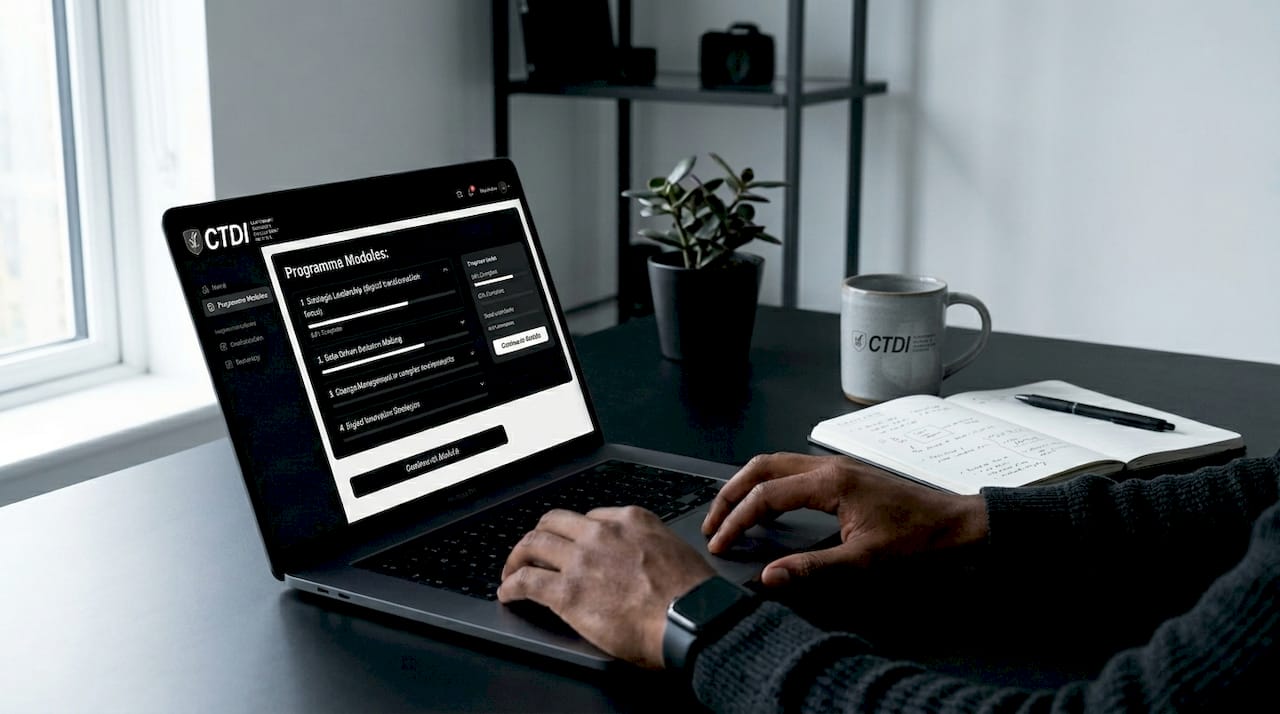
The defining feature is learner control. You log in at midnight or during a lunch break, revisit a concept you did not fully grasp the first time, or fast-track through material you already know. 24/7 access to materials is a standard characteristic of well-designed self-paced programmes, and it is precisely this feature that makes the format attractive to adult learners with unpredictable schedules.
It is worth clarifying the distinction between asynchronous learning and self-paced learning, because the two terms are often used interchangeably but they are not identical. Cohort-based asynchronous programmes with weekly deadlines are asynchronous but not self-paced. In those models, you complete work in your own time but you must keep up with the group. True self-paced education removes the group timeline entirely, letting you progress independently.
The table below compares the three main delivery formats you are likely to encounter.
| Feature | Self-paced | Cohort-based asynchronous | Synchronous (live) |
|---|---|---|---|
| Schedule | Fully flexible | Weekly deadlines | Fixed class times |
| Interaction | Forums, email | Peer discussion boards | Live video, Q&A |
| Pace control | Learner sets pace | Group sets pace | Instructor sets pace |
| Accountability | Self-directed | Peer and instructor | Instructor-led |
| Repetition | Unlimited replays | Limited by deadlines | Real-time only |
Pro Tip: When selecting a self-paced platform, look for one that includes progress tracking, built-in knowledge checks, and access to a human support contact. Platforms without these features tend to produce lower completion rates.
What are the main advantages and challenges of self-paced learning?
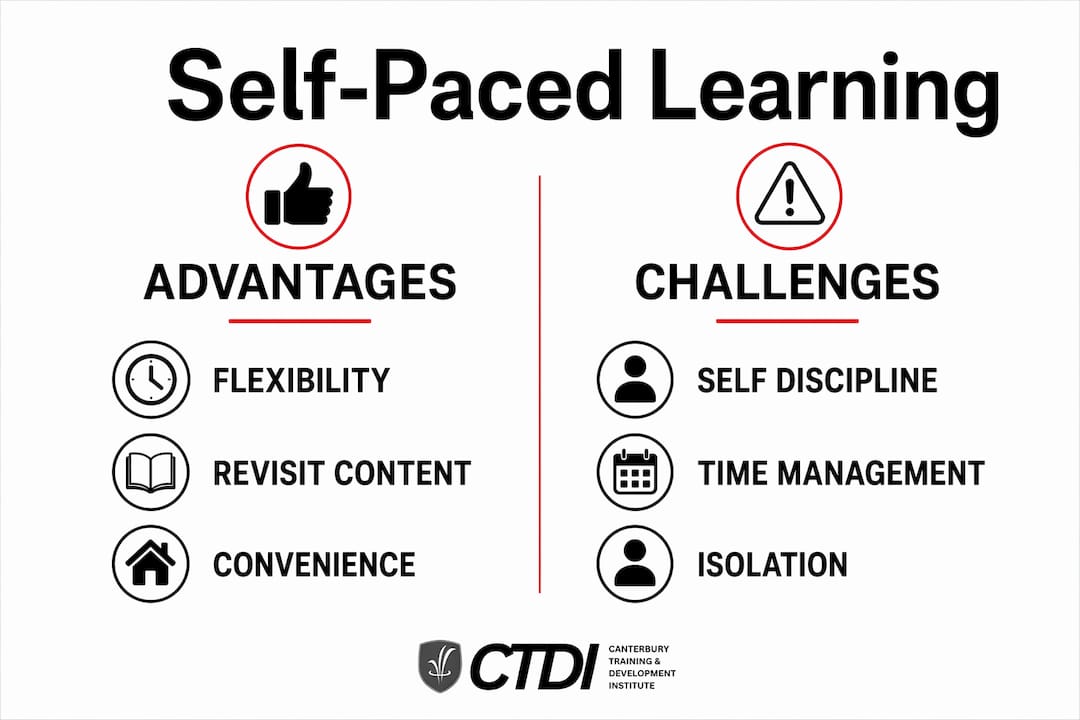
The advantages of self-paced learning are most visible when you look at who adult learners actually are. The OECD's 2025 report found that one in four adults face barriers to participating in education, with lack of time and cost topping the list. Self-paced education directly addresses both. You pay once for access and study whenever a window opens in your day, whether that is 20 minutes on a commute or two hours on a Sunday morning.
Beyond convenience, the format offers genuine pedagogical advantages. Learners can revisit difficult concepts as many times as needed, which is something a live lecture simply cannot offer. Professionals who already have background knowledge in a subject can move through foundational content quickly and spend more time on advanced material. This kind of pace control is not available in a cohort model where the group moves together regardless of individual readiness.
The benefits of self-paced learning extend to organisations as well. Companies using self-paced LMS-based training can onboard large numbers of staff without coordinating schedules, making it a practical choice for distributed teams across different time zones.
That said, the format is not without its challenges. Self-paced learning demands strong self-regulation and personal discipline, because progress relies entirely on the learner's initiative. Without a class to attend or peers to keep pace with, it is easy to deprioritise study when life gets busy. Procrastination is the most commonly cited obstacle among self-paced learners, and it is a real one.
Some learners also report feelings of isolation. The absence of real-time peer interaction can make the experience feel solitary, particularly for those who thrive on discussion and debate. This is not a flaw in the format so much as a mismatch between the format and the learner's preferences.
Who benefits most from self-paced learning:
- Working professionals upskilling alongside full-time employment
- Parents managing study around family commitments
- Students in regional or remote areas without access to campus-based programmes
- Career changers who need to move at their own speed through unfamiliar content
- Employers training geographically distributed teams
Pro Tip: Treat your self-paced course like a scheduled appointment. Block specific study times in your calendar each week and protect them the same way you would a work meeting. Consistency beats intensity every time.
How does self-paced learning compare to other learning models?
The clearest contrast is between self-paced and cohort-based learning. In a cohort model, a group of learners begins and ends a course together, following a shared timeline. Cohort learning moves learners as a group on fixed timelines, which creates built-in accountability and peer connection but removes the flexibility that many adult learners need. If you miss a week due to work travel or illness, you fall behind the group.
Self-paced education inverts this structure. You can pause, rewind, or fast-track through concepts based on your own understanding and availability. There is no penalty for taking three weeks on a module that others complete in one, and no pressure to rush through content you find genuinely challenging.
Synchronous learning, where instructor and learners meet in real time via platforms like Zoom or Microsoft Teams, offers the richest interaction but the least flexibility. It suits learners who need immediate feedback and thrive in structured, socially engaging environments. The trade-off is that you must be available at a specific time, which is a significant constraint for many working adults.
The table below maps these differences clearly.
| Dimension | Self-paced | Cohort-based | Synchronous |
|---|---|---|---|
| Scheduling flexibility | High | Moderate | Low |
| Learner autonomy | High | Moderate | Low |
| Peer interaction | Low | High | High |
| Instructor feedback | Delayed or async | Delayed or async | Immediate |
| Completion accountability | Self-imposed | Peer and deadline | Instructor-led |
| Best suited for | Independent learners | Collaborative learners | Structured learners |
Neither format is universally superior. The right choice depends on your learning style, your schedule, and the nature of the skills you are developing. For knowledge-based content such as compliance training, digital marketing theory, or environmental management principles, self-paced formats perform well. For complex interpersonal skills that require live practice and real-time feedback, synchronous or blended models tend to produce better outcomes. You can explore this comparison further in Edu's guide on online versus classroom learning.
What practical strategies help you succeed in self-paced study?
Success in self-paced environments is not accidental. Research on self-regulated learning shows that learners who plan, monitor their progress, and reflect on their performance achieve significantly better outcomes in asynchronous settings than those who approach content passively. This is the discipline of self-directed learning, and it is a skill you can build deliberately.
One of the most common failure modes in self-paced programmes is treating the course as a passive content library. Without structured paths and accountability, learners browse materials without completing them, and completion rates suffer. The solution is to impose your own structure even when the programme does not require it.
A structured study plan for a self-paced course might look like this:
- Review the full course outline before you begin. Understand the total scope, identify which modules are most relevant to your immediate goals, and estimate realistic time requirements for each section.
- Set a personal completion date. Even if the programme has no hard deadline, give yourself one. Work backwards from that date to assign weekly study targets.
- Schedule fixed study blocks in your calendar. Treat these as non-negotiable appointments. Two focused hours per week beats sporadic marathon sessions that leave you fatigued and behind.
- Use progress tracking tools. Most LMS platforms display completion percentages. Check yours weekly and adjust your pace if you are falling behind your personal schedule.
- Engage with available support. Post questions in discussion forums, email your instructor, or join a study group if one exists. Effective skill development requires feedback and interaction, not just content consumption.
- Review and reflect after each module. Write a brief note on what you learned and how it connects to your work or study goals. This reflection step is what separates learners who retain knowledge from those who forget it within a week.
The tools that support this process are straightforward. Google Calendar or Outlook for scheduling, Notion or a simple checklist app for tracking module completion, and a dedicated study space that signals to your brain that it is time to focus. None of these require a subscription or technical expertise.
Pro Tip: Overestimating your available study time is the single most common planning error in self-paced learning. When building your study schedule, use half of what you think you have. Life will fill the rest.
Key takeaways
Self-paced learning succeeds when learner autonomy is matched with deliberate structure, consistent self-regulation, and access to quality support.
| Point | Details |
|---|---|
| Definition and format | Self-paced learning gives learners full control over timing and pace, delivered via LMS platforms with 24/7 access. |
| Distinct from asynchronous | Not all asynchronous learning is self-paced. Cohort-based programmes with deadlines are asynchronous but not self-paced. |
| Key advantages | Flexibility, cost accessibility, and the ability to revisit content make it ideal for working adults and professionals. |
| Main challenge | Self-regulation and personal discipline are required. Without structure, completion rates drop significantly. |
| Success strategy | Planning, progress monitoring, and seeking feedback are the three habits that separate successful self-paced learners from those who stall. |
Self-paced learning in 2026: what I've seen actually work
I have watched hundreds of learners move through self-paced programmes over the years, and the pattern is consistent. The learners who succeed are not necessarily the most academically capable. They are the ones who treat the course like a professional commitment rather than a personal project they will get to eventually.
The biggest misconception I encounter is that flexibility means ease. It does not. Self-paced education is flexible in scheduling, not in effort. If anything, it demands more from you than a structured classroom because no one is chasing you. The advantages of self-paced education are real and significant, but they are only accessible to learners who show up consistently.
What concerns me about the current market is the proliferation of programmes that offer flexibility without substance. A course that is nothing more than a folder of videos is not a self-paced programme. It is a content dump. Quality self-paced programmes include clear learning outcomes, structured pathways, progress gates, and access to human support. These elements are not optional extras. They are what separate a credential that employers respect from one they do not.
My advice to anyone considering self-paced study in 2026 is to choose a programme that balances genuine flexibility with genuine structure. Ask the provider what support is available, whether there are progress checkpoints, and what the completion rate looks like. Those questions will tell you more about the quality of a programme than any marketing copy.
— Sam
Start your self-paced learning journey with Edu
Edu, through the Canterbury Training and Development Institute (CTDI), offers nationally recognised online diplomas designed for learners who need flexibility without sacrificing quality. Courses in AI, digital marketing, and environmental sustainability are delivered 100% online, with learner-controlled pacing and expert trainer support built into every programme.

Whether you are a working professional looking to pivot careers or a student building credentials for the job market, CTDI's structured self-paced model gives you the autonomy to study on your terms. Programmes are developed by industry experts and aligned with current employer needs across Australia. Enrol in a diploma course today and take the first step toward a qualification that works around your life, not the other way around.
FAQ
What is self-paced learning in simple terms?
Self-paced learning is an educational format where you control when and how quickly you progress through course materials, with no fixed class times or live instructor sessions. You access content through an online platform and complete lessons, assessments, and activities on your own schedule.
Is self-paced learning the same as online learning?
Not exactly. Online learning is a broad category that includes live virtual classes, cohort-based programmes with weekly deadlines, and self-paced courses. Self-paced learning is one specific type of online delivery where the learner, not the instructor or cohort, sets the pace.
What are the main benefits of self-paced learning for working professionals?
The primary benefits are scheduling flexibility, the ability to revisit content as needed, and the removal of fixed attendance requirements. The OECD identifies time and cost as the top barriers for adult learners, and self-paced formats directly address both by allowing study during any available window without additional scheduling costs.
Why do some learners struggle with self-paced programmes?
The most common reason is insufficient self-regulation. Without external deadlines or peer accountability, learners tend to deprioritise study when competing demands arise. Research on self-regulated learning confirms that planning, progress monitoring, and reflection are the skills that determine success in self-paced environments.
How do I know if a self-paced programme is high quality?
Look for programmes that include clear learning outcomes, structured module pathways, progress tracking, knowledge checks, and access to human support such as an instructor or student services team. Programmes that offer only video content without these elements tend to produce low completion rates and limited skill development.