

TL;DR:
- Online learning offers structured, flexible education through various formats tailored to different needs. Its effectiveness depends on instructional quality, learner motivation, and appropriate course design. When well-chosen and committed to, online education can significantly enhance career growth and skills development.
Online learning is far more than sitting through video calls in your pyjamas. E-learning or virtual learning is structured education delivered through the internet, giving you access to lessons, quizzes, discussions, and practical tasks without ever stepping into a classroom. For Australians juggling work, family, and ambition, that distinction matters enormously. This article breaks down what online learning actually involves, maps out the different types and methods available, and explains why certain approaches produce better career outcomes than others. Whether you are a student starting out or a professional looking to upskill, this guide will give you a clear and practical picture.
Table of Contents
- Defining online learning: Core principles and types
- Comparing online learning methods: Strengths and suitability
- What makes online learning effective?
- Practical benefits for career and personal growth
- What most guides miss about online learning
- Take the next step with online learning
- Frequently asked questions
Key Takeaways
| Point | Details |
|---|---|
| Flexible access | Online learning allows you to study from anywhere at times that suit your life and career. |
| Diverse formats | Options like asynchronous, synchronous, and blended models match different learning preferences. |
| Career growth | Online courses are increasingly focused on job-ready skills and professional upskilling. |
| Evidence-based outcomes | Research shows online and blended learning can match or exceed traditional classroom results. |
| Success factors | Motivation, engagement, and quality program design are essential for positive learning outcomes. |
Defining online learning: Core principles and types
A lot of people still picture online learning as a simple swap: instead of sitting in a lecture hall, you watch the same lecture on a laptop. That is a significant underestimate of what the field actually offers. Online learning today is a broad ecosystem with distinct formats, pedagogical approaches, and technologies, all designed to serve different learners with different goals.
At its core, internet-based education provides access to structured content, whether that is video lectures, written modules, interactive quizzes, peer forums, or live sessions, through a digital platform. The defining feature is that a physical classroom is not required. But beyond that shared trait, the experience can vary dramatically depending on the format you choose.
The main types of online learning include:
- Asynchronous learning: You access pre-recorded lessons, readings, and assessments at any time that suits you. There is no requirement to log in at a set hour. This is the format most Australians imagine when they think of self-paced study.
- Synchronous learning: Sessions happen in real time, often via platforms like Zoom or Microsoft Teams, with live interaction between students and instructors. Think of it as a virtual classroom with a timetable.
- Blended or hybrid learning: A combination of online and face-to-face elements. You might complete theoretical modules online and then attend workshops or practical assessments in person.
- MOOCs (Massive Open Online Courses): Large-scale courses hosted by platforms like Coursera or edX, typically open to thousands of learners simultaneously, often with optional paid certification.
- Microlearning: Short, focused learning bursts, usually five to fifteen minutes long, designed to teach one specific skill or concept at a time.
- AI-assisted learning: Platforms that use artificial intelligence to personalise the learning pathway, adjust difficulty, provide instant feedback, and flag areas where a learner is struggling.
Each of these formats suits different learner needs, and understanding those differences is the first step to choosing the right path.
"The format of your online learning experience shapes your outcomes just as much as the content itself. Choosing the wrong structure for your lifestyle is one of the most common reasons learners disengage."
The vocational online education benefits are clearest when learners select a format that fits their actual schedule and preferred way of working, rather than defaulting to whatever is most advertised.
Pro Tip: Before enrolling in any online programme, ask yourself honestly whether you thrive with total schedule freedom or whether you need live accountability. Your honest answer should point you toward asynchronous or synchronous formats respectively.
Comparing online learning methods: Strengths and suitability
Understanding the types is one thing. Knowing which type will actually work for your situation is another. Each format comes with real advantages and genuine limitations, and no single model is universally superior.
Here is a direct comparison to help you evaluate your options:
| Learning format | Best suited for | Key strength | Main limitation |
|---|---|---|---|
| Asynchronous | Busy professionals, shift workers, parents | Total schedule flexibility | Requires strong self-discipline |
| Synchronous | Learners who value interaction | Real-time feedback and peer connection | Fixed schedule, timezone constraints |
| Blended or hybrid | Vocational and practical skills | Combines flexibility with hands-on learning | Requires some travel or attendance |
| MOOCs | Exploratory learners, broad upskilling | Low cost, wide topic range | Lower completion rates on average |
| Microlearning | On-the-job skill-building | Fast, focused, easy to fit into daily life | Not ideal for deep or complex subjects |
| AI-assisted | Personalised learners, tech-comfortable | Adaptive feedback, personalised pacing | Relies on platform quality and data |
Research supports the value of choosing carefully. Studies examining blended learning outcomes show that blended approaches frequently outperform pure online delivery, with a standardised mean difference of 0.611 in favour of blended over online-only models. That is a meaningful result, though it comes with the caveat that instructional design and learner motivation still play a major role.
When each format tends to work best:
- Asynchronous works extremely well for Australians in regional areas where reliable transport is limited, or for those working irregular hours such as healthcare workers, tradespeople, or hospitality staff.
- Synchronous is a strong fit if you are studying a subject that benefits from real-time discussion, such as communication, negotiation, or project management.
- Blended formats are particularly suited to vocational training where practical demonstration or assessment matters, such as childcare, aged care, or environmental management.
- Microlearning suits people who want to supplement existing knowledge, pick up a specific technical skill, or stay current in fast-moving fields like digital marketing or cybersecurity.
Understanding how career growth connects to online learning is easier when you match the right format to your specific career stage and industry. A junior marketing professional upskilling in data analytics has very different needs compared to a mid-career nurse seeking a leadership qualification.
The role of expert trainers in online education should not be underestimated either. The quality of facilitation, even in asynchronous environments, significantly influences whether learners stay engaged and complete their studies.
What makes online learning effective?
This is the question that really matters. You can understand every format available and still walk away from an online course with very little to show for it if the programme itself is poorly designed or if you are not ready for the demands of self-directed study.
Let us look at what the evidence actually says about effectiveness.
| Measure | Data point | Source context |
|---|---|---|
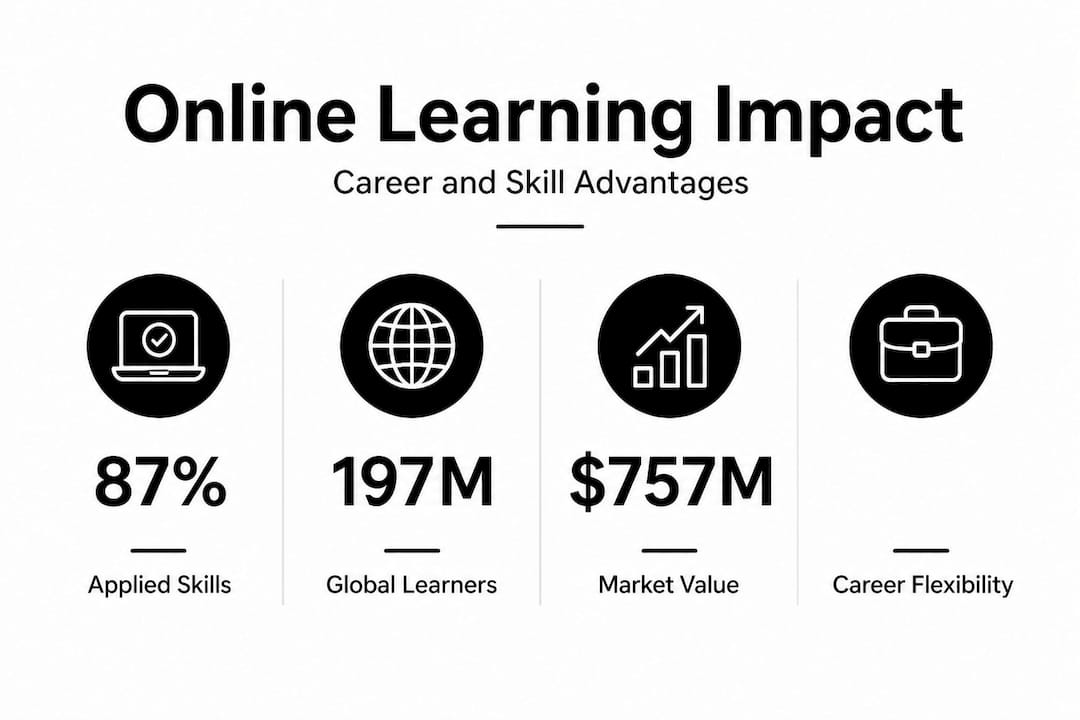
| Global learners on Coursera | 197 million registered | 2025 platform figures |
| Coursera annual revenue | $757 million | 2025 figures |
| Asynchronous skill acquisition | 87% acquire applicable skills | Learner outcome studies |
| Blended vs online effect size | SMD = 0.611 in favour of blended | Meta-analysis 2025 |
According to online learning statistics, 87% of asynchronous learners report acquiring skills they can apply directly to their work. That is a strong figure, and it reflects the real-world demand that has made online learning a core part of how organisations develop their workforce.
The global market continues to mature. With Coursera reaching 197 million learners and generating close to $757 million in revenue in 2025, the scale of enterprise upskilling happening through digital platforms is hard to ignore. Australian employers are increasingly aligned with this shift, expecting staff to engage in ongoing professional development.
But scale does not automatically mean effectiveness. Meta-analyses investigating cognitive outcomes in online study show mixed results. Online-only learning can match or exceed traditional classroom outcomes in some contexts, particularly for adult learners in structured programmes. But the results are inconsistent, largely because programme quality varies so much across providers.
What the research consistently highlights as drivers of effectiveness:
- Instructional design quality: Clear learning objectives, well-sequenced content, and regular assessments dramatically improve outcomes.
- Learner motivation: Adults who enter a course with a clear career goal tend to complete at higher rates and retain more information.
- Feedback mechanisms: Timely, specific feedback, whether from an instructor, automated system, or peer, is one of the strongest predictors of learning success.
- Community and connection: Even in asynchronous environments, access to discussion boards and peer interaction reduces feelings of isolation and improves persistence.
- Technical accessibility: Reliable internet access and a stable device are basic requirements that still present barriers for some learners, particularly in regional and remote Australia.
Pro Tip: When evaluating any online course, look beyond the topic list. Check whether the programme includes assessment checkpoints, provides timely instructor feedback, and has a completion support system in place. These features predict outcomes far better than course length or price.
Exploring high-demand online courses is a practical next step once you understand what makes programmes work. Knowing what employers want in 2026 will help you direct your study time toward the areas that offer the strongest return.
Practical benefits for career and personal growth
Theory and research are useful context. But for most Australians considering online education, the real question is: what will this actually do for my career?
The benefits are concrete and well-documented when learners approach online study with clear intentions and a quality programme. Here is how online learning typically delivers value in practice.
1. Upskilling without interrupting your income
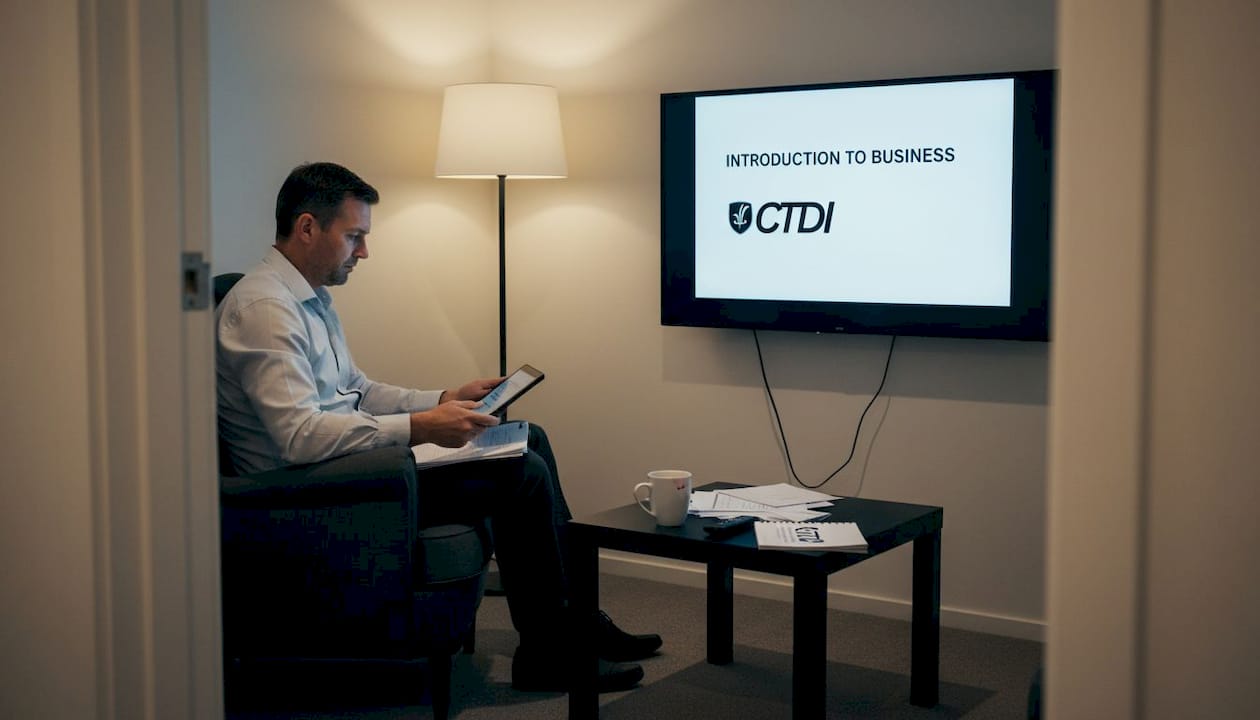
This is perhaps the most significant practical advantage. Unlike full-time university study, most online vocational programmes allow you to keep working while you learn. You can apply new knowledge in your current role immediately, which reinforces learning and demonstrates professional initiative to your employer.
2. Access to nationally recognised qualifications
In Australia, vocational programmes delivered through registered training organisations lead to qualifications that sit on the Australian Qualifications Framework. These are not informal certificates. They carry real weight with employers across industries.
3. Career transitions with reduced financial risk
Online study costs significantly less than full-time campus-based education in most cases. For someone considering a career change, completing a diploma or certificate online while working part-time is far more financially manageable than leaving the workforce entirely.
4. Industry-relevant skills, updated regularly
Reputable online vocational programmes are developed with industry input and updated to reflect current employer expectations. This is especially valuable in fast-moving fields like digital marketing, artificial intelligence, and environmental management, where skills from five years ago may already be outdated.
5. Building a portfolio and demonstrating capability
Well-designed online courses include projects, case studies, and assessments that produce tangible work. This means you graduate with evidence of your skills, not just a certificate, which carries real weight in job applications and performance reviews.
Recommended steps to get started:
- Clarify your career goal before selecting a course. Know the role or industry you are aiming for.
- Research providers thoroughly. Look for nationally accredited programmes with verifiable outcomes.
- Match the format to your schedule honestly. Account for your actual weekly availability, not an optimistic version of it.
- Set a consistent study block each week, even if it is only a few hours. Regular, short sessions outperform sporadic long ones.
- Engage with the learning community. Use discussion forums, reach out to instructors, and connect with peers.
- Apply your learning immediately. Find opportunities at work or in personal projects to practise new skills as you go.
Pro Tip: Treat your online course like a professional commitment. Block study time in your calendar, tell your household what those hours are for, and treat deadlines as non-negotiable. Learners who do this complete at significantly higher rates than those who approach study casually.
The connection between career-focused course design and genuine employment outcomes is well established. Programmes built around specific industry competencies give you a much clearer path than broadly themed courses. Reading through vocational student success stories can also help you understand what is realistically achievable within a study timeframe that fits your life.
The value of flexible vocational training grows when design quality and learner motivation work together. Neither alone is enough. A highly motivated learner in a poorly designed programme will struggle just as much as a disengaged learner in an excellent one.
What most guides miss about online learning
Most articles about online learning stop at enthusiasm. They describe the flexibility, celebrate the numbers, and send you off to enrol. What they rarely do is tell you where the model still falls short, and why that matters for the decisions you make right now.
Here is our honest take after years of working in vocational education.
Flexibility is a feature, not a guarantee of success. The freedom to study anytime is genuinely powerful. But for learners who struggle with self-regulation, that same freedom becomes an obstacle. Without deadlines, checkpoints, and accountability structures, many people start courses they never finish. The industry completion rate problem is real, and it is largely invisible in marketing materials.
The research base has genuine gaps. Long-term skill retention studies in online and blended learning are limited. Most studies measure outcomes at course completion, not six or twelve months later. We do not yet know with confidence how well online-acquired skills hold up over time compared to immersive in-person training. Researchers also note underrepresentation of certain regions, including parts of regional Australia, in the evidence base, meaning the findings may not translate equally to all learners.
Not all credentials are equal. The online education space includes providers of outstanding quality and providers who issue certificates for minimal effort. The presence of a digital badge or completion certificate does not automatically signal value to an employer. Accreditation, industry alignment, and programme rigour matter far more than aesthetics.
Equity and access are unresolved challenges. Online learning promises access to anyone with an internet connection. But reliable connectivity is not universal in Australia. Learners in remote communities, those on low incomes, or those without a suitable study environment at home face structural barriers that enthusiasm alone cannot overcome.
Our view is that the most important thing you can do as a prospective online learner is ask hard questions before enrolling. What is the completion rate for this programme? How is the learning designed? What support exists when you get stuck? How do employers in your target industry regard this qualification?
The future of online learning is genuinely exciting, and future-proof online courses in fields like AI, data, and sustainability are already changing who gets hired and who does not. But the value you extract depends entirely on choosing well and committing genuinely.
Take the next step with online learning
If you have read this far, you already understand more about online learning than most people who are currently enrolled in a course. Now the question is what to do with that understanding.
At CTDI, we build nationally recognised online qualifications around exactly the principles this article describes: clear career outcomes, expert facilitation, practical assessment, and genuine industry relevance. Whether you are looking to enrol in an online diploma in digital marketing, environmental management, AI, or another high-demand field, or your organisation needs corporate training programmes to upskill an entire team, we have flexible options designed to fit real lives. Our courses are fully self-paced, 100% online, and supported by trainers who work in the industries they teach. You do not have to figure out the next step alone.
Frequently asked questions
How does online learning differ from traditional learning?
Online learning is delivered through the internet and gives you control over when and where you study, while traditional learning requires attendance at fixed times in a physical location.
What are the main types of online learning?
The main types are asynchronous, synchronous, blended, MOOCs, microlearning, and AI-assisted learning, each designed for different learning styles and life circumstances.
Is online learning as effective as face-to-face education?
Meta-analysis findings show online learning can match or exceed traditional outcomes, with blended formats showing the strongest results overall.
What skills can I learn through online courses?
From technical vocational skills to leadership and communication, 87% of asynchronous learners report gaining directly applicable workplace skills through their online study.
Are there limits to what online learning can offer?
Your motivation and the programme's design are the two biggest factors in your success, and long-term retention research is still developing, so choosing a rigorous, accredited course matters enormously.
Recommended
- Career growth through online learning in Australia
- Why career-focused courses boost your job prospects
- How online education empowers vocational students in 2026 — Canterbury Training and Development Institute
- How online education empowers vocational students in 2026
- Coursefy.ai - AI-Powered Learning Platform
- From Office to Online: How to Transition to a Fully Remote Career