

TL;DR:
- Understanding how vocational online learning aligns with Australia's regulated quality framework offers a strategic advantage before enrolling.
- Effective professional development involves structured cycles of needs assessment, assessment, reflection, and continuous improvement, ensuring real skill growth.
Upskilling mid-career is something most Australian professionals think about, but far fewer actually act on with a clear plan. The online vocational training landscape in Australia is rich with opportunity, yet many people stall at the starting line because the process feels opaque or overwhelming. Understanding how vocational online learning works — from curriculum alignment and assessment validity through to ongoing monitoring and continuous improvement — gives you a real strategic edge before you even enrol in a single course.
Table of Contents
- Understanding the professional development process in Australia
- Preparation: Mapping your learning and assessment path
- Execution: Taking action and staying on track
- Verification: Measuring results and ensuring quality
- The uncomfortable truth about professional development online
- Take the next step in your professional development
- Frequently asked questions
Key Takeaways
| Point | Details |
|---|---|
| Roadmap matters | A clear and structured approach to online professional development leads to better outcomes. |
| Quality over hours | Focusing on relevant and high-quality training is more valuable than simply meeting minimum hour requirements. |
| Benchmarks for context | National completion and learning statistics offer useful but flexible targets—compare progress within the right qualification level. |
| Overcome constraints | Budget or time limitations are common; strategic planning and awareness of choices help ensure participation isn’t blocked. |
| Continuous improvement | Regularly review your progress and seek feedback to make your professional development meaningful and effective. |
Understanding the professional development process in Australia
To get the most out of online learning, it's critical to understand how professional development is structured and why governance isn't just red tape but actually shapes your outcomes.
Professional development, in the context of Australian vocational education and training (VET), refers to any deliberate activity that builds your skills, knowledge, or competency in a way that is relevant to your current or future work. It is not simply reading an article or attending a one-off webinar. At its most effective, it is a purposeful, structured cycle that includes needs identification, learning delivery, assessment, reflection, and ongoing improvement.
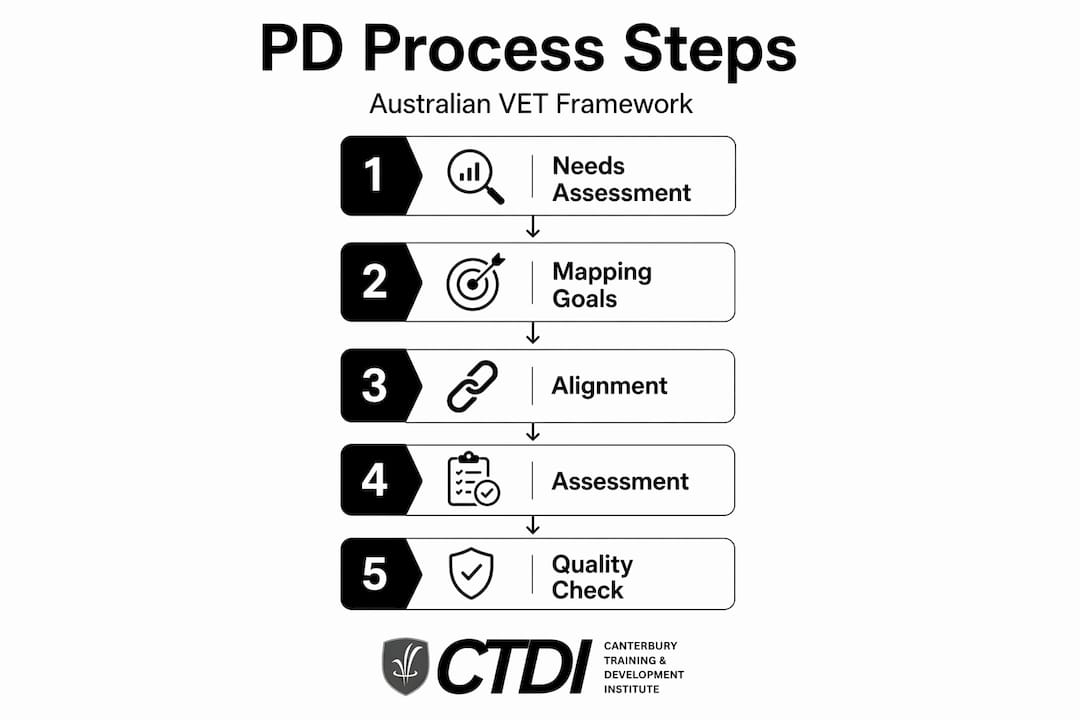
This structure matters enormously in Australia because the national VET system is one of the most regulated and standardised in the world. Every Registered Training Organisation (RTO) operates under strict obligations that ultimately protect you as a learner. When you invest your time and money in a course, you deserve assurance that the qualification you receive is worth something in the labour market. The career growth benefits that come from online learning are directly tied to this quality assurance architecture.
A cornerstone concept in Australian VET governance is the Training and Assessment Strategy (TAS). The TAS framework is a document that RTOs are required to maintain, and it must be accurate and current at all times. It covers compliance plans, resource allocation, assessment tools, prior-to-use review records, work placement details, and validation practices. In plain language, it is the operational blueprint that ensures your training is delivered consistently and assessed fairly. As a learner, you may never see this document directly, but its quality is reflected in every interaction you have with your training provider.
Underpinning all of this is the VET Quality Framework (VQF). The VQF is a set of legislated standards that all RTOs must meet, designed to ensure national consistency, integrity, and rigour across all training delivery. Think of it as the rulebook that keeps every provider honest, regardless of whether they deliver training in a classroom, a workplace, or entirely online.
Flexible online PD vs traditional compliance-only approaches
| Feature | Flexible online PD | Traditional compliance-only PD |
|---|---|---|
| Scheduling | Self-paced, 24/7 access | Fixed timetable, location-bound |
| Assessment style | Portfolio, scenario-based, online submission | Written exams, supervised practicals |
| Learner focus | Skills relevance and career application | Meeting minimum regulatory requirements |
| Feedback loop | Ongoing, built into the platform | Often end-of-course or annual |
| Cost model | Often lower, no travel required | Higher due to venue and facilitation costs |
| Outcome quality | High, when course is well-designed | Variable, depends heavily on delivery |
Key elements your online professional development should include:
- Needs identification: A clear alignment between your career goals and the units being studied
- Structured delivery: Content sequenced to build knowledge progressively
- Valid assessment: Tasks that genuinely test your ability to apply skills in real contexts
- Feedback mechanisms: Regular, constructive feedback from qualified trainers
- Validation practices: Quality checks that confirm the assessment is accurate and consistent
- Continuous improvement cycles: Provider updates to content based on industry changes
Understanding the professional development and skills gains available through structured VET programmes helps you set realistic expectations and choose more wisely.
Preparation: Mapping your learning and assessment path
Once you know how the process works, your next step is mapping where you want to go and what resources you will need to get there.
Preparation is probably the most underrated phase of the entire professional development journey. Most people skip it entirely, enrolling in whatever course looks relevant or is currently on promotion, without considering whether it genuinely fits their career trajectory. This is a costly mistake, both financially and in terms of time.

Start by getting specific about your professional goals. Are you aiming for a promotion in your current organisation? Transitioning to a new industry? Building freelance credentials? Each of these scenarios calls for a different set of units and qualifications. For example, someone aiming for a digital marketing management role will benefit more from a higher-level diploma with strategic units than from a series of entry-level certificates that don't connect to each other.
Curriculum and assessment alignment is a critical factor in the Australian VET context. The best programmes connect each unit to practical, real-world evidence. Before you enrol, ask yourself: what will I actually be doing to demonstrate competency? If the assessment is a single multiple-choice quiz, that is a red flag. Strong VET assessments include portfolios, case studies, workplace projects, and scenario-based tasks that reflect genuine job requirements.
Next, map out what evidence you might need to collect. Many VET assessments require you to demonstrate skills in a workplace or simulated environment. If you are currently employed, this could mean documenting processes you already perform. If you are not working in your target field yet, check whether the RTO offers simulated environments or templates that substitute for direct workplace evidence. The role of expert trainers in guiding this evidence-gathering process can be genuinely significant, especially if you are changing careers.
Budget, time, and access considerations
| Constraint | Common impact | Practical workaround |
|---|---|---|
| No employer PD budget | Out-of-pocket cost | Government subsidies, payment plans, self-invest strategically |
| Limited study time | Slow progress, dropout risk | Choose genuinely self-paced courses, block study time weekly |
| Poor internet access | Difficulty with video content or submissions | Download-first platforms, mobile-friendly LMS, off-peak access |
| Lack of workplace examples | Assessment completion challenges | Use simulated case studies, speak to trainer early |
| Unsure of entitlements | Missed funding opportunities | Contact your state training authority or RTO directly |
This is not a theoretical concern. A 2020 to 2024 comparative analysis of the Australian career development industry found that in 2024, 25% of practitioners had no allocated professional development budget, and 21% were unsure of their entitlements. If you fall into either group, you are far from alone, and there are concrete steps you can take.
Pro Tip: Before committing to any course, contact the RTO directly and ask three questions: What government funding applies to this course for someone with my profile? What is the realistic weekly time commitment? What happens if I need to take a break partway through? The answers will tell you a great deal about whether this provider is genuinely learner-focused or just chasing enrolments.
Learning what flexible online education for career growth actually looks like in practice will help you filter out courses that only appear flexible but still demand rigid participation.
Execution: Taking action and staying on track
With a mapped-out plan, you're ready to start. Here's how to stay in motion and avoid losing momentum.
Many learners start with enormous enthusiasm and stall by week three. This is not a character flaw. It is a predictable pattern that the best online learners plan for in advance. The following steps will help you execute your professional development with intention rather than hope.
- Enrol strategically: Choose your start date deliberately. Avoid enrolling during a period when you know work or life demands will be at their peak. Give yourself a genuine runway.
- Set up your learning environment: Dedicate a physical space and time for study. Treating it like a scheduled appointment, not something you will get to eventually, makes a measurable difference in completion.
- Complete the orientation module first: Many online courses include an orientation or introduction module that learners skip. Do not. It typically contains critical information about submission expectations, assessment formats, and support contacts.
- Engage actively with each unit: Passive reading accumulates very little. Take notes, attempt practice activities, and relate every concept to a real scenario from your work experience.
- Submit assessments progressively: Avoid the trap of completing all units and then attempting to write all assessments at once. Submit as you go. It maintains momentum and gives you the benefit of trainer feedback before your final submissions.
- Reflect after each assessment: Spend ten minutes after each submission noting what you learned and how it connects to your professional goals. This reflection habit dramatically increases knowledge retention.
- Track your progress formally: Use a simple spreadsheet or the platform's progress tracker to monitor which units you have completed and which are outstanding.
Support from expert trainers is one of the most underutilised resources in online VET. Many learners treat trainers as assessment gatekeepers rather than as professional guides. Reach out early, ask questions, and treat the relationship as a professional mentorship.
Common barriers and how to address them:
- Motivation dips: Normal, especially around weeks four to six. Reconnect with your original goal. Read back through what you wrote when you first enrolled about why this qualification mattered.
- Technology issues: Have a backup plan. If your primary device fails, know where you can access a library computer or borrow a device. Contact your RTO immediately if a technology issue affects a submission deadline.
- Time pressure from work or family: Communicate your study schedule to people who matter. Protecting even one hour of uninterrupted study time per week adds up significantly over a semester.
Pro Tip: Set three personal milestones for every course you undertake: a one-quarter check-in (am I on pace?), a halfway celebration (acknowledge real progress), and a pre-completion review (is all evidence gathered and ready?). These milestones convert an abstract end goal into a series of achievable steps.
Completing an online qualification is a marathon, not a sprint. The learners who finish are not necessarily the most talented. They are the ones who show up consistently, ask for help before they fall behind, and treat setbacks as information rather than failure.
Online professional development rewards persistence. The data backs this up. VET completion rates after four years for 2020-commencing qualifications were 49%, up from 47% for 2019-commencing cohorts. Diploma-level or higher qualifications showed a 55% completion rate, while Certificate I sat at 40%. The message is clear: the further you invest in higher-level qualifications, the more likely you are to follow through to the end.
Verification: Measuring results and ensuring quality
After taking action, the final step is ensuring that what you learned is meaningful and meets its intended outcomes.
Too many learners treat completion as the finish line. Receiving a certificate is a milestone, but the real question is: did this training change what you can do? Measuring outcomes is both a personal responsibility and a quality assurance matter, and both deserve your attention.
On the personal side, the most practical way to evaluate your professional development is to assess your own applied competency. Can you now perform tasks you could not perform before? Have you received recognition from colleagues, managers, or clients for skills you developed through your training? Are you being considered for opportunities that were previously out of reach? These are the real metrics.
Formally, quality assurance in Australian VET is maintained through the VQF requirements that RTOs must meet. After your course, you may be asked to complete a learner satisfaction survey or participate in a validation process. These are not bureaucratic exercises. They are the mechanisms by which RTOs improve their programmes for future learners, and your input directly influences quality.
Key ways to assess and verify your learning outcomes:
- Review the assessment feedback: Go back through trainer comments on your submitted assessments. Identify patterns in what you did well and where you were stretched.
- Apply skills within 30 days: The fastest way to lock in new knowledge is application. Find a real work task where you can use what you learned within a month of completing your qualification.
- Seek structured feedback from your workplace: Ask a manager or mentor whether they have noticed a change in your work since you completed the training.
- Compare your post-course CV to your pre-course CV: Can you now list specific competencies and a nationally recognised qualification that you could not claim before?
- Check in with your long-term goals: Does this qualification move you closer to where you want to be in three years? If not, what is the next logical step?
Stat to know: ATD's 2025 State of the Industry report, drawing on data from 539 organisations, found an average of 13.7 learning hours per employee in 2024 and an average direct learning expenditure of $1,254 per employee. This gives you a useful benchmark when evaluating whether your own investment of time and money is proportionate to industry norms.
An important nuance here is that quality and relevance matter more than simply accumulating hours. An RTO that helps you build genuinely applicable skills in 15 focused hours will serve your career better than a provider that fills 40 hours with content that has no bearing on your actual work. Evaluate your training by what you can now do, not by how many hours you logged. This is where the real impact of online PD on your career becomes visible.
The uncomfortable truth about professional development online
Here is something most training providers will not say directly: completing a qualification is not the same as developing professionally. This distinction matters enormously, and it is one of the primary reasons that so many Australians finish a course, add the credential to their LinkedIn profile, and then wonder why nothing has changed.
The formal framework in Australia is necessary. The VQF, the TAS, the compliance obligations on RTOs — all of these exist to protect you and to ensure a baseline of quality. But they are a floor, not a ceiling. Meeting minimum requirements does not automatically translate to real capability development. The structure creates the conditions for quality learning. You have to bring the intention.
This is especially relevant for professionals who approach their PD as a compliance obligation rather than a genuine investment. If your primary motivation is to tick a box — to renew a licence, satisfy a professional association, or demonstrate to an employer that you completed a required course — you will probably finish the course with exactly what you came in with: a piece of paper and not much else.
The learners who see the most meaningful career outcomes from online vocational training are the ones who treat every assessment as a thinking exercise, every piece of feedback as a coaching opportunity, and every unit as a chance to reframe how they see their own work. Online education genuinely empowers vocational students when approached this way, but that empowerment is not passive. It requires active engagement with the material and honest reflection about your own practice.
The other myth worth challenging is the idea that preset pathways are always the right fit. The Australian VET system offers flexibility through credit transfer, recognition of prior learning (RPL), and a wide range of elective units within many qualifications. Yet most learners never investigate these options. Before you start a course, ask your RTO whether any units can be credited from previous study or whether RPL applies to your existing experience. You might be able to fast-track your qualification significantly, saving both time and money.
Pro Tip: At the start of every unit, write a single sentence that completes this prompt: "By the end of this unit, I want to be able to..." Then at the end, return to that sentence and honestly assess whether you achieved it. If you did not, go deeper before moving on. This one habit separates professional growth from credential collection.
The focus on quality and relevance over hour accumulation is not just good advice. It is the actual differentiator between learners who transform their careers and those who simply maintain a training log.
Take the next step in your professional development
Ready for a real-world difference? Here is how to put this process into motion for your career.
Understanding the process is valuable. Actually starting is where careers change. At Canterbury TDI, every course is designed to reflect genuine industry need, delivered entirely online at your own pace, and supported by qualified trainers who understand what working professionals actually need from their vocational training.
Whether you are looking to enrol in an accredited online programme that fits around your existing work schedule, or you want to specialise in a high-demand area, Canterbury TDI has nationally recognised pathways built specifically for you. The Advanced Diploma of Digital Marketing is ideal for professionals looking to move into senior marketing and digital strategy roles, while the Certificate IV in Environmental Sustainability opens doors across sustainability, compliance, and environmental management sectors. Both are 100% online, self-paced, and built on the principles this article has explored: quality, relevance, and real-world application.
Frequently asked questions
What is the professional development process in Australian VET?
It is a structured series of steps including needs assessment, curriculum mapping, assessment, ongoing monitoring, feedback, and continuous improvement within national standards, all aligned to VET curriculum requirements.
How do I know if my online vocational training meets quality standards?
Courses from RTOs must comply with the VET Quality Framework, which assures national standards for content, assessment, and ongoing review, so always confirm your provider is a registered RTO.
What are typical completion rates for online VET qualifications?
Nationally, the four-year completion rate is 49% for all qualification levels, with diplomas and above reaching 55% and Certificate I sitting at 40%.
How much time and money should I expect to invest each year?
Benchmarks from ATD's 2025 research show an average of 13.7 formal learning hours per employee annually, with an average direct spend of $1,254 per employee across 539 organisations surveyed.
What if my employer provides no PD budget or I have limited access?
You are not alone. A 2024 industry analysis found 25% of Australian practitioners had no PD budget allocated, but government funding schemes, payment plans, and strategic course selection can make quality training accessible regardless.