

TL;DR:
- Online professional development has become essential for Australian workers because industry relevance and digital literacy significantly influence employability and wages. Well-structured courses with real-world tasks, expert trainers, and ongoing reinforcement yield the best career outcomes, especially for career changers, regional workers, and those re-entering the workforce. Ultimately, success relies on intentional engagement and applying skills practically, not merely earning certificates.
More than a third of the Australian workforce participated in work-related training in 2023, and those who did saw real, measurable rewards tied directly to their investment. Yet many professionals still treat ongoing learning as optional, something to tackle "when things slow down." The truth is that traditional qualifications, even strong ones, have a shelf life. Industries evolve, technology reshapes job requirements, and employers increasingly favour candidates who demonstrate a habit of continuous growth. This article explores why online professional development has shifted from a nice-to-have to a career essential, and how to make it work practically in an Australian context.
Table of Contents
- Why online professional development matters in Australia
- The benefits of online professional development for your career
- What makes online PD effective (and when it fails))
- Who benefits most from online professional development?
- Common myths and limitations of online professional development
- Our take: what actually works (and what most people miss))
- Take your next career step with industry-aligned online training
- Frequently asked questions
Key Takeaways
| Point | Details |
|---|---|
| Income and stability boost | Professionals who take online PD in Australia earn more and remain with employers longer. |
| Real job skills matter | The most effective online PD builds practical workplace skills, not just theory. |
| Flexibility for career changers | Online PD makes upskilling accessible for career changers, working adults, and regional Australians. |
| Effectiveness varies | Course quality and alignment to industry needs make a big difference in employability outcomes. |
| Choose supported programs | Structured PD with mentoring and real tasks is far more valuable than stand-alone online modules. |
Why online professional development matters in Australia
Australia's workforce is changing at a pace that makes standing still genuinely risky. The link between professional development gains and career momentum is no longer theoretical. It is backed by robust data showing clear differences in income, job retention, and promotion rates between those who upskill regularly and those who do not.
The 2025 Learning That Works Report paints a compelling picture. Australians who participated in work-related training saw their average income rise by over $2400 per year compared to non-participants. That is not a marginal improvement. For most working Australians, that figure represents a meaningful boost, one that compounds over time as skills and credentials accumulate.
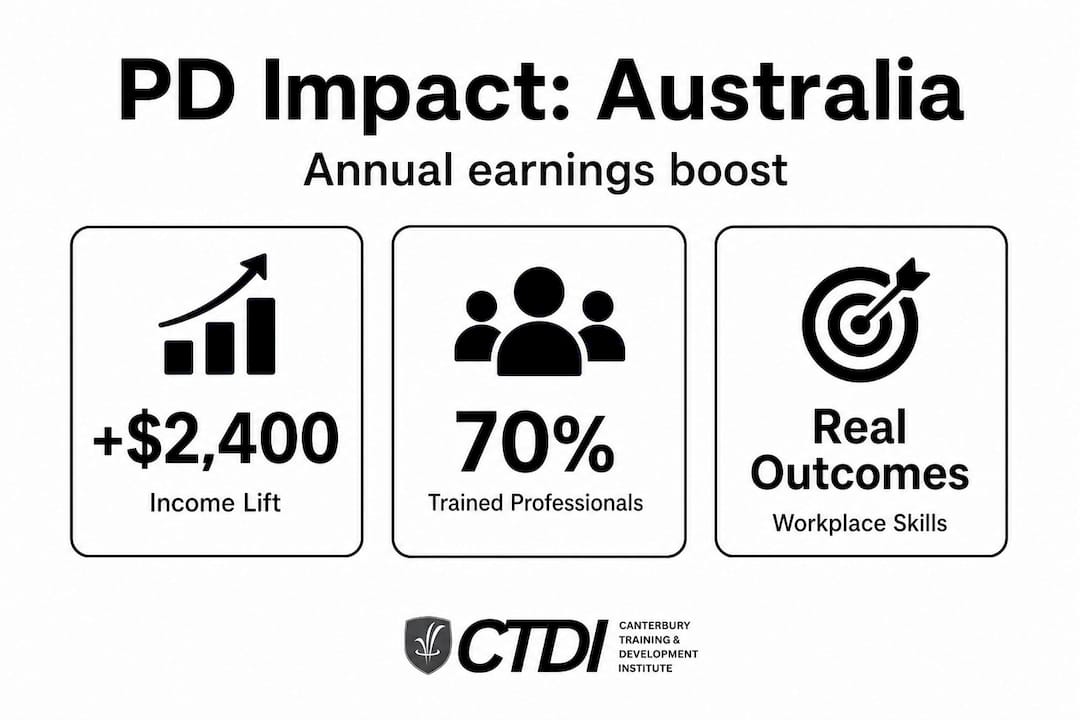
Here is a snapshot of what the data reveals:
| Outcome | Training participants | Non-participants |
|---|---|---|
| Average annual income lift | Over $2,400 | None recorded |
| Job switching rate | Lower | Higher |
| Employer-reported productivity | Improved | Baseline |
| Access to promotion opportunities | Significantly higher | Limited |
The reasons many Australians hesitate to invest in professional development are well known: cost, time, uncertainty about which course to choose, and scepticism about whether online learning "counts." These objections are understandable. But online delivery has resolved most of them. Flexible, self-paced formats mean you can study around full-time work and family. Fee-help options and short-course pricing have reduced the financial barrier significantly.
What gets in the way most often is not money or time. It is the mistaken belief that a single degree or years of experience will carry you indefinitely. They will not. Employers are actively screening for candidates who show evidence of ongoing growth, digital literacy, and current industry knowledge.
Key reasons Australian professionals are choosing online PD right now:
- The job market is rewarding specialised, up-to-date skills over general experience alone
- Digital literacy gaps are increasingly visible to employers, even in traditionally non-tech roles
- Career-focused courses are now available in virtually every sector, from environmental management to digital marketing and leadership
- Flexible online delivery removes the geographic barriers that previously shut out regional workers
- Industry-recognised credentials carry genuine weight with hiring managers who know the landscape
The shift is structural, not cyclical. Investing in online professional development is not a trend. It is a response to a labour market that rewards adaptability and current knowledge.
The benefits of online professional development for your career
Understanding the importance of upskilling is one thing. Knowing exactly what you stand to gain is what drives the decision. Online learning for career growth delivers outcomes that go well beyond a certificate on your wall.
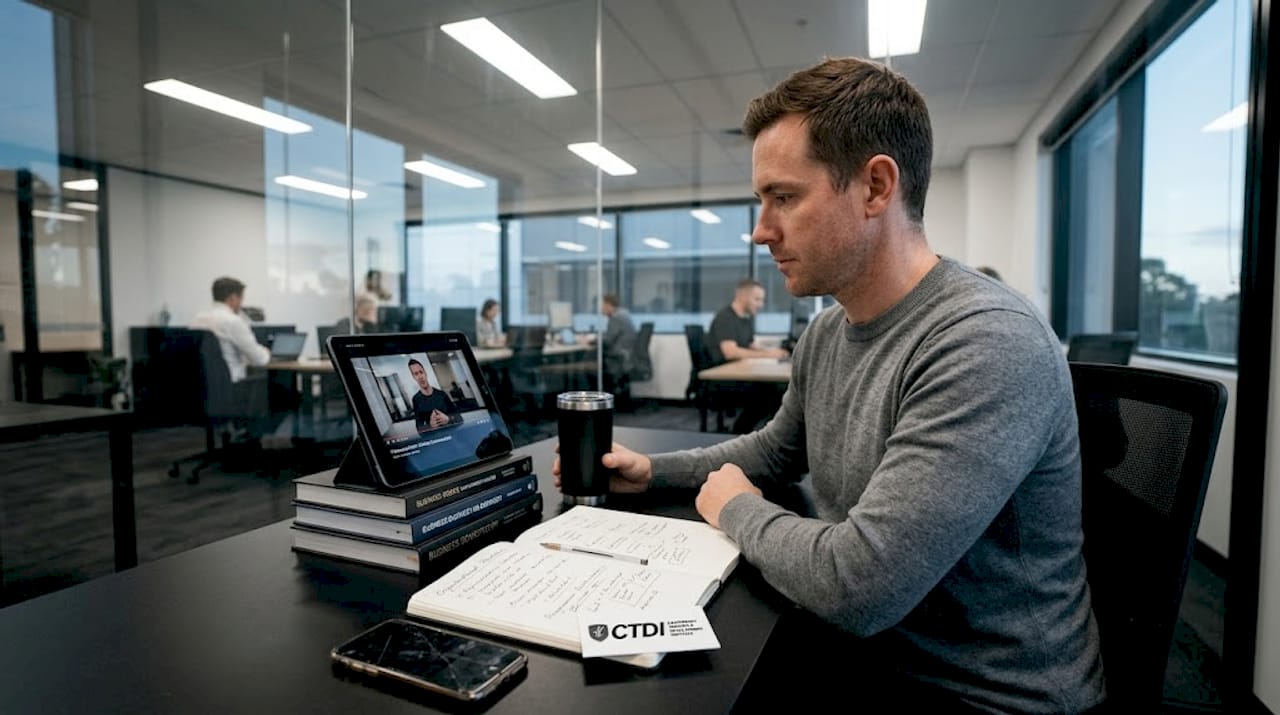
The Australian Government's Employability Skills Training programme documents that employability-focused training improves workplace and job search skills, digital literacy, and industry-specific knowledge. These are not soft gains. They are the exact attributes employers list when describing their ideal candidates.
Here is how online PD translates into practical career outcomes:
- More job options. Targeted online credentials signal capability in specific areas. A marketer with a digital marketing qualification is a stronger candidate than one without, even if their experience level is similar.
- Faster promotions. Employers internally promote people who show initiative and relevant skill growth. Completing an online programme is visible evidence of both.
- Pay increases. As documented in the Learning That Works data, income rises follow skill investment. Negotiating a pay review is easier when you can point to new, industry-aligned credentials.
- Stronger professional networks. Well-designed online courses connect you to peer cohorts, industry mentors, and expert trainers who can open doors well beyond the course itself.
- Digital literacy gains. Simply navigating and completing an online programme builds digital confidence, which is increasingly a baseline expectation in most industries.
"Employability-focused training improves workplace and job search skills, digital literacy, and industry-specific knowledge, delivering real advantages for both job seekers and those looking to advance internally." Australian Government Employability Skills Training
The flexibility argument deserves direct attention. Most working adults cannot attend evening classes or take a semester off. Online PD removes this constraint entirely. You study when it suits you, at a pace that fits your life. This accessibility is precisely why participation rates are climbing, particularly among working parents, regional professionals, and those managing career transitions alongside current employment.
Let us compare the two broad approaches:
| Factor | Traditional face-to-face PD | Online PD |
|---|---|---|
| Flexibility | Fixed schedule, fixed location | Self-paced, location-independent |
| Cost | Often higher (travel, venue, time off work) | Generally lower and more accessible |
| Access to specialist trainers | Limited to local options | National and international experts |
| Industry network access | Local cohort | Broader, often national network |
| Pace of credential achievement | Tied to course timetable | Faster completion possible |
Pro Tip: When you finish a course, do not just add the credential to your resume. Write a short case study showing how you applied what you learned to a real work situation. This is what actually impresses hiring managers and gives you something concrete to discuss in interviews.
The training and career success connection is strongest when learners approach online PD strategically. Choose courses aligned to where your target industry is heading, not just where it is now. Forward-looking credentials in areas like AI applications, sustainability, and data-informed decision-making are already creating clear differentiation in the job market.
What makes online PD effective (and when it fails)
Not every online course delivers on its promise. This is one of the most important things to understand before you invest your time and money. The format alone does not determine quality. What matters is what is inside the programme and how it is structured.
Research published in BMC Medical Education found that CPD combining practical skills with support and ongoing reinforcement outperforms brief or single-component approaches by a significant margin. In plain terms: a short, watch-and-click online course with no applied tasks, no feedback, and no mentoring rarely produces lasting change in your skills or your employability.
What actually separates effective online PD from the rest:
- Real-world tasks and projects. Not quizzes or multiple-choice assessments, but tasks that mirror actual job requirements. If a course asks you to build something, write something, or solve something realistic, that is a strong indicator.
- Expert trainer access. Courses built and delivered by current industry practitioners carry immediate credibility. Expert trainers who have worked in the field bring nuance and contemporary knowledge that textbook-only content cannot replicate.
- Structured support mechanisms. Forums, one-on-one check-ins, or cohort-based interaction all increase completion rates and real-world application.
- Industry alignment. Programmes developed in consultation with employers and industry bodies are far more likely to produce credentials that hiring managers actually recognise and value.
- Ongoing reinforcement. Learning that happens once and is never revisited fades. Effective programmes build in review, reflection, and application over time.
"The evidence consistently shows that continuing professional development works best when it combines practical skill development, organisational support, and ongoing reinforcement, not just single, short-duration activities." BMC Medical Education, 2025
The failure mode is equally clear. Tick-the-box online training, the kind produced rapidly, rarely updated, and designed primarily for bulk sales, tends to generate completion certificates rather than career outcomes. Many professionals have experienced this disappointment. They complete something, add it to their LinkedIn profile, and find that nothing changes in terms of job opportunities or employer perception.
Online education for vocational students in Australia is improving rapidly as providers invest in better course design and support infrastructure. The best programmes today look nothing like the self-study PDFs of a decade ago. But scrutiny is still essential.
Pro Tip: Before enrolling, ask the provider three direct questions: Who designed this course and what industry experience do they have? What does the assessment involve? What support will I receive if I fall behind or get stuck? The answers will tell you almost everything you need to know about whether the course is worth your time.
Who benefits most from online professional development?
Online professional development is not equally beneficial for all people in all situations. Understanding which groups gain the most helps you calibrate your own expectations and choose accordingly.
Career changers represent perhaps the highest-benefit group. The Australian Government's data confirms that career-changer employability improves meaningfully when training links to job search and workplace competencies and delivers employer-relevant knowledge. If you are moving from one industry to another, an industry-recognised online credential is often the fastest, most efficient way to signal genuine capability to employers who have never seen you in action.
Return-to-work parents and people re-entering the workforce after extended breaks also gain substantially. Online PD provides current, credentialed evidence of up-to-date knowledge, which directly addresses the common employer concern about gaps in employment history.
Regional Australians face a structural disadvantage in accessing face-to-face professional training. Many specialist providers are concentrated in capital cities. Online delivery removes this entirely. A professional in regional Queensland or rural South Australia has access to exactly the same programmes as someone in Sydney or Melbourne. This is genuinely transformative for regional workforce development.
| Group | Primary benefit of online PD |
|---|---|
| Career changers | Credential that signals capability in new field |
| Return-to-work parents | Current knowledge and employment gap bridging |
| Regional workers | Equal access regardless of location |
| Employed professionals | Upskilling without leaving current job |
| Employers and team leaders | Scalable, cost-effective staff development |
Are you in a high-benefit group? Check these indicators:
- You are targeting a role or industry where your current experience does not directly translate
- You want to move into a more senior or specialist position in your current field
- Your industry has shifted significantly in the past three to five years and your formal training predates those changes
- You live or work outside a major city and face limited access to in-person professional training
- You are managing a return to the workforce after a career break
- Your employer is supporting your development but needs evidence of structured learning
Flexible education for career growth is particularly valuable for working adults who need to manage career development alongside existing responsibilities. The self-paced format means you control the timeline, which is critical for anyone balancing study with employment, caregiving, or both.
Employers who invest in online PD for their teams also see measurable returns. Upskilling existing employees is faster and far less costly than recruiting for specialist roles. It also signals to your workforce that growth and development are genuinely valued, which has a direct impact on retention.
Common myths and limitations of online professional development
The evidence for online PD is strong, but it is not unlimited. Being clear-eyed about the limitations helps you make better decisions and avoid common disappointments.
Myth: All online courses carry the same value. They absolutely do not. A nationally recognised vocational qualification from a registered training organisation carries far more weight with Australian employers than an unaccredited short course from an overseas platform. Accreditation matters. Industry recognition matters. Provider reputation matters.
Myth: Completing an online course guarantees a job. No single course or credential guarantees employment. Professional development improves your positioning significantly, but job outcomes depend on how you apply and communicate what you have learned, how well the credential matches what employers actually need, and how effectively you combine that learning with practical experience.
Myth: Online learning is easier or less rigorous than face-to-face training. Well-designed online programmes demand exactly the same intellectual and practical effort as their face-to-face equivalents. The difference is in delivery, not in depth.
Research in CPD effectiveness also flags a genuine limitation: the evidence for CPD effectiveness can be unevenly distributed geographically, which limits how broadly certain findings can be applied. Most robust research comes from high-income, English-speaking professional contexts, and not all industries have equivalent research depth behind their CPD recommendations.
Some industries simply do not yet have strong online offerings. Hands-on trade work, certain healthcare procedures, and roles requiring physical presence still require face-to-face components. Online PD works best when the skills being developed are transferable to a digital learning environment, not as a universal substitute for all forms of professional training.
"The generalisability of CPD effectiveness research is limited by geographic concentration and the types of professions studied, which means results in one context may not transfer directly to another." BMC Medical Education, 2025
What should you do with these limitations? Start with your industry. Research what kinds of credentials your target employers actually recognise. Look for programmes that are industry-validated and built by people who understand the Australian job market. Explore areas like digital marketing career growth, where online training has a particularly strong track record of producing job-ready graduates with skills that employers explicitly value.
Use online PD as a powerful core of your career development strategy. Combine it with practical application, professional networking, and mentoring wherever possible. The combination is consistently more effective than any single element alone.
Our take: what actually works (and what most people miss)
We work with Australian learners at all stages of their career journeys, and there is a pattern we see repeatedly that most career guides never mention honestly.
Completion certificates, on their own, mean almost nothing to experienced employers and recruiters. What they look for is evidence of applied capability. Can you demonstrate that you took the learning, used it in a real context, and produced something tangible? That is the question that separates candidates who complete courses from candidates who advance their careers.
The uncomfortable truth is that many people invest in online PD with the right intentions but the wrong expectations. They expect the credential to do the work for them. It will not. The credential opens a door. What you carry through that door is what matters.
Short, unsupported online courses are particularly prone to this gap. They feel productive. You watch, you click, you receive a certificate. But without practical tasks, without expert feedback, and without application in a real work context, very little transfers to actual job performance. Employers sense this quickly, especially experienced interviewers who know exactly what a substantive learning experience looks like compared to a box-ticking exercise.
What we have seen work, consistently and reliably, is programmes that combine three things: real-world projects that mirror actual job tasks, access to expert trainers and real outcomes with genuine industry experience, and an ongoing structure that keeps learners engaged over time rather than delivering a single burst of content and disappearing.
The learners who get the most from online PD are also the ones who treat it like professional work, not supplementary reading. They block time for it. They apply what they learn immediately. They seek feedback. They connect the learning directly to a specific career goal, not just a vague sense that more skills are better.
If you approach online professional development that way, the returns are real and lasting. If you approach it as a credential-collecting exercise, you will likely find it disappointing. The format is not the variable. The intention and the quality of the programme are what determine the outcome.
Take your next career step with industry-aligned online training
The evidence is clear: strategic, well-designed online professional development delivers real career outcomes for Australian professionals and career changers. Whether you are looking to change industries, step into a leadership role, or develop specialist skills that the market is actively seeking, the right programme can make a significant difference to your trajectory.
At Canterbury TDI, we build online programmes specifically for professionals who need credentials that actually mean something to Australian employers. Our courses are industry-validated, delivered by expert practitioners, and designed around real-world application, not just content consumption. From the advanced diploma of digital marketing to the certificate in environmental sustainability, every programme we offer is built to improve your employability and career options in a measurable way. If you are ready to move from intention to action, enrol in an online diploma and start building credentials that open real doors.
Frequently asked questions
Does online professional development increase earnings in Australia?
Yes. Professionals who undertook work-related training in Australia saw their average income rise by over $2400 annually compared to those who did not participate in training.
Can online PD courses help me change careers?
Absolutely. Career-changer employability improves significantly when online training connects directly to workplace competencies and delivers credentials that employers in the target industry recognise.
What skills can I develop through online professional development?
You can build a wide range of workplace capabilities including communication, teamwork, digital literacy, and industry-specific knowledge that employers actively seek when hiring and promoting.
Does online professional development work for all industries?
It is highly effective in many fields, but evidence for CPD effectiveness is stronger in certain professional sectors, and some hands-on industries still require face-to-face components alongside any online training.
How do I choose an online course that improves employability?
Prioritise programmes with real-world projects, expert mentorship, and industry alignment rather than those offering only completion certificates. Effective CPD consistently combines practical skill development with ongoing support, not just a single burst of online content.