

TL;DR:
- Online learning offers flexible, career-oriented qualifications that cater to working adults, providing measurable outcomes and practical skills. It enables learners to study on their own schedule while fostering deep engagement through interactive platforms and self-directed pace. Success depends on self-management, proactive support, and understanding the financial and personal commitments involved.
Online learning matters more than many people realise, yet the misconception persists that it is somehow less rigorous or too impersonal to support real career advancement. If you are weighing up whether to study a vocational qualification online in Australia, particularly in fields like AI, digital marketing, or environmental management, this guide is written for you. The case for flexible, online education is not built on convenience alone. It rests on measurable outcomes, genuine credential value, and a learning model that fits the reality of working adult life rather than ignoring it.
Table of Contents
- Understanding online learning's flexibility and real-world benefits
- How short, career-focused online credentials boost fast skill acquisition
- Managing costs and practical considerations for Australian online learners
- Effectiveness of online learning compared to traditional classroom study
- Maximising success in online learning: tips for self-management and planning
- Why online learning's flexibility is its greatest challenge and opportunity
- Explore CTDI's flexible online qualifications for future-ready careers
- Frequently asked questions
Understanding online learning's flexibility and real-world benefits
The single greatest advantage of online learning is not the technology. It is time. When you are managing a job, a family, or both, a rigid class timetable is not just inconvenient. It is often simply impossible. Online education removes that barrier entirely, letting you study in the evenings, on weekends, or in focused blocks during a lunch break.
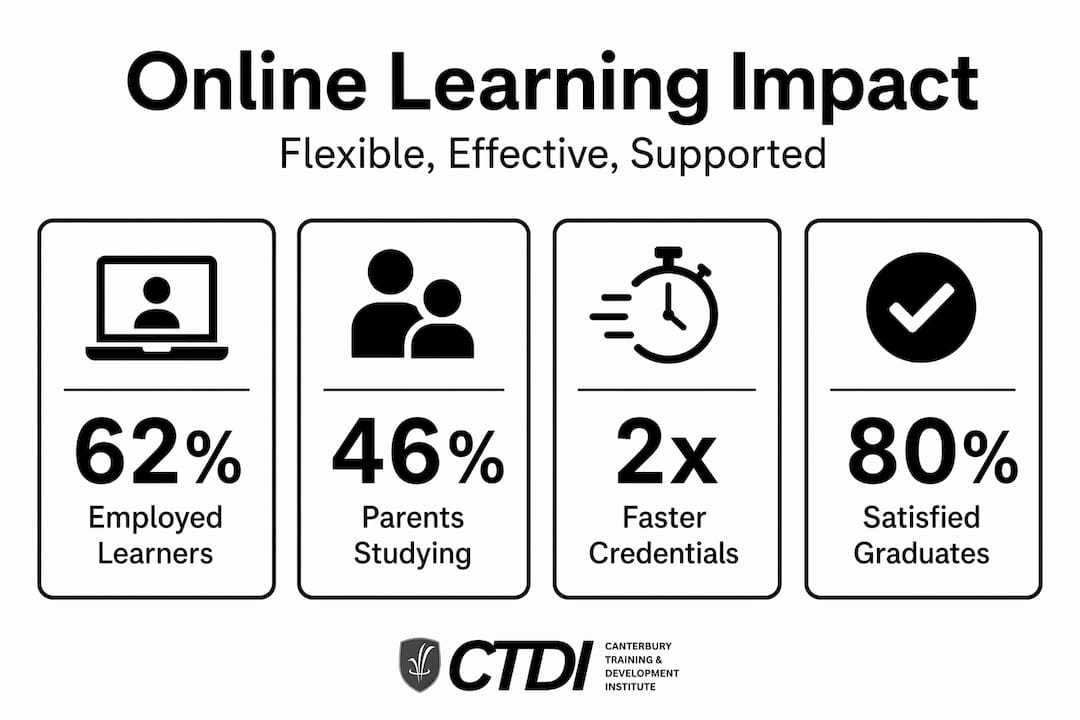
More than half of online learners work or have children, completing their coursework on their own schedule rather than around an institution's timetable. That statistic alone reframes the conversation. Online learning was not designed as a second-best option. It was built around the way working adults actually live.
The importance of online education goes well beyond scheduling. Modern platforms support genuine interaction through discussion boards, live Q&A sessions, recorded lectures, and direct messaging with instructors. Learners with disabilities also benefit significantly, as digital formats allow screen readers, adjustable text sizes, caption support, and self-paced progression that classroom environments struggle to replicate.
Here is what flexibility looks like in practice for online vocational students:
- Study at 10pm after the kids are in bed without falling behind
- Revisit a recorded lecture before an assessment rather than relying on notes
- Complete short modules during a commute or a lunch break
- Pause enrolment or adjust your study load if life becomes demanding
- Access course materials from anywhere in Australia or internationally
"The benefits of e-learning are not just about convenience. They are about access. When learners can engage with material on their own terms, comprehension and completion rates improve significantly."
For a deeper look at how online education empowers vocational students across different life stages, the evidence is consistently positive. And if you are still undecided between formats, a direct comparison of online learning vs classroom learning is worth exploring before you enrol.
With the key benefit of flexibility established, it is important to understand how online learning translates into effective, career-focused credentials.
How short, career-focused online credentials boost fast skill acquisition
One of the most significant shifts in the advantages of online learning is the rise of short credentials. Rather than committing three or four years to a degree before seeing any career return, vocational learners can now stack focused qualifications and build expertise progressively.
The structure of these credentials matters. Here is how the model works in practice:
- Choose a focused area such as AI applications in marketing or environmental compliance, rather than a broad field
- Complete a short course or microcredential that targets a specific, job-relevant skill set
- Earn a shareable certificate that can be added to your LinkedIn profile or professional portfolio immediately
- Stack further credentials over time to build towards a full diploma or advanced qualification
- Apply skills immediately in your current role or use the credential to pursue a new position
The AI in Marketing Microcertificate at Harvard Extension School, for example, requires only two graduate courses to be completed within one year, giving learners a focused, recognised credential without the multi-year commitment. Similarly, AI in Digital Marketing courses on Coursera can be completed in as little as two hours and come with a shareable certificate.
These are not novelty credentials. Employers in Australia's growing digital and sustainability sectors are actively looking for candidates who demonstrate current, applied knowledge. A certificate in AI tools for digital marketing or environmental data analysis signals that you are up to date and motivated, two qualities that outweigh years of static experience.
Pro Tip: Add your completed certificates to the Licences and Certifications section of your LinkedIn profile immediately after earning them. Recruiters searching for AI or digital marketing skills will find you faster, and it demonstrates you are actively investing in your career.
Reasons to choose online courses in high-demand fields are well documented. If you are considering where to start, the diploma of artificial intelligence offered through CTDI is a nationally recognised qualification built around practical, applied learning. You can also explore top online courses in high-demand fields for 2026 or learn more about why career-focused courses boost your job prospects in a competitive market.
Having seen how credential structure accelerates career progress, let us consider practical financial and resource factors for Australian learners planning online education.
Managing costs and practical considerations for Australian online learners
Online study often feels more affordable than it actually is at the point of enrolment. Tuition fees get the attention, but they are rarely the full picture. This is especially true for learners considering Free TAFE programmes, which, despite the name, do not always mean zero financial outlay.
Australian learners should verify technology, resource fees, and any travel or in-person fees beyond the course cost before committing, even when enrolling in a Free TAFE programme. Hidden costs can include:
- A reliable laptop or desktop capable of running required software
- High-speed internet access, especially if your course includes video-heavy content or live sessions
- Textbooks, workbooks, or proprietary software licences
- Any optional or compulsory in-person workshop or assessment days, including travel and accommodation if you are regional or remote
- Examination or assessment fees not included in base tuition
None of these costs should be a dealbreaker, but not knowing about them is what causes students to drop out mid-course. A learner who budgets accurately is far more likely to complete their qualification than one who is surprised by unexpected expenses three months in.
Pro Tip: Before you enrol, email the training provider and ask directly: "What costs beyond tuition should I plan for?" A good provider will give you a clear, itemised answer. If they cannot or will not, that tells you something important about their student support culture.
The good news is that career growth through online learning in Australia is well supported by government subsidies and provider flexibility. Many vocational courses offer payment plans, and some employers will fund or reimburse study in fields directly relevant to their operations. It is worth asking your employer before assuming you will shoulder the cost alone.
Revisiting the online learning vs classroom comparison from a cost angle also reveals that online learning typically eliminates commuting costs, on-campus meal expenses, and the need to take unpaid leave for classes, making it genuinely more affordable for many working Australians once all factors are considered.
With financial and logistical clarity, the next question is how online learning outcomes compare with traditional study modes in real career scenarios.
Effectiveness of online learning compared to traditional classroom study
A persistent concern about online learning is whether it actually works as well as sitting in a classroom. The research answers this question clearly.

Online learning outcomes often exceed those of face-to-face instruction, particularly when blended with some in-person elements. The U.S. Department of Education's meta-analysis of over a thousand empirical studies found that students in online conditions performed modestly better than those receiving face-to-face instruction. That is not a marginal finding. It challenges the assumption that presence equals learning.
Blended learning shows the strongest outcome advantages, combining online flexibility with occasional in-person engagement. But even pure online learning consistently outperforms or matches traditional classroom delivery. Why virtual classes are effective comes down to a few factors that classroom learning rarely offers.
| Factor | Traditional classroom | Online learning |
|---|---|---|
| Schedule control | Fixed timetable | Fully flexible |
| Content revisiting | Notes only | Recorded lectures on demand |
| Learner pace | Set by instructor | Self-directed |
| Geographic access | Local only | Anywhere in Australia |
| Learning reflection | In-class, time-limited | Asynchronous, deeper |
| Outcome quality | Solid | Equal or better |
The table above reflects why advantages of online learning are not limited to convenience. Self-directed learners who choose when and how to engage with material tend to process it more deeply. There is no social pressure to move on before you are ready, and no penalty for replaying a complex explanation three times.
"Online learning fosters greater learner control and self-reflection, which are known contributors to deeper cognitive engagement and longer-term retention of skills."
It is also worth noting that vocational courses, by nature, are already heavily practical. Whether you are learning to analyse environmental data, build a digital marketing campaign, or apply AI tools to a business problem, the skills are demonstrated through tasks and projects rather than written examinations. Online delivery suits this assessment style exceptionally well. For further evidence on online education effectiveness, the research base continues to grow and consistently supports flexible learning models.
Having built confidence in online learning's flexibility and outcomes, let us explore practical strategies that help learners succeed in self-paced online education.
Maximising success in online learning: tips for self-management and planning
Knowing that online learning works is one thing. Making it work for you is another. The learners who get the most out of self-paced study are not necessarily the most academic. They are the most organised.
Time-blocking, consistent submissions, and using support channels are the key self-management habits that separate completers from dropouts in online programmes. Here is a practical framework to build those habits from day one:
- Block study time in your calendar as a recurring, non-negotiable appointment. Treat it like a work meeting you cannot miss. Even two focused hours three times a week adds up to consistent progress.
- Break your course into weekly milestones so you always know what you should have completed by Sunday evening. This prevents the drift that comes from open-ended timelines.
- Contact your instructor early, ideally in the first week, even if you have no pressing question. Establishing that relationship early means you will not hesitate to reach out when you genuinely need help.
- Engage with peer discussion boards regularly. Other students studying the same material in the same industry context are one of the most underused resources in online courses.
- Review your progress against the course outline monthly and adjust your study load if work or life demands have shifted. Being proactive about pace prevents you from falling so far behind that catching up feels impossible.
Pro Tip: Set a specific "office hours" equivalent for yourself. Choose a fixed time each week to review feedback, reply to discussion posts, and check in on your progress. It takes about 20 minutes but keeps you connected to the course even during busy periods.
Understanding how expert trainers shape your success in online education is also worth reading if you want to understand what distinguishes a high-quality provider from one that simply uploads PDFs and calls it a course. And for ongoing motivation, revisiting your reasons for enrolling is important. The career growth through online learning available to Australian vocational students in 2026 is substantial, but it requires commitment to realise.
Now that you understand how to succeed in online learning, let us reflect on its broader implications and fresh perspectives on its role in vocational education.
Why online learning's flexibility is its greatest challenge and opportunity
Most articles about the importance of online education spend their energy reassuring you. We want to offer something more useful: an honest assessment of where the model demands more from you than a classroom ever would.
Flexibility is not passive. When no one takes attendance, when no one notices if you skip a week, and when your course materials sit patiently in a browser tab you can open whenever you are ready, the responsibility for progress shifts entirely to you. Flexibility is a double-edged sword that demands self-motivation. Learners without solid self-management habits often struggle to complete courses, regardless of how well-designed the content is.
This is not a reason to avoid online learning. It is a reason to go in with your eyes open.
The learners who thrive in online vocational programmes share a particular mindset. They do not treat flexibility as permission to be vague about when they will study. They treat it as an opportunity to design a study schedule that actually fits their life, and then they protect that schedule. They also actively seek support rather than waiting until they are overwhelmed. The support is there. Using it early is a sign of experience, not weakness.
There is a deeper point here about how we measure educational success. Traditional schooling measures presence. You showed up; you participated. Online learning forces a more honest metric: engagement and output. Did you complete the work? Did you apply the concepts? Can you demonstrate the skill? That shift is uncomfortable for some learners initially, but it is also a more accurate reflection of what employers actually care about.
For those considering a credential in AI, digital marketing, or environmental management, this is genuinely good news. These fields reward demonstrated capability over credentials on paper. An online learner who has actively engaged with real tools, built a portfolio of assessed work, and pursued industry-relevant knowledge is often better prepared than a classroom student who attended dutifully but passively.
The future of vocational education in Australia is not classroom-versus-online. It is about building learners who know how to learn effectively in any format and who treat their own professional development as an ongoing, self-directed project rather than a one-time event.
Explore CTDI's flexible online qualifications for future-ready careers
If you have recognised yourself in this article, a working adult, a career changer, or someone ready to build expertise in a high-demand field, CTDI's online programmes are built with you in mind. The Canterbury Training & Development Institute offers nationally recognised diplomas in artificial intelligence, digital marketing, and environmental management, all delivered 100% online with the flexibility to study around your existing commitments.
CTDI courses are designed by industry professionals and delivered by expert trainers who understand what employers in Australia are actually looking for. There are no rigid timetables, no campus commutes, and no compromise on credential quality. Whether you are ready to start now or still comparing your options, exploring CTDI's online qualifications takes less than five minutes. When you are ready to take the next step, enrol now and begin building the skills that will define your career in 2026 and beyond.
Frequently asked questions
Is online learning effective for gaining new skills in AI or digital marketing?
Yes. Online learning outcomes often exceed those of face-to-face instruction, and practical, skills-based courses in AI and digital marketing are particularly well-suited to self-paced, project-based online delivery.
What hidden costs should I consider beyond tuition when enrolling in online courses in Australia?
Budget for a capable laptop, reliable internet, any software licences, and potential travel if in-person assessments are required. Australian learners should verify these fees with their provider before enrolling, even in Free TAFE programmes.
How long does it typically take to complete a career-focused online certificate in marketing AI?
Completion of two graduate courses within one year is required for Harvard Extension School's AI in Marketing Microcertificate, making it a fast, focused pathway to a recognised credential in this growing field.
What habits help students succeed in flexible online learning environments?
Consistent study blocks, early contact with instructors, and regular participation in course discussion boards are the habits that matter most. Time-blocking and using support channels consistently separate students who complete their courses from those who fall behind.