

TL;DR:
- Blended learning, combining online and classroom formats, consistently produces the best educational outcomes.
- Online courses offer flexibility and cost savings but require high-quality design and learner motivation for success.
The debate between online learning and classroom education is one that more students and professionals wrestle with each year. With flexible study options now covering everything from digital marketing to environmental management, it's tempting to assume that online learning is simply the better choice. But that assumption deserves a closer look. The latest research paints a more nuanced picture, one where course design, engagement levels, and the blend of formats matter far more than the delivery channel alone. This article unpacks the evidence so you can make a truly informed decision about your own career development.
Table of Contents
- How online learning and classroom education differ
- Strengths and limitations: Online learning vs classroom
- Which learning format gets better results?
- Practical tips for choosing the right format
- A fresh perspective: Why blended learning beats the extremes
- Next steps: Find flexible vocational courses for career growth
- Frequently asked questions
Key Takeaways
| Point | Details |
|---|---|
| Blended learning leads outcomes | Mixing online and classroom formats delivers the strongest vocational and skill results for most learners. |
| Online saves time and money | Online study can be 40-60% faster and 50-70% cheaper than traditional classroom. |
| Motivation is key online | Retention and engagement are essential in online formats, boosted by good course design. |
| Choose format for your needs | Consider your goals, job demands, and learning style to pick or mix formats for optimal career growth. |
| No major exam difference | Research shows exams scores are similar across online, blended, and classroom when engagement is high. |
How online learning and classroom education differ
Before comparing results, it helps to understand what each format actually involves in practice. Online learning delivers course content through digital platforms, allowing you to study at your own pace, anywhere you have an internet connection. Classroom learning, by contrast, brings students and trainers together in a shared physical space on a fixed schedule. Both approaches have been around long enough to build real track records, but they serve quite different needs.
One of the clearest differences is flexibility. Online learning allows working professionals to study around their existing schedules without needing to relocate or take extended leave from their jobs. For someone juggling a full-time role and family responsibilities, this is not a minor perk. It is often the deciding factor. Flexible education for career growth is one of the most powerful tools available for people who cannot put their lives on hold to upskill.
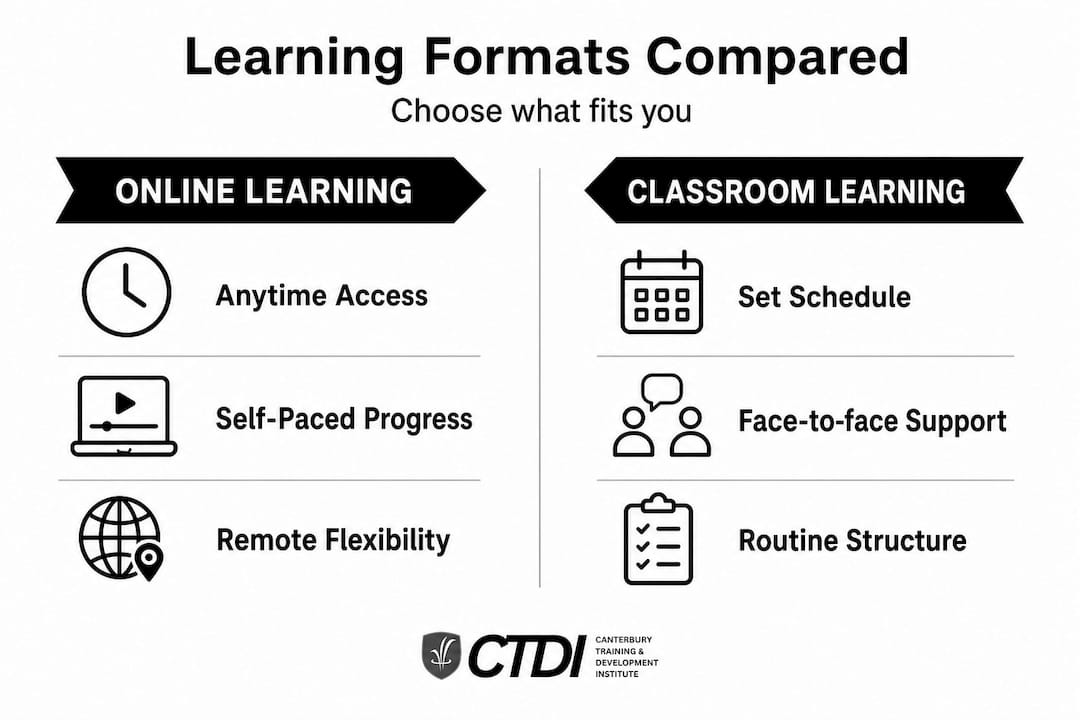
Classroom learning, on the other hand, offers a structured timetable that suits learners who thrive on routine and direct human interaction. There is immediate feedback from a trainer, real-time discussion with classmates, and a social accountability that keeps many students on track. For courses involving hands-on, practical work, the physical environment adds something that screens genuinely struggle to replicate.
Here is a quick comparison of how the two formats stack up across common factors:
| Factor | Online learning | Classroom learning |
|---|---|---|
| Flexibility | High, self-paced | Low, fixed schedule |
| Accessibility | Study anywhere | Location dependent |
| Social interaction | Limited, often asynchronous | Rich, real-time |
| Trainer feedback | Delayed or written | Immediate and verbal |
| Cost | Generally lower | Generally higher |
| Practical skills | Challenging to deliver | Easier to facilitate |
| Motivation support | Requires self-discipline | Built-in peer pressure |
Key considerations when evaluating each format include:
- Your current work schedule and whether you can commit to fixed class times
- Your preferred learning style, whether you absorb material better alone or in group discussion
- The nature of the skills you are trying to develop, technical knowledge versus hands-on practice
- Your access to technology and a reliable internet connection
- The level of trainer support you need to stay motivated and on track
Pro Tip: Before enrolment, spend a week tracking how many hours you genuinely have free for study. Be honest about whether those hours are focused and distraction-free. This single exercise reveals more about which format suits you than any comparison chart.
Choosing the right format is also about understanding career-focused courses and what they require in terms of applied learning. Some qualifications demand a level of practical demonstration that online platforms are only beginning to address effectively.
Strengths and limitations: Online learning vs classroom
Now that you have seen the basic distinctions, it is worth examining the comparative strengths and weaknesses more closely. This is where many learners get surprised by the data.
Online training is genuinely faster and cheaper than most people expect. Studies show that online training takes 40 to 60 per cent less time than equivalent classroom instruction, producing cost savings of between 50 and 70 per cent. For an employer paying for staff development, or a professional funding their own upskilling, that difference is substantial. It also means you can return to the workforce with new credentials far sooner.
However, cost and speed are not the whole story. Research highlights that online learners frequently report lower engagement, feelings of isolation, and technology barriers as significant hurdles. These are not just comfort issues. They directly affect whether you finish the course and retain what you learn. The same research shows that retention rates improve by 25 to 60 per cent when courses are designed with strong interactive elements, clear structure, and regular feedback loops.
"Retention rates in online education improve by 25 to 60 per cent when course design prioritises interaction, feedback, and structured progression." This finding fundamentally changes how we should evaluate online learning quality. It means a badly designed online course and a well-designed one are not remotely comparable, even if they carry the same credential.
Classroom learning has its own limitations. It is less accessible for people in regional areas or those with demanding job schedules. The cost of travel, accommodation, and lost working hours adds up quickly. Classroom delivery also tends to move at the pace of the group, which can frustrate faster learners and leave slower ones behind.
Here is a more detailed breakdown of strengths and limitations:
| Criterion | Online learning | Classroom learning |
|---|---|---|
| Time to completion | 40 to 60% faster | Standard duration |
| Upfront cost | 50 to 70% less expensive | Higher direct costs |
| Motivation | Self-driven required | Peer-supported naturally |
| Practical skill acquisition | Moderate to limited | Strong |
| Accessibility for remote learners | Excellent | Poor |
| Engagement quality | Design dependent | Consistently high |
| Dropout risk | Higher without support | Lower with peer structure |
Key strengths of career growth with online learning include:
- The ability to revisit recorded material as many times as needed
- Self-paced progression that accommodates illness, travel, or busy periods at work
- Access to courses from institutions regardless of geographic location
- A digital learning environment that builds technology skills alongside vocational knowledge
The biggest predictor of online learning success is not the platform. It is the quality of the course design and the expertise of the people who built it. Expert trainers in online learning make an enormous difference to the depth of learning that takes place, even when they never meet their students in person.
Which learning format gets better results?
With strengths and weaknesses outlined, what does actual evidence show about learning outcomes and career results? This is where the data gets genuinely interesting, and where conventional wisdom tends to fall apart.
The clearest finding from current research is that blended learning, which combines elements of both online and classroom instruction, consistently outperforms either format used alone. Meta-analyses confirm that blended learning achieves a standardised mean difference of 0.611 on student outcomes compared to other approaches, with particularly strong results for cognitive skills (SMD of 0.698) and affective outcomes such as motivation and attitude (SMD of 0.533). These are meaningful gains, not marginal statistical noise.

What about online versus traditional classroom? Research published in peer-reviewed journals shows that online and blended formats perform modestly better than face-to-face learning on average, but pure online delivery is not significantly better than traditional classroom instruction. In other words, switching entirely to online does not automatically give you an advantage. The method alone is not enough.
Perhaps the most practically useful finding is about engagement. Recent studies found no significant difference in exam performance between online and in-person learners in synchronous hybrid environments. The deciding variable was not where students were sitting. It was how engaged they were in the material. High engagement produced high performance regardless of the setting.
Key research findings at a glance:
- Blended learning outperforms pure online (SMD 0.611) and shows strongest gains in cognitive skill development
- Pure online learning is not significantly better than classroom instruction on its own
- Engagement is the most reliable predictor of exam performance across all formats
- Course design quality dramatically influences retention, sometimes by 25 to 60 per cent
- Practical vocational skills are still more effectively taught in mixed or hands-on environments
To maximise your outcomes regardless of format, follow this progression:
- Assess your engagement risk. If you know you struggle with self-motivation, choose a format with built-in accountability, either a blended programme or a well-structured online course with mentor support.
- Prioritise course design over delivery method. Look for courses built by industry professionals with clear learning objectives, regular assessments, and active feedback mechanisms.
- Build a consistent study routine. Even online learners benefit from treating study like a fixed appointment rather than something done when convenient.
- Seek practical application opportunities. Look for courses that require you to apply skills to real tasks, case studies, or workplace projects, not just read content and answer multiple-choice questions.
- Connect with a learning community. Even in online environments, forums, peer groups, and live Q and A sessions significantly reduce isolation and improve retention.
Empowering vocational students through well-designed programmes is not just about delivering content. It is about creating conditions where practical skill development actually happens. The evidence strongly supports this view, and the best institutions build their programmes around it. Expert trainers in online education who understand these dynamics are central to delivering outcomes that translate into career advancement.
Practical tips for choosing the right format
Having analysed research and real-world results, it is time to translate that into practical guidance you can actually use. The decision is rarely as simple as "online or classroom." More often, it is about finding the right combination for your specific situation.
Research is clear that for students and working professionals pursuing flexible vocational training, online formats excel in accessibility and career continuity. However, they do present genuine challenges around motivation and practical skill acquisition. Blended formats consistently deliver the best outcomes when both flexibility and depth of learning are priorities.
It is also worth acknowledging that evidence has gaps, particularly around long-term retention and outcomes in underrepresented contexts such as regional learners, mature-age students, and first-generation professionals. This means you should treat published research as a useful guide rather than an absolute prescription. Your individual circumstances always matter.
Here is a practical decision framework you can use right now:
- Define your career goal first. Are you seeking a promotion, a career change, or entry into a new industry? Different goals demand different types of credentials and skills.
- List your non-negotiables. Do you need to keep working full-time while you study? Do you live outside a major city? These constraints narrow your realistic options immediately.
- Research course design, not just delivery mode. Ask providers how courses are structured, who built the content, what support is available, and how practical skills are assessed.
- Look at completion and satisfaction rates. Reputable providers will share data on student outcomes. If they cannot or will not, that tells you something important.
- Start with a trial. Many platforms offer short introductory modules or sample content. Completing a short trial in your chosen format before committing to a full qualification is sound risk management.
- Build in a review point. After four to six weeks of study, honestly evaluate whether the format is working for you. It is far better to adjust early than to grind through an unsuitable format for months.
Pro Tip: If your chosen field involves hands-on practical assessment, ask specifically how the course addresses this before enrolling. A well-designed course will have a clear, credible answer. Vague responses about "simulated environments" without detail should prompt further scrutiny.
The digital marketing learning process, for example, involves a mix of strategic thinking, creative execution, and technical platform skills. A purely theoretical online course will not prepare you as well as one that requires you to build real campaigns, analyse live data, and receive expert critique of your work.
A fresh perspective: Why blended learning beats the extremes
Here is an opinion that tends to ruffle feathers in education circles: both the online-first evangelists and the classroom traditionalists are arguing the wrong point. The real question is never "which format is better?" It is "which combination of formats, at what intensity, produces the outcomes this particular learner needs right now?"
The research supports a blended approach, not because it is a convenient compromise, but because it mirrors how skilled professionals actually learn on the job. You absorb theory independently, apply it in structured interactions, receive expert feedback, refine your approach, and repeat. That cycle does not happen exclusively online or exclusively in a room. It happens through a combination of both.
Evidence confirms that blended learning produces stronger outcomes, especially in cognitive skills and affective development such as motivation, confidence, and professional identity. These are the exact qualities employers look for. Technical knowledge alone rarely distinguishes candidates in competitive job markets. How you think about problems and how you approach new challenges is what creates lasting career advantage.
The real pitfall is optimising for convenience alone. Choosing a course purely because it requires the least disruption to your current routine is understandable, but it is a form of low-expectation thinking. The most career-relevant qualifications are ones that push you into slightly uncomfortable territory, whether that means engaging in live discussions, completing practical assessments, or receiving blunt feedback from an industry expert.
The opposite mistake is assuming that traditional classroom attendance is inherently more rigorous or credible. Employers across industries are long past the point of dismissing online credentials. What they examine is whether you can demonstrate the skills the credential claims to represent. A well-designed online programme from a reputable institution delivers that demonstration just as effectively as a classroom does, often faster and at a fraction of the cost.
We believe the professionals who get the most from their learning invest intentionally in vocational success online by treating their studies with the same focus and discipline they bring to their best work days. They do not wait for motivation to arrive. They build environments, habits, and study plans that manufacture it. That mindset, more than any delivery format, is what turns a vocational qualification into genuine career momentum.
Next steps: Find flexible vocational courses for career growth
Choosing the right learning format is a meaningful decision, and the research gives you a strong foundation for making it wisely. The next step is finding courses that match your career goals, your schedule, and your preferred style of learning.
At CTDI, we build our programmes with exactly this challenge in mind. Whether you are exploring CTDI online qualifications across AI, digital marketing, or environmental management, or looking for structured pathways to a recognised credential, our courses are designed by industry experts to deliver practical, career-relevant skills. If you are ready to take the next step, you can enrol in online diplomas directly through our website, or explore how our corporate training partnerships can upskill your entire team with flexible, nationally recognised programmes. Reach out if you have questions. We are here to help you find the right fit.
Frequently asked questions
Is online learning as effective as classroom teaching?
Blended learning outperforms both pure online and face-to-face formats, but effectiveness depends heavily on course design quality and learner engagement levels throughout the programme.
Can online courses boost my career prospects?
Online study allows working professionals to study around existing schedules without relocation, making it a highly practical pathway for career advancement while maintaining current employment.
Are online courses cheaper and faster than classroom study?
Online training takes 40 to 60 per cent less time than classroom equivalents and can reduce costs by 50 to 70 per cent, making it a significantly more efficient option for many learners.
Do students get lower engagement and support online?
Online learning can produce lower engagement and feelings of isolation, but well-designed courses lift retention rates by 25 to 60 per cent through interactive content, structured feedback, and active community features.
Is there a difference in exam results between learning formats?
Recent research found no significant difference in exam performance between online and in-person learners in synchronous hybrid environments, with engagement being the key mediating factor in both cases.