

The Certificate III in Business, national code BSB30120, is a nationally recognised vocational qualification that equips you with practical skills for office administration, customer service, medical administration, and records management roles across Australia. If you have been searching for "certificate 111 in business," you are looking for this qualification — the Roman numeral III is the correct form, and using the code BSB30120 on training.gov.au or MySkills will give you accurate results every time.
Your immediate next step: visit training.gov.au or MySkills to find a registered training organisation (RTO) near you, confirm state funding eligibility, and check whether a traineeship pathway suits your situation.
Key takeaways
The Certificate III in Business (BSB30120) is a nationally recognised qualification built from 13 units — 6 core and 7 elective — where your elective choices determine your specialisation and your employability.
| Point | Details |
|---|---|
| National code is BSB30120 | Use this code on training.gov.au and MySkills to find verified RTOs and avoid mismatched listings. |
| 13 units: 6 core, 7 elective | Four electives from one group earn a named specialisation on your testamur. |
| Study modes vary widely | Options include full-time TAFE, self-paced online, blended, and traineeship — each with different timelines and costs. |
| Elective choice drives outcomes | Match electives to your target job role before you enrol, not after. |
| Verify your RTO before committing | Check registration on training.gov.au, confirm CRICOS status if international, and compare unit codes not marketing titles. |
Table of Contents
- What does the Certificate III in Business actually cover?
- Who is this qualification for, and where can it take you?
- How long does it take, and what study modes are available?
- What are the entry requirements and how is the course assessed?
- How do you apply and choose the right RTO?
- What does it cost, and is there funding available?
- What does "nationally recognised" actually mean?
- How to choose electives that actually help you get hired
- A note from Sam at CTDI
- Sources
What does the Certificate III in Business actually cover?
The qualification is built from 13 units: 6 core and 7 elective, and that structure is fixed by the national training package. The core units are non-negotiable — every student completes them regardless of specialisation. The elective units are where the qualification becomes genuinely flexible.
Core units
The six core units cover the foundations every business environment expects:
- BSBCRT311 — Apply critical thinking skills in a team environment
- BSBPEF201 — Support personal wellbeing in the workplace
- BSBSUS211 — Participate in sustainable work practices
- BSBTWK301 — Use inclusive work practices
- BSBWHS311 — Assist with maintaining workplace safety
- BSBXCM301 — Engage in workplace communication
Together, these address workplace communication, work health and safety, sustainability, and team dynamics — the skills employers across every business sector expect from day one.
Elective units and specialisations
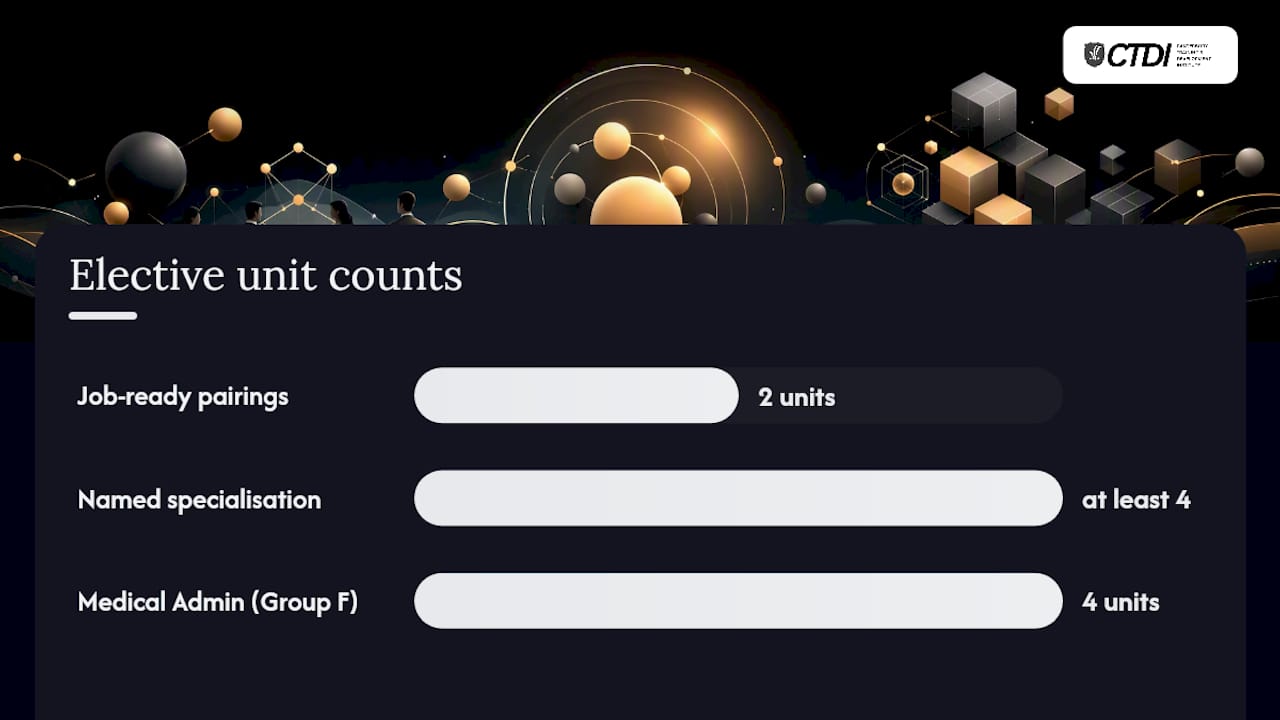
The seven elective units are drawn from Groups A through G in the packaging rules. To earn a named specialisation on your testamur, you must select at least four elective units from a single designated group. The specialisations that can appear on your testamur include:
| Specialisation | Elective group focus |
|---|---|
| Customer Engagement | Customer service, complaints handling, client contact |
| Business Administration | Document production, financial processing, records |
| Medical Administration | Health terminology, patient records, clinic workflows |
| Records and Information Management | Information systems, records control, data management |
A sample of elective units across the groups includes BSBOPS304 (Deliver and monitor a service to customers), BSBFIN301 (Process financial transactions), BSBMED301 (Interpret and apply medical terminology), and BSBRKG301 (Control records). You are not locked into a single group for all seven electives — the packaging rules allow some electives from outside your primary group — but the four-unit minimum in one group is what triggers the specialisation name on your certificate.
Pro Tip: Check the BSB30120 packaging rules PDF before you enrol and confirm which elective group your RTO actually delivers. Not every provider offers every group.
Who is this qualification for, and where can it take you?
The Certificate III in Business suits a wide range of learners. School leavers use it as a direct entry point into office work. Career changers with informal experience in administration or customer service use it to formalise what they already know. Existing workers complete it through a traineeship while earning a wage. It is also common for employers to enrol staff who have been performing business support roles without a formal credential.
Common job roles tied to each specialisation include:
- Customer Engagement — customer service representative, contact centre operator, client services officer
- Business Administration — administration assistant, office administrator, business support officer
- Medical Administration — medical receptionist, clinic administrator, health information officer
- Records and Information Management — records assistant, information management officer, document controller
The NSW Department of Education describes typical tasks for Certificate III holders as producing business documents, managing records, handling customer enquiries, and supporting team operations — a realistic picture of what entry-level roles actually involve.
For further study, the Certificate III in Business is a recognised pathway into a Certificate IV in Business, Certificate IV in Business Administration, or a Diploma of Business. Jobs and Skills Australia's occupation profiles let you check labour-market demand for specific roles before you commit to a specialisation. YourCareer is another useful tool for mapping qualification outcomes to employment pathways.
How long does it take, and what study modes are available?
Duration depends heavily on how you study. The Charles Darwin University course listing illustrates how nominal hours break down across core and elective units, with totals typically in the range of 405–500 hours depending on elective choices. That translates to different real-world timelines depending on your study mode.
| Study mode | Typical duration | Key considerations |
|---|---|---|
| Full-time classroom (TAFE/RTO) | 6–12 months | Structured timetable; face-to-face support; suits school leavers |
| Part-time classroom or blended | 12 months | Flexible scheduling; suits workers; mix of online and on-campus |
| Self-paced online | 6 months | Maximum flexibility; requires self-discipline; no commute |
| Traineeship | 12–24 months | Paid work + training; assessment happens on the job |

Traineeships deserve a separate note. Under a traineeship arrangement, your employer signs a training contract with an RTO, and your assessment is largely based on workplace evidence gathered while you work. This changes both the timeline and the cost structure — traineeship students often pay reduced fees or none at all, depending on state funding arrangements. For many learners, a traineeship is the most direct route to a job with formal recognition attached.
What are the entry requirements and how is the course assessed?
There are no formal academic prerequisites for BSB30120. Most RTOs do not require a Year 12 certificate, though they will typically assess your language, literacy, and numeracy (LLN) skills to confirm you can manage the coursework. For traineeship enrolments, you must be employed in a relevant business role, and minimum age requirements (usually 15 or 16) apply depending on the state.
Assessment across the qualification is competency-based. You are assessed as either competent or not yet competent — there are no percentage grades. Assessment tasks typically include:
- Written knowledge questions
- Practical tasks and simulations (producing documents, handling customer scenarios)
- Workplace observations or third-party reports from supervisors
- Portfolio evidence gathered over the course of study
Recognition of Prior Learning
Recognition of Prior Learning (RPL) allows you to convert existing skills and experience into credit toward the qualification without completing full units from scratch. If you have worked in an office, customer service, or medical administration role, RPL can significantly shorten your study time.
To apply for RPL, you typically submit a portfolio of workplace evidence: position descriptions, work samples, supervisor statements, and examples of tasks you have performed. The RTO then maps your evidence against unit competency requirements.
Pro Tip: Before your RPL assessment, organise your evidence by unit code rather than by job role. Assessors work through each unit systematically, and evidence mapped to specific competencies is far easier to assess — which usually means a faster outcome for you.
How do you apply and choose the right RTO?
Choosing an RTO is as important as choosing the qualification itself. Two providers can both offer BSB30120 but deliver it in very different ways, with different elective combinations, support levels, and fee structures.
Step-by-step application checklist
- Search MySkills (myskills.gov.au) using the code BSB30120 to find registered providers in your state or online.
- Verify on training.gov.au that your chosen RTO is currently registered and that BSB30120 is within their scope of registration.
- Check CRICOS registration if you are an international student — only CRICOS-registered providers can legally enrol international students in Australia.
- Confirm state funding eligibility via your state training portal (see Section 7 below for portal links).
- Compare elective offerings — ask each RTO which elective groups they deliver and whether your target specialisation is available.
- Review assessment methods — confirm whether assessment is online, workplace-based, or a mix, and whether RPL is available.
- Gather your documents — typically: proof of identity, USI (Unique Student Identifier), LLN assessment results, and employment details for traineeship applications.
RTO quality checklist
When comparing providers, look for:
- A current national provider code and active registration on training.gov.au
- Clear information about student support services (academic support, welfare, complaints processes)
- Transparent fee schedules with no hidden charges
- Specific unit codes listed for each elective group, not just marketing titles
- Accessible contact with a real trainer or student adviser before enrolment
Skills SA's MyTraining portal is a good example of a state portal that lists local delivery options alongside funding information — most states have an equivalent.
What does it cost, and is there funding available?
Fees for BSB30120 vary considerably. TAFE providers typically charge between $1,000 and $3,000 for domestic students studying without a subsidy, while private RTOs range more widely depending on delivery mode, included resources, and support levels. Online self-paced delivery is often at the lower end; blended or intensive classroom delivery tends to cost more.
State and territory governments fund a significant portion of vocational training through their own subsidy schemes. Key places to check:
- NSW: Smart and Skilled — check eligibility at training.nsw.gov.au
- Victoria: Skills First — check at skills.vic.gov.au
- Queensland: User Choice and Certificate 3 Guarantee — check at desbt.qld.gov.au
- WA: TAFE WA and Learn TAFE WA — state-subsidised places available for eligible students
- SA: MyTraining Skills SA — lists funded providers and concession rates
- All states: jobsandskills.gov.au for national funding programme information
Traineeship students often access the lowest effective cost, since the employer covers part of the training fee and the student may be eligible for additional state subsidies on top of their traineeship wage.
Pro Tip: Always ask your RTO whether course materials, software licences, and assessment fees are included in the quoted price. Some providers advertise a low headline fee and charge separately for resources — the total cost can look very different once you add those in.
What does "nationally recognised" actually mean?
A nationally recognised qualification is one that has been developed within the Australian Qualifications Framework (AQF) and accredited under a national training package. BSB30120 sits within the BSB Business Services Training Package, which is maintained and updated by the relevant industry reference committee and approved by the Australian Industry and Skills Committee (AISC).
What "nationally recognised" means in practice: your BSB30120 certificate is accepted by employers and further education providers across every Australian state and territory. You do not need to re-qualify if you move interstate, and the credential carries the same weight whether you studied in Perth, Brisbane, or online. The qualification is also recognised for credit transfer purposes at many universities and higher education providers offering business-related diplomas and degrees.
The training.gov.au entry for BSB30120 is the authoritative source for packaging rules, unit lists, release history, and current status. If a provider tells you something about the qualification that contradicts what you read there, trust training.gov.au. For RTO verification, MySkills (myskills.gov.au) lets you search by provider name, location, or qualification code and confirms whether a provider is currently registered.
For international students, CRICOS registration is a separate requirement from national RTO registration. An RTO can be fully registered to deliver BSB30120 to domestic students but not authorised to enrol international students unless they also hold a current CRICOS registration. Always verify both.
Understanding what a nationally recognised qualification actually means before you enrol saves a lot of confusion later — particularly when comparing providers who use terms like "accredited" loosely in their marketing.
How to choose electives that actually help you get hired
Elective selection is the single most consequential decision you make when enrolling in BSB30120, as understanding the educational certificate importance can guide you toward better career outcomes. The national training package prescribes which electives create each specialisation, which means your elective choices directly determine what appears on your testamur and what skills you can evidence to employers.
A practical framework for choosing:
- Start with your target job. Identify two or three specific roles you want to apply for within 12–24 months of completing the qualification.
- Map the skills those roles require. Look at job advertisements on Seek or Indeed for your target roles and note the recurring skill requirements.
- Match electives to those skills. Choose elective units whose competency outcomes directly correspond to the skills employers are asking for.
- Confirm the specialisation trigger. Check that at least four of your chosen electives come from the same group to earn the named specialisation.
- Consider RPL opportunities. If you already have strong skills in one area, choose electives in that area to maximise your RPL evidence — then use your remaining electives to stretch into a skill gap.
Some elective pairings that work well for common roles:
- Business Administration: BSBFIN301 (Process financial transactions) paired with BSBOPS301 (Maintain business resources) gives you a credible payroll and office operations profile.
- Customer Engagement: BSBOPS304 (Deliver and monitor a service to customers) paired with BSBOPS305 (Process customer complaints) directly maps to contact centre and client services job descriptions.
- Medical Administration: Selecting all four Group F units, including BSBMED301 (Interpret and apply medical terminology), means your assessment tasks can reflect actual clinic workflows rather than generic office scenarios.
Two providers can both advertise a "Business Administration" specialisation but include different elective unit combinations. Always compare unit codes, not marketing titles, when choosing between RTOs.
Pro Tip: Download the BSB30120 packaging rules PDF and highlight the four elective units you want before you contact any RTO. You will ask better questions and spot gaps in a provider's offering much faster.
Understanding how career pathways in Australia connect to qualification choices helps you think beyond the certificate itself and plan the next step before you finish the current one.
A note from Sam at CTDI
The students I speak with most often are people who already know what kind of work they want — they just need the credential to back it up. The Certificate III in Business is well-suited to that situation, particularly when you approach elective selection with a clear job target in mind rather than choosing whatever the RTO defaults to.
A few things worth watching for when you compare providers:
- Confirm that your preferred specialisation is actually delivered, not just listed as available in principle.
- Ask specifically whether assessment is competency-based and whether workplace evidence is accepted — some online providers rely heavily on written assignments, which suits some learners but not others.
- Check that student support includes access to a real trainer, not just a help desk.
CTDI offers nationally accredited online vocational courses with flexible, self-paced delivery and direct access to industry-experienced trainers. If you are weighing up your study options, explore CTDI's current enrolment options to see what is available.

Ready to take the next step? CTDI delivers nationally accredited vocational training online, with self-paced study and expert support built in. Enrol now at CTDI and start building the skills Australian employers are looking for.
Sources
- Training
- BSB30120 Certificate III in Business (BSB30120 - 2026) | Charles Darwin University
- Occupation and industry profiles — Jobs and Skills Australia
- Your Career — Australian Government career guidance