

TL;DR:
- Starting coaching in Australia typically involves pursuing an ICF-accredited Level 1 programme or completing a nationally recognized AQF Certificate IV in Workplace and Business Coaching. Graduate Certificates from universities like Charles Sturt provide deeper theoretical knowledge, especially for leadership roles; accreditation and mentor coaching hours are critical factors before enrollment. While an ICF Level 1 programme offers the most direct path to an ACC credential, business skills and practice development remain essential for establishing a sustainable coaching practice.
For most people starting out, the two most credible first steps are enrolling in an ICF-accredited Level 1 programme or completing the AQF Certificate IV in Workplace and Business Coaching through a registered training organisation. If you already hold a degree and want to move into organisational or executive coaching, a Graduate Certificate from a university such as Charles Sturt University is worth considering instead. Either way, the single most important thing to check before you enrol is whether the programme carries ICF Level 1 or Level 2 accreditation and how many mentor coaching hours are built in.
Here is what that means in practice:
- ICF Level 1 accredited programmes map learning outcomes to the ICF core competencies, include mentor coaching, and count toward the Associate Certified Coach (ACC) credential pathway.
- AQF Certificate IV programmes are nationally recognised under the Australian Qualifications Framework and are delivered by registered training organisations (RTOs) such as IECL; they may or may not carry ICF accreditation, so you need to check.
- Graduate Certificates (AQF Level 8) suit coaches who want a university credential and a stronger theoretical foundation, particularly for leadership or organisational roles.
Pro Tip: Before you pay a deposit, search the provider's name on the ICF website to confirm its programme accreditation status. A provider that claims ICF affiliation but does not appear in the ICF directory is a red flag.
Table of Contents
- What does "business coaching certificate" actually mean in Australia?
- How does ICF accreditation work for Australian coaches?
- What do coaching courses typically include?
- How do you choose the right business coaching programme?
- What do representative programme types look like in Australia?
- AQF Certificate IV versus a Graduate Certificate: which pathway suits you?
- Key takeaways
- The credential is only half the picture
- Build your business skills alongside your coaching credential
- Useful sources and next links to check
What does "business coaching certificate" actually mean in Australia?
The phrase "business coaching certificate" is not a single, standardised qualification. Depending on where you look, it can refer to three quite different things, and confusing them is one of the most common mistakes prospective coaches make.
The three main categories
AQF Certificate IV in Workplace and Business Coaching sits at AQF Level 4 within the national vocational education and training (VET) system. RTOs such as IECL deliver it, and it is nationally recognised across Australia. The focus is practical: you learn to facilitate coaching conversations in workplace settings. Some Certificate IV programmes also carry ICF accreditation, but not all do, so you need to check the course listing directly.
University Graduate Certificates in coaching or organisational coaching (AQF Level 8) are postgraduate qualifications. Charles Sturt University's Graduate Certificate in Organisational Coaching and Leadership is a well-known example. These programmes tend to go deeper on theory, leadership psychology, and organisational systems. Entry typically requires an undergraduate degree, and the study load is heavier than a Certificate IV.
ICF-accredited Level 1 and Level 2 programmes are coach training programmes that have been reviewed and accredited by the International Coaching Federation. Level 1 prepares you for the ACC credential; Level 2 prepares you for the Professional Certified Coach (PCC) credential, which requires a higher coaching hours threshold and a more rigorous performance evaluation. These programmes are offered by private providers and some universities, and they can be delivered entirely online.
One more category worth knowing: some programmes offer ICF Continuing Coach Education (CCE) units rather than full Level 1 or Level 2 accreditation. CCE units can contribute to credential renewal or partially to credential applications, but they are not a substitute for a full accredited training pathway if your goal is an ACC or PCC credential.
| Dimension | AQF Certificate IV (VET) | University Graduate Certificate | ICF Level 1/2 programme |
|---|---|---|---|
| Accreditation | AQF Level 4, national RTO recognition | AQF Level 8, university award | ICF programme accreditation (Level 1 or 2) |
| Typical length and mode | several months, blended or online | over multiple years, blended or campus | several months, online or blended cohort |
| Mentor coaching included | Varies by provider | Varies by provider | Yes, required for ICF accreditation |
| Pathway to ICF credential | Possible if also ICF accredited | Possible if also ICF accredited | Direct pathway (ACC for Level 1, PCC for Level 2) |
| Typical cost band | a few thousand Australian dollars | between about ten to twenty-five thousand Australian dollars | thousands of Australian dollars |
Pro Tip: If your goal is an ICF credential, the most direct route is an ICF Level 1 accredited programme. If your goal is a nationally recognised Australian qualification, a Certificate IV or Graduate Certificate gives you that. The best programmes offer both.
How does ICF accreditation work for Australian coaches?
The International Coaching Federation is the global benchmark for coaching programme standards. It accredits training programmes, not individual coaches. When a programme holds ICF Level 1 or Level 2 accreditation, it means the ICF has reviewed the curriculum, confirmed it maps to the ICF core competencies, and verified that mentor coaching and supervised practice are included.
Completing an accredited programme does not automatically give you an ICF credential. You still need to apply separately, document your hours, and pass the ICF assessment.
ICF credential pathways: ACC, PCC, MCC
The three ICF credentials form a progression:
- PCC (Professional Certified Coach): — requires more training, more coaching hours, and a performance evaluation at a higher standard. Level 2 programmes prepare you for this pathway.
What the ACC pathway typically requires
According to ICF credentials and standards, the ACC pathway commonly includes:
| Requirement | Typical threshold |
|---|---|
| ICF-accredited training hours | 60+ hours |
| Mentor coaching hours | about 10 hours |
| Coaching practice hours | 100+ hours |
| Performance evaluation | ICF Coaching Knowledge Assessment (CKA) |
Dedicated candidates who prioritise their hours and scheduling can complete the ACC pathway within several months of finishing their training. The practical bottleneck is almost always the coaching hours, not the coursework. You need real clients, and securing them early in your programme makes a significant difference to your timeline.
A realistic timeline: If you start an ICF Level 1 programme today, complete it within six months, and begin accumulating coaching hours alongside your study, an ACC application within 12 months is achievable. Most candidates take longer because they wait until after graduation to find clients.
Checklist: what to confirm in any course listing before enrolling
- Does the programme hold ICF Level 1 or Level 2 accreditation (not just CCE units)?
- How many mentor coaching hours are included, and are they one-on-one or group?
- Are supervised coaching sessions and recorded session assessment part of the curriculum?
- Do the learning outcomes explicitly reference the ICF core competencies?
- What is the total training hours count, and does it meet the 60+ hour threshold for ACC?
What do coaching courses typically include?
Most reputable business coach training programmes share a common set of components, though the depth and delivery vary considerably.
Core curriculum elements
The ICF core competencies are the reference model that well-designed programmes use to structure their learning outcomes. You can expect coursework covering:
- Coaching presence and active listening
- Powerful questioning and direct communication
- Goal setting, accountability, and progress tracking
- Ethics and professional standards in coaching
- Business and practice development modules (client acquisition, pricing, contracts, systems)
That last category matters more than many programmes admit. Coaching competency alone does not build a practice. Programmes that include business skills modules, marketing frameworks, and client management systems give graduates a genuine head start.
Mentor coaching and supervised practice
Mentor coaching is a formal process where an experienced coach observes your coaching, gives structured feedback, and helps you develop your skills against the ICF competencies. It is not the same as being coached yourself, and it is not optional if you want an ICF credential.
Supervised practice typically involves coaching real clients, recording sessions, and submitting recordings for assessment. This is where most candidates slow down. Finding clients willing to be recorded takes time, and many programmes expect you to arrange pro-bono placements yourself. Start looking for practice clients in the first week of your course, not the last.
How do you choose the right business coaching programme?
The market for coaching certification online is crowded, and not all programmes are equal. These questions cut through the noise.
Questions to ask before you enrol
- Is the programme ICF accredited at Level 1 or Level 2? — Check the ICF directory directly, not just the provider's marketing copy.
Red flags to watch for
- No mentor coaching included, or mentor coaching described vaguely without an hours count
- Training hours that are unclear or bundled with self-study in a way that inflates the count
- No assessment of recorded coaching sessions
- Income claims that promise specific earnings without caveats
- ICF "affiliation" language that does not correspond to actual programme accreditation in the ICF directory
A note on costs and funding
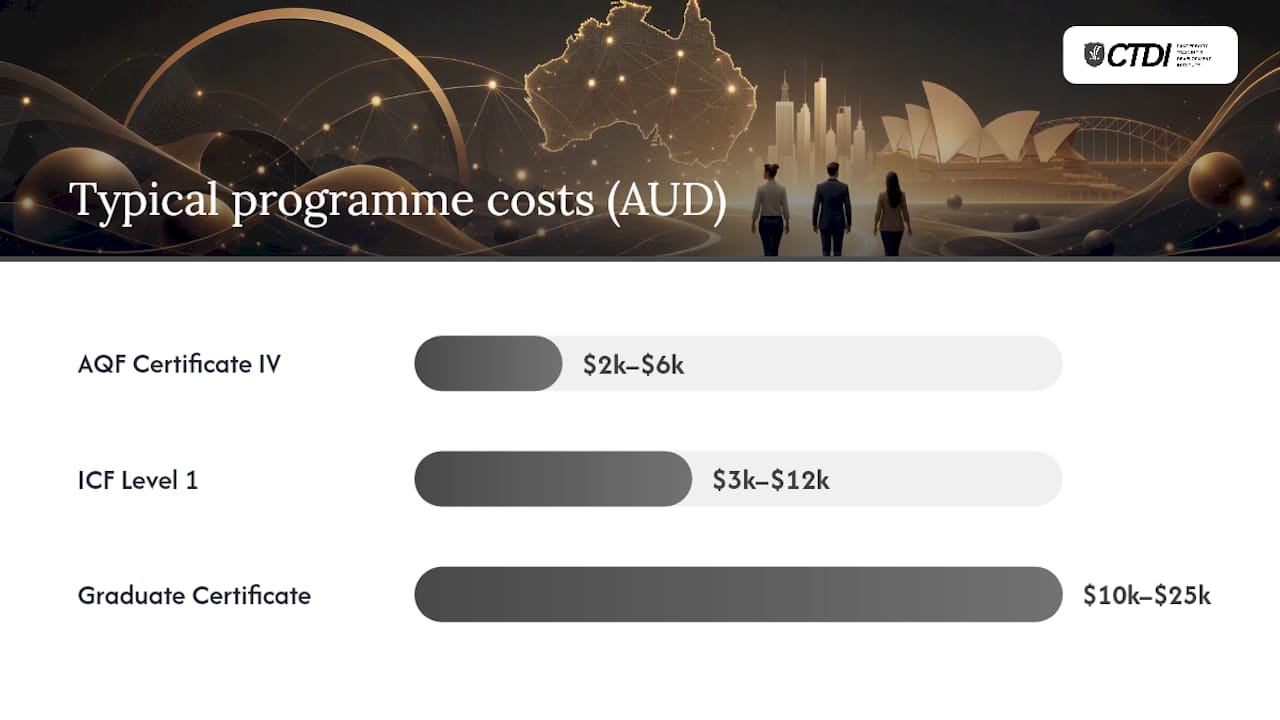
Certificate IV programmes through RTOs typically range from $2,000 to $6,000 AUD. ICF Level 1 programmes from private providers generally sit between $3,000 and $12,000 AUD. University Graduate Certificates are the most expensive option, often $10,000 to $25,000 AUD or more depending on the institution. Some RTO-delivered programmes may be eligible for VET Student Loans; confirm eligibility directly with the provider and check the nationally accredited courses framework to understand what recognised qualifications look like in practice.
What do representative programme types look like in Australia?
Rather than ranking providers, it helps to understand what each programme type looks like in practice so you can match a course page to the categories already covered.
- University Graduate Certificate (e.g. Charles Sturt University's Graduate Certificate in Organisational Coaching and Leadership): — AQF Level 8, postgraduate entry, stronger on theory and leadership applications. Best suited to people with a degree who want to move into executive or organisational coaching roles.
- ICF Level 1 online programme: provider pages typically list detailed hour breakdowns, mentor coaching inclusions, and delivery logistics. These are the key verification points. Look for explicit ICF programme accreditation, not just claims of ICF alignment.
| Programme type | Accreditation | Typical cost (AUD) | Best suited to |
|---|---|---|---|
| AQF Certificate IV (RTO) | AQF Level 4, national | $2,000–$6,000 | Workplace coaches, HR professionals |
| Graduate Certificate (university) | AQF Level 8, university | $10,000–$25,000 | Degree holders, organisational/executive coaching |
| ICF Level 1 programme | ICF Level 1 | $3,000–$12,000 | Coaches targeting ACC credential |
| ICF Level 2 programme | ICF Level 2 | several thousand Australian dollars and up | Coaches targeting PCC credential |
| CCE-only programme | ICF CCE units only | several hundred to a few thousand dollars | Credential renewal, supplementary learning |
Pro Tip: When you land on a course page, look for three things immediately: the ICF programme accreditation level (not just a logo), the mentor coaching hours count, and whether recorded session assessment is included. If any of these are missing from the page, ask the provider directly before proceeding.
For a broader view of how coaching communities and peer networks can support your development alongside formal study, third-party perspectives are worth exploring.
AQF Certificate IV versus a Graduate Certificate: which pathway suits you?
The Australian Qualifications Framework sets the national standard for education and training qualifications. Certificate IV sits at AQF Level 4, which signals a qualification focused on practical skills and applied knowledge in a defined context. A Graduate Certificate sits at AQF Level 8, a postgraduate award that requires a higher level of theoretical understanding and independent analysis.
Both are nationally recognised. The difference is not just prestige; it is purpose.
Who should choose a Certificate IV?
A Certificate IV suits you if you are entering coaching from a non-degree background, working in a workplace role (team leader, HR, operations) and want to formalise coaching skills, or want a shorter, more affordable pathway to practice. It is also a practical starting point if you plan to pursue ICF accreditation later, provided the specific Certificate IV programme you choose also holds ICF Level 1 accreditation. Understanding why national accreditation matters for your career is worth reading before you decide.
Who should choose a Graduate Certificate?
A Graduate Certificate makes more sense if you already hold a degree, are targeting executive, leadership, or organisational coaching roles, or want the credibility of a university award for corporate clients. The study load is heavier and the cost is higher, but the theoretical depth and AQF Level 8 status carry weight in organisational settings.
Key takeaways
An ICF Level 1 accredited programme is the most direct path to an ACC credential in Australia, but the bottleneck is always coaching hours, not coursework.
| Point | Details |
|---|---|
| Check ICF accreditation first | Confirm Level 1 or Level 2 status in the ICF directory before enrolling, not just on the provider's website. |
| Mentor coaching hours matter | Look for at least 10 hours of mentor coaching included; group and one-on-one hours are weighted differently. |
| Start finding clients early | The coaching hours for ACC take time; secure practice clients in the first weeks of your programme, not after. |
| Match pathway to career goal | Certificate IV suits workplace and independent coaches; a Graduate Certificate suits executive and organisational roles. |
| Edu's vocational programmes | CTDI's nationally accredited courses in digital marketing and AI help coaches build the business skills to run a practice. |
The credential is only half the picture
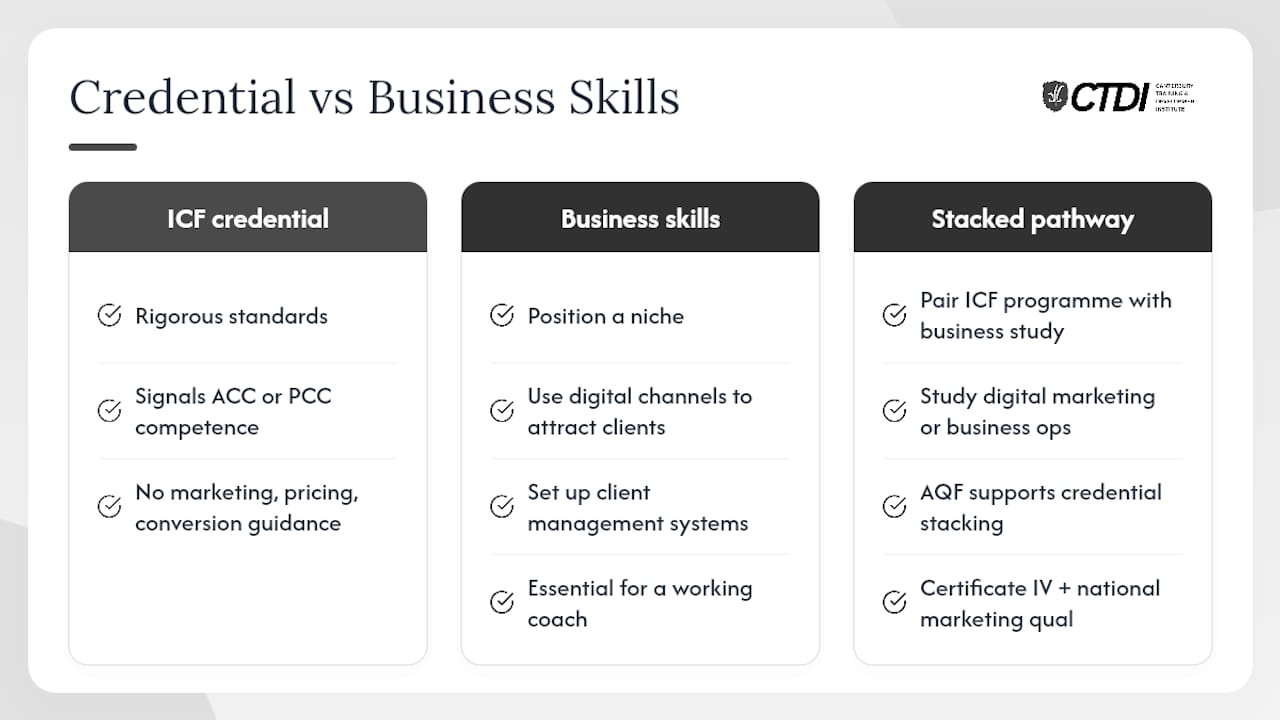
There is a gap in how most coaching programmes are marketed in Australia, and it is worth naming directly. The industry puts enormous emphasis on ICF credentials, and rightly so. The ICF credentials and standards framework is rigorous, and an ACC or PCC credential signals genuine competence to prospective clients. But a credential does not tell a client how to find you, what to charge, or how to convert an enquiry into a paid engagement.
The coaches who build sustainable practices earliest are almost always the ones who treated business skills as seriously as coaching skills from day one. That means understanding how to position a niche, how to use digital channels to attract clients, and how to set up simple client management systems. These are not soft extras; they are the difference between a qualified coach and a working coach.
From a vocational training perspective, the most underrated move for a new coach is pairing an ICF-accredited coaching programme with formal study in digital marketing or business operations. Not because the coaching credential is insufficient, but because the business side of coaching is genuinely a separate skill set, and most coaching programmes give it only passing attention.
The AQF framework supports this kind of credential stacking. A Certificate IV in coaching and a nationally recognised qualification in digital marketing are both legitimate, stackable credentials that together give you a more complete professional profile than either does alone.
Build your business skills alongside your coaching credential
Earning an ICF-accredited coaching credential gives you the competence to coach. Running a profitable practice also requires the ability to attract clients, manage your digital presence, and operate your business with confidence. That is where Edu comes in.
Canterbury Training and Development Institute (CTDI) offers nationally accredited online vocational programmes in digital marketing and AI for business, designed for working professionals who need flexible, self-paced study. These qualifications do not issue ICF credentials, but they do give you a recognised AQF qualification and practical skills that directly support a coaching practice: content marketing, client acquisition, social media strategy, and AI-assisted business tools.
If you are building toward a coaching career and want to arrive with both the coaching credential and the business capability to back it up, CTDI's programmes are a practical next step. Enrol now or request course information to see which programme fits your timeline.
Useful sources and next links to check
Use these primary sources to verify accreditation claims and follow up on programme details directly.
- International Coaching Federation
- ICF credentials and standards
- ICF core competencies
- Online ICF‑Accredited Level 1 Coaching Certification
- Become a Certified Business Coach | Mindvalley
- ICF Certification | Small Business Coach Training for PCC (Level 2)
- Become an ICF-Certified Coach. 100% Online.
What to check on any course page:
For practical guidance on how accreditation in Australia works across different qualification types, the CTDI blog covers the national recognition process in detail. You can also explore coaching competency insights for applied perspectives on skill development beyond the classroom.