

TL;DR:
- Accreditation in Australia confirms that courses, qualifications, or training providers meet national quality standards and is granted by regulators like ASQA, TEQSA, or sector-specific bodies. There are three types: course accreditation, provider accreditation, and professional accreditation, each with distinct requirements and governing authorities. Proper preparation, clear documentation, stakeholder engagement, and timely responses are essential, as the process can take up to 18 months and costs over $8,600.
Accreditation in Australia is the formal recognition granted by government regulators or professional bodies that confirms a course, qualification, or training provider meets national quality standards. Knowing how to get accredited in Australia is the first step for any professional or organisation seeking to deliver or enrol in education that carries real weight with employers and licensing authorities. The primary regulators include the Australian Skills Quality Authority (ASQA), the Tertiary Education Quality and Standards Agency (TEQSA), the New South Wales Education Standards Authority (NESA), and the Australian Institute for Teaching and School Leadership (AITSL). Getting this right opens doors to career advancement, legal compliance, and nationally recognised qualifications that transfer across every state and territory.
What types of accreditation exist in Australia?
Three distinct types of accreditation operate in Australia, and confusing them is one of the most common mistakes applicants make.
Course accreditation applies to individual training products delivered within the Vocational Education and Training (VET) sector. ASQA assesses whether a course meets national standards before it can be formally listed on the National Register, known as training.gov.au. A course must align with the Australian Qualifications Framework, which sets ten qualification levels and defines the learning outcomes required at each. The AQF ensures qualifications are nationally recognised and comparable across education sectors. That comparability is what makes an AQF-aligned qualification credible to any Australian employer.
Provider accreditation refers to the registration of a training organisation itself. A Registered Training Organisation (RTO) is a business or institution approved by ASQA to deliver nationally recognised training. Without RTO status, an organisation cannot issue AQF qualifications. This is a separate process from course accreditation, and both are often required together.
Professional accreditation is legally mandatory for practice in many regulated occupations. It is distinct from government course registration and sits outside the CRICOS framework entirely. The Nursing and Midwifery Board of Australia (NMBA) governs nursing graduates, while AITSL sets standards for initial teacher education programmes. Professional accreditation ensures graduates meet clinical or pedagogical standards before they can legally practise.
Key regulatory bodies at a glance
| Accreditation type | Governing body | Who it applies to |
|---|---|---|
| VET course accreditation | ASQA | Training providers, course developers |
| Higher education accreditation | TEQSA | Universities, private higher education providers |
| Initial teacher education | AITSL / NESA | Teacher education programmes |
| Nursing and midwifery | NMBA | Nursing schools and graduates |
| RTO registration | ASQA | Any organisation delivering VET qualifications |
The distinction between these types matters because each carries different fees, timelines, and documentation requirements. Applying to the wrong body wastes months and money.
What do you need before applying for accreditation?
Preparation determines whether your application succeeds or stalls at the first review. Regulators assess readiness before they assess content, so arriving unprepared is costly.

For RTO registration, financial viability for three years must be demonstrated through business plans and financial projections. The RTO registration process itself takes 6–12 months. That timeline assumes your documentation is complete from day one, which rarely happens without deliberate preparation.
For course accreditation under ASQA, the VET Accredited Courses 2021 policy sets the templates and standards your course documentation must follow. You need to show industry need, define target learners, map learning outcomes to the AQF, and demonstrate that your assessment strategies are valid and reliable. Skipping any of these elements triggers a rectification notice, which adds weeks to your timeline.
Stakeholder consultation is not optional. ASQA expects evidence that industry representatives, employers, and relevant professional bodies have been engaged during course development. A letter of support from an industry association carries real weight. Without it, your application signals that the course was developed in isolation from the sector it claims to serve.
For NSW-based programmes, applications must be submitted at least 8 months before the planned delivery date. Assessment panels receive documentation 4 weeks before their meeting, and providers must respond to draft reports within 6 weeks. Build those windows into your project plan before you write a single unit of competency.
Pro Tip: Create a readiness checklist that maps every required document to the relevant standard before you begin writing course content. Identifying gaps early saves far more time than fixing them mid-application.
Step-by-step: how to achieve accreditation in Australia
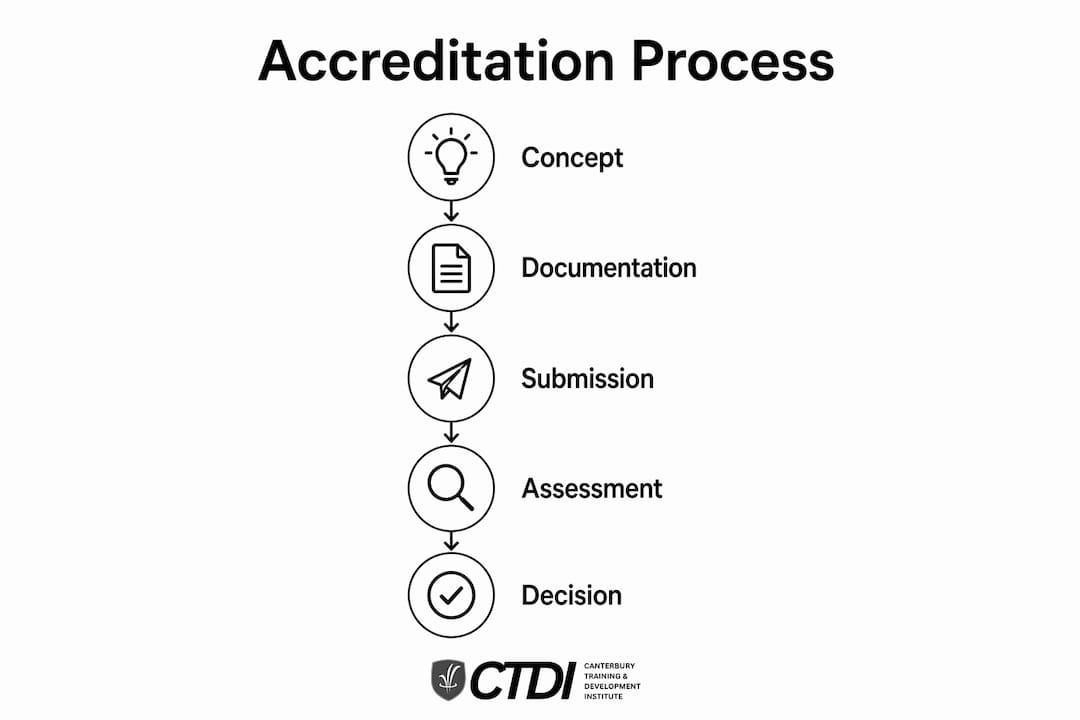
The accreditation process in Australia follows a defined sequence. Each stage has specific requirements, fees, and response windows.
Stage 1: Initial concept submission
The first formal step is submitting a course concept to ASQA. This document outlines the proposed qualification, the target learner group, the industry need, and evidence of stakeholder engagement. The initial lodgement fee is $600, and concept approval takes approximately 6 months. This stage is a gatekeeping mechanism. ASQA uses it to confirm there is genuine demand before investing assessment resources in a full application review.
Stage 2: Full course documentation
Once the concept is approved, you develop the complete course documentation. This includes:
- Units of competency with detailed performance criteria
- Assessment conditions and tools
- Trainer and assessor qualification requirements
- Delivery mode descriptions and resource requirements
- Mapping documents that align each unit to AQF level descriptors
Use the national templates published by ASQA. Deviating from these templates is a common reason applications are returned at the completeness check stage.
Stage 3: Formal application submission
The full accreditation fee is $8,000, payable at submission. ASQA conducts a completeness check first, confirming all required documents are present and in the correct format. If anything is missing, you receive a notice and a short window to supply the outstanding material. Passing the completeness check moves your application into the detailed review phase.
Stage 4: Detailed assessment and rectification
During the detailed review, ASQA assessors evaluate your course against the Standards for VET Accredited Courses. They examine whether learning outcomes are achievable, whether assessment strategies are fit for purpose, and whether the course fills a genuine gap in the training market. If assessors identify non-compliance, they issue a notice. Applicants have 14 calendar days to respond to non-compliance notices during assessment. Missing that window can result in the application being refused without further review.
Stage 5: Final decision and registration
After the rectification period, ASQA makes a final accreditation decision. Approved courses are listed on training.gov.au and assigned an official course code. Accreditation is typically granted for a fixed period, after which re-accreditation is required. Maintaining compliance with the Standards for RTOs 2015 throughout the accreditation period is a legal obligation, not a suggestion.
Pro Tip: Keep a dedicated communication log with your ASQA contact officer. Documenting every exchange protects you if a dispute arises about what was agreed during the rectification phase.
The full process from concept to final decision commonly spans 12–18 months for a new course. For step-by-step course accreditation guidance specific to 2026 requirements, detailed breakdowns of each stage are available to help you plan accurately.
What are the most common accreditation mistakes in Australia?
Most accreditation applications that fail or stall share the same handful of problems. Knowing them in advance is the most practical advantage you can have.
- Incomplete documentation. Missing a single required template or leaving a section blank triggers a completeness check failure. Assessors do not fill gaps for you.
- Insufficient financial planning. Underestimating the cost and time of the process is a leading cause of withdrawal. The fees alone total $8,600 for concept and full application, before staff time and consultant costs.
- Weak stakeholder engagement. A course developed without documented industry consultation signals poor market validation. ASQA expects named organisations and specific feedback, not generic letters of support.
- Late responses to assessment reports. The 14-day response window for non-compliance notices is firm. Providers who treat it as flexible often find their application refused.
- Ignoring ongoing compliance. Compliance with Standards for RTOs 2015 is required regardless of organisation size. Small providers are audited on the same criteria as large institutions.
Expert compliance consultants are commonly engaged to avoid these delays and administrative pitfalls. The cost of a consultant is almost always lower than the cost of a refused application and a second lodgement fee.
Pro Tip: Before submitting, ask someone outside your team to review your application against the ASQA standards checklist. Fresh eyes catch gaps that familiarity hides.
Understanding why accreditation matters beyond the compliance checkbox helps applicants approach the process with the right mindset. Accreditation is not a bureaucratic hurdle. It is the mechanism that makes your qualification credible to every employer, licensing board, and further education institution in the country.
Key takeaways
Gaining accreditation in Australia requires matching the right regulatory pathway to your specific goal, preparing thorough documentation before applying, and responding to assessor feedback within strict timeframes.
| Point | Details |
|---|---|
| Choose the right accreditation type | Course, provider, and professional accreditation each have different regulators and requirements. |
| Prepare documentation before applying | Financial plans, stakeholder evidence, and AQF-aligned course content must be ready before lodgement. |
| Budget for fees and timelines | The concept and full application fees total $8,600, and the full process takes 12–18 months. |
| Respond to assessors within 14 days | Non-compliance notices carry a 14-calendar-day response window; missing it risks refusal. |
| Maintain compliance post-accreditation | Standards for RTOs 2015 apply throughout the accreditation period, not just at the point of approval. |
What I have learned about accreditation that most guides leave out
Most accreditation guides focus on the paperwork. What they underplay is the organisational readiness problem. I have seen well-resourced organisations submit technically complete applications that still stall for months, because the people responsible for responding to assessor queries were not empowered to make decisions quickly. The 14-day response window is unforgiving. If your internal approval chain takes two weeks to sign off a one-page response, you will miss it.
The other thing I would tell anyone starting this process: do not treat stakeholder engagement as a box to tick. The organisations that sail through ASQA review are the ones that genuinely co-designed their course with industry partners. Those partners provide specific, credible feedback that assessors can verify. A generic letter from an industry body you emailed once is not the same thing, and assessors know the difference.
Post-accreditation compliance is where many providers lose focus. Accreditation is not a permanent status. It requires active maintenance, including keeping trainer qualifications current, updating assessment tools when industry standards change, and responding to audit requests promptly. I have seen providers invest enormous effort in gaining accreditation and then treat ongoing compliance as an afterthought. That approach leads to conditions being placed on registration, which is far more disruptive than getting the initial application right.
The most important strategic decision you make is choosing the accreditation pathway that actually aligns with your career or organisational goal. Gaining an RTO registration when what you need is professional accreditation through AITSL wastes a year and significant money. Map your goal first, then choose the pathway. Everything else follows from that.
— Sam
Accredited online courses at Canterbury Training and Development Institute
If you are a professional looking to enrol in nationally recognised training rather than deliver it, the accreditation process looks very different. You need a provider whose courses already carry AQF recognition and whose qualifications are accepted by employers and licensing bodies across Australia.

Edu, the Canterbury Training and Development Institute (CTDI), offers accredited online diplomas in AI, digital marketing, and environmental management. Courses are delivered 100% online and self-paced, designed by industry experts for professionals who need recognised qualifications without pausing their careers. For organisations looking to upskill teams through accredited training, corporate training partnerships are also available. Enrolments are open now.
FAQ
What is accreditation in Australia?
Accreditation in Australia is formal recognition from a government regulator or professional body confirming that a course, qualification, or training provider meets national quality standards. The key regulators include ASQA, TEQSA, AITSL, and sector-specific bodies such as the NMBA.
How long does the accreditation process take in Australia?
RTO registration typically takes 6–12 months, while full course accreditation through ASQA commonly spans 12–18 months from concept submission to final decision. NSW-based programme applications must be submitted at least 8 months before planned delivery.
How much does it cost to get a course accredited through ASQA?
The initial concept lodgement fee is $600, and the full accreditation application fee is $8,000, bringing the minimum total to $8,600 before staff time or consultant costs.
Can small training providers get accredited in Australia?
Small training providers can obtain accreditation, but they must meet the same ASQA standards as large institutions, including qualified trainers, compliant assessment tools, and effective policies aligned with the Standards for RTOs 2015.
What is the difference between course accreditation and professional accreditation?
Course accreditation registers a training product on the National Register via ASQA, while professional accreditation is granted by sector bodies such as AITSL or the NMBA and is legally required for practice in regulated occupations. Both may be needed depending on your field. For a broader overview of accredited courses in Australia and their career benefits, further reading is available.