

TL;DR:
- Course accreditation involves an independent evaluation confirming that educational programs meet established quality and industry standards. Proper documentation mapping each criterion is essential to avoid rejection and ensure program credibility. Managing deadlines and active post-approval maintenance are crucial for sustained accreditation status and trustworthiness.
Course accreditation is the formal process by which an independent body evaluates an educational programme against defined quality and industry standards, then certifies it as meeting those benchmarks. For students and professionals in Australia, understanding the step by step course accreditation process is the difference between holding a qualification that opens doors and holding one that employers quietly discount. Bodies such as ABET, the US Environmental Protection Agency (EPA), the International CPTED Association (ICA), and CPD certification services each operate distinct accreditation frameworks, but all share a common logic: structured evidence, mapped to specific criteria, reviewed by qualified assessors. This guide walks you through every stage, from initial documentation to post-approval obligations, so you can approach the process with clarity and confidence.
What are the prerequisites and documentation needed to start?
Before you submit a single form, you need to assemble a specific set of materials. Accreditation bodies do not accept vague course descriptions or informal syllabi. They expect structured, criterion-referenced evidence that proves your programme delivers what it claims.

The core documents required across most accreditation frameworks include a self-study report, a course proposal with defined learning outcomes, an assessment blueprint, instructor qualification records, and course delivery materials. EPA mandates detailed training facility information, test blueprints, quality control plans, and supporting materials as part of every application package. That level of specificity is not unusual. It reflects the standard expectation across professional accreditation bodies.
The table below compares documentation requirements across four major frameworks to help you understand what each body prioritises.
| Document type | ABET | EPA | ICA (CAP) | CPD (VeriCPD) |
|---|---|---|---|---|
| Self-study report | Required, criterion-mapped | Not specified | Competency matrix | Course information form |
| Learning outcomes | Mapped to General and Program Criteria | Defined training objectives | Linked to CPTED competencies | Measurable and defined |
| Instructor qualifications | Required | Required with documentation | Required for membership | Relevant experience stated |
| Assessment blueprint | Implied by criteria evidence | Explicitly required | Included in CAP Matrix | Delivery modality described |
| Facility or delivery details | Programme-specific | Full facility description | Online or in-person noted | Delivery format confirmed |
Understanding where your documentation gaps are before you apply saves weeks of back-and-forth with assessors. ABET expects programmes to satisfy all General Criteria plus any discipline-specific Programme Criteria, with traceable evidence for each. That means you cannot bundle evidence loosely and hope reviewers find what they need. Every claim must point directly to a criterion.
Key documentation categories to prepare before applying:
- Self-study report or competency matrix, structured by criterion
- Defined learning outcomes with measurable assessment methods
- Instructor CVs and qualification certificates
- Course delivery materials including slides, readings, and assessments
- Quality control or moderation plan for assessments
- Facility or platform description (physical or online)
- Fee payment confirmation and membership records where required
Pro Tip: Consult your target accreditation body's published criteria at least three months before you plan to apply. Early stakeholder consultation, including input from industry advisers and potential assessors, identifies documentation gaps before they become rejection reasons.
Step by step guide through the course accreditation process
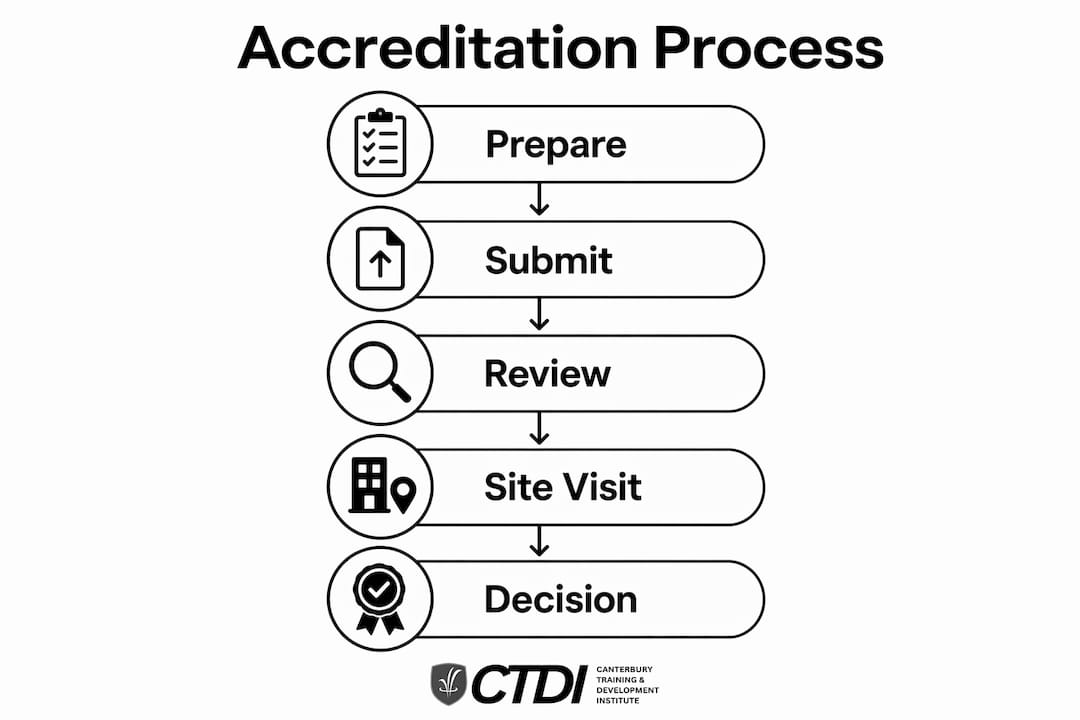
The accreditation process follows a predictable sequence across most bodies, even though timelines and terminology differ. Knowing each phase in advance lets you build a project plan rather than react to each stage as it arrives.
Here is a numbered walkthrough of the typical accreditation procedure, with estimated durations based on published body requirements.
-
Eligibility check and membership (1 to 4 weeks). Confirm your programme meets the body's basic eligibility criteria. ICA, for example, requires active membership before an application can be lodged. ABET requires institutional eligibility confirmation before a formal review begins.
-
Application submission and fee payment (1 to 2 weeks). Submit your formal application through the body's designated portal or system. EPA requires separate applications for initial accreditation, reaccreditation, amendments, and certificate replacement, each with its own fee. Treating these as distinct administrative tasks prevents costly confusion.
-
Documentation package preparation (4 to 12 weeks). Compile your self-study report, competency matrix, or course information form depending on the body. This is the most labour-intensive phase and the one most applicants underestimate.
-
Submission within the designated window (fixed deadline). Most bodies enforce strict submission windows. ICA mandates that all materials be submitted within two years of the initial application. Missing that window means restarting the entire process from step one.
-
Peer review or panel assessment (6 to 16 weeks). Qualified assessors evaluate your submission against the body's published criteria. ABET uses a structured peer-review model where self-study files are assessed criterion by criterion, not as a narrative whole.
-
Outcome notification (2 to 4 weeks after review). You receive one of three outcomes: approved, not approved, or incomplete. Each outcome carries specific next steps.
-
Resubmission if required (within 3 months for ICA). If your application receives a "not approved" outcome, ICA allows resubmission within three months. Missing that window resets the process entirely.
-
Accreditation granted and obligations begin (ongoing). Once approved, you receive formal certification, logo usage rights in some cases, and a set of ongoing reporting or renewal obligations.
The table below summarises typical timelines across the four frameworks discussed in this guide.
| Phase | ABET | EPA | ICA (CAP) | CPD (VeriCPD) |
|---|---|---|---|---|
| Application to submission | Varies by cycle | Immediate online portal | Up to 2 years | Weeks to months |
| Review period | 6 to 12 months | Not published | Not specified | Weeks |
| Resubmission window | Programme-specific | Separate new application | 3 months | Reapply |
| Accreditation validity | 6 years typical | 4 years | Programme-specific | Annual or multi-year |
| Reaccreditation notice | 2 years before expiry | 180 days before expiry | On renewal | On renewal |
Pro Tip: Build an internal deadline calendar that works backwards from every submission date. If ICA's two-year window sounds generous, it disappears quickly once you account for instructor availability, document drafting, and internal review cycles. Treat accreditation deadlines as fixed project constraints, not flexible targets.
How to meet accreditation criteria and avoid common pitfalls
Meeting accreditation criteria is not about producing the most voluminous submission. It is about producing the most precisely mapped one. Assessors are not reading your course materials for enjoyment. They are checking whether specific evidence exists for each specific criterion.
ABET's computing accreditation framework separates General Criteria from Programme Criteria, and both must be satisfied with direct, traceable evidence. A self-study report that addresses General Criteria thoroughly but ignores Programme Criteria will receive an incomplete or not approved outcome regardless of how well written it is. The same logic applies to CPD accreditation, where assessment checks whether training objectives are defined, content is structured, delivery is appropriate, and outcomes are measurable. Vague objectives fail on every one of those dimensions.
The most common mistakes applicants make, and how to avoid them:
- Incomplete documentation. Submitting a self-study report without an assessment blueprint or instructor qualifications is the single most frequent cause of rejection. Cross-reference the body's published checklist before submitting.
- Missing deadlines. Late submissions are not accepted with apologies. They reset the process. Build buffer time into every stage of your preparation.
- Insufficient evidence mapping. Listing learning outcomes without linking them to specific assessment tasks and criteria is not evidence. It is a claim. Assessors need to see the connection explicitly.
- Bundling evidence loosely. Organising your submission by document type rather than by criterion forces assessors to hunt for evidence. Criterion-by-criterion organisation, as ABET recommends, produces faster and more favourable reviews.
- Ignoring Programme-specific criteria. Applicants who focus only on General Criteria and overlook discipline-specific requirements consistently receive incomplete outcomes. Read the full criteria document, not just the summary.
- Underqualified instructors. EPA and ICA both require documented instructor qualifications. A strong course with an inadequately credentialled instructor will not pass review.
The underlying principle across all these pitfalls is the same. Accreditation bodies are assessing your programme's quality through the quality of your submission. A disorganised or incomplete application signals a disorganised or incomplete programme, regardless of how good the actual teaching is.
What to expect after submitting your accreditation application
Post-submission is not a passive waiting period. It is a phase that requires active management, particularly if your outcome is anything other than a straightforward approval.
The three possible outcomes across most accreditation frameworks are approved, not approved, and incomplete. Each carries distinct obligations.
- Approved. Your programme receives formal accreditation, typically with a certificate, logo usage rights, and a defined validity period. ICA awards accreditation with logo usage rights and requires instructors to provide evidentiary letters guiding students toward related certification pathways. Approval is not the end of your obligations. It is the beginning of your maintenance obligations.
- Not approved. You receive detailed feedback identifying which criteria were not met. ICA allows resubmission within three months. Use that window to address every identified gap, not just the most obvious ones.
- Incomplete. Your submission was missing required materials. Most bodies allow you to supply the missing documentation within a defined period without restarting the full process.
Reaccreditation is the other major post-approval obligation. EPA training accreditations expire every four years, and reaccreditation applications must be submitted no later than 180 days before expiry. That is a six-month lead time, which means reaccreditation planning should begin in year three of a four-year cycle. Treating reaccreditation as a separate project, with its own documentation review and internal timeline, prevents the last-minute scrambles that cause programmes to lapse.
For students and professionals evaluating whether a course is genuinely accredited, the validity period matters. A course accredited in 2019 under a four-year cycle may have lapsed in 2023 without renewal. Always verify the current accreditation status directly with the issuing body before enrolment.
Key takeaways
Successful course accreditation requires criterion-mapped documentation, strict deadline management, and active post-approval maintenance across every major accreditation framework.
| Point | Details |
|---|---|
| Prepare documentation early | Compile self-study reports, instructor qualifications, and assessment blueprints before applying. |
| Map evidence to criteria | Link every learning outcome and assessment task directly to the body's published criteria. |
| Manage deadlines as fixed constraints | Missing submission windows resets the process; build backwards from every deadline. |
| Understand post-approval obligations | Accreditation validity periods and reaccreditation timelines require active ongoing management. |
| Verify current accreditation status | Confirm a course's accreditation is current before enrolment, as programmes can lapse without renewal. |
Why preparation discipline matters more than anything else
Having worked through accreditation processes across multiple educational contexts, the single factor that separates successful applications from failed ones is not the quality of the course. It is the quality of the preparation.
Most applicants underestimate the administrative discipline required. They have excellent courses, qualified instructors, and genuine learning outcomes. But they submit documentation that is loosely organised, criterion-mapping that is implied rather than explicit, and timelines that assume everything will go smoothly. Accreditation bodies are not designed to be forgiving of administrative gaps. They are designed to assess whether a programme can sustain quality over time, and a disorganised application is evidence that it cannot.
The advice I give consistently is this: treat your accreditation submission as a product in its own right. It needs a project manager, a review cycle, and a quality check against the body's published criteria before it leaves your hands. Proactive communication with the accreditation body during preparation, not just at submission, also makes a measurable difference. Most bodies will clarify ambiguous criteria if you ask. The ones who do not ask are the ones who guess wrong and receive incomplete outcomes.
For students evaluating accredited courses, the lesson is parallel. An accredited qualification in Australia carries weight precisely because the accreditation process is rigorous. When a provider has done the work to meet those standards, you are enrolling in a programme that has been independently verified, not just self-described as quality.
— Sam
Start your career with an accredited CTDI course

Edu, the Canterbury Training and Development Institute (CTDI), offers nationally recognised vocational qualifications that have been developed to meet industry standards across high-growth fields. If you are researching the accreditation process because you want to enrol in a programme that genuinely meets those standards, CTDI's accredited diplomas and certificates are built with that rigour in mind. From the Advanced Diploma of Digital Marketing to the Certificate IV in Environmental Sustainability, each programme is designed by industry experts and delivered 100% online at your own pace. Enrol now and take the next step toward a qualification that employers recognise and respect.
FAQ
What is course accreditation and why does it matter?
Course accreditation is the formal process by which an independent body evaluates an educational programme against defined quality standards and certifies it as meeting those benchmarks. Accredited qualifications carry greater credibility with employers and professional bodies than unaccredited ones, directly affecting career outcomes.
How long does the course accreditation process take?
Timelines vary significantly by body. ABET reviews typically span six to twelve months from submission, while CPD accreditation through providers like VeriCPD can be completed in weeks. ICA allows up to two years for full documentation submission after the initial application.
What happens if my accreditation application is rejected?
A "not approved" outcome from bodies like ICA allows resubmission within three months, provided you address all identified gaps. Missing that resubmission window means restarting the full process from the beginning, including fees and documentation.
How often does course accreditation need to be renewed?
Renewal cycles differ by body. EPA accreditations expire every four years, with reaccreditation applications due 180 days before expiry. ABET typically operates on six-year cycles. Always check the specific body's renewal requirements.
How can students verify a course is currently accredited?
Contact the accrediting body directly and request confirmation of the programme's current status. Accreditation can lapse if a provider misses renewal deadlines, so checking at the time of enrolment, not just at the time of marketing, is the only reliable method.