

The quickest path to a recognised green skills credential in Australia is an AQF-listed VET qualification found on Training, because that's what employers and government contracts actually check. If you need to move faster or spend less, state-funded skill sets and free micro-learning like the Green Skills Passport get you working knowledge in days rather than months.
Here's how the three options stack up in practice:
- Formal recognition: AQF-accredited qualifications (Certificate II through Diploma) listed on training.gov.au, the register employers and procurement teams actually check.
- Fast, low-cost entry: State-funded skill sets, such as the Green Skills - Safety Skill Set through Jobs and Skills WA, often delivered fee-free.
- Quick literacy boost: National micro-learning like the EY Microsoft Green Skills Passport, a free 10-hour introduction.
Key Takeaways
Choosing the right green skills pathway in Australia comes down to matching AQF-verified qualifications to your career goal, using funded skill sets for fast entry, and treating micro-credentials as a supplement rather than a substitute.
| Point | Details |
|---|---|
| Check training.gov.au first | Verify any qualification or unit code against the national register before enrolling or paying. |
| Use fee-free skill sets for speed | Programs like the Jobs and Skills WA Green Skills safety skill set offer fast, low-cost entry that can credit toward further study. |
| Treat micro-credentials as a top-up | Free options like the Green Skills Passport build literacy fast but don't replace licensed qualifications. |
| Prioritise applied assessment | Courses with workplace simulation or real project tasks, not just quizzes, build competency employers trust. |
| Consider CTDI for formal recognition | CTDI's online Certificate IV in Environmental Sustainability suits working learners needing an AQF-listed credential for coordinator or advisory roles. |
Table of Contents
- What counts as green skills training in Australia?
- Where government and industry support green skills training
- How do you choose an accredited green skills course?
- Why CTDI fits these green skills pathways
- What are the entry requirements for green skills courses?
- How do you access career support after finishing a course?
- Where does green skills training lead: employment or further study?
- Accredited providers versus non-accredited: what's the real difference?
- Which green jobs and roles actually use these skills?
- Get started on an accredited green skills qualification
- Frequently asked questions
- Sources
What counts as green skills training in Australia?
Not every course labeled "sustainability" carries the same weight with employers, and the difference usually comes down to where it sits on the Australian Qualifications Framework. AQF-listed qualifications, from Certificate II through to Diploma level, are the only training type recorded on training.gov.au, which is what recruiters, government agencies, and licensing bodies actually search when verifying a candidate's credentials. A short course or webinar might teach you something genuinely useful, but if it doesn't appear on that register, it won't satisfy a job ad that specifies "nationally recognised training."
Three tiers cover most learners:
- AQF qualifications — structured, assessed, and portable across employers. A Certificate II sits at entry level with supervised tasks; a Certificate IV or Diploma signals independent judgement and often management responsibility. UEE22125 Certificate II in Sustainable Energy is a solid example, built for career starters wanting hands-on grounding in renewables.
- Skill sets — smaller, targeted bundles of units from a full qualification, often state-funded. The Jobs and Skills WA Green Skills safety skill set is fee-free and its units can credit toward a fuller qualification later, so it's not a dead end.
- Micro-credentials — industry-designed, usually shorter than a skill set, and not always AQF-listed. The EY Microsoft Green Skills Passport falls here: excellent for building literacy fast, but it won't replace a licensed qualification if a role requires one.
The trade-off is straightforward: skill sets and micro-credentials get you moving quickly and cheaply, while full AQF qualifications carry the weight formal employment and contracting usually demand.
Where government and industry support green skills training
Several coordinated efforts are shaping how green skills training gets funded and delivered across the country, and knowing which lever applies to you saves a lot of wasted searching. National policy conversations, echoed in OECD research on skills for the green transition, push VET providers to embed sustainability content across existing training packages rather than treating it as a bolt-on elective. That's a slow-moving but real shift, and it's why you're now seeing sustainability units appear inside qualifications that have nothing to do with environmental management on the surface, from construction to hospitality.
At state level, the practical action happens through funded skill sets:
- Jobs and Skills WA runs fee-free short courses, including the Green Skills safety skill set, aimed at getting workers job-ready without a large training bill.
- Eligibility typically depends on residency, age, and prior qualification level, so check the specific portal for your state before assuming you qualify.
- International capability-building programs, like the Australia Awards Aus4ASEAN green skills initiative, show how institutional partnerships extend training capacity beyond what any single provider could offer alone.
Industry-backed micro-learning, like the Green Skills Passport, sits alongside these government schemes rather than competing with them. Think of it as the on-ramp; the funded skill sets and AQF qualifications are the highway.
How do you choose an accredited green skills course?
Start by checking the course against the AQF register, because everything else is secondary if that step fails. Search the exact qualification or unit code on training.gov.au, not just the provider's marketing name for it. A course calling itself "Certificate IV in Sustainability" needs to match a real, current entry, complete with unit codes like BSBSUS411 Apply environmentally sustainable work practices. If the provider can't tell you the unit codes, that's a warning sign worth taking seriously.
Beyond accreditation, look for applied learning. Competency-based training relies on demonstrated skill, not just multiple-choice quizzes, and providers that build in workplace simulations or real project tasks tend to produce graduates who can actually do the job on day one.
Run through this checklist before enrolling:
- Confirm the qualification or skill set is listed on training.gov.au under its exact code.
- Check whether assessments include applied tasks, simulated workplace scenarios, or real project work.
- Ask about credit transfer if you've already completed a skill set or micro-credential.
- Confirm delivery mode (online, blended, or in-person) suits your work and study routine.
- Check funding eligibility, including state fee-free places and employer-sponsored options.
Pro Tip: Ring the provider and ask them to quote the specific unit codes covered in the course before you pay a cent. A legitimate registered training organisation will rattle them off without hesitation.
Why CTDI fits these green skills pathways
CTDI offers a Certificate IV in Environmental Sustainability as a nationally recognised, fully online qualification, built for people who need flexibility without sacrificing accreditation. It's designed for working learners: self-paced study, industry-informed assessment tasks, and a structure that maps to the kind of applied competency employers expect from a Certificate IV holder.
Formal recognition matters most when a role requires evidence of competency rather than general awareness, which is exactly where an AQF-listed qualification earns its keep over a short course alone.
What this looks like in practice:
- Delivery is 100% online and self-paced, suiting people balancing study with work or family commitments.
- Assessments are designed by industry practitioners rather than generic academic templates.
- The qualification sits at Certificate IV level, appropriate for sustainability officer, coordinator, or advisory-track roles rather than purely entry-level positions.
If you're weighing this against a short skill set, the comparison usually comes down to depth versus speed: a skill set gets you working faster, while a Certificate IV gives you the rounded competency base that supports promotion or contracting work later.
What are the entry requirements for green skills courses?
Most green skills training in Australia doesn't demand a science background or prior sustainability experience, which surprises a lot of career changers who assume otherwise. Entry-level skill sets and Certificate II qualifications typically ask for nothing more than being over school-leaving age, with some providers requesting basic literacy and numeracy given the technical vocabulary involved in areas like energy auditing or waste systems.
Certificate IV and Diploma-level courses raise the bar slightly. Providers often look for either a related Certificate III, relevant industry experience, or in CTDI's case, straightforward admission based on your ability to engage with self-paced online study and industry-style assessment tasks. There's rarely a hard prerequisite qualification for a Certificate IV in Environmental Sustainability, but having some workplace exposure to compliance, operations, or facilities management makes the coursework click faster.
For international students or career changers coming from outside the sector, expect providers to check English language proficiency and, for AQF qualifications, verify your identity and eligibility for enrolment in a nationally recognised course. Employer-sponsored candidates usually skip a lot of this friction, since the employer has already vetted the fit between the course and the role.
The practical takeaway: don't let a lack of formal science or engineering background stop you from starting. Green skills training is built to take generalists and give them job-specific competency, not to filter for people who already have it.
How do you access career support after finishing a course?
Career support usually starts before you finish your final assessment, not after, so ask about it during enrolment rather than treating it as an afterthought. Registered training organisations that take employment outcomes seriously typically offer resume guidance, interview preparation, and in some cases direct connections to employer partners looking for graduates with specific unit competencies.

For AQF qualifications, your certificate itself becomes a practical job-search tool, since it lists the exact units you've completed. That specificity lets you match your application directly to job ads asking for particular competencies, rather than relying on a vague "completed sustainability training" line on your resume. Employers hiring for compliance, facilities, or environmental coordinator roles often screen for exact unit codes, so knowing yours by heart is worth the five minutes it takes to memorise them.
Job seekers should also look beyond the training provider. Industry associations, state-based Jobs and Skills portals, and LinkedIn groups built around sustainability roles are often faster-moving than a provider's own job board. If your course included applied projects or workplace simulations, ask your trainer whether any of that work can be turned into a portfolio piece. Employers in emerging fields like carbon accounting or circular economy roles increasingly want to see applied evidence, not just a certificate number.
Where does green skills training lead: employment or further study?
A green skills qualification rarely functions as a dead end. Most AQF courses are built with vertical pathways in mind, so a Certificate II can credit toward a Certificate IV, and a Certificate IV often opens the door to a Diploma or even university recognition of prior learning. This stacking structure means the training you start with doesn't lock you into a ceiling.
On the employment side, the qualification level you hold shapes the roles realistically open to you. Certificate II and skill set holders typically move into entry-level operational roles: site assistants, energy auditors' support staff, waste management technicians. Certificate IV and Diploma holders move toward coordination and advisory roles, where independent judgement and stakeholder communication matter more than hands-on technical execution alone.
For those unsure whether to head straight into work or keep studying, a hybrid approach often works best. Combining an AQF qualification with a targeted industry microcredential can round out job readiness faster than either path alone, particularly for career changers moving from an unrelated field. The qualification proves formal competency; the microcredential proves you've kept current with specific tools or technical developments the broader course didn't cover in depth.
Accredited providers versus non-accredited: what's the real difference?
The gap between a nationally recognised training provider and a non-accredited one comes down to one thing: whether your certificate means anything to a third party. Registered training organisations are audited against national standards, their qualifications appear on training.gov.au, and their assessments must meet defined competency benchmarks set by the relevant training package. A non-accredited provider can teach genuinely good content, but there's no external body verifying that what you learned matches an industry-recognised standard.
This matters most in regulated or safety-sensitive work. If a job ad specifies "Certificate IV in Environmental Sustainability" or references a specific unit code, a certificate from a non-accredited course simply won't satisfy that requirement, no matter how thorough the content was. Government contracts and many corporate procurement processes have the same rigidity, often requiring evidence of AQF-listed training as a compliance condition.
Non-accredited courses still have a place, particularly for quick upskilling on a specific tool or concept where formal certification isn't the point. The mistake is assuming they're interchangeable with accredited training when it comes to job applications, licensing, or career progression. Before paying for any course, a thirty-second search on training.gov.au tells you which category you're dealing with.
Which green jobs and roles actually use these skills?
Job titles in this space map fairly predictably to qualification level, which makes planning your training a lot less guesswork than it sounds. Entry-level roles like site assistant, waste operations support, or junior energy auditor typically suit Certificate II holders or someone who's completed a funded skill set. Move up to Certificate IV or Diploma level and you're looking at sustainability officer, environmental coordinator, or compliance advisor positions, where independent decision-making and stakeholder liaison become part of the job.
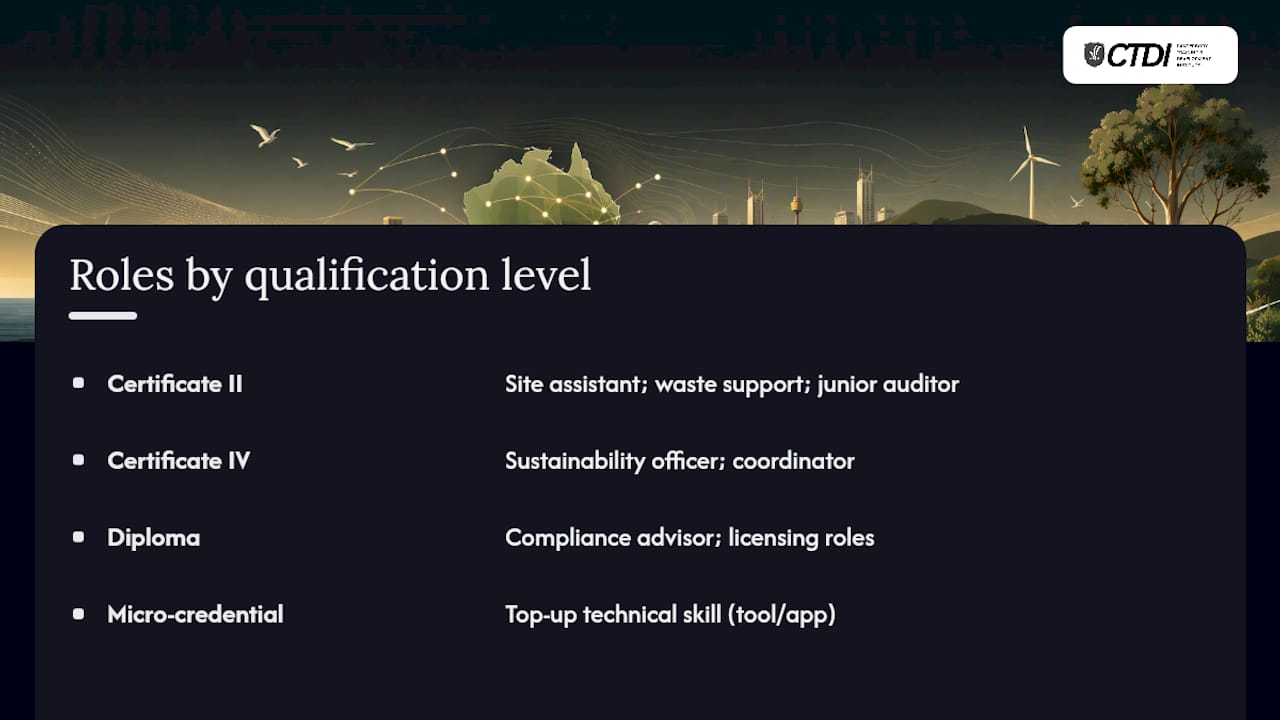
Micro-credentials fit best as a top-up rather than a foundation. If you already hold a relevant qualification and want to add a specific technical skill, such as a carbon accounting tool or an AI application for sustainability reporting, a short industry course does the job without requiring you to repeat a full qualification. But for government contracting or roles with licensing requirements, a full AQF qualification generally remains non-negotiable.
Underneath all of this sit cross-cutting competencies, systems thinking, energy efficiency planning, and environmental management documentation, that OECD and UNESCO guidance both flag as increasingly essential regardless of specific job title.
Get started on an accredited green skills qualification
Most of the free skill sets and micro-credentials covered above are excellent starting points, but they stop short of the formal recognition a Certificate IV carries. CTDI's Certificate IV in Environmental Sustainability gives working Australians a nationally recognised qualification without requiring time off work, delivered entirely online and self-paced, with assessment tasks built by industry practitioners rather than generic templates.
This suits career changers moving into sustainability coordination, employees whose companies are formalising environmental compliance roles, and anyone who's already done a skill set or the Green Skills Passport and wants the credential that actually satisfies employer and government requirements, as explained in office fit outs and sustainability. If you're weighing your next step, browse the full course details and enrol to see whether the Certificate IV fits your timeline and career goal, or explore CTDI's Advanced Diploma of Digital Marketing if your sustainability role also touches on communications and reporting.
Frequently asked questions
What is the fastest way to get started in green skills training in Australia? A free micro-learning course like the Green Skills Passport gets you foundational literacy in about 10 hours, while a state-funded skill set like the Jobs and Skills WA Green Skills safety skill set offers a fee-free entry point that credits toward further study.
Do I need a science background to enrol in a green skills course? No. Most entry-level skill sets and Certificate II qualifications require no prior sustainability or science background, just basic literacy and numeracy for the technical content involved.
How do I know if a green skills course is nationally recognised? Search the exact qualification name or unit code on training.gov.au. If it doesn't appear there under that code, it isn't an AQF-accredited qualification.
Can a short skill set lead to a full qualification later? Yes. Many state-funded skill sets, including the Jobs and Skills WA example, use units drawn from full qualifications, so completed units can often credit toward a Certificate II, IV, or higher later.
What roles can I access with a Certificate IV in Environmental Sustainability? Certificate IV holders typically move into sustainability officer, environmental coordinator, or compliance advisor roles, where independent judgement and stakeholder communication are part of the job.
Is CTDI's Certificate IV delivered fully online? Yes. CTDI delivers the Certificate IV in Environmental Sustainability as a self-paced, fully online qualification designed for working learners.
Are micro-credentials a substitute for an AQF qualification? Generally no. Micro-credentials work well as a technical top-up for people who already hold a relevant qualification, but government contracts and licensed roles usually require a full AQF-listed credential.
What cross-cutting skills matter most in green jobs regardless of role? Systems thinking, energy efficiency planning, and environmental management documentation come up repeatedly across sustainability roles, according to OECD and UNESCO policy guidance on skills for the green transition.
Sources
- Training
- Green Skills - Safety Skill Set | Jobs and Skills WA
- Green Skills Passport: sustainability skills and green jobs program | EY - Australia
- Empowered citizens, informed consumers and skilled workers (OECD report)