
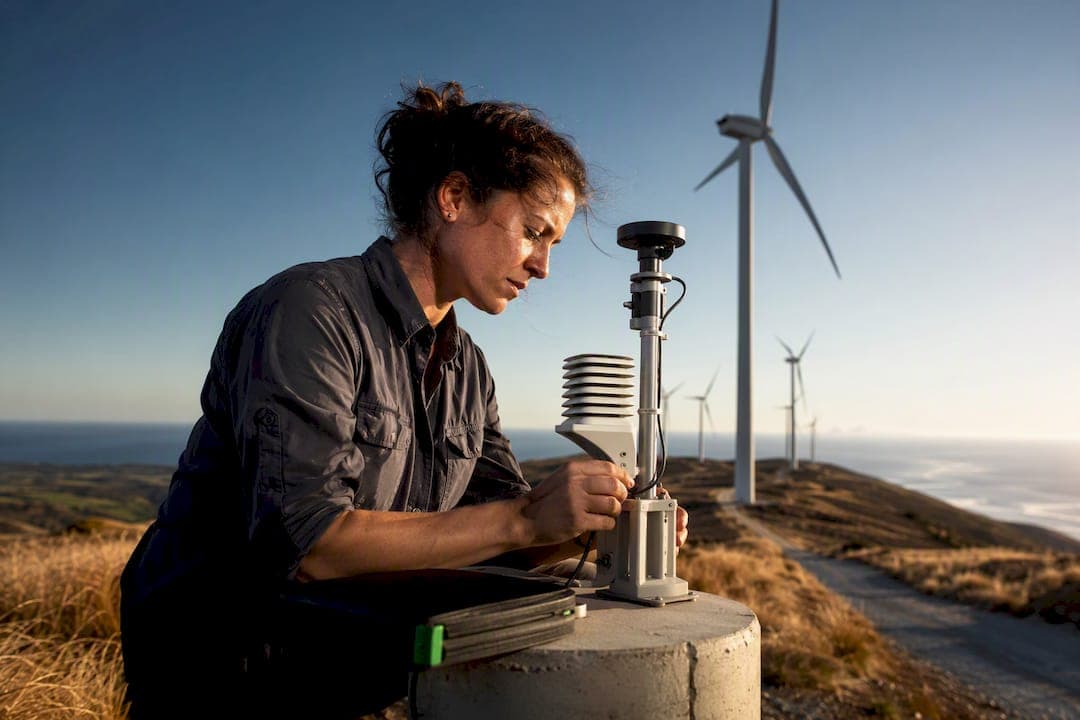
Yes, you can build a career in sustainability, and you do not need a science degree to start. The realistic paths split into five broad lanes: in‑house ESG roles, consulting, clean energy and technical work, policy and planning, and community or NGO roles. Pick one lane, then close your biggest skills gap with a targeted micro‑course or a small project you can point to in an interview. The rest of this guide walks through skills, study options, portfolio building and where the jobs actually sit.
Table of Contents
- How do you build a career in sustainability in Australia?
- What skills do employers in sustainability actually want?
- VET, degree or micro‑credential: which study path fits?
- Step-by-step: moving into or advancing in sustainability
- How do you gain hands‑on sustainability experience?
- Where do you find sustainability jobs and build a network?
- How long does it realistically take to build a sustainability career?
- What certifications and memberships matter in Australia?
- Which sustainability industries and sectors are growing in Australia?
- How do government policies affect sustainability careers?
- What can you expect to earn in a sustainability role?
- Which CTDI course supports a move into sustainability?
- Sources
- FAQ
How do you build a career in sustainability in Australia?
Sustainability work spans far more than "sustainability officer" job titles. Most people entering the field either move sideways from an adjacent profession or specialise from within a role they already hold.
- In‑house sustainability/ESG roles sit inside corporations, councils and universities, tracking emissions data, writing sustainability reports and coordinating targets across departments. Typical employers include ASX‑listed companies, local councils and universities; progression usually runs from coordinator to manager to head of sustainability over several years.
- Sustainability consulting involves advising multiple clients on climate risk, ESG disclosure or supply chain impacts, often for engineering or professional services firms. Day‑to‑day work is heavy on report writing, client workshops and data modelling.
- Renewable energy and technical roles cover engineering, project development and asset management for solar, wind and storage projects, employing electricians, engineers and project managers.
- Policy and regulation roles sit in government departments and advocacy bodies, shaping the rules that everyone else works within.
- Sustainable finance and biodiversity/water/community roles round out the field, from green bond analysts to catchment officers and NGO program staff.
Project managers, engineers, urban planners and accountants often transition fastest, because their core skills transfer directly and only the sustainability layer needs building. UTS career guidance notes that many successful sustainability professionals arrive this way rather than through a dedicated sustainability degree, having spent years in an adjacent field before making the switch, a pattern worth remembering if you already have ten years in construction, finance or local government under your belt.
What skills do employers in sustainability actually want?
Employers rarely hire for enthusiasm alone. They want people who can read a carbon footprint, sit through a stakeholder meeting without losing the room, and turn a spreadsheet into a decision.
Technical knowledge that comes up repeatedly in job ads includes carbon accounting basics, ESG reporting frameworks (like the Global Reporting Initiative or the ISSB standards), lifecycle thinking, and sector-specific knowledge such as energy efficiency or waste management, depending on the role.
Transferable skills matter just as much, and often more, for career changers:
- Project management and the ability to run a multi‑stakeholder initiative to deadline.
- Stakeholder engagement, since most sustainability work involves persuading people who do not report to you.
- Systems thinking, or the ability to see how one change in a supply chain ripples elsewhere.
- Data translation, turning a spreadsheet of emissions figures into a business case a chief financial officer will fund.
Statistic callout: The Infrastructure Sustainability capability framework maps 27 areas of practice across a five‑level competency structure for infrastructure sustainability professionals, giving job seekers a genuine benchmark for what "skilled" actually looks like at each career stage.
Evidence beats claims on a resumé. A finished project with measurable outcomes, benchmarked against a recognised framework, tells an employer more than a list of buzzwords ever will.
VET, degree or micro‑credential: which study path fits?
Australia's education system offers three genuinely different products here, and mixing them up wastes both time and money.
Nationally recognised VET qualifications (Certificate IV and Diploma level) are built for practitioner roles: environmental technicians, sustainability coordinators, compliance officers. They are shorter than a degree, delivered by registered training organisations, and focused on applied skills rather than theory.
University degrees, undergraduate or postgraduate, suit strategic and technical specialisations such as climate science, environmental engineering or ESG leadership roles that expect a Masters‑level qualification.
Micro‑credentials and CPD are short, targeted, and useful for topping up a specific skill gap, but they carry less standalone weight with employers.
- Certificate IV: entry to mid‑level practitioner roles, typically self‑paced online study over months rather than years.
- Bachelor or Masters degree: technical specialist or strategic leadership tracks, usually two to four years of study.
- Micro‑credential or short course: fastest way to plug a single gap, best combined with a project as proof of application.
The catch with micro‑credentials is recognition. Infrastructure Australia's workforce report points to a growing mismatch between the volume of short courses on offer and how much weight employers actually give them, recommending clearer national coordination of training pathways. A micro‑credential sitting alone on a LinkedIn profile rarely moves a hiring manager; paired with a real project, it does.
Pro Tip: Before enrolling in anything, pull three job ads for your target role and list every technical requirement they repeat. Pick the single course that closes the most common gap, not the one with the flashiest name.
Step-by-step: moving into or advancing in sustainability
A career shift into sustainability rarely happens by accident. It happens through a sequence most people skip because it feels slower than firing off applications.
- Pick and research a target role. Gather three real job ads for that title and note which requirements appear in all of them. That short list is your actual gap analysis, more useful than any generic skills checklist.
- Map your transferable skills against the gaps. If you are an accountant eyeing sustainable finance, you already have half the toolkit. Identify one or two focused courses or micro‑projects that close what is genuinely missing, not everything that looks interesting.
- Build two portfolio pieces and rewrite your resumé. Lead with outcomes, not duties. "Reduced site energy use by mapping consumption across three shifts" beats "responsible for sustainability initiatives" every time.
- Apply for placements, volunteer roles and targeted jobs. Follow up applications with the specific evidence from your portfolio, not a generic cover letter. UTS's guidance on becoming a sustainability consultant stresses that the professionals who get hired are the ones who can translate technical detail into a business case a non‑specialist will act on.
Expect this sequence to take months, not weeks, particularly if you are studying part‑time alongside a current job.
How do you gain hands‑on sustainability experience?
Nobody hires a sustainability manager who has never actually measured anything. The good news is that measurable projects do not require a corporate mandate.
- A basic carbon footprint calculation for your own household or small business, done properly with sourced emissions factors, is a legitimate portfolio piece.
- A workplace energy audit, even an informal one for your current employer, demonstrates the exact skill consultants get paid for.
- A waste diversion plan for a community group or small operator shows you can design and measure an intervention, not just describe one.
Placements are easier to find than most people assume. Local councils regularly run sustainability or environment placements, and several jurisdictions publish decarbonisation pathway guides that flag training and job hotspots, including the Net Zero Careers Guide from the Department of Employment and Workplace Relations. Industry bodies and NGOs also take on volunteers for shorter projects.
Pro Tip: Design projects you can finish in four to eight weeks, then present them as a mini case study with a before-and-after metric. A completed small project beats a half‑finished ambitious one, every time.
Where do you find sustainability jobs and build a network?
Job boards alone rarely fill a sustainability career pipeline. The roles that matter most often surface through channels most job seekers never check.
- Specialist environmental and sustainability job boards, plus sector career hubs run by industry associations.
- Government graduate programs, which regularly run sustainability, environment or climate streams.
- Industry association listings and member directories, often the first place a new role gets posted.
Networking works best when it is specific. Attending a sector event or joining a professional association gives you access to informational interviews, which beat cold applications for uncovering roles before they are advertised. When you do approach an employer directly, send a short, evidence‑led message with a one‑page summary of a relevant project attached, not a generic "I'm passionate about sustainability" email.
How long does it realistically take to build a sustainability career?
Progression in this field tends to move in stages rather than a straight line, and the timeline depends heavily on your starting point.
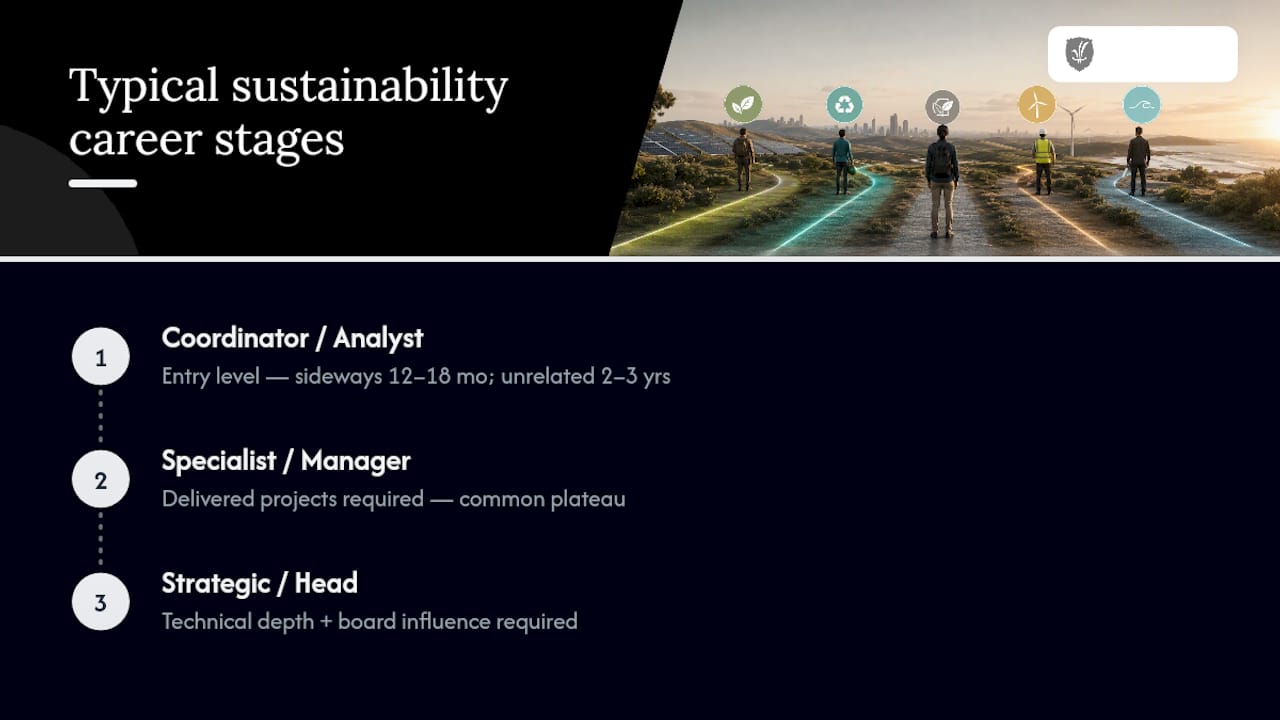
Someone moving sideways from an adjacent role, an engineer picking up climate risk work, for instance, might see a title change within twelve to eighteen months, because the technical foundation is already there. Someone starting from a completely unrelated field, retail management moving into ESG reporting, say, should realistically expect two to three years of combined study, project work and junior roles before reaching a coordinator or specialist title.
Seniority in sustainability tends to follow a familiar shape: coordinator or analyst roles first, then a specialist or manager title once you can point to delivered projects, then strategic or head‑of‑function roles that demand both technical depth and the ability to influence a board. Skipping straight to a senior title without that track record is uncommon, regardless of how strong your enthusiasm is.
Plateaus are common at the coordinator‑to‑manager step, largely because that jump requires demonstrated impact rather than just accumulated knowledge. This is exactly where a portfolio of measurable projects, an energy audit here, a waste plan there, earns its keep. Nobody can promise a specific promotion timeline or guarantee a particular outcome, but the professionals who progress fastest consistently show one pattern: they pair study with a steady drip of small, finished, measurable projects rather than waiting for the "big" opportunity to prove themselves.
What certifications and memberships matter in Australia?
Certifications sit alongside formal qualifications rather than replacing them, and knowing the difference protects you from wasting money on the wrong one.
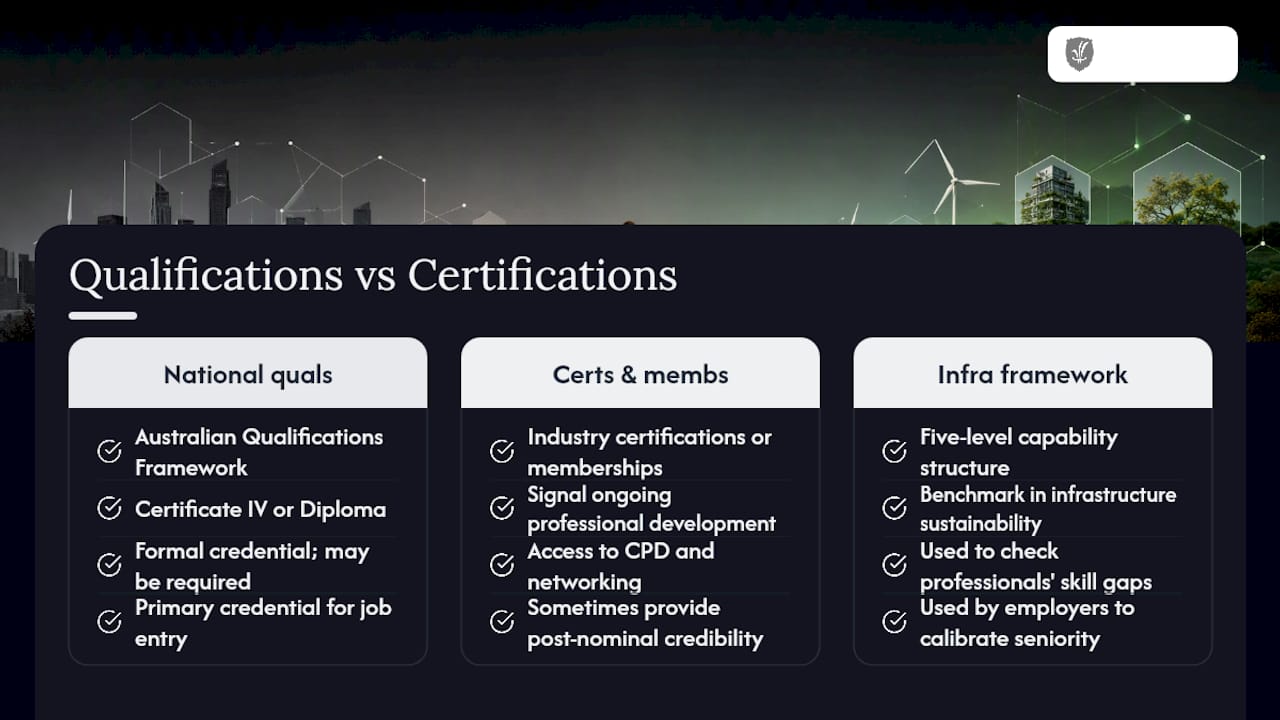
Nationally recognised qualifications, a Certificate IV or Diploma issued under the Australian Qualifications Framework, carry different weight to industry certifications or association memberships, which typically signal ongoing professional development rather than a formal credential. The Infrastructure Sustainability capability framework is one of the more respected benchmarks in infrastructure and construction sustainability, used by employers to calibrate seniority and by professionals to check their own skill gaps against a five‑level structure.
Professional membership bodies relevant to Australian sustainability careers include groups tied to environmental management, ESG reporting and climate risk, alongside sector‑specific bodies for clean energy professionals. Membership generally gives you access to continuing professional development, networking events and, in some cases, a recognised post‑nominal that signals credibility to employers.
None of these certifications substitute for a nationally recognised VET qualification or degree if a role specifically requires one. Treat them as an ongoing layer of professional credibility, useful for staying current and for networking, rather than the primary credential that gets you through the door. Check the specific requirements listed on job ads for your target role before assuming a membership alone will suffice.
Which sustainability industries and sectors are growing in Australia?
Sustainability work is not a single industry, but a layer sitting across dozens of them, and the growth is uneven.
Renewable energy and the broader clean energy sector is the most visible growth area, driving demand for engineers, technicians, project managers and analysts as solar, wind and storage capacity expands. The Clean Energy Council's careers guidance notes that employers in this space value transferable skills heavily, and that trade and VET pathways sit alongside degree routes as legitimate entry points.
Corporate sustainability and ESG reporting has grown quickly inside listed companies, banks and professional services firms, driven largely by tightening disclosure expectations. Conservation and biodiversity roles, catchment management, land rehabilitation, marine and terrestrial ecology, remain smaller in headcount but persistent, often sitting within government agencies and NGOs rather than the private sector. Water management, waste and circular economy, and sustainable finance round out the picture, each with its own specialist skill set but overlapping heavily on the core competencies covered earlier: data translation, stakeholder engagement and project delivery.
How do government policies affect sustainability careers?
Policy settings shape which sustainability jobs get funded and where they cluster, sometimes more than any individual employer's ambition.
Australia's net‑zero commitments have pushed governments to invest directly in workforce planning rather than leaving it to individual employers. Infrastructure Australia's workforce report recommends a national stocktake and coordinated training to improve transparency around career pathways and worker mobility between sectors, an acknowledgment that the current system is fragmented enough to confuse even motivated career changers. State and territory decarbonisation pathway guides, published as part of DEWR's broader net‑zero careers resources, map training and job hotspots by region, which is genuinely useful if you are trying to work out where demand is concentrated rather than guessing.
Mandatory climate disclosure requirements for larger companies have also driven demand for ESG reporting skills specifically, since compliance is no longer optional for the businesses affected. None of this guarantees a particular job outcome for any individual reader, policy settings shift, and funding cycles are not permanent, but they do explain why certain roles (climate risk analysts, ESG reporting specialists, decarbonisation project managers) have expanded noticeably compared to five years ago.
What can you expect to earn in a sustainability role?
Pay in sustainability roles varies enormously by sector, seniority and location, and no single figure represents the field. A council sustainability coordinator, a corporate ESG manager at a large bank, and a clean energy project engineer sit on genuinely different pay scales, shaped as much by the employing industry as by the sustainability label attached to the job title.
Rather than promising a specific salary figure, which would be misleading given how much roles vary, the more useful approach is to benchmark against the broader profession you are entering. A sustainability role inside banking or finance tends to track finance sector pay more closely than it tracks a not‑for‑profit's sustainability program salary. Similarly, technical clean energy roles, engineering and project management in particular, tend to sit closer to broader engineering and construction pay bands than to policy or advocacy roles.
Career changers should check current, role‑specific salary data through sector job boards and recruitment agencies rather than relying on generalised figures, since a single average masks enormous variation between a junior coordinator role and a senior strategic position. The most reliable comparison point is usually the salary band for your target employer's broader industry, adjusted for the seniority level you are actually applying at, not a blanket "sustainability salary" figure that does not reflect where you are actually trying to land.
Which CTDI course supports a move into sustainability?
If you have read this far and landed on the practitioner path, in‑house coordinator roles, compliance, environmental reporting, a nationally recognised VET qualification is usually the fastest route to a credential employers actually recognise for that level.
CanterburyTDI's Certificate IV in Environment Sustainable Management is designed for exactly that gap: a nationally recognised qualification, delivered fully online and self‑paced, built by industry practitioners around the skills coordinator and officer roles actually require.
The course suits people juggling a current job while retraining, since there is no fixed timetable to work around, and it is supported with dedicated student assistance rather than leaving learners to work through the material alone. Course fees are covered by a one‑off enrolment fee, with current pricing detail available on the enrolment page. Before committing, compare the course outline against the requirements listed in job ads for your specific target role, the mapping exercise from earlier in this guide works just as well here. If digital skills or AI literacy also feature in your target roles, CanterburyTDI's Diploma of Artificial Intelligence is worth a look as a complementary credential.
Sources
- Infrastructure Sustainability capability framework
- Delivering net‑zero infrastructure: workforce report
- Net Zero Careers Guide (DEWR)
- How to become a sustainability consultant | UTS Online
FAQ
How do you start a career in sustainability?
Pick one target career direction, in‑house ESG, consulting, clean energy, policy or community roles, then map your existing skills against three real job ads for that role. Close the biggest gap with a targeted course or a small measurable project, such as a workplace energy audit, and build your resumé around outcomes rather than duties.
What are the three pillars of sustainability?
The commonly cited framework splits sustainability into environmental, social and economic pillars, meaning decisions need to hold up ecologically, socially and financially at once. Most Australian sustainability roles draw on all three, though the balance shifts depending on whether you are working in conservation, corporate ESG or clean energy.
Is sustainability a good career path?
It offers genuine variety, from technical clean energy roles to policy and corporate ESG, with growing demand tied to Australia's net‑zero commitments and disclosure requirements. It is not a guaranteed path to a specific job or salary, and success tends to depend on pairing relevant study with demonstrable project experience rather than the field's growth alone.
What career opportunities exist in sustainability?
Opportunities span in‑house corporate and council roles, consulting, renewable energy and technical positions, policy and regulation, sustainable finance, and conservation or community‑sector work. Many roles are also emerging as existing professions, engineering, accounting, urban planning, absorb sustainability responsibilities rather than creating entirely new job titles.
Does CanterburyTDI offer a sustainability qualification?
Yes, CanterburyTDI's Certificate IV in Environment Sustainable Management is a nationally recognised VET qualification delivered fully online. Course fees are covered by a one‑off enrolment fee, with current pricing available on CanterburyTDI's enrolment page.
Recommended
- Best ESG certifications in Australia: which one suits your career?
- The fastest routes to accredited green skills training in Australia
- Match Your Role to an ESG Certification in Australia With a Certificate IV
This article provides general information only. Course requirements, study pathways, credit arrangements and career outcomes may vary. Always confirm current requirements with the relevant education provider or authority.