

Before you hand over a single dollar, verify the provider's RTO number and the exact course code on Training, then ask for the training plan. Confirm the course sits inside that provider's scope of registration, the fees are itemised in writing, and student support is described in specific terms rather than slogans. A provider like Canterbury Training & Development Institute (CTDI), or any other accredited RTO, should hand over this information without hesitation.
Table of Contents
- What criteria matter most when choosing a training provider in Australia?
- How do I verify a training provider's RTO registration?
- What should a training plan actually show you?
- Which support services and trainer credentials should you check?
- What fees, refunds and funding options should you confirm?
- How do you judge course outcomes and pathways after completion?
- What questions should you ask a provider before enrolling?
- How CTDI supports working adults through accredited online study
- Where to verify providers and courses yourself
- Sources
- FAQ
What criteria matter most when choosing a training provider in Australia?
Shortlisting a training provider comes down to six checks, and none of them require guesswork if you know where to look.
- RTO registration and scope. The provider must appear on the National Training Register with an active status, and your specific course must sit inside its scope of registration, not just its marketing pages.
- Delivery mode and schedule. Online, self-paced, blended or classroom, the format needs to fit around your job and family commitments, not the other way around.
- Course outcomes and AQF level. Check the Australian Qualifications Framework level and the units of competency against the career outcome you actually want.
- Student support and trainer currency. Look for named support services, current assessment methods, and a genuine recognition of prior learning (RPL) policy.
- Transparent fees. A full written breakdown, a stated refund policy, and clarity on any government subsidy or loan eligibility.
- Pathways after completion. Evidence of credit transfer arrangements, articulation agreements, or recognised industry standing, rather than vague promises.
Run every provider on your shortlist through this same list. A provider that answers all six clearly is worth pursuing further; one that dodges even one deserves a harder look before you enrol.
How do I verify a training provider's RTO registration?
Checking registration takes minutes once you know the right register.
- Search training.gov.au by RTO number, ABN, or business name, and confirm the listing shows an active status with a named regulator, either ASQA, the Victorian Registration and Qualifications Authority (VRQA), or the Training Accreditation Council (TAC) in Western Australia.
- Match the course code exactly. A provider can be a legitimately registered RTO and still deliver a course outside its approved scope. Only RTOs listed on the National Training Register can lawfully issue nationally recognised qualifications, and that authority only extends to the courses named on their scope.
- Check CRICOS status separately if you're an overseas student or the course targets that market. Registration as an RTO doesn't automatically confirm CRICOS approval. The CRICOS course search tool covers that separately.
- Know where your records sit. ASQA confirms that RTOs must hold student records for a minimum period, and explains how to trace them if a provider deregisters mid course.
Pro Tip: Bookmark the training.gov.au listing for your chosen provider before you enrol. If the provider deregisters later, you'll already have the RTO number and course code on hand, which speeds up any record request to ASQA considerably.
With roughly 4,000 registered training organisations operating across the country, a five-minute registration check is a small price for the certainty it buys.
What should a training plan actually show you?
A training plan is the working document that turns a course listing into a concrete study commitment, and it should tell you, before you pay anything, exactly what you're signing up for.
- Delivery mode and dates. Start dates, expected completion time, and whether study is self-paced or scheduled.
- Units of competency. The exact units, listed against the relevant training package, not a paraphrased summary.
- Assessment types. Written tasks, practical demonstrations, workplace evidence, or a mix.
- RPL arrangements. What evidence counts, and how a provider will assess it.
An effective training plan should detail delivery mode, dates, units of competency and RPL arrangements, and reviewing it before enrolling is standard practice, not an unusual request. A nationally recognised qualification differs from a non-accredited short course in one important way: only the former sits on a provider's registered scope and leads to a credential recognised across the VET system. Compare the units line by line against the training package it's drawn from. Elective choices can shift what you actually learn.
Which support services and trainer credentials should you check?
Support services separate providers who help you finish from providers who simply enrol you. Ask specifically for:
- Study coaching or academic support, not just a general help desk.
- Learning management system (LMS) access details, including how quickly you get logged in after enrolling.
- Assessment feedback turnaround times.
- Language, literacy, and disability support options.
- Career guidance or post-course advice.
Ask for trainer CVs or short bios showing current industry practice, not just a teaching qualification from a decade ago. Course content designed with input from people still working in the field tends to stay relevant to what employers actually expect.
Pro Tip: Request sample learning materials and a short call with student support before enrolling. How quickly and specifically they respond tells you more about the provider than anything on their website.

What fees, refunds and funding options should you confirm?
Fee transparency separates a reputable provider from one hoping you won't ask too many questions. Before enrolling, insist on:
- A full written fee breakdown: tuition, materials, assessment, and any repeat-assessment charges.
- Confirmation of whether the course sits on a state-subsidised list, such as NSW's Smart and Skilled program, and that student fees follow the published rules for that scheme.
- Whether the provider and course are approved for VET Student Loans, and what that approval means for your repayment obligations later.
- The refund policy, any cooling-off period, and whether deferred payment plans exist.
Government-subsidised programs set specific student fees and eligibility rules that approved providers must follow, so a quoted price that seems unusually high or low against the published rate is worth questioning directly. Never assume loan eligibility. Confirm it in writing.
How do you judge course outcomes and pathways after completion?
A course is only as useful as where it takes you next, so ask providers to show their outcomes rather than describe them.
- Request learning outcomes and competency statements mapped to real job tasks, not generic phrases like "industry-ready."
- Ask for evidence of credit-transfer pathways or partnerships with higher-education providers, ideally in writing.
- Evaluate employment outcome claims against real supporting evidence, such as anonymised graduate destination data or named employer partnerships, rather than testimonials alone.
- Remember that no provider can guarantee a job, a salary, or a promotion. Treat any claim that sounds like a guarantee as a red flag rather than reassurance.
What questions should you ask a provider before enrolling?
Copy these into an email or use them on a call with any shortlisted provider.
- What's your RTO number, and which regulator oversees you, ASQA, VRQA, or TAC?
- What's the exact course code, and is it listed on your scope of registration on training.gov.au?
- Is the course CRICOS-approved, if that applies to you?
- What's the delivery mode, expected completion time, and what does assessment involve?
- Who provides learner support, and what's the typical response time?
- Can I see a sample of your learning materials or training plan before I enrol?
- What's the full fee breakdown, and is the course government-subsidised or loan-approved?
- What's your refund policy if I need to withdraw?
A provider that answers all eight without deflecting is one you can trust to keep answering questions after you've paid.
How CTDI supports working adults through accredited online study
A provider can deliver nationally recognised online vocational diplomas in fields such as artificial intelligence, digital marketing, and environmentally sustainable management, designed for people studying around a full time job rather than instead of one.

Course content from such providers is often designed with input from people currently working in these fields, and delivery may be entirely self-paced online, which matters if your week doesn't allow for fixed class times. Student support commonly runs alongside the coursework, covering practical questions that come up when juggling study with other commitments. If the checklist above has you ready to apply the same scrutiny to a real course, browse CTDI's current diploma offerings or head straight to enrol in an accredited online diploma to see fees, units of competency, and start dates for yourself.
Where to verify providers and courses yourself
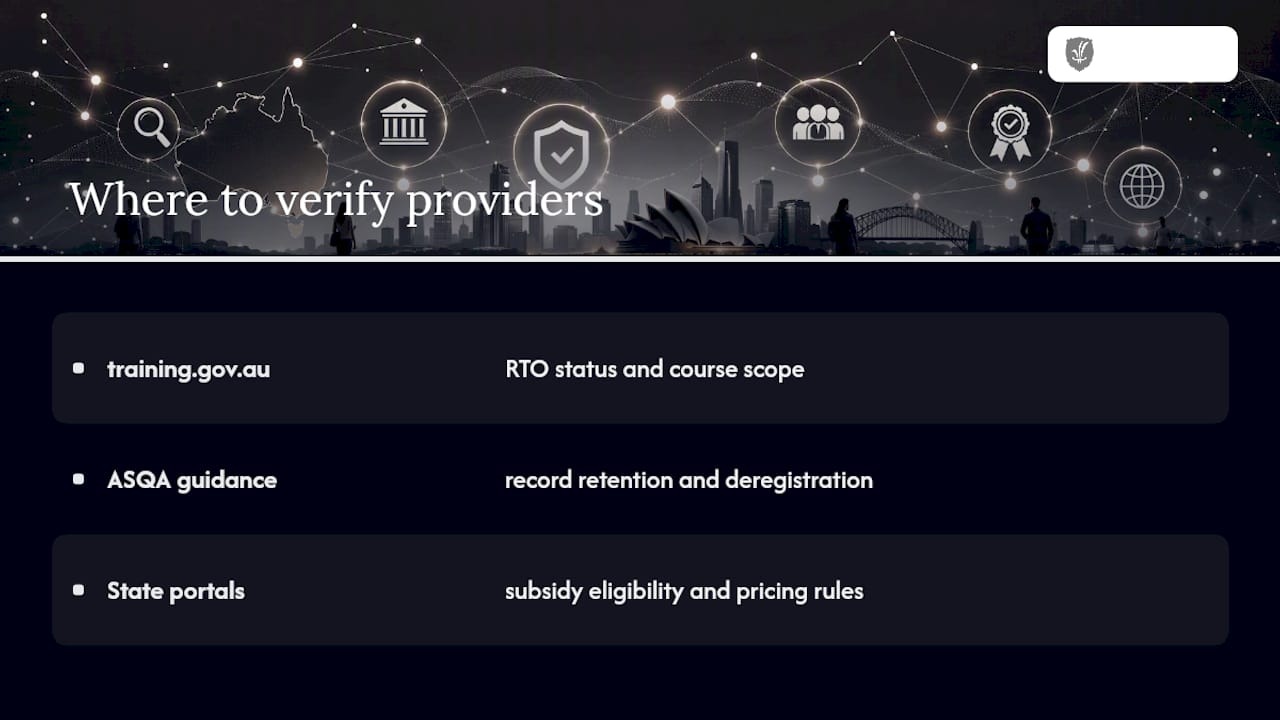
Three official sources cover almost everything discussed above. training.gov.au confirms RTO status and course scope directly. ASQA's student records guidance explains record retention and what happens if a provider deregisters. State training portals, such as NSW's Smart and Skilled listings, confirm subsidised course eligibility and pricing rules in your jurisdiction.
Sources
- Training
- ASQA — student records
- NSW government — training plan guidance
- Business Queensland — training organisations
FAQ
How do I choose a training provider?
Verify the RTO number and course code on training.gov.au, request the training plan, and confirm fees, support services, and pathways in writing before you enrol.
What are the best online training providers in Australia?
There's no single "best" provider for every learner. The right fit depends on your course scope, delivery mode, and career goal, so compare shortlisted providers against the same checklist rather than a general ranking.
What are the different types of training providers?
Providers range from registered training organisations (RTOs) delivering nationally recognised qualifications to non-accredited course providers offering short skills training; only RTOs listed on training.gov.au can issue nationally recognised credentials.
How do I set up a training provider?
Setting up an RTO involves applying for registration with ASQA or your state regulator and meeting the standards for RTOs, a process well beyond the scope of choosing a course, but worth knowing if you're assessing how seriously a provider takes compliance.
Does completing a nationally recognised course guarantee a job?
No provider, including CTDI, can guarantee employment, a salary outcome, or a promotion. Treat verified outcomes data and employer partnerships as evidence, and treat guarantees as a warning sign.
Recommended
- Vocational training in Australia: how to find accredited courses
- Exactly What Assessors Need: RPL in Australia for Experienced Workers
- Employee training checklist for HR managers: 2026 guide
This article provides general information only. Course requirements, study pathways, credit arrangements and career outcomes may vary. Always confirm current requirements with the relevant education provider or authority.