

You can use a VET Student Loan for eligible Diploma or Advanced Diploma courses that lead into veterinary work, but only when the course, the provider, and your own circumstances all clear the eligibility bar. Before you go further, check five things: the course is VSL-approved, the provider is VSL-approved, you'll study mainly in Australia, you meet the citizenship rules, and you can pass the academic suitability test. Confirm all of it through your provider and the official eligibility tool before you enrol.
TL;DR:
- Only students with a VSL-approved diploma course at an approved provider studying mainly in Australia qualify for the loan, and they must pass the academic suitability test.
- The application process requires gathering specific documents, confirming provider approval in writing, and submitting the eCAF before census day to avoid delays or rejection.
- VSL covers tuition fees but often excludes equipment, textbooks, uniforms, and administrative costs, and the loan incurs fees and annual indexation that increase total repayment.
- Students should verify their eligibility using official tools and sources, as rules around provider approval, course level, and literacy/numeracy tests are strict and commonly overlooked.
- State subsidies and fee-free TAFE options may be more suitable, especially for priority groups, while commercial finance is required for equipment or practice investments after graduation.
Table of Contents
- Vet student loans eligibility: the full checklist
- What VSL covers, plus the fees that grow your debt
- How to check approval and apply, step by step
- Free TAFE, state subsidies, and where commercial finance fits in
- Pitfalls that delay or derail your application
- How CTDI supports students through the eligibility maze
- Where to verify the details yourself
- Why the eligibility rules exist, and where students underestimate them
- Sources
Vet student loans eligibility: the full checklist
VET Student Loans only apply to Diploma and Advanced Diploma level courses. A Certificate III or IV in animal studies won't qualify you for VSL, no matter how relevant it is to veterinary work, because the scheme is built around higher-level vocational qualifications. Ask your training provider directly whether your specific course sits on their VSL-approved list, and get that confirmation in writing rather than assuming.
Provider approval matters just as much as course level. Plenty of registered training organisations run animal science or veterinary nursing diplomas, but not all of them hold VSL approval. The Department of Employment and Workplace Relations states plainly that you must be studying with an approved provider, and it's your job to verify that before you sign anything.
Beyond course and provider, the government checks several other boxes:
- Study location: your course must be delivered primarily in Australia, not offshore.
- Citizenship or residency: Australian citizens qualify automatically; New Zealand citizens need long-term Subclass 444 residency, and permanent residents or humanitarian visa holders have their own specific tests.
- Academic suitability: you need a Year 12 certificate, a Certificate IV or higher, an International Baccalaureate, or you must sit an ACSF Exit Level 3 literacy and numeracy test.
- Tax file number and USI: both are compulsory before your application can proceed.
- HELP balance: you need remaining capacity under the lifetime HELP loan limit.
- Parental consent: required if you're under 18 when you apply.
If you don't hold Year 12 or a Certificate IV, the ACSF test becomes the deciding factor. Miss Exit Level 3 in either reading or numeracy and your VSL application stalls, regardless of how strong the rest of your application looks.
What VSL covers, plus the fees that grow your debt
VET Student Loans pay tuition fees for your approved course, but they don't automatically cover every cost attached to studying. Equipment, textbooks, uniforms, and some administrative charges often sit outside the loan, so check your fee schedule against what VSL actually pays before you assume you're covered.

The loan fee is the detail most students overlook. Every dollar you borrow through VSL attracts a loan fee, and the outstanding balance is also subject to indexation each year. That means the amount you eventually repay can be noticeably higher than the tuition figure quoted at enrolment. The myGov VET student loans page confirms both mechanics apply from the moment the loan is drawn down.
Repayment doesn't start the day you finish studying. It kicks in once your income crosses the compulsory repayment threshold, at which point the Australian Taxation Office withholds repayments through the tax system, the same as HECS-HELP debt. Tell your employer once you're near that threshold so the right amount gets withheld from your pay.
If you already carry HELP debt from a university degree, VSL draws from the same lifetime cap. Run the numbers through the official VSL calculator before enrolling so you know exactly how much room you have left and what your combined debt will look like after indexation.
How to check approval and apply, step by step
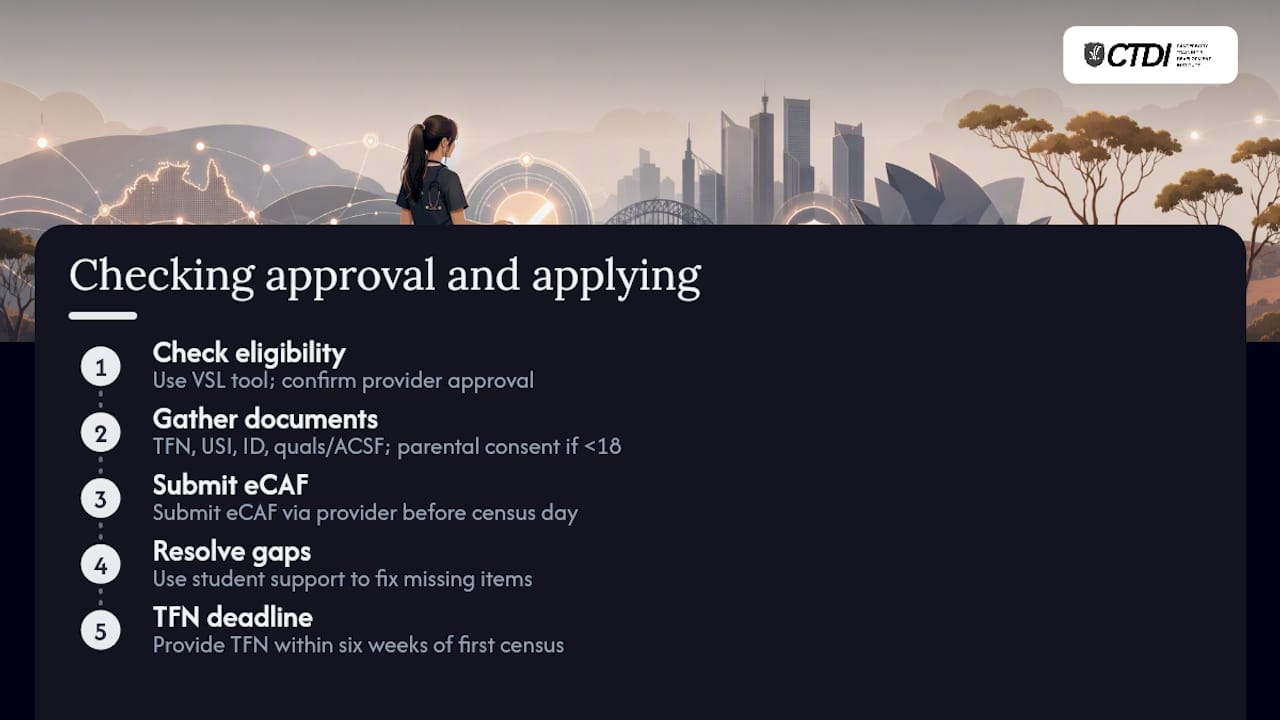
1. Use the eligibility tool and ask your provider directly. Start with the official VSL eligibility tool on Your Career, then follow up with the provider itself and get written confirmation that both your course and their approval status are current. Providers aren't always upfront about this, so ask the direct question: "Is this specific course VSL-approved right now?"
2. Gather your documents early. You'll need your TFN, USI, proof of citizenship or residency, and either your academic qualifications or ACSF test results. If you're under 18, get parental consent sorted before enrolment week, not during it.
3. Submit the eCAF through your approved provider before census day. You apply for the loan via the electronic Commonwealth Assistance Form, which your provider issues, not a general government portal. Census day matters enormously here: loans can't be approved retrospectively for a census date that's already passed, so submit early. You'll also get a two-business-day cooling-off window after signing, during which you can withdraw without penalty.
4. Chase up any gaps with student support. If you need to sit the LLN test or you're missing documentation, your provider's student support team is the fastest way to resolve it before the deadline closes on you.
Pro Tip: Many providers require your TFN within six weeks of your first census day, not at enrolment. Set a reminder the day you enrol, because missing that window can hold up your entire loan.
Free TAFE, state subsidies, and where commercial finance fits in
VSL isn't the only funding path, and for some students it isn't even the best one. Fee-Free TAFE places, now a permanent feature under the Free TAFE Act 2025, cover tuition outright for priority cohorts and don't require repayment at all. If you fit a priority group, that's worth checking before you take on any loan.
State portals are worth a separate look, since eligibility and course lists vary by state:
- Queensland's Skills Gateway
- Victoria's Skills First program
- WA's Jobs and Skills WA portal
These state-subsidised places often prioritise specific industries or regional students, so a veterinary-related diploma might qualify in one state and not another.
One distinction trips people up later in their careers: VSL and Free TAFE fund study, not business. Once you're practising, buying equipment or a share in a veterinary clinic runs through commercial finance, assessed on trading history, security, and cash flow, not your study record. Keep those two funding worlds separate in your planning.
Pitfalls that delay or derail your application
- Skipping the LLN test preparation. If you don't hold Year 12 or a Certificate IV, get support before you sit the ACSF assessment, not after you've failed it once.
- Assuming provider approval instead of confirming it. Get it in writing. Verbal reassurance from an enrolment adviser isn't evidence if something goes wrong later.
- Missing census day. Loans can't be backdated, so apply for the upcoming census date, never a date that's already passed.
- Ignoring the loan fee and indexation when budgeting. Run the official VSL calculator before you commit, not after your first repayment notice arrives.
- Losing track of your TFN, USI, or HELP balance. Keep these records somewhere secure and check your remaining HELP capacity before you enrol in anything else.
How CTDI supports students through the eligibility maze
Working out whether a course actually meets VSL's academic suitability and provider approval rules is one of the more frustrating parts of enrolling. At CTDI, courses are nationally recognised and delivered 100% online, with student support built into the enrolment process rather than bolted on afterwards.
That support matters most when a student needs LLN assistance to meet the ACSF Exit Level 3 requirement, or simply needs someone to walk through documentation before an eCAF gets submitted. Clear enrolment processes and responsive student support reduce the number of things that can go wrong between "interested" and "approved." If you're weighing up an accredited online diploma pathway and want to understand how the enrolment and support process works in practice, CTDI's enrolment page sets out the courses currently open and what student support looks like once you're in.
Where to verify the details yourself
Don't take any of this on faith. Cross-check it against the primary sources. The DEWR eligibility guidance and the VSL student manual are the authoritative references for every rule above. The myGov VET student loans page covers repayment and the loan calculator, and the Free TAFE portal lists state-by-state subsidised alternatives. When in doubt, call your provider's student support line, not a forum.
Why the eligibility rules exist, and where students underestimate them
Most guides treat VSL eligibility as a formality, a box to tick before the "real" content of studying begins. That's backwards. The academic suitability test and the provider approval check are the two places where otherwise strong applicants get stuck, and neither gets nearly enough attention until it's too late to fix quickly.
The LLN requirement in particular gets underestimated constantly. Students assume it's a rubber stamp because they've managed fine in high school or previous jobs, then find the ACSF Exit Level 3 numeracy component genuinely challenging under test conditions. Sitting that test cold, without support, is the single most avoidable reason a VSL application stalls, and it's entirely preventable with a few weeks of preparation.
The other blind spot is cost. Students fixate on the tuition figure and forget the loan fee and indexation sitting on top of it. That's not a minor footnote. Run the numbers early, because the gap between "what the course costs" and "what you'll actually repay" can be the difference between a manageable debt and an unpleasant surprise years down the track.
— Sam
This article is general information, not a substitute for advice from a qualified financial advisor. Consult a qualified financial professional about your own circumstances before acting on anything here.
Sources
- VET student loans | myGov
- Who’s eligible for a VET Student Loan? - Department of Employment and Workplace Relations