

The fastest route to job-ready HR skills is a short course that combines nationally recognised accreditation with a practical workplace project, not a generic webinar with a certificate of attendance. Start your search with the Australian HR Institute (AHRI), Open Universities Australia, your local TAFE or RTO, and Training to check accreditation before you pay a cent.
- AHRI for industry-aligned professional development and capability framework mapping
- Open Universities Australia for university-backed microcredentials you can study online
- TAFE and RTOs for AQF-aligned certificates with practical assessment
- training.gov.au to verify any course is nationally recognised before enrolling
Accreditation plus a real assessment task is what employers actually check when they look at your resume.
Key Takeaways
Accredited short HR courses that pair a training.gov.au-listed credential with a practical, project-based assessment deliver the strongest career return for the time invested.
| Point | Details |
|---|---|
| Verify before enrolling | Search the exact course code on training.gov.au and check the AQF level before paying for any course. |
| Match format to goal | Use microcredentials for one skill gap, AQF certificates for formal credit, and SHRM-aligned prep for a professional exam. |
| Prioritise practical assessment | Choose courses with a workplace project, HRIS audit, or dashboard task over quiz-only assessment. |
| Build a staged portfolio | Layer entry-level units toward higher qualifications rather than treating one course as the finish line. |
| Prioritise analytics skills | HR roles increasingly demand HRIS and data literacy, so weight your course selection toward tech-enabled modules. |
Table of Contents
- Where to find human resources short courses worth your time
- What "short course" actually means in HR training
- How to choose the right short HR course
- Duration, cost, and what credential you'll actually receive
- The HR skills employers actually want you to have
- How to verify a course is legitimately accredited
- Ready to build a short HR course into your career plan?
- Frequently asked questions
- Sources
Where to find human resources short courses worth your time
Not every provider category serves the same purpose, so it helps to know what each one is actually good for before you start comparing course pages.
Professional associations like AHRI run short courses mapped to their own capability framework, which matters if you want your training recognised by HR peers and hiring managers who already know the AHRI brand. University short-course platforms, particularly Open Universities Australia, package microcredentials from real universities into stackable, self-paced units, often with a pathway into a postgraduate qualification later.
TAFE campuses and other Registered Training Organisations (RTOs) deliver AQF-aligned units of competency, the kind that show up as a Statement of Attainment and count toward a full qualification. Industry certifiers and private providers, including bodies like HRCI, sit alongside these with certificate-style programs aimed at early-career HR staff who want a specific, in-demand skill fast.
Whichever path you take, run the provider through training.gov.au and cross-check the qualification level against the AQF levels framework before you enrol. CTDI's own guide to national recognition walks through exactly what that listing should show.
- Professional association courses (AHRI): capability-aligned, respected by HR practitioners
- University microcredentials available through Open Universities Australia can often be stacked and may provide pathways for further study
- TAFE and RTOs offer AQF units that include Statements of Attainment and practical assessments
- Industry certifiers (HRCI and similar): targeted skills, employer-recognised certificates
What "short course" actually means in HR training
The term covers several quite different formats, and mixing them up is the easiest way to buy the wrong thing.
A microcredential is a small, standalone unit of learning, often four to eight weeks, that targets one specific skill such as HR analytics or recruitment interviewing. A short certificate or Statement of Attainment is tied to a formal AQF unit of competency delivered by an RTO, meaning it can later count toward a full Certificate IV or Diploma. Professional certification preparation courses, the kind built around frameworks like SHRM's Body of Applied Skills and Knowledge, are designed to get you exam-ready for a credential such as SHRM-CP rather than issuing an AQF qualification of their own.
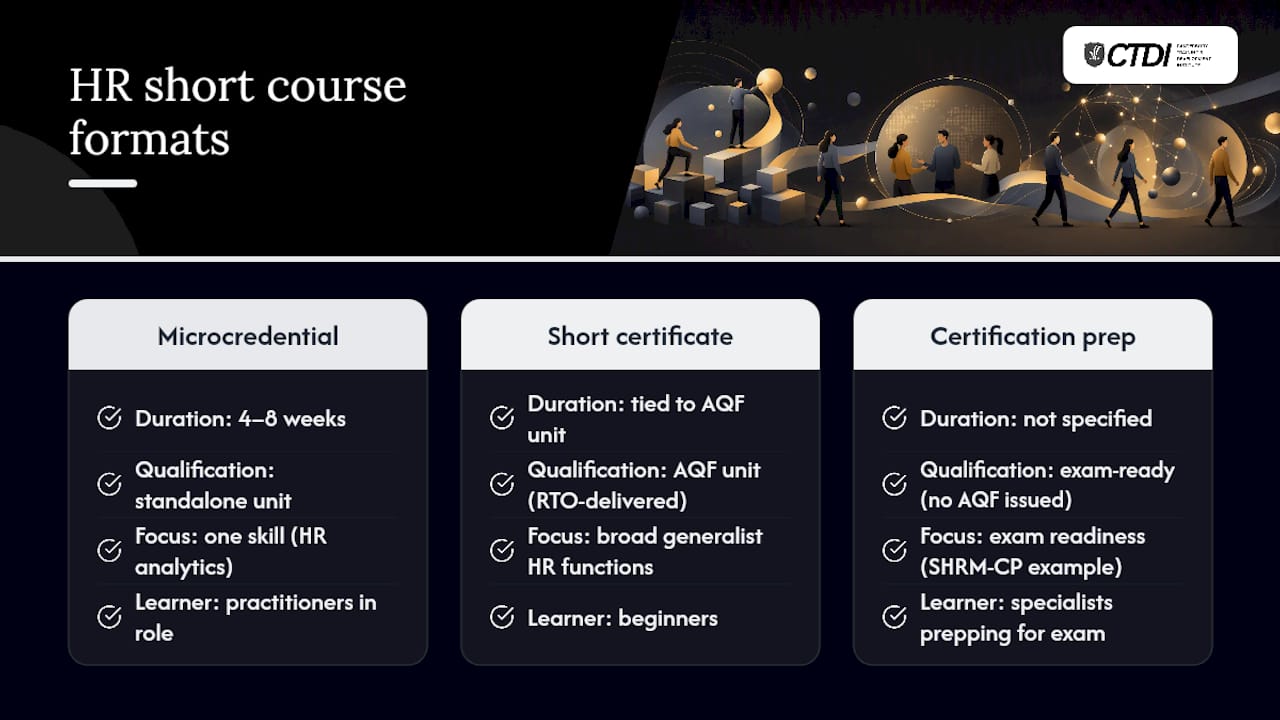
Each format suits a different stage. Beginners get more out of a broad AQF-aligned certificate covering generalist HR functions. Practitioners already in a role benefit more from a tightly scoped microcredential in one skill gap, such as performance management or HRIS basics. Specialists prepping for a professional exam need the certification-aligned option, not a generalist unit.
How to choose the right short HR course
Run every course you're considering through the same checklist before you enrol. It saves you from discovering three weeks in that the "certificate" you paid for has no formal standing anywhere.
- Accreditation status. Is it nationally recognised training listed on Training, or is it professional PD with no AQF standing? Both have value, but only one counts toward a formal qualification.
- AQF level or Statement of Attainment. Check what the AQF says the credential actually represents, and whether it maps to a unit you could later use for credit transfer.
- Practical assessment. Does the course include a workplace project, an audit, or a built artefact, or is it multiple-choice quizzes only? Employers and experienced practitioners increasingly favour courses that produce something concrete, such as an HRIS audit report or an automated policy workflow, over pure theory.
- Pathway to further study. Can the credit transfer into a Certificate IV, Diploma, or degree, per CTDI's breakdown of training package qualifications?
- Delivery mode and time commitment. Live online, blended, or fully self-paced, and does that fit around your job?
- Employer recognition. Has the provider partnered with real businesses, and does it show genuine outcomes rather than vague marketing claims?
- Cost and refund policy. What's included, what happens if you need to withdraw, and is pricing transparent up front?
When you contact a provider directly, ask specifically whether the course is nationally recognised, what the assessment actually involves, whether credit transfers to a higher qualification, and how experienced the trainers are in real HR roles rather than just in teaching.
Pro Tip: Search the exact course code on training.gov.au before you enrol, not just the provider's name. Providers sometimes market a course loosely while only a narrower, differently named unit is actually accredited. If AHRI alignment matters to you, check the course page for an explicit reference to the AHRI capability framework rather than a general claim of "HR professional development."
Duration, cost, and what credential you'll actually receive
Expect wide variation depending on format. Microcredentials typically run a few hours to a few weeks of study. AQF-aligned certificate units through a TAFE or RTO usually run several weeks to a few months, especially if they include a supervised workplace assessment. Professional certification preparation courses, such as those built around SHRM's exam framework, often run longer because they're covering exam content, not just one skill.
- Self-paced online units: generally the cheapest, lowest time commitment, minimal live support
- Trainer-led or blended courses: cost more, include feedback and practical assessment, better suited if you need the credential to genuinely count
- AQF Certificate/Diploma units: priced by the RTO, with cost tied to assessment complexity and resources included
A Statement of Attainment confirms you've completed one or more nationally recognised units, distinct from a professional PD certificate that has no formal AQF standing but may still carry weight with an industry body like AHRI.
The HR skills employers actually want you to have
Short courses are only worth your money if they teach what hiring managers are actually screening for, and the shift over the past few years has been unmistakable.
Modern HR roles increasingly expect practitioners to move from administrative "order taker" to strategic partner, and that shift leans heavily on AI screening adoption by HR leaders involving HR analytics, HRIS familiarity, and data-driven decision making. A generalist course that skips technology and analytics is teaching yesterday's HR function.
- HR analytics and data literacy — reading and building dashboards, not just collecting data
- HRIS familiarity — comfortable navigating the systems most workplaces already run on
- Talent acquisition and interviewing — structured, defensible hiring processes
- Performance management — setting, tracking, and documenting outcomes fairly
- Employee relations and workplace compliance — the area CTDI covers in depth in its workplace compliance guide
- Learning and development basics — designing training that people actually finish
Employers consistently rate technology and analytics skills among the fastest-growing requirements in HR roles, which is precisely why university-level HR units now build analytics and AI literacy into the core curriculum rather than treating it as an elective add-on.
How to verify a course is legitimately accredited
Run this check before you pay, not after.
- Search the exact course code on Training and confirm the RTO listing is current and matches the provider's name.
- Cross-check the qualification level against the AQF levels framework to see what credential you'll genuinely receive.
- Ask the provider directly for a sample Statement of Attainment and their credit-transfer policy in writing.
A genuinely nationally recognised unit will always carry a training.gov.au code. A professional PD short course won't, and that's fine as long as the provider isn't implying otherwise, and ideally it still carries recognition from a body like AHRI.
An educator's note on practical learning
Courses that end in a real deliverable, an HRIS audit, a dashboard, a policy workflow, teach more than any quiz ever will. CTDI builds its vocational programs around exactly that principle: nationally recognised, project-based, and built for people who need the skill at work, not just the certificate.

Ready to build a short HR course into your career plan?
If you're weighing up a microcredential against a full AQF-aligned certificate, don't treat it as an either/or decision. Building a learning portfolio that runs from entry-level operational skills through to strategic HR capability tends to serve careers better than one isolated course, an approach CTDI's own career development resources cover in more detail.
CTDI's nationally accredited online vocational courses are built for exactly this brief: flexible, self-paced, and designed by industry practitioners around real workplace tasks rather than theory alone. If you're ready to add a credible, accredited HR-adjacent qualification to your resume, explore CTDI's current course enrolments and see which pathway fits where you are in your career right now.
Frequently asked questions
Are human resources short courses nationally recognised? Some are, some aren't, and the difference matters. A course is only nationally recognised if it's listed on training.gov.au with a matching RTO and course code. Professional PD courses without that listing can still be valuable, particularly with AHRI alignment, but they don't carry AQF standing.
Can I do a short HR course for free? Free HR training courses exist, mostly as taster modules or webinars from associations and platforms, but they rarely include the practical assessment or formal credential employers look for. Treat free courses as a way to test interest before committing to an accredited program.
How long does a short HR course usually take? Anywhere from a few hours for a single microcredential to a few months for an AQF-aligned certificate unit with supervised assessment. Self-paced online formats generally sit at the shorter end.
Will a short course credit toward a full HR qualification? It can, if the unit is AQF-aligned and the provider issues a Statement of Attainment. Ask directly about credit transfer before enrolling, since not every short course is designed to stack into a Certificate IV or Diploma.
Do employers actually value these credentials? Employers respond most to courses that combine recognised accreditation with demonstrable outputs, a dashboard, an audit, a completed project, over a certificate of attendance with no assessment behind it.