

Workplace compliance in Australia means following the Fair Work Act 2009 (Cth), the National Employment Standards (NES), modern awards, and the Work Health and Safety Act 2011, plus your employer's internal policies. In practice, it covers pay and entitlements, safe working conditions, anti-discrimination obligations, privacy, and record-keeping. Every worker and employer operates inside this framework, whether they know it or not.
- Pay and conditions: minimum wages, leave entitlements, and award classifications under the NES and modern awards
- Work health and safety (WHS): risk assessments, incident reporting, and safe systems of work
- Anti-discrimination and harassment: obligations under federal and state equal opportunity laws
- Privacy and data protection: handling employee and customer records under the Privacy Act 1988
- Record-keeping: maintaining accurate payroll, contracts, and training records
Pro Tip: Completing a nationally recognised vocational unit that covers WHS or workplace relations gives you a qualification code you can cite on your CV, turning abstract compliance knowledge into documented, verifiable competence.
Table of Contents
- What does workplace compliance cover in Australia?
- Who is responsible, and what happens when things go wrong?
- Why workplace compliance matters for your career
- How accredited vocational training helps you prove compliance competence
- How to choose an accredited compliance-related vocational course
- Quick next steps to get compliance-ready
- Key takeaways
- Why compliance training is worth more than people think
- Nationally recognised online courses from Edu (CTDI)
- Useful sources and regulator pages
What does workplace compliance cover in Australia?
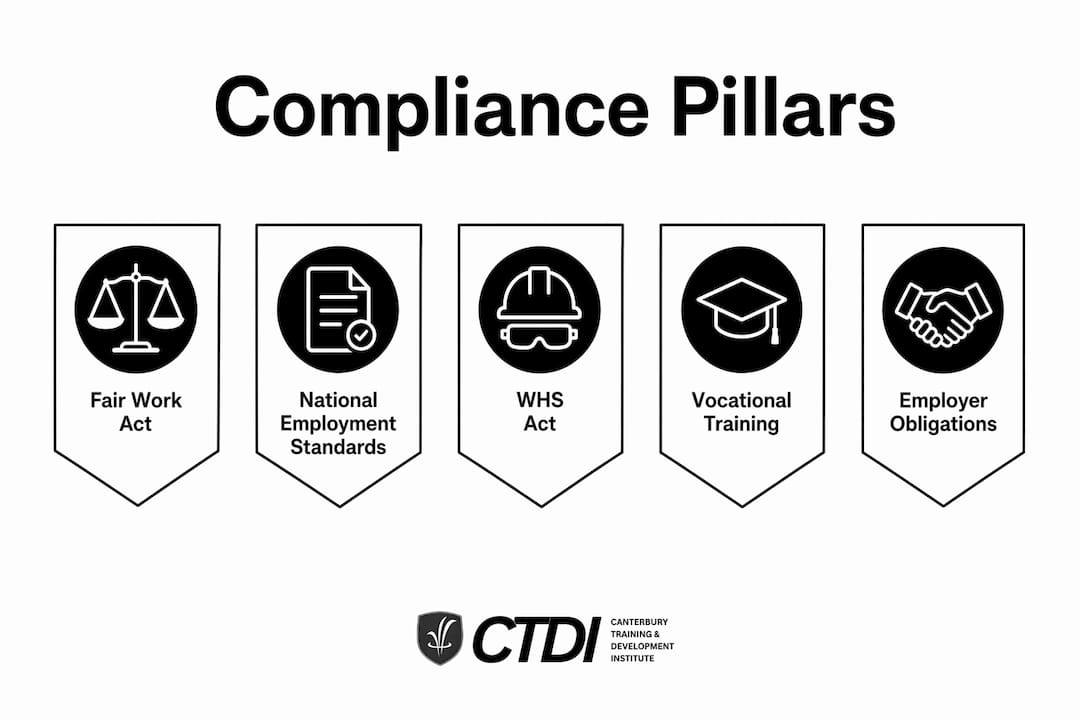
The legal framework has three main pillars. The Fair Work Act 2009 establishes the national safety net: the NES, modern awards, and enterprise agreements, plus Chapter 4 enforcement powers. The WHS Act 2011 sets the duty to eliminate or minimise risks at work. State and territory legislation adds obligations around workers' compensation, payroll tax, and some WHS enforcement details, so a policy that satisfies requirements in one state may need adjustment in another.
| Legal source | What it requires in practice |
|---|---|
| Fair Work Act 2009 (Cth) | Correct pay rates, leave entitlements, written contracts, dispute resolution |
| National Employment Standards (NES) | minimum entitlements including annual leave, parental leave, and notice periods |
| Modern awards | Industry or occupation-specific pay rates and conditions on top of the NES |
| WHS Act 2011 | Risk assessments, safe systems of work, incident reporting, training |
| Privacy Act 1988 | Lawful collection, storage, and use of personal information |
| Anti-discrimination laws | Prohibition on discrimination in hiring, promotion, and day-to-day management |
In everyday work, these obligations show up in concrete ways: a roster must not breach maximum daily hours under an award; a new employee must receive a Fair Work Information Statement on day one; a hazardous task requires a documented safe work procedure before anyone starts. Practical employer checklists covering payroll, award classification, WHS, and record-keeping help translate these legal requirements into operational steps.

Recent reforms have raised the stakes. Criminal wage-theft offences and strengthened positive duty obligations under anti-discrimination laws mean organisations that embed ongoing compliance training see measurable reductions in incidents and lower staff turnover.
Who is responsible, and what happens when things go wrong?
Responsibility is shared, not delegated downward.
Employer duties (as a person conducting a business or undertaking, or PCBU):
- Provide safe systems of work, adequate training, and appropriate supervision
- Pay the correct award rate and maintain accurate employment records
- Consult workers on health and safety matters
- Report notifiable incidents to the relevant WHS regulator
Worker duties under Section 28 of the WHS Act 2011:
- Take reasonable care for your own physical and psychological health and safety
- Take reasonable care that your acts or omissions do not adversely affect others
- Follow reasonable instructions given by the PCBU
- Co-operate with any reasonable WHS policy or procedure the PCBU has notified to workers
A worker who fails to meet these duties commits an offence. The category depends on severity:
Category 1 (reckless or negligent conduct exposing someone to risk of death or serious injury): highest penalties. Category 2 (failure that exposes someone to risk of death or serious injury): significant penalties. Category 3 (failure to comply with the duty, without the exposure element): lower penalties but still a criminal offence under the WHS Act 2011.
Accessorial liability extends these risks beyond the direct employer. HR staff, payroll advisers, and holding companies can be held personally liable when they are involved in a contravention of the Fair Work Act. That is not a theoretical risk; the Fair Work Ombudsman pursues individuals, not just businesses.
Safe Work Australia's national compliance and enforcement policy guides how regulators respond: proportionately, consistently, and with tools ranging from education and improvement notices through to enforceable undertakings and prosecution.
Why workplace compliance matters for your career
Employers screen for compliance competence before they hire. A candidate who can name the relevant award, describe a WHS risk-assessment process, or explain record-keeping obligations stands out from one who cannot. That gap widens at the supervisory and management level, where personal liability under accessorial liability provisions becomes a real consideration.
Operationally, organisations with strong compliance cultures report fewer incidents, lower workers' compensation costs, and better staff retention. For you as a worker, that translates to a safer workplace and a more stable employer. Training that drives career outcomes is not just about ticking boxes; it builds the kind of documented competence that shows up in performance reviews and promotion decisions.
How accredited vocational training helps you prove compliance competence
A nationally recognised qualification delivered by a Registered Training Organisation (RTO) does something a short online course cannot: it produces assessment evidence that employers and regulators accept as proof of competence.
Compliance-relevant units typically cover WHS risk management, workplace relations, anti-discrimination obligations, privacy and data handling, and record-keeping procedures. Each unit carries a code (for example, BSBWHS411 or BSBHRM525) that maps to a specific competency standard. When you complete the unit, you receive a Statement of Attainment or a qualification that names those codes, and that document is portable across employers and industries.
Look for these signals when assessing a course:
- RTO code listed on the provider's website and verifiable on training.gov.au
- Nationally recognised logo and qualification code on all marketing materials
- Unit codes that match the compliance areas relevant to your job or target role
- Trainer industry experience in the compliance or HR field, not just teaching credentials
- Student support including access to trainers, assessment feedback, and study resources
- Assessment tasks that mirror real workplace documents: policy drafts, incident reports, risk assessments
Training package qualifications in Australia are built around these standards, so the unit codes you study today remain recognised when you move roles or states.
How to choose an accredited compliance-related vocational course
- Confirm RTO status. Search the provider's RTO code on training.gov.au before you do anything else. If it is not there, the qualification is not nationally recognised.
- Match unit codes to your job. Ask the provider which specific units cover WHS, workplace relations, or the compliance area your employer or target role requires.
- Check assessment methods. Competency-based assessment should include realistic workplace tasks, not just multiple-choice quizzes. Ask whether assessment is simulated or workplace-based.
- Review trainer backgrounds. Industry experience in HR, WHS, or compliance matters more than a generic training credential.
- Evaluate student support. Can you contact a trainer directly? Is there a structured feedback process for assessments?
- Consider delivery and duration. Skill sets (one to three units) can be completed in weeks. Certificates typically take three to six months. Diplomas usually run six to twelve months. Self-paced online delivery suits working professionals.
- Check RPL options. If you already have workplace experience, Recognition of Prior Learning may reduce your study load.
- International students: confirm CRICOS. If you are studying on a student visa, the provider must hold a CRICOS registration in addition to RTO status.
Quick next steps to get compliance-ready
Immediate actions:
- Identify the compliance units your current or target role requires (ask your employer or check the relevant award and WHS guidance)
- Request unit outlines from at least two RTOs and compare assessment methods
- Verify each provider's RTO code on training.gov.au
- Ask about student support and trainer contact hours before enrolling
Timelines to expect: a single skill set takes two to eight weeks; a Certificate III or IV typically three to six months; a Diploma six to twelve months with self-paced online study.
Cost shapes: short skill sets are generally the most affordable entry point. Certificates and diplomas vary by provider and delivery mode. Check whether your employer will sponsor the cost, and investigate VET Student Loans eligibility for diploma-level qualifications.
Keep your evidence. Use an employee training checklist to record completed units, assessment dates, and qualification codes. Store copies of your Statements of Attainment alongside any workplace policy samples or WHS documents you produced during assessment. That file is your compliance portfolio.
Key takeaways
Workplace compliance in Australia rests on the Fair Work Act 2009, the NES, and the WHS Act 2011, and a nationally recognised vocational qualification is the most portable way to prove you understand and can apply those obligations.
| Point | Details |
|---|---|
| Legal anchors | The Fair Work Act 2009, NES, and WHS Act 2011 form the core compliance framework for Australian workplaces. |
| Shared responsibility | Employers hold primary duties; workers have four specific duties under Section 28 of the WHS Act 2011. |
| Enforcement is real | Breaches can result in Category 1–3 criminal offences; accessorial liability can reach HR staff and advisers personally. |
| Career value | Compliance skills appear in job advertisements across HR, operations, and management roles nationwide. |
| Edu (CTDI) | Edu offers nationally recognised online vocational courses with industry-expert trainers, and practical, assessment-based learning. |
Why compliance training is worth more than people think
Most articles on workplace compliance stop at the legal checklist. That misses the more interesting point: compliance competence is one of the few transferable skills that makes you harder to dismiss and easier to promote, regardless of industry.
The shift to criminal wage-theft offences and strengthened positive duty obligations under anti-discrimination law has changed the calculus for employers. They now need staff who can document, not just do. A worker who understands the WHS Act, can write a risk assessment, and knows what a modern award requires is genuinely useful in a way that a worker who has only been told the rules is not.
The vocational training system in Australia is well-suited to building that kind of competence, precisely because it is competency-based. You do not pass by memorising definitions; you pass by producing evidence that you can apply the knowledge. That evidence, in the form of a Statement of Attainment with a unit code, travels with you.
The gap most learners underestimate is not the knowledge gap. It is the documentation gap. Employers and regulators want proof, and a nationally recognised qualification is the most credible form that proof takes.
Nationally recognised online courses from Edu (CTDI)
Knowing the framework is one thing. Having a qualification that proves it is another.

Edu, the Canterbury Training & Development Institute, offers nationally recognised online diplomas and vocational courses designed by industry experts, delivered entirely online at your own pace. Courses are built around real workplace tasks, so your assessments produce the kind of documented evidence employers and regulators actually look for. Student support is built in, not bolted on.
If you are ready to turn compliance knowledge into a portable, accredited qualification, view enrolment options and check which unit codes match your career goals. Verify the RTO code and qualification details on training.gov.au before you enrol, as you would with any provider.
Useful sources and regulator pages
- Fair Work Act 2009 (Cth) — the consolidated legislation covering the NES, modern awards, enterprise agreements, and Chapter 4 enforcement powers. Read this for the primary legal text on pay, entitlements, and dispute resolution.
- Fair Work Ombudsman — practical employer and worker guidance, pay calculators, award finders, and accessorial liability information. The best starting point for understanding your day-to-day obligations.
- Safe Work Australia — National Compliance and Enforcement Policy — explains how WHS regulators apply enforcement tools, from education notices to prosecution. Useful for understanding what regulators expect and how they respond to breaches.
- Comcare — Duties of workers under the WHS Act — detailed regulatory guide to Section 28 worker duties, offence categories, and penalty tiers. Print this for study and employer conversations about WHS obligations.
- How to get accredited in Australia — practical guidance on verifying RTO status, reading qualification codes, and confirming national recognition before you enrol.
This article provides general information about workplace compliance in Australia. It is not legal or professional advice. Confirm current obligations with the relevant regulator or a qualified adviser for your specific situation.