

TL;DR:
- Upskilling helps Australian workers stay competitive by building new skills and obtaining recognized qualifications. It enhances career growth, job security, and employability while reducing costs for employers and improving retention. Continuous, targeted learning using government-supported programs is essential to adapt to rapid technological changes in the job market.
Upskilling is the process of expanding your existing skills to stay competitive in Australia's fast-changing job market. The case for doing it now is stronger than ever. Free TAFE recorded 742,000 enrolments in its first three years through april 2026, signalling that the Australian government treats lifelong learning as an economic necessity, not a personal preference. Employers have shifted their hiring criteria too. Nearly 70% of companies now prioritise skills over formal degrees, which means a recognised vocational qualification or a targeted short course can carry as much weight as a university degree. Understanding why upskill in Australia matters is the first step toward making deliberate, career-defining choices about where to invest your time and energy.
What are the real benefits of upskilling for Australians?
Upskilling delivers measurable advantages for both workers and the organisations that employ them. For individuals, the most direct benefit is career growth. Workers who build new competencies become candidates for internal promotions, lateral moves into higher-demand roles, and salary negotiations backed by demonstrated capability. Coursera reports 18% of learners completing skills courses receive a salary boost. That figure represents real income gains from a targeted training investment.

Job security is the second major benefit. Automation and AI are reshaping tasks across every sector, and workers whose skills remain static face genuine displacement risk. Upskilling acts as career cushioning, building adjacent competencies proactively so disruption does not catch you unprepared. A project coordinator who adds data analysis skills, for example, becomes far harder to replace than one who does not.
For employers, the financial logic is equally clear. Replacing a skilled employee costs between six and nine months of their salary. Investing in internal upskilling avoids that cost entirely while retaining institutional knowledge.
"Australian employees now rank development opportunities as highly as compensation when considering employers. Companies investing in continuous training see improved retention and internal mobility."
The retention benefit compounds over time. Workers who see a clear development pathway stay longer, perform better, and refer others. That cycle reduces recruitment costs, lifts team capability, and builds a culture where learning is expected rather than exceptional. The importance of upskilling extends well beyond the individual worker and into the health of the entire organisation.
Key individual benefits include:
- Higher earning potential: Demonstrated new skills support salary reviews and promotion applications.
- Greater employability: Skills-based hiring means your capability matters more than your credential history.
- Career resilience: Adjacent skills protect you when your current role changes or disappears.
- Internal mobility: Employers prefer to promote from within when workers show initiative and growth.
- Engagement and confidence: Learning new things directly improves job satisfaction and self-efficacy.
Which skills and industries are driving upskilling demand in Australia?
By 2030, 39% of workers' core skills are expected to change due to technology, according to the World Economic Forum. That is not a distant forecast. The shift is already visible in Australian hiring patterns, where digital literacy, AI competency, and adaptive problem-solving appear in job advertisements across sectors that previously required none of those capabilities.
Highly technical skills have a half-life as short as 2.5 years, meaning a qualification earned in 2023 may already be partially outdated. This is not a reason to avoid training. It is a reason to treat training as a recurring activity rather than a one-off event.
The skills most in demand across Australian industries right now include:
- Digital literacy: Proficiency with data tools, cloud platforms, and digital communication systems.
- AI competency: Understanding how to work with AI tools, interpret outputs, and apply them to real tasks. 70% of professionals use AI weekly, making this a baseline expectation in many roles.
- Adaptive problem-solving: The ability to respond to novel situations without a fixed playbook.
- Interpersonal and communication skills: Collaboration, negotiation, and stakeholder management remain irreplaceable by automation.
- Sustainability literacy: Understanding environmental regulations, reporting frameworks, and green practices is now required in construction, resources, and corporate governance.
The table below maps high-demand skills to the Australian sectors where they are most urgently needed.
| Skill category | High-demand sectors in Australia |
|---|---|
| Digital literacy | Financial services, retail, government |
| AI and data analysis | IT, marketing, health care, logistics |
| Sustainability and environmental management | Construction, resources, corporate governance |
| Interpersonal and leadership skills | Health care, education, professional services |
| Trades and technical skills | Infrastructure, manufacturing, utilities |
Health care, IT, and the trades are experiencing the sharpest skill shortages. Marketing has shifted dramatically toward data and AI-driven practice, creating strong demand for workers who combine creative and analytical capability. Sustainability roles are growing as Australian businesses face increasing regulatory and investor pressure to report on environmental performance.
How can you upskill effectively in Australia?
Effective upskilling combines formal training, on-the-job practice, and self-directed learning. Programs that blend all three approaches yield better career progress than courses alone. A worker who completes a digital marketing diploma and then applies those skills in a live workplace project consolidates learning far faster than one who studies in isolation.
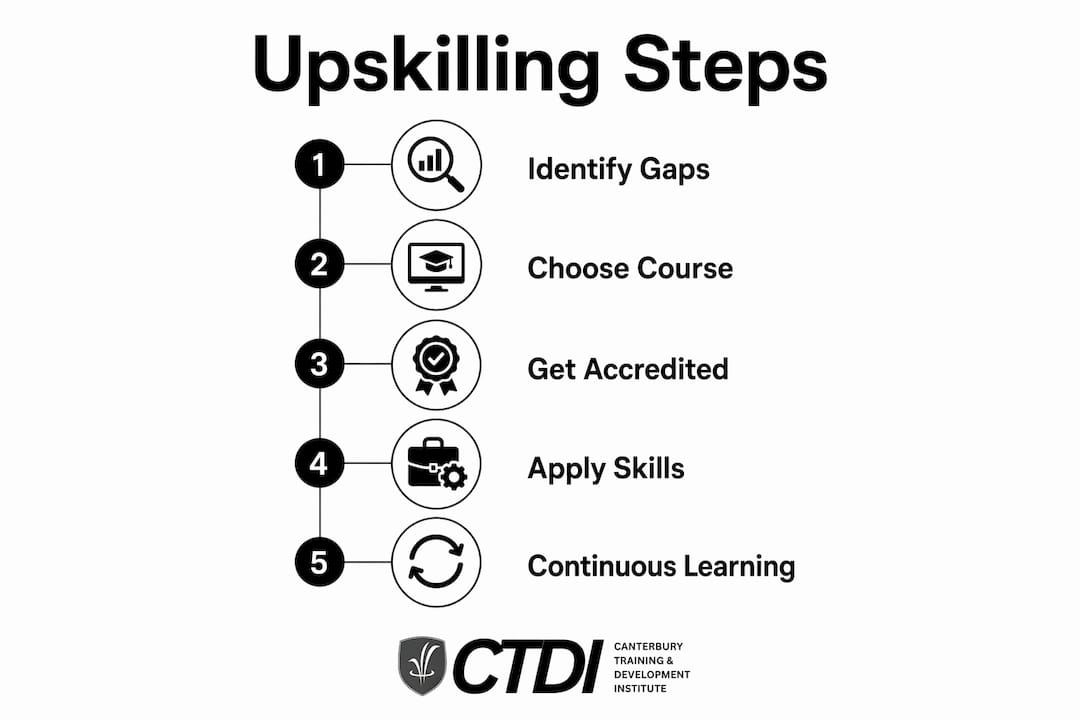
Here is a practical process for upskilling with real career impact:
- Audit your current skills. List what you do well, what your role requires, and where the gap sits. Be specific. "I need to understand Google Analytics 4" is more useful than "I need digital skills."
- Research what employers actually want. Read current job advertisements in your target sector. Note which skills appear repeatedly. Cross-reference with industry reports from bodies like the National Centre for Vocational Education Research (NCVER).
- Choose accredited training where it counts. For roles that require demonstrated competency, a nationally recognised qualification carries more weight than a self-paced certificate of completion. Accredited courses in Australia signal to employers that your skills have been assessed against a defined standard.
- Apply learning immediately. Do not wait until you finish a course to practise. Use new skills in your current role, in volunteer projects, or in freelance work. Application accelerates retention and gives you concrete examples for interviews.
- Schedule regular skills reviews. Set a calendar reminder every six months to reassess your skill set against market demand. Given that technical skills can become outdated within 2.5 years, this habit keeps you ahead rather than catching up.
- Seek feedback from managers and mentors. Regular skills audits and manager feedback improve upskilling program effectiveness. A manager who knows your development goals can direct relevant work your way.
Pro Tip: When selecting a course, check whether it leads to a nationally recognised qualification on the Australian Qualifications Framework (AQF). AQF-registered qualifications are portable across employers and states, which maximises the return on your training investment.
Government-funded upskilling programs in Australia reduce the financial barrier significantly. Free TAFE covers priority qualifications in health care, technology, construction, and education. For workers considering a career change or a step up, these programmes remove cost as an excuse for inaction. Explore career growth through online learning as a flexible path that fits around existing work and family commitments.
The mindset shift matters as much as the method. Workers who treat upskilling as a continuous habit rather than a one-off event build compounding advantages over time. Each new skill makes the next one easier to acquire, and the habit itself signals to employers that you are someone who grows.
What challenges make upskilling difficult, and how do you overcome them?
The most common barriers to upskilling are time, cost, and cultural resistance. Each one is real, but each one has a practical solution.
Time is the barrier most workers cite first. Full-time roles, family commitments, and fatigue make it genuinely hard to add study on top of everything else. The solution is not to find more time. It is to embed learning into existing time. Embedding learning time into work schedules and using micro-learning formats, short focused modules of 10–20 minutes, makes consistent progress achievable without requiring large blocks of free time.
Cost stops many workers from starting. Free TAFE and employer-funded training programmes address this directly. Workers who are not aware of these options often assume upskilling requires expensive private enrolment. Checking eligibility for government-subsidised training before paying full price is a basic step that many skip.
Cultural resistance is the least-discussed barrier and often the hardest to shift. In some workplaces, taking time to learn is seen as unproductive. Managers who do not model learning behaviour send a clear signal that development is not valued. Organisations that invest in continuous training see improved retention precisely because that investment signals commitment to employees.
Additional barriers and their solutions include:
- Lack of awareness: Many workers do not know which skills are in demand. Fixing this requires reading industry publications, attending sector events, and talking to people already working in target roles.
- Choosing the wrong training: Completing a course that does not align with employer needs wastes time and money. Research job advertisements before enrolling.
- Measuring participation instead of outcomes: Tracking how many courses a team completes tells you nothing useful. Measuring competency demonstration and internal mobility rates tells you whether upskilling is actually working.
Pro Tip: Ask your employer directly whether they offer a training budget or study leave. Many Australian organisations have formal policies that workers never access simply because they did not ask. A single conversation can unlock hundreds of dollars in funded training.
Workplace upskilling examples show that the workers who overcome these barriers consistently are those who treat learning as a professional responsibility rather than an optional extra.
Key takeaways
Upskilling in Australia is a career necessity, not a career option, and the workers who build it as a continuous habit will consistently outperform those who treat it as a one-off event.
| Point | Details |
|---|---|
| Skills now outrank degrees | Nearly 70% of Australian employers prioritise demonstrated skills over formal qualifications when hiring. |
| Technical skills expire quickly | Highly technical skills have a half-life as short as 2.5 years, requiring regular training to stay current. |
| Blended learning works best | Combining formal courses, on-the-job practice, and self-directed learning produces better career outcomes than courses alone. |
| Government support is available | Free TAFE recorded 742,000 enrolments in three years, making subsidised upskilling accessible to most Australians. |
| Measure outcomes, not participation | Tracking competency gains and internal mobility rates shows whether upskilling is delivering real career impact. |
Upskilling as a career strategy, not a checkbox
The framing I see most often is wrong. Workers treat upskilling as something they do once when they feel threatened, a short course completed in a panic after a restructure announcement or a performance review. That approach delivers minimal return.
The workers I have watched build genuinely durable careers treat upskilling the way elite athletes treat conditioning. It is not something you do when you feel weak. It is something you do consistently so you are never caught unprepared. The career cushioning concept captures this well. Building adjacent skills before you need them is the difference between reacting to disruption and being positioned ahead of it.
The other mistake I see is chasing credentials without a clear purpose. A diploma in digital marketing means something concrete if you are moving into a marketing role or building a freelance practice. It means very little if you enrol because it sounded interesting and then never apply the skills. Every training decision should start with a specific career outcome in mind.
My practical advice is this: pick one skill gap that directly affects your next career move, find the most credible accredited pathway to close it, and apply what you learn within 30 days of starting. That cycle, repeated consistently, builds the kind of track record that makes career advancement feel less like luck and more like a logical outcome.
— Sam
Upskilling programmes at Edu worth considering
Edu, the Canterbury Training and Development Institute, offers nationally accredited online diplomas designed for workers who want to upskill without pausing their careers.
Programmes in AI, digital marketing, and environmental management are delivered entirely online and built around real industry requirements. The Advanced Diploma of Digital Marketing is one example, combining AI-powered marketing practice with the kind of applied learning that employers recognise immediately. Every course is self-paced, which means you control the schedule. If you are ready to close a specific skill gap with a qualification that carries genuine weight in the Australian job market, enrol now and choose the programme that fits your next career move.
FAQ
What does upskilling mean in the Australian context?
Upskilling means expanding your existing skills to meet current and future job requirements. In Australia, it includes formal vocational training, government-funded programmes like Free TAFE, and on-the-job learning aligned with nationally recognised qualifications.
Why is upskilling particularly urgent in Australia right now?
The World Economic Forum projects that 39% of workers' core skills will change by 2030 due to technology. Australian employers are already prioritising skills over degrees, making continuous learning a direct factor in employability and career progression.
How do I choose the right upskilling programme in Australia?
Start by identifying the specific skill gap that affects your next career move, then look for an AQF-registered qualification that closes it. Check whether government subsidies like Free TAFE apply before paying full price.
Can upskilling lead to a higher salary in Australia?
Yes. Coursera data shows 18% of learners who complete skills courses receive a salary boost. Workers who demonstrate new competencies have a concrete basis for salary negotiations and promotion applications.
How much time does upskilling realistically require?
Effective upskilling does not require large blocks of free time. Micro-learning formats of 10–20 minutes per day, embedded into a regular schedule, produce consistent progress. Self-paced online diplomas allow you to study around existing work and family commitments.