

TL;DR:
- Upskilling involves continually learning new skills to remain competitive amid rapidly changing job requirements. It offers professionals increased earning potential, job security, and faster career growth by adapting to AI and automation shifts. Engaging in structured, employer-supported learning helps build confidence, marketability, and long-term career resilience.
Upskilling is defined as the ongoing process of acquiring new competencies to stay effective and competitive as workplace demands shift. The urgency is real: 70% of professionals now use AI tools weekly, and the half-life of technical skills has shrunk to as little as 2.5 years. That means a qualification or skill set you earned in 2023 may already be losing its edge. Understanding why upskilling is important is no longer optional for anyone serious about career longevity. Whether you are just starting out or two decades into your field, continuous skill development is the clearest path to staying relevant, promotable, and secure.
What are the key benefits of upskilling for individual professionals?
The financial case for skill development is direct. High-skilled workers earn 2.2–2.4 times more than their low-skilled counterparts, and 18% of professionals report a salary increase after completing an upskilling programme. Those are not marginal gains. They represent the difference between stagnating in a role and building genuine financial momentum across a career.
Job security is the second major benefit. Automation and AI are not replacing all jobs, but they are replacing specific tasks within jobs. Professionals who continuously build new skills become harder to replace because they adapt faster than their roles change. Workers who do not upskill face a narrowing set of opportunities as employers prioritise candidates who can operate in AI-assisted environments.

Career advancement follows naturally from skill development. Professionals who demonstrate new capabilities attract internal promotion opportunities, project leadership roles, and cross-functional assignments. These are the visible signs of career growth, and they rarely come to those who rely solely on experience accumulated years ago.
The personal benefits extend beyond salary and title. Upskilling builds confidence. Learning a new tool, methodology, or domain and applying it successfully changes how you carry yourself at work. That confidence compounds over time, making you more willing to take on stretch assignments and speak up in rooms where decisions are made.
Key benefits of upskilling for individual professionals include:
- Higher earning potential: Skilled workers earn significantly more, with documented salary increases post-training.
- Greater job security: Adaptable professionals are less vulnerable to automation and restructuring.
- Faster career advancement: New skills open doors to promotions, leadership roles, and lateral moves.
- Improved confidence and engagement: Learning new competencies increases motivation and workplace satisfaction.
- Stronger adaptability: Professionals who learn continuously adjust faster when industries shift.
- Broader professional networks: Formal learning programmes connect you with peers, mentors, and industry contacts.
How does upskilling benefit organisations and why does this matter to you?
Organisations that invest in continuous learning create better workplaces for the people inside them. Employees with year-round access to upskilling are nearly twice as likely to report high engagement, with 59% of those workers engaged compared to just 31% of those without regular learning opportunities. Engagement is not a soft metric. It predicts productivity, retention, and the quality of work produced.
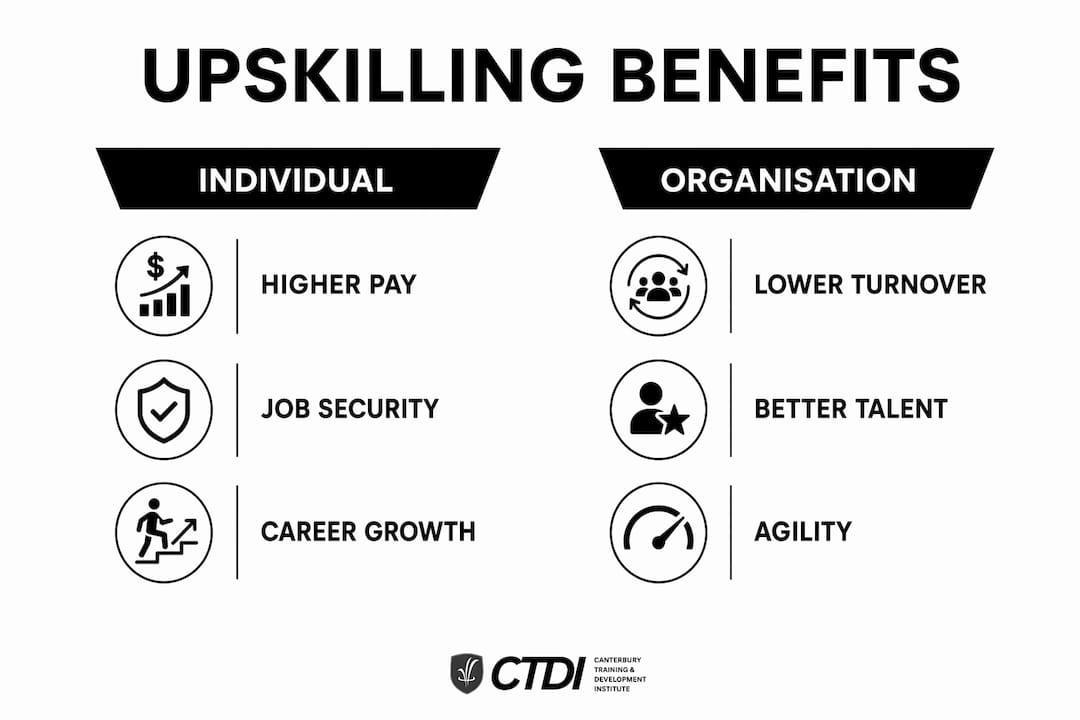
The cost argument also matters to you personally. Hiring new talent costs significantly more than training existing staff, which means organisations that upskill their people are more likely to retain them. When a company sees you as a development investment rather than a replaceable headcount, your position becomes more stable. You benefit directly from your employer's financial incentive to keep you.
Internal mobility is another outcome of organisational upskilling programmes. Companies that build learning cultures create pathways for employees to move between departments, take on new functions, and grow without leaving the organisation. For you, that means more options. You are not locked into one role or one team. You can move toward the work that interests you most.
| Organisational outcome | What it means for you |
|---|---|
| Lower turnover costs | Your employer has a financial reason to retain and develop you |
| Higher engagement rates | You work in a more motivated, productive team environment |
| Internal mobility pathways | You can change roles without changing employers |
| Stronger market competitiveness | Your organisation stays relevant, protecting your job |
Organisations that delay upskilling face widening skill gaps and stalled transformation. That stagnation affects everyone inside the business. When a company falls behind its competitors, restructuring and redundancies follow. Working for an organisation that actively invests in learning is itself a form of career protection.
Pro Tip: Align your learning goals with your organisation's stated priorities. When your upskilling plan directly supports a business objective, your employer is far more likely to fund it through training grants or tuition reimbursement.
What challenges do professionals face when upskilling and how can they overcome them?
Time is the most cited barrier to skill development. Most professionals feel they cannot add learning to an already full schedule. The solution is not to find more time but to embed learning into existing routines. Fifteen minutes of focused reading before a meeting, a short online module during lunch, or a weekly podcast on your commute all accumulate into meaningful progress over months.
Budget is the second barrier, and it is often a false one. Many professionals are unaware that their employer offers training grants, study leave, or tuition reimbursement. These programmes exist and go underused because employees never ask. Before spending your own money on a course, check your organisation's HR policies and speak directly with your manager about available funding.
Cultural resistance is a subtler obstacle. Some workplaces do not actively encourage learning, and some managers feel threatened by employees who develop skills beyond their current role. The way to navigate this is to frame your development in terms of team benefit. When you position new skills as something that helps your team deliver better results, you reduce friction and often gain support.
A structured approach to overcoming upskilling barriers:
- Audit your current skills. List what you know, what your role requires now, and what it will likely require in two years. The gap between those lists is your development priority.
- Align with organisational goals. Map your learning plan to your employer's stated objectives. This is the fastest path to sponsorship and support.
- Use employer-funded resources first. Ask HR about training budgets, government-funded programmes, and professional development allowances before self-funding.
- Start small and build consistency. A daily 20-minute learning habit produces more than an occasional full-day workshop.
- Apply new knowledge immediately. Use what you learn in your current role as soon as possible. Application accelerates retention and demonstrates value to your employer.
Pro Tip: The "audit-then-align" method works. Assess your skills against your industry's current job postings every six months. The skills appearing most frequently in roles above yours are the ones worth prioritising next.
What practical steps can you take to start upskilling effectively?
The most effective upskilling starts with identifying which skills are actually in demand. Search current job postings for roles one level above yours and note which qualifications and tools appear repeatedly. That list is more reliable than any generic career advice because it reflects what employers are actively hiring for right now.
Skills-first hiring is reshaping how employers evaluate candidates. 86% of HR professionals say non-degree certificates are valuable, and 78% say practical experience equals or exceeds degree value. This shift means a vocational qualification or industry certificate can open doors that a decade ago required a university degree. The OECD's research into skills-first labour markets confirms this trend is structural, not temporary.
Applying new skills immediately is the step most professionals skip. Completing a course and filing the certificate away produces little lasting benefit. The professionals who gain the most from upskilling are those who find a way to use the new skill within days of learning it, even in a small way. Immediate application cements knowledge and creates a visible track record of growth.
Seeking feedback closes the loop. After applying a new skill, ask a colleague, manager, or mentor what they observed. Feedback tells you whether your application was effective and where to focus next. Without it, you are developing in isolation and may be reinforcing gaps rather than closing them.
Practical steps to build an effective upskilling habit:
- Identify high-demand skills by reviewing job postings in your field every quarter.
- Choose credentials that employers recognise, including vocational certificates, industry micro-credentials, and nationally accredited diplomas.
- Set a weekly learning block of at least two hours and treat it as a fixed appointment.
- Apply new knowledge within the week you learn it, even in a low-stakes context.
- Track your progress by keeping a simple log of skills learned, courses completed, and applications made.
- Seek feedback actively from peers and managers after applying something new.
- Review and repeat the audit every six months to stay aligned with market demands.
For professionals working in AI, digital marketing, or sustainability, the pace of change makes this cycle especially critical. Exploring workplace upskilling examples from your own industry gives you concrete models to follow rather than abstract advice to interpret.
Key takeaways
Upskilling is the single most reliable way to protect and advance your career as technical skills become outdated faster and employers increasingly prioritise demonstrated ability over credentials alone.
| Point | Details |
|---|---|
| Skills expire faster than ever | Technical skills become outdated in as little as 2.5 years, making continuous learning non-negotiable. |
| Upskilling pays directly | High-skilled workers earn 2.2–2.4 times more, with 18% reporting salary increases after upskilling. |
| Engagement doubles with learning access | Professionals with year-round learning opportunities report high engagement at nearly twice the rate of those without. |
| Employer funding goes unused | Many professionals never ask about training grants or tuition reimbursement that their employer already offers. |
| Skills-first hiring is here | 86% of HR professionals value non-degree certificates, making vocational qualifications a legitimate career accelerator. |
Upskilling as a career strategy, not a safety net
Most people approach upskilling defensively. They learn a new tool when their job feels threatened or complete a course when a performance review flags a gap. That reactive posture means you are always catching up rather than getting ahead.
The professionals I have seen build genuinely strong careers treat upskilling as an offensive growth strategy. They are not learning because they are scared. They are learning because they want to be the person in the room who understands what is coming next. That positioning creates options. It means you can choose your next role rather than accept whatever is available.
The economic argument reinforces this. A 327% return on investment over three years has been documented from structured upskilling programmes. That figure applies to organisations, but the logic holds for individuals too. Time and money invested in skill development compound. The person who spends two hours a week learning for three years does not just know more. They think differently, adapt faster, and attract better opportunities.
What I find most underappreciated is the confidence effect. Professionals who learn consistently carry themselves differently. They ask better questions, take on harder problems, and build reputations that precede them. That is not a soft outcome. It is a career asset that shows up in salary negotiations, promotion decisions, and the quality of work you are trusted with. If you are weighing whether to invest time in professional development, the answer is almost always yes. The cost of not learning is higher than it looks from the outside.
— Sam
Nationally recognised training to support your upskilling goals
Knowing why upskilling matters is the first step. Taking action on it is where careers actually change.
Edu, the Canterbury Training and Development Institute, offers 100% online, self-paced diplomas designed around the skills Australian employers are actively seeking. Programmes in AI, digital marketing, and environmental sustainability are built by industry experts and structured for working professionals who cannot pause their careers to study. Courses are nationally recognised, accessible from anywhere in Australia, and designed to deliver practical skills you can apply immediately. If you are ready to move from intention to progress, explore current enrolment options and find the programme that fits your next career step. For those focused on marketing careers, the Advanced Diploma of Digital Marketing offers a direct pathway into AI-powered marketing roles.
FAQ
What is upskilling and why does it matter?
Upskilling is the process of learning new skills to stay effective as job requirements change. It matters because technical skills now become outdated in as little as 2.5 years, making continuous learning a career necessity rather than a bonus.
How much more do upskilled workers earn?
High-skilled workers earn 2.2–2.4 times more than low-skilled counterparts, and 18% of professionals report a direct salary increase after completing an upskilling programme.
How can I upskill if I have no time or budget?
Start by asking your employer about training grants or tuition reimbursement, as many professionals are unaware these exist. Build a daily 15–20 minute learning habit and apply new knowledge immediately within your current role to maximise impact without large time blocks.
Is a vocational certificate worth it compared to a university degree?
86% of HR professionals say non-degree certificates are valuable, and 78% say practical experience equals or exceeds degree value. Vocational qualifications are a legitimate and increasingly preferred pathway for career advancement in many industries.
What skills should I prioritise when upskilling?
Review current job postings for roles one level above yours every quarter and note which tools and qualifications appear most frequently. Skills tied to AI, data literacy, digital marketing, and sustainability consistently rank among the highest-demand areas across Australian industries in 2026.