

TL;DR:
- Upskilling employees is a strategic investment that enhances productivity, profits, and innovation. It also boosts engagement and retention by demonstrating employer commitment and providing clear growth paths. Effective programs rely on data-driven assessments, targeted solutions, and ongoing outcome measurement.
Upskilling is defined as the systematic development of employees' skills beyond their current roles to meet evolving organisational needs and industry demands. HR professionals increasingly treat it not as a training perk but as a core business function. Companies with strong learning cultures enjoy 52% greater productivity, 17% higher profits, and are 92% more likely to develop novel processes. Those numbers reframe the question of why upskill employees from a welfare concern into a straightforward financial argument. Organisations that act on this evidence gain a measurable edge in retention, profitability, and team performance.
Why upskill employees: the measurable business case
The productivity and profit gains from upskilling are not marginal. They are structural.
Organisations with active learning cultures report 52% greater productivity and 17% higher profits than those without. That gap compounds over time because skilled teams require less supervision, make fewer errors, and complete work faster.
The innovation advantage is equally striking. Companies that invest in workforce development are 92% more likely to innovate by developing novel processes. This matters because process innovation, not just product innovation, drives long-term competitive advantage in most industries.
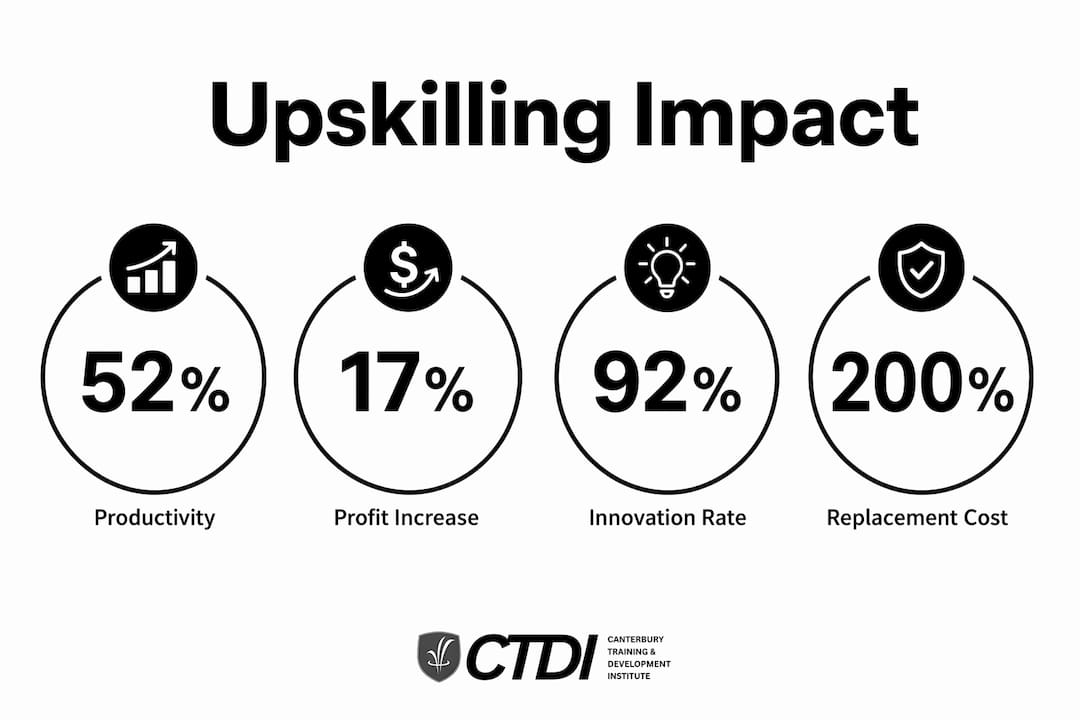
Retention savings alone justify the investment. Replacing a departing employee can cost up to 200% of their annual salary when you account for recruitment, onboarding, and lost productivity. Upskilling is, by comparison, a fraction of that cost. For a business with 50 employees and moderate turnover, the savings from retaining even two or three people per year can fund an entire learning programme.
The benefits of employee upskilling also extend to individual performance. Targeted training produces a 10% output increase within 12 weeks and doubles the likelihood of promotion. That promotion pipeline matters to employers because internal advancement is cheaper than external hiring and preserves institutional knowledge.
Key gains at a glance:
- Productivity: 52% higher in organisations with strong learning cultures
- Profitability: 17% greater profits compared to low-learning organisations
- Innovation: 92% more likely to develop new processes
- Retention: Turnover replacement costs up to 200% of annual salary
- Individual output: 10% increase within 12 weeks of targeted training
- Career progression: Trained employees are twice as likely to be promoted
How upskilling improves employee engagement and retention
Engagement and retention are two of the most expensive problems in HR. Upskilling addresses both at the source.

Organisations that promote year-round upskilling report 59% employee engagement, compared to 31% in organisations that do not. That 28-percentage-point gap is not a rounding error. It represents the difference between a workforce that shows up committed and one that is physically present but mentally elsewhere.
The psychological mechanism is straightforward. When employers invest in an employee's growth, that employee interprets it as a signal of long-term value. They feel seen, not just used. That perception drives loyalty more reliably than salary increments alone.
The flip side is equally well documented. 69% of employees report their skills are underutilised, and underutilisation correlates directly with disengagement. A capable person doing work that does not challenge them will disengage quietly, then leave loudly. Upskilling closes that gap by giving people work that stretches them.
Career growth is the other lever. Employees who see a clear path to promotion stay longer. When upskilling programmes are tied to advancement criteria, they give employees a concrete reason to remain. The importance of upskilling staff becomes especially clear when you compare the cost of a structured learning programme against the cost of replacing a mid-level specialist.
Contrary to a common fear among managers, providing growth opportunities does not make employees more likely to leave for competitors. The evidence shows the opposite: it signals employer investment in their future, which reduces turnover risk.
Pro Tip: Link upskilling opportunities directly to your performance review cycle. Employees who see a clear connection between learning and advancement are far more likely to complete programmes and apply new skills on the job.
- Tie learning milestones to promotion criteria
- Communicate programme availability at onboarding, not just annually
- Assign mentors to employees in active upskilling tracks
- Recognise skill achievements publicly to reinforce the culture
What makes an upskilling strategy actually work?
Most upskilling programmes fail not because the training is poor but because the strategy around it is weak. Three structural pillars determine whether a programme delivers results or collects dust.
Pillar 1: Data-driven skills gap assessment
Successful upskilling requires data-driven gap assessments before any learning solution is selected. This means analysing performance data, business objectives, and role requirements together. A gap assessment without business context produces training that is technically accurate but operationally irrelevant.
The process starts with identifying which skills your organisation needs in the next 12–24 months, then mapping current employee capabilities against that target. The delta between the two is your training priority list.
Pillar 2: Solution-oriented learning design
Generic off-the-shelf courses rarely close specific skill gaps. Effective programmes select or design learning that addresses the exact competency deficit identified in the gap assessment. This might mean a nationally accredited qualification for a technical role, a short-form online module for a process skill, or a structured mentoring arrangement for leadership development.
The format matters less than the fit. A well-chosen short course beats a poorly chosen diploma every time.
Pillar 3: Consistent outcome reporting
Upskilling programmes fail when employees cannot immediately apply new skills and when outcomes are not tracked. Reporting must link training completion to business KPIs: productivity metrics, error rates, customer satisfaction scores, and promotion rates. Without that link, upskilling remains a cost centre rather than a growth investment.
Pro Tip: Set a 90-day review point after every training cohort completes a programme. Measure output changes, manager feedback, and employee confidence scores. That data becomes the business case for your next budget request.
The table below compares two common approaches to structuring an upskilling programme:
| Feature | One-off training events | Continuous learning programmes |
|---|---|---|
| Skill retention | Low after 30 days | High with regular reinforcement |
| Business KPI linkage | Rarely measured | Built into programme design |
| Employee engagement impact | Short-term spike | Sustained improvement |
| Manager workload | Unchanged | Reduced over time |
| Return on investment | Difficult to demonstrate | Trackable and reportable |
Year-round communication is non-negotiable. Employees who hear about learning opportunities once a year, at an annual review, are far less likely to participate than those who receive regular, contextual reminders. Embedding upskilling into team meetings, manager conversations, and internal communications keeps it visible and accessible.
What hidden benefits do managers and teams gain?
The return on upskilling extends well beyond the employee being trained. Most HR calculations miss this entirely.
Training improves manager efficiency by reducing the volume of frontline queries managers receive. When employees can solve problems independently, managers reclaim time for strategic work. Harvard Business School research found that managerial productivity gains account for nearly half of the total organisational benefits from training programmes.
"The ROI of upskilling is consistently underestimated because most organisations only measure trainee output. The managerial and team-level efficiency gains are substantial and often exceed the direct productivity improvement of the person trained." — Harvard Business School, Working Knowledge
That finding reframes how HR professionals should calculate the return on investment for learning programmes. If you are only counting the output improvement of the trained employee, you are missing close to half the value.
The spillover effects are practical and immediate. A trained employee who handles their own technical queries, resolves customer issues without escalation, and onboards new colleagues independently removes several recurring demands from their manager's calendar. Multiply that across a team of ten and the time savings become significant.
Upskilling also enables leaner team structures over time. When individual contributors operate with greater autonomy, organisations can reduce the ratio of managers to staff without losing oversight quality. That structural efficiency is a long-term advantage that compounds as the learning culture matures.
The advantages of workforce development are therefore best understood at three levels: the individual employee, the immediate team, and the management layer above. Programmes that are designed with all three levels in mind consistently outperform those focused only on the individual.
How to implement an upskilling programme in 2026
Launching an upskilling programme does not require a large budget or a dedicated L&D team. It requires a clear process and consistent follow-through.
-
Conduct a skills gap analysis. Use performance review data, manager feedback, and business planning documents to identify the skills your organisation needs most. Prioritise gaps that directly affect revenue, customer experience, or operational efficiency.
-
Select targeted learning solutions. Match each identified gap to a specific learning format. A nationally accredited qualification suits roles requiring formal credentials. Short online modules suit process or tool-specific skills. Peer mentoring suits leadership and communication development. How to upskill online is a practical starting point for HR professionals exploring flexible delivery options.
-
Communicate programme availability year-round. Do not rely on annual reviews to inform employees about learning opportunities. Build upskilling into team meetings, manager one-on-ones, and internal newsletters. Year-round communication is directly linked to the 28-percentage-point engagement advantage seen in high-upskilling organisations.
-
Create immediate application opportunities. Assign projects or responsibilities that require the new skill within two weeks of training completion. Employees who cannot apply what they have learned quickly lose both the skill and the motivation to continue developing.
-
Measure and report outcomes. Track productivity changes, promotion rates, retention figures, and manager time savings at 30, 60, and 90 days post-training. Link these metrics to business KPIs and present them to leadership. That reporting cycle turns upskilling from a cost into a documented investment.
Nearly 70% of organisations now prioritise skills over formal education when hiring. That shift means your existing employees' demonstrated competencies matter more than ever, and upskilling is the most direct way to build those competencies at scale.
Key takeaways
Upskilling employees is the single most cost-effective way to improve productivity, reduce turnover, and build the innovation capacity your organisation needs to compete in 2026.
| Point | Details |
|---|---|
| Productivity and profit gains are proven | Organisations with learning cultures report 52% higher productivity and 17% greater profits. |
| Engagement rises with year-round learning | Companies promoting upskilling continuously see 59% engagement versus 31% in those that do not. |
| Turnover costs justify the investment | Replacing one employee costs up to 200% of their annual salary, making upskilling far cheaper. |
| Manager efficiency is a hidden return | Managerial productivity gains account for nearly half of total training benefits. |
| Strategy beats volume | Data-driven gap assessments, targeted solutions, and KPI-linked reporting determine programme success. |
The uncomfortable truth about how most organisations approach upskilling
I have spent years watching organisations treat upskilling as a compliance exercise. They run a mandatory course in february, tick the box, and wonder why nothing changes by june. The problem is not the training. The problem is the absence of strategy around it.
The shift I have seen work consistently is treating upskilling as an operational function, not an HR event. That means skills gap data sits alongside financial data in leadership reviews. It means managers are accountable for their team's learning participation, not just their output. It means the question "what skill does this person need to do their job better?" is asked before a performance issue becomes a performance problem.
What surprises most HR professionals when they see the Harvard Business School research is the managerial efficiency finding. They expect to see employee output improve. They do not expect to find that nearly half the return comes from managers being freed up to do more valuable work. That insight alone should change how you pitch upskilling budgets to your CFO.
The organisations I respect most on this are the ones that have stopped asking "can we afford to upskill?" and started asking "what is it costing us not to?" The professional development data consistently shows that the answer to the second question is far larger than most leaders expect. Skill growth is not a benefit you offer employees. It is a competitive advantage you build for your organisation.
— Sam
How Edu supports your workforce development goals
Edu, the Canterbury Training and Development Institute, offers nationally recognised online diplomas designed for working professionals and the employers who invest in them.

Courses in AI, digital marketing, and environmental sustainability are delivered 100% online, self-paced, and built by industry experts. That format means your employees can upskill without disrupting operations. Whether you are building capability in a single team or rolling out development across a department, Edu's online enrolment options give you a direct path from skills gap to qualified workforce. The courses align with real industry demand, so the skills your people gain are immediately applicable to the work they are already doing.
FAQ
What does upskilling employees mean?
Upskilling employees means systematically developing their skills beyond their current role requirements to meet evolving business and industry needs. It differs from reskilling, which prepares employees for entirely different roles.
Why invest in employee training rather than hiring new staff?
Replacing an employee costs up to 200% of their annual salary, while targeted training produces measurable output gains within 12 weeks. Upskilling existing staff is faster, cheaper, and preserves institutional knowledge.
How does upskilling affect employee engagement?
Organisations that promote upskilling year-round report 59% employee engagement compared to 31% in those that do not, a gap of 28 percentage points. Employees who feel their skills are being developed are significantly less likely to disengage or leave.
What are the key steps to upskill employees effectively?
Conduct a data-driven skills gap analysis, select targeted learning solutions matched to specific gaps, communicate availability year-round, create immediate application opportunities, and measure outcomes against business KPIs.
How do you measure the return on an upskilling programme?
Track productivity changes, promotion rates, retention figures, and manager time savings at 30, 60, and 90 days after training. Research from Suraasa and Harvard Business School confirms that managerial efficiency gains alone account for nearly half of total programme benefits.