

TL;DR:
- Investing in staff training yields measurable ROI, reduces turnover, and enhances organizational competitiveness. Effective programs focus on clear outcomes, proper delivery formats, and tracking performance over 6 to 12 months. Manager involvement and strong data systems are crucial to proving training’s long-term impact and value.
Most employers already sense that staff training matters, but the question of why invest in staff training gets complicated the moment budgets tighten. The hesitation is understandable. If a staff member leaves within a year, does the investment pay off? The research says yes, and the numbers are more compelling than most leaders realise. This article breaks down the real advantages of staff development, including measurable ROI, retention gains, and practical evaluation frameworks that turn training from a line item into a competitive asset.
Table of Contents
- Key takeaways
- Why invest in staff training: the core business case
- Training spend benchmarks and ROI
- How training drives employee retention
- Practical steps to optimise your training investment
- My take on what most organisations get wrong
- How CTDI supports your training investment
- FAQ
Key takeaways
| Point | Details |
|---|---|
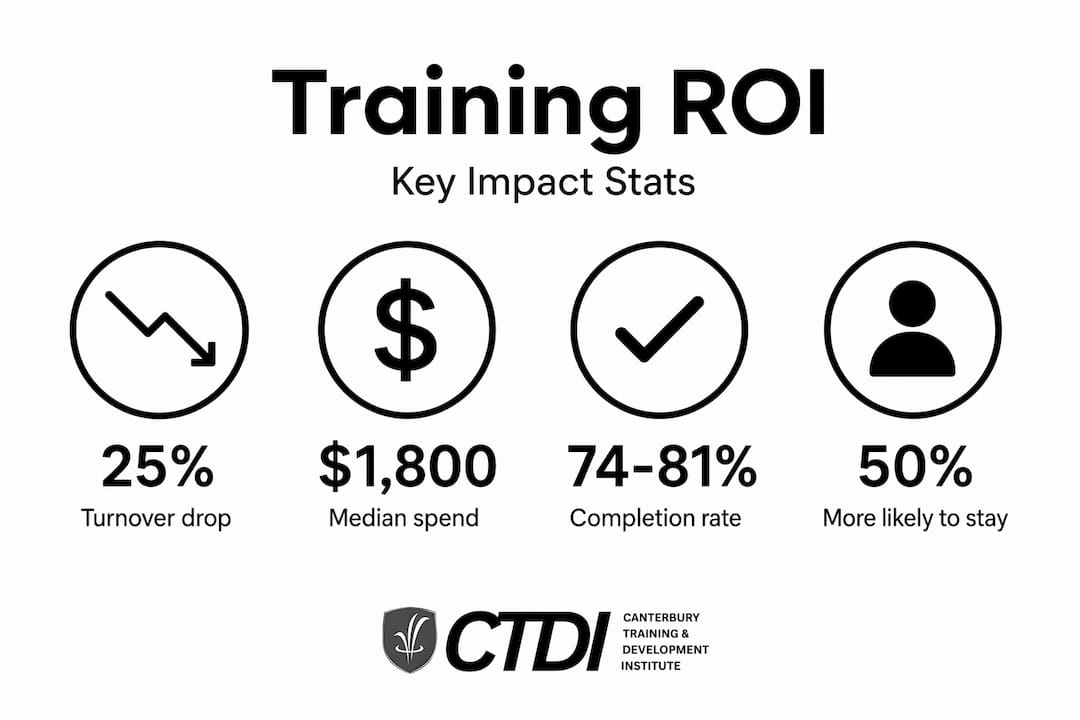
| Training reduces turnover | Clear onboarding and training programmes can cut voluntary turnover by up to 25%. |
| Spend levels affect outcomes | Organisations spending $5,400 to $9,200 per employee in reskilling see measurably stronger productivity gains than those at the median. |
| Programme structure matters | Manager-led cohort training produces completion rates of 74 to 81 per cent, far above self-paced alternatives. |
| ROI requires long-term tracking | Linking training to business outcomes takes 6 to 12 months of data and persistent learner tracking systems. |
| Training signals commitment | Employees who feel well-prepared through training are around 50% more likely to stay with their employer. |
Why invest in staff training: the core business case
The most persistent myth in workforce management is that training money walks out the door when an employee leaves. Employers often underinvest precisely because they expect short employment durations, which weakens the perceived incentive to fund development that pays off over time. But this logic is self-defeating. Undertrained staff leave faster, cost more to replace, and perform below their potential while they are with you.
The advantages of staff development span several dimensions of business performance.
- Productivity and efficiency. Trained employees complete tasks faster, make fewer errors, and require less supervision. These gains compound over time, particularly when training is aligned to specific role requirements rather than generic compliance topics.
- Retention and loyalty. Staff who receive structured, relevant training report higher engagement and stronger connection to their employer. When people feel their professional growth is supported, they are less likely to look elsewhere.
- Competitive positioning. Workforce capabilities directly determine what your organisation can offer clients and how quickly it can adapt to market changes. Investing in training aligns your team with evolving industry demands, particularly in areas like AI, digital marketing, and sustainability.
- Culture and morale. Training signals that leadership values its people. That signal has a direct effect on morale, particularly among high performers who want to keep growing.
- Reduced management burden. Well-trained teams require less daily troubleshooting. Managers spend less time correcting errors and more time on strategic work.
Public investment backs this logic at scale. In California, over 60,000 workers are being supported through $37.2 million in apprenticeship and workforce training funding, explicitly designed to help employers build skilled workforces that compete and grow. Governments do not invest that kind of money in training without strong evidence it works.
"Workforce training should be viewed as a strategic capability investment tied to regional economic priorities and industry growth rather than a generic HR expense."
The staff training importance conversation has shifted. It is no longer about whether training is worth it. It is about how to do it well enough to see the return.
Training spend benchmarks and ROI
Understanding the investment means knowing what effective training actually costs, and what the return looks like in real terms.
What organisations are spending
The median corporate spend on AI reskilling sits at around $1,800 per employee. That figure produces modest gains. High-performing organisations that spend between $5,400 and $9,200 per employee achieve measurable productivity improvements that justify the outlay and then some. The difference is not just money. It is how the programme is designed and delivered.
| Training tier | Spend per employee | Typical outcome |
|---|---|---|
| Median spend | ~$1,800 | Modest knowledge gains, limited behaviour change |
| Mid-range spend | ~$3,500 to $5,000 | Improved competency with structured delivery |
| High-impact spend | $5,400 to $9,200 | Measurable productivity gains, higher completion rates |
Evaluating return on investment
The two most widely used evaluation frameworks are the Kirkpatrick model and the Phillips ROI model. Kirkpatrick measures training across four levels: reaction, learning, behaviour, and results. The results level is where business outcomes live, and fewer than 35% of organisations consistently measure it. That is why so many leaders struggle to prove training ROI. They are measuring satisfaction surveys and quiz scores rather than linking training participation to actual business performance data.
The Phillips model builds on Kirkpatrick by calculating a financial ROI percentage, using cost data alongside business outcome improvements. Both models require a critical ingredient most organisations are missing: persistent learner IDs that connect participation records to performance metrics over time.
Pro Tip: Design your data architecture before your training programme. Assign each participant a tracking ID that connects their learning records to productivity, retention, and performance data from day one. Without this, you are measuring opinions rather than outcomes.
For organisations evaluating the training and development ROI question, the key insight is this. True ROI requires linking participant behaviour to business results over 6 to 12 months. Post-training satisfaction scores are not ROI. They are a starting point.
How training drives employee retention
The connection between training and retention is one of the most underutilised arguments for investing in staff development. The data is clear and the mechanism is straightforward.

Clear onboarding and training programmes can reduce voluntary turnover by up to 25 per cent. The reason comes down to four dimensions of training clarity: structure, currency, accessibility, and consistency. When new employees know exactly what they need to learn, can access it easily, and receive it consistently across their team, they build operational confidence faster. That confidence translates directly into staying longer.
Consider what it costs to replace a staff member. Conservative estimates place replacement costs at between 50 and 200 per cent of annual salary, depending on the role. That figure includes recruitment advertising, interviewer time, onboarding costs, lost productivity during the vacancy period, and the productivity dip while the new hire gets up to speed. Against those numbers, investing in structured training that keeps one extra person per year looks very different.
Here are four practical levers for using training to reduce early turnover:
- Make the first contribution happen early. Design onboarding so new staff make their first real contribution within the first month. One-off induction sessions do not achieve this. A structured, role-specific learning pathway does.
- Keep content current. Outdated training damages confidence rather than building it. Staff who complete training and then find that the actual processes differ from what they learned lose trust in the organisation quickly.
- Make training accessible on demand. New employees need to revisit information as questions arise. Training locked behind scheduled sessions or difficult portals increases anxiety and decreases performance.
- Apply consistency across teams. Inconsistent training experiences create informal knowledge silos. When one team member knows the systems and another does not, friction and frustration follow.
Pro Tip: Do not measure onboarding success by course completion. Measure it by how quickly new staff can operate independently and make their first meaningful contribution. That is the metric that predicts whether they will still be with you in six months.
Employees who feel well-prepared through training are around 50 per cent more likely to stay with their company, particularly during the critical first few months. That statistic alone reframes the entire cost-versus-benefit debate around why invest in employee education. The risk is not that you train someone and they leave. The risk is that you do not train them and they leave faster. For further reading on how training supports corporate success in Australia, the mechanisms behind that relationship are worth understanding in detail.
Practical steps to optimise your training investment
Knowing the benefits is one thing. Designing a programme that actually delivers them is another. The good news is that the gap between average and high-performing training investments is mostly structural, not financial.
Design backwards from business outcomes
Start with the result you want. Do you need to reduce error rates in a specific process? Increase sales conversion? Improve client satisfaction scores? Define that outcome first, then design the training to produce the behaviours that drive it. This is the reverse Kirkpatrick design approach, and it is the single most effective shift you can make in how you build training programmes.
Most organisations design training by asking "what do people need to know?" A better question is "what do people need to do differently, and how will we measure whether they are doing it?"
Choose delivery formats that drive completion
Manager-facilitated cohort training and embedded workflow learning produce completion rates of 74 to 81 per cent. Self-paced online courses without accountability structures routinely fall well below 30 per cent completion. The value of workforce training depends entirely on whether people actually finish and apply it.
| Delivery format | Typical completion rate | Behaviour change potential |
|---|---|---|
| Self-paced, no accountability | Under 30% | Low |
| Manager-facilitated cohort | 74 to 81% | High |
| Embedded workflow learning | 75%+ | Very high |
| Blended with manager check-ins | 60 to 75% | Moderate to high |
Build data systems that track what matters
Organisations must use persistent learner IDs to link training records to performance and retention data across 6 to 12 months. Without this architecture, you cannot demonstrate ROI to a CFO or a board. With it, training transforms from a narrative into evidence.
Measure output, not activity. Completion rates tell you that learning happened. They do not tell you that performance changed. Tie each training investment to a specific business metric and track that metric before, during, and after the programme. For insights on how expert trainers shape outcomes in structured delivery environments, that context is directly applicable to how you select and deploy training facilitators internally.
My take on what most organisations get wrong
I have observed a frustrating pattern in how organisations approach staff training. They invest in a programme, measure satisfaction scores at the end, see positive results, and then wonder six months later why productivity has not shifted. The answer is almost always the same. They measured the wrong thing and then drew the wrong conclusion.
The importance of training employees is not captured in how people feel after a workshop. It is captured in what they do differently at their desks the following month and what that behaviour change costs or earns the business. Most organisations simply do not have the data infrastructure to connect those dots, and because they cannot prove the return, the next budget cycle sees training cut first.
What I have found consistently is that the leaders who get this right stop thinking about training as a programme and start thinking about it as a capability system. They ask different questions. Not "did people complete the course?" but "what decisions are our people making differently now, and what is that worth?"
Manager involvement is the variable that changes everything. When managers treat training as something that happens to their team, completion rates and behaviour change both suffer. When managers co-own the learning outcomes, treat sessions as team priorities, and follow up on application in the weeks after, the results are genuinely different. I have seen this distinction separate high-performing teams from average ones in organisations of every size.
The other thing worth saying directly: the fear that trained employees will leave and take their new skills elsewhere is real but statistically backwards. The staff who leave are disproportionately the ones who felt unsupported, unchallenged, and underdeveloped. Training your people well is not a retention risk. It is a retention strategy.
— Sam
How CTDI supports your training investment

If you are ready to move from understanding why to actually building training capability in your organisation, Canterbury Training and Development Institute offers a practical starting point. CTDI provides nationally recognised, accredited courses in AI, digital marketing, and environmental sustainability, all delivered online and designed by industry experts to produce real workforce capability.
The formats are built for working professionals and busy teams. Self-paced, 100 per cent online delivery means your staff can upskill without disrupting operations. Every programme is structured around measurable competencies and practical application, which means you are investing in outcomes rather than attendance records.
If your workforce needs to develop AI skills for a competitive future, or if your organisation has identified digital marketing or sustainability as capability priorities, CTDI's course catalogue aligns directly with those needs. Explore the full range of programmes and take the next step toward a training investment that you can measure and defend.
Enrol your team today and start building workforce capability that sticks.
FAQ
Why invest in staff training if employees might leave?
Undertrained employees leave faster than well-trained ones, and replacement costs far exceed the cost of development. Training is a retention tool, not a retention risk.
What is a realistic training budget per employee?
The median corporate spend sits around $1,800 per employee, but high-impact reskilling programmes spending $5,400 to $9,200 per person achieve significantly stronger productivity outcomes.
How do you measure training and development ROI?
Use the Kirkpatrick model to track training from reaction through to business results, and apply the Phillips model to calculate a financial return. Measuring level 4 results requires linking participant data to performance metrics over 6 to 12 months.
How much can training reduce staff turnover?
Clear, structured onboarding and training programmes can reduce voluntary turnover by up to 25 per cent by improving role clarity and operational confidence in the first six months.
What delivery format produces the best training outcomes?
Manager-facilitated cohort learning and embedded workflow training produce completion rates of 74 to 81 per cent and the strongest behaviour change results, compared to unstructured self-paced formats.
Recommended
- How training drives corporate success and careers in Australia — Canterbury Training and Development Institute
- How training drives corporate success and careers in Australia
- Top corporate training tips for boosting employee growth remotely
- Why pursue professional development: skills and career gains — Canterbury Training and Development Institute