

TL;DR:
- Upskilling involves learning new skills or enhancing existing ones to remain relevant and advance professionally. It offers measurable benefits like higher earnings, better job security, and increased internal mobility in 2026.
Upskilling is the process of learning new skills or enhancing existing ones to stay relevant and advance professionally in a fast-changing work environment. The term sits alongside "continuous professional development" as the recognised industry standard for deliberate, career-focused learning. Right now, that process is more urgent than ever. 70% of professionals use AI weekly in their workflows, which means the baseline for what counts as a competent worker is shifting fast. The World Economic Forum and LinkedIn Learning both flag skill half-life as a growing concern: the useful lifespan of a technical skill is shrinking, and professionals who do not actively build new capabilities will find themselves outpaced. Understanding why upskill in 2026 matters is the first step toward doing something about it.
Why upskill in 2026? The core benefits explained
Upskilling delivers measurable returns for both individuals and the organisations they work for. The benefits are not abstract. They show up in pay packets, performance reviews, and job security.

Higher earnings in high-demand areas
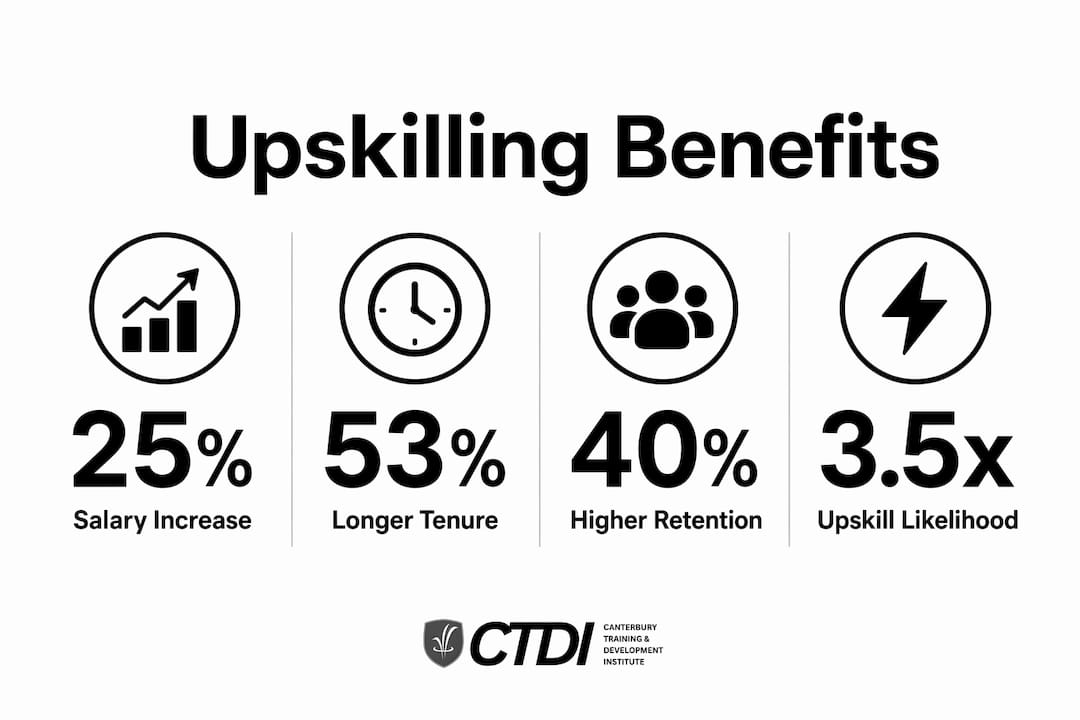
AI and data skills command salary premiums of 15–25% in 2026 compared to equivalent roles without those competencies. That gap is not a rounding error. It represents tens of thousands of dollars over a career, and it grows wider each year that a professional delays building those skills.
Stronger job security and adaptability
Professionals who upskill regularly adapt faster when roles change or industries shift. This adaptability is the single most reliable form of job security available, because no employer can guarantee a role will exist in five years. What they can guarantee is that a worker who learns continuously will find a way to stay valuable.
Better engagement and retention
Organisations that invest in learning see measurable improvements in staff retention. Employees who feel their skills are growing report higher job satisfaction and are less likely to look elsewhere. This creates a direct link between learning culture and reduced turnover costs.
Social capital and internal networks
Proactive upskilling builds social capital by creating trust, strengthening internal networks, and generating shared organisational understanding. Professionals who learn emerging skills bring new vocabulary and frameworks into team conversations. That shared language reduces friction and speeds up collaboration across departments.
Competitive advantage in the job market
Candidates who hold current, relevant credentials stand out in hiring processes. Certifications signal commitment and fill knowledge gaps that recruiters notice immediately. The importance of skills in 2026 is reflected in job descriptions that now routinely list AI literacy, data analysis, and digital communication as baseline requirements rather than bonus attributes.
How does upskilling differ from reskilling?
Upskilling and reskilling are related but distinct approaches to workforce development. Choosing the right one depends on where you are in your career and where you want to go.
Upskilling means building on your existing skill set to perform your current role better or qualify for a more senior version of it. A marketing coordinator who learns AI-powered campaign analysis is upskilling. The role stays recognisable; the capability level rises.
Reskilling means learning an entirely new set of skills to move into a different role or industry. A retail manager who trains to become a data analyst is reskilling. The career direction changes fundamentally.
| Dimension | Upskilling | Reskilling |
|---|---|---|
| Starting point | Current role and skills | Current role only |
| Destination | Enhanced or senior version of current role | New role or industry |
| Time investment | Moderate, builds on existing knowledge | Higher, requires foundational learning |
| Best suited for | Career advancement within a field | Career change or role elimination |
| 2026 relevance | High, especially for AI and digital skills | High, for roles at risk of automation |
Organisations are 3.5 times more likely to upskill existing employees than hire externally to address AI skill gaps. That preference reflects both cost efficiency and the value of institutional knowledge. For most professionals in 2026, upskilling is the faster, lower-risk path to career advancement because it builds on what you already know rather than starting from scratch.
What skills should you prioritise when upskilling in 2026?
The most valuable skills in 2026 fall into two broad categories: technical capabilities that machines cannot yet fully replicate, and human capabilities that make technical work meaningful. The strongest professionals build both.
Technical skills worth your time
AI literacy sits at the top of every credible priority list. You do not need to write code, but you do need to understand how AI tools work, where they fail, and how to direct them effectively. Prompt engineering, AI workflow integration, and output evaluation are practical entry points.
Data analysis and interpretation follow closely. Roles across marketing, operations, finance, and healthcare now require professionals to read data, spot patterns, and communicate findings clearly. Tools like Excel, Power BI, and Python basics are accessible starting points.
FinOps and cloud cost management represent a more specialised but highly rewarded area. DevOps engineers implementing FinOps can reduce cloud infrastructure costs by 30–40%, making this skill set extremely attractive to employers managing tight technology budgets.
Human skills that multiply technical value
Building communication skills is critical for technical professionals who want to break through career ceilings. Technical expertise without the ability to explain, persuade, and present findings limits how far that expertise can take you. The professionals who advance fastest combine deep technical knowledge with clear, confident communication.
Creative thinking and analytical reasoning are equally important. AI handles repetitive pattern recognition well. It struggles with novel problems, ethical judgement, and creative synthesis. These are the areas where human professionals can widen the gap between themselves and automation.
How to learn without burning out
Aim for five hours of focused learning per week. That figure is sustainable alongside full-time work and produces compounding results over a year. Spreading learning across five one-hour sessions is more effective than a single five-hour block on weekends.
Apply new skills within two weeks of learning them. Skills not practised within that window are largely forgotten within a month. The most effective learners build immediate application into their plan: take a short course on Monday, use the technique in a real project by Friday.
Pro Tip: When choosing what to learn next, open three job descriptions for the role you want in 12 months and highlight every skill requirement you cannot currently demonstrate. That gap list is your upskilling priority list.
Certifications add genuine value when they signal commitment, fill knowledge gaps, and aid recruiter recognition. Treat them as evidence of learning, not as the learning itself. A certificate without applied experience is a credential without proof.
How does upskilling accelerate career advancement?
Upskilling does not just make you better at your current job. It opens doors inside your organisation that most professionals do not realise exist.
Internal mobility as a career tool
Internal mobility leads to 53% longer employee tenure and 40% higher retention after internal job moves. Those numbers matter for you personally because they show that moving into a new role within your current organisation is one of the most effective career moves available. Upskilling is the primary mechanism that makes internal moves possible.
Professionals who build new skills become visible to managers across departments. They get invited to cross-functional projects. They build relationships outside their immediate team. Each of these outcomes compounds over time into a broader professional network and a stronger reputation.
Acting as the CEO of your own career
Professionals in 2026 must treat themselves as CEOs of their own careers. That means conducting quarterly skill audits, comparing your current capabilities against the roles you are targeting, and setting specific learning goals for the next 90 days. It means not waiting for your employer to hand you a development plan.
Here are the habits that define proactive career managers in 2026:
- Conduct a skills gap audit every quarter against two or three target job descriptions.
- Schedule a career development conversation with your manager at least twice a year.
- Volunteer for at least one cross-functional project per year to build skills and relationships simultaneously.
- Track completed learning in a visible format, such as a LinkedIn profile or internal portfolio, so that growth is apparent to decision-makers.
- Identify one mentor inside or outside your organisation who works in the role you want next.
Self-directed upskilling increases the likelihood of being invited to cross-functional projects because proactive learners are perceived as reliable and growth-oriented. That perception is a social signal. It shapes how colleagues and managers think about you before any formal promotion process begins.
Pro Tip: After completing any course or certification, write a one-paragraph summary of what you learned and how you plan to apply it. Share it with your manager. This single habit makes your learning visible and positions you as someone who takes development seriously.
What challenges come with upskilling and how do you overcome them?
Learning new skills is not always comfortable. Recognising the common obstacles makes them easier to manage.
"Absorbing new information, though sometimes uncomfortable, enhances long-term cognitive adaptability and independence. The discomfort of not knowing is temporary. The benefit of having learned is permanent."
Adult brain function benefits from continuous learning despite short-term discomfort. The feeling of being confused or slow during early learning is not a sign that you are failing. It is a sign that your brain is building new connections. Reframing that discomfort as progress rather than failure is one of the most useful mindset shifts a professional can make.
Common challenges and practical responses:
- Time pressure. Block learning time in your calendar as a non-negotiable appointment. Treat it the way you treat a client meeting.
- Lack of organisational support. Many employers offer learning budgets that go unclaimed. Ask your manager or HR team directly what funding is available before spending your own money.
- Choosing the wrong skills. Focus on skills that appear repeatedly in job descriptions for your target role. Avoid learning tools or platforms that are not yet widely adopted in your industry.
- Loss of motivation mid-course. Connect your learning to a specific future identity. Helping yourself visualise who you can become is more motivating than focusing on what you need to learn. Picture the role, the title, and the work you want to be doing in two years.
- Burnout from over-committing. Learn one skill at a time. Depth beats breadth. A professional who genuinely masters AI workflow integration is more employable than one who has sampled ten tools without applying any of them.
The how to upskill online question has a practical answer: choose accredited, self-paced programmes that let you learn around your existing commitments rather than forcing a rigid schedule.
Key takeaways
Upskilling in 2026 is the most direct path to career advancement because AI adoption, shrinking skill half-lives, and employer preference for internal development all reward professionals who learn continuously and apply skills immediately.
| Point | Details |
|---|---|
| AI is the baseline | 70% of professionals use AI weekly, making AI literacy a minimum requirement, not a bonus. |
| Salary premiums are real | AI and data skills command 15–25% salary premiums, making targeted upskilling a direct financial decision. |
| Apply skills within two weeks | Skills not applied within two weeks are largely forgotten within a month, so build practice into every learning plan. |
| Internal mobility pays off | Internal job moves lead to 40% higher retention and 53% longer tenure, making upskilling a tool for advancement inside your current organisation. |
| Own your career development | Quarterly skill audits, manager conversations, and cross-functional projects are the habits that separate proactive professionals from reactive ones. |
Why I think most professionals are upskilling backwards
Most career advice tells you to pick a skill, take a course, and add it to your CV. That sequence sounds logical. In practice, it produces a lot of certificates and very little career movement.
The professionals I have seen advance fastest in 2026 do it differently. They start with the role they want, reverse-engineer the skills that role requires, and then build learning plans around that specific destination. They are not collecting credentials. They are closing gaps.
The AI conversation is real, but it is also misunderstood. The professionals most at risk are not the ones who lack AI skills. They are the ones who are waiting to see how things settle before they commit to learning anything. That wait is expensive. The AI skills training curve is steep enough that starting six months later puts you a year behind in practical experience.
The other thing most articles miss is the social dimension. Learning visibly, sharing what you know, and arriving at meetings with new frameworks does more for your career than any single certification. Proactive learners generate shared understanding and reduce friction in team settings. That is a form of leadership, and it gets noticed.
My honest advice: treat your career like a business you run. Audit your skills every quarter. Set 90-day learning goals. Make your development visible to the people who make decisions about your future. The professionals who do this consistently are not the ones worrying about automation. They are the ones being asked to lead the response to it.
— Sam
Ready to build the skills that 2026 demands?
Knowing what to learn is one thing. Having a structured, accredited pathway to get there is another.
Edu, through the Canterbury Training and Development Institute, offers 100% online diplomas in AI, digital marketing, and sustainability, all designed by industry experts and built around the skills employers are actively hiring for right now. Courses are self-paced, which means you can fit study around your existing work and life commitments without sacrificing either. Whether you are building AI literacy from the ground up or advancing toward a specialist role, enrol in a diploma programme that matches where you want to go. For professionals focused on marketing careers, the Advanced Diploma of Digital Marketing combines AI tools with practical campaign skills that employers are paying a premium for in 2026.
FAQ
What does upskilling mean?
Upskilling is the process of learning new skills or improving existing ones to advance in your current career path. It differs from reskilling, which involves training for an entirely different role or industry.
Why is upskilling important in 2026?
Rapid AI adoption and shrinking skill half-lives mean that professionals who do not actively learn new capabilities fall behind quickly. 70% of professionals already use AI weekly, making continuous skill development a baseline expectation rather than a differentiator.
What are the most valuable future skills to learn in 2026?
AI literacy, data analysis, cloud cost management, and communication skills top the priority list for 2026. The strongest professionals combine technical skills with the ability to explain and apply them in real work contexts.
How much time should I spend upskilling each week?
Five hours per week is a sustainable and effective target for professionals in full-time roles. Spreading that time across multiple shorter sessions produces better retention than a single long study block.
Does upskilling lead to higher pay?
AI and data skills command salary premiums of 15–25% in 2026 compared to equivalent roles without those competencies. Targeted upskilling in high-demand areas is one of the most direct ways to increase your earning potential.