

TL;DR:
- Industry-relevant training is based on external standards and assessed by independent bodies, ensuring verifiable job-ready skills. Such programs link curricula to recognized occupational frameworks and include third-party assessments to build employer trust. Choosing accreditation, external evaluation, and industry endorsement guarantees that credentials genuinely signal industry relevance and value.
Industry-relevant training is structured learning aligned to recognised external standards, occupational frameworks, and credentialing authorities specific to a given sector. Unlike generic professional development, it ties curriculum directly to what employers, regulators, and industry bodies define as job-ready competency. Programs like Certified Nursing Assistant (CNA) courses, which must comply with the CMS 75-hour federal minimum, and CompTIA Security+, which requires passing a 90-question exam tied to US Department of Defense requirements, illustrate what genuine industry alignment looks like. If you are exploring training to advance your career or shift into a new field, understanding what makes a program truly industry-relevant is the most important decision you will make.
What is industry-relevant training, and how does it differ from general learning?
Industry-relevant training is defined by one core feature: its curriculum, standards, and credentialing are anchored to an external authority recognised within a specific occupational sector. This is what separates it from general professional development training, which may improve knowledge or confidence but rarely produces credentials that employers can verify against an independent benchmark.

The distinction becomes clearest when you compare program types side by side.
| Feature | Industry-relevant training | General professional development |
|---|---|---|
| Curriculum source | External occupational or regulatory standard | Internal or generic learning objectives |
| Credential issuer | Industry body, government, or accreditation authority | Employer or training provider |
| Assessment method | External exam, portfolio review, or regulated evaluation | Internal quiz or completion certificate |
| Employer recognition | High, tied to known credential | Variable, depends on provider reputation |
| Recertification required | Often, to maintain currency | Rarely mandated |
The sectors where this distinction matters most are healthcare, information technology, and the skilled trades. In healthcare, a CNA must meet state-mandated clinical hours and pass a competency evaluation administered by a third party. In IT, vendor-neutral credentials like CompTIA Security+ cover foundational cybersecurity competencies recognised across multiple industries, making them valuable for career changers and entry-level candidates alike. In the trades, apprenticeship programmes combine supervised practical work with formal qualifications registered under national frameworks.
What general training cannot replicate is external verification. Skills training for industries that carries weight with hiring managers is assessed against job-relevant criteria by someone outside the training provider. That independence is what makes the credential traceable and trustworthy. Without it, a certificate is simply a record of attendance, not a proof of competency.
The practical implication for you is straightforward. Before enrolling in any programme, ask who sets the standard the curriculum is built on, and who conducts the final assessment. If the answer to both questions is the training provider itself, the qualification sits in the general development category regardless of how it is marketed.
How is the effectiveness of industry-relevant training measured?
Most training programmes measure success by asking participants whether they enjoyed the experience. That is a significant problem, because satisfaction tells you nothing about whether skills transferred to the job or produced any measurable outcome for the learner or their employer.
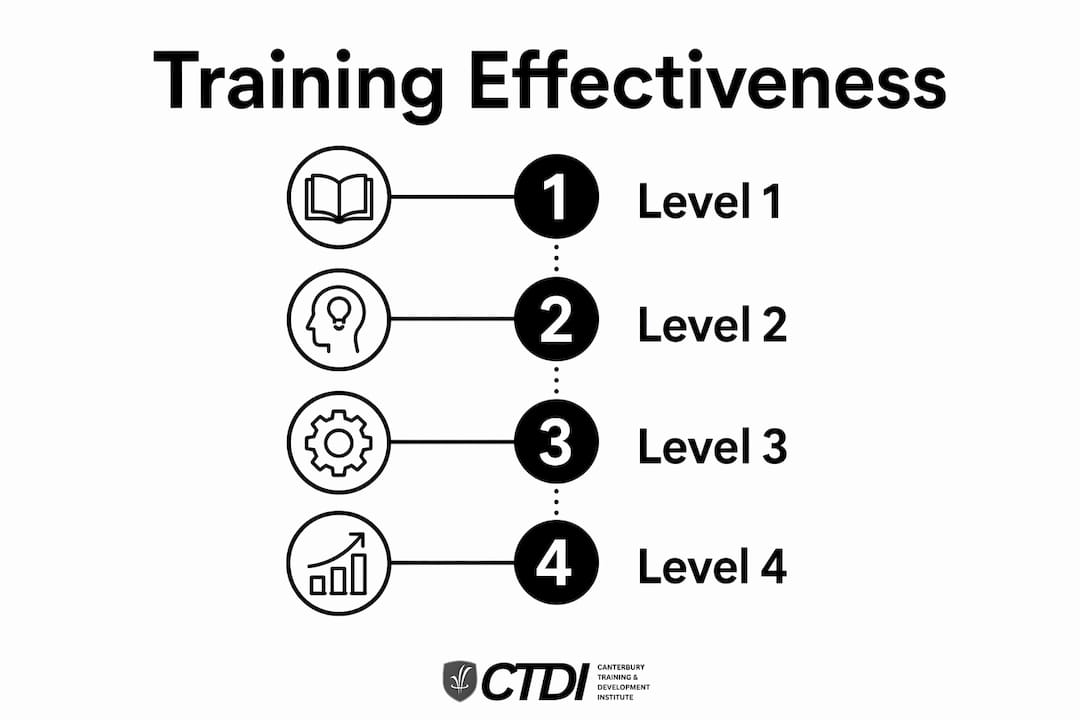
The most widely used framework for rigorous evaluation is the Kirkpatrick Model, which assesses training across four escalating levels.
- Reaction. Did participants find the training relevant and engaging? Collected immediately after the session via surveys or feedback forms.
- Learning. Did participants acquire the intended knowledge or skills? Measured through pre and post assessments, practical demonstrations, or exam results.
- Behaviour. Are participants applying what they learned in their actual work? Measured 30 to 90 days post-training to allow time for application in real conditions.
- Results. Has the training produced tangible organisational or career outcomes? Tracked over 3 to 12 months after completion, covering metrics like productivity, error rates, or employment outcomes.
The uncomfortable reality is that most evaluations stall at Level 1. Providers collect satisfaction scores, report high completion rates, and call the programme a success. Levels 3 and 4 require linking individual learner data across time, which demands persistent participant identifiers and a commitment to follow-up that many providers simply do not build into their systems. Linking learner data across all four levels is what separates programmes that claim impact from those that can demonstrate it.
For you as a prospective learner, this matters because it shapes how you evaluate provider claims. When a training organisation says its graduates achieve strong employment outcomes, ask what data they collected and when. Outcome data gathered 12 months post-completion is credible. A testimonial from a recent graduate is not.
Pro Tip: Ask any training provider for their Level 3 and Level 4 evaluation data before enrolling. If they cannot produce it, their claims about employment outcomes rest on satisfaction scores alone.
The importance of industry training that is rigorously evaluated extends beyond individual career decisions. Employers who fund staff development through workforce development programmes need evidence that training changes behaviour on the job, not just knowledge scores on a post-course quiz. Programmes that build evaluation into their design from the start are the ones worth your time and money.
Do credentials and micro-credentials actually signal industry relevance to employers?
The short answer is: it depends entirely on the credential and how you present it. Not all qualifications carry equal weight, and the gap between a respected industry certification and a low-stakes digital badge is wider than most learners realise.
Credentials generally fall into three categories.
- University certificates and diplomas. Carry institutional authority and are well understood by employers, particularly when the institution is accredited and the programme aligns to industry standards. UNC Charlotte's professional development catalogue, for example, offers over 200 options combining certifications and hands-on technical skills, illustrating how universities can bridge academic credibility with job-ready training.
- Industry certifications. Issued by sector bodies or vendor-neutral organisations, these are often the most directly recognised by hiring managers in technical fields. CompTIA Security+, for instance, is recognised across both private sector IT roles and government defence requirements.
- Digital badges and micro-credentials. Increasingly common, but employer trust is uneven. A 2025 Eduvantis survey of 150 US hiring managers found that 57% actively verify micro-credentials, treating them as supplemental signals rather than primary hiring criteria. That verification rate signals genuine interest, but also confirms that badges alone rarely close a hiring decision.
What distinguishes a respected credential from a weak one comes down to three factors: the authority of the issuing body, the rigour of the assessment, and the transparency of what was learned. Employers want clear visibility into skills gained and assessment rigour when evaluating any non-traditional qualification.
"Candidates presenting micro-credentials with contextual proof, such as workload, assessment type, and rigour, decrease employer verification friction and improve hiring prospects." — Eduvantis Research, 2025
The practical takeaway is that a micro-credential presented with a detailed proof package, covering learning outcomes, instructional hours, assessment method, and the standard it maps to, performs significantly better in hiring conversations than a badge presented alone. If you are building a portfolio of qualifications, treat each credential as a case you need to make, not a trophy you display. Exploring professional development online can help you understand how to structure that case effectively.
How to choose the right industry-relevant training programme
Choosing the right programme requires evaluating it against four specific criteria, not just reputation or price.
Curriculum alignment to recognised standards. The first question is whether the programme's learning objectives map to an external occupational framework, regulatory requirement, or industry body standard. A programme that references its own internal competency framework without tying it to an external authority is not truly industry-relevant, regardless of how it is described. Industry-responsive training frameworks prioritise standardised, traceable, and frequently updated content tailored to real workforce dynamics.
External assessment and credential verification. Look for programmes where the final assessment is conducted or moderated by an independent body. This is the mechanism that makes the resulting credential verifiable. An exam administered by CompTIA, a clinical evaluation conducted by a state-approved assessor, or a portfolio review against a national qualifications framework all meet this standard. An internal multiple-choice quiz does not.
Recertification and currency requirements. Many industry-relevant credentials require periodic renewal to remain valid. This is a feature, not a burden. It signals that the issuing body takes currency seriously and that the credential reflects current practice rather than knowledge from five years ago. Before enrolling, check whether the credential has a maintenance requirement and factor that into your long-term planning.
Employer and industry endorsement. The most reliable signal that a programme is genuinely valued is direct endorsement from employers or industry associations in your target sector. This can take the form of corporate training partnerships, advisory board involvement from industry practitioners, or explicit recognition by professional bodies. Programmes developed in isolation from the industries they claim to serve rarely produce the employment outcomes they advertise.
| Evaluation criterion | What to look for | Red flag |
|---|---|---|
| Curriculum standard | Maps to external occupational or regulatory framework | References only internal competency framework |
| Assessment method | External exam, regulated evaluation, or third-party review | Internal quiz or self-assessment only |
| Credential issuer | Industry body, government authority, or accredited institution | Training provider issues its own certificate |
| Recertification | Renewal required to maintain currency | No maintenance requirement exists |
| Industry endorsement | Employer partnerships or professional body recognition | No industry advisory input disclosed |
Pro Tip: Search for the credential name alongside the words "employer recognition" or "hiring" before you enrol. Real-world hiring conversations about that credential will surface quickly, giving you unfiltered evidence of its market value.
Balancing regulatory mandates against market-driven signals is also worth considering. Some credentials are legally required to practise in a field, such as nursing registration or electrical licensing. Others are market signals that improve your competitiveness without being mandatory. Both are legitimate reasons to pursue training, but they carry different risk profiles. A regulatory credential has a guaranteed floor of employer recognition. A market-driven credential depends on whether the market continues to value it. Reviewing examples of online training programmes across different sectors can help you map which credentials fall into which category for your target field.
Key takeaways
Industry-relevant training is defined by external standard alignment, independent assessment, and verifiable credentials. Programmes that lack these three elements cannot credibly claim to deliver job-ready skills.
| Point | Details |
|---|---|
| External alignment is non-negotiable | Curriculum must map to a recognised occupational or regulatory standard, not an internal framework. |
| Independent assessment creates trust | Credentials verified by a third party carry significantly more weight with employers than provider-issued certificates. |
| Evaluation must reach Level 3 and 4 | Behaviour change and business results, measured weeks to months post-training, are the only credible proof of impact. |
| Micro-credentials need a proof package | Present badges with learning outcomes, assessment type, and instructional hours to reduce employer verification friction. |
| Recertification signals currency | Credentials with renewal requirements reflect active standard maintenance and are more trusted by hiring managers. |
Why the industry training conversation needs to get more honest
Sam here. After years of watching learners make expensive training decisions based on marketing copy rather than evidence, I have one consistent observation: the gap between what providers claim and what they can prove is enormous, and it almost always comes down to evaluation rigour.
The programmes I have seen produce genuine career outcomes share a common feature. They are built backwards from an external standard, not forwards from a syllabus. The developers started with what an employer or regulatory body requires, then designed the curriculum to close that gap. That sounds obvious, but it is genuinely rare. Most training is designed around what is convenient to teach, then retrofitted with industry language.
The other pattern I notice is that learners consistently underestimate the importance of the assessment mechanism. A course that ends with a provider-issued certificate of completion is not the same as one that ends with an externally moderated exam or a regulated practical evaluation. The credential looks similar on a resume. The difference only becomes visible when an employer tries to verify it, or when the learner sits in a job and realises the training did not actually prepare them for the work.
My honest advice is to treat the assessment method as the single most important variable when comparing programmes. Everything else, the platform, the instructor quality, the course materials, matters less than whether the credential you receive at the end is independently verifiable and tied to a standard that employers in your target sector actually recognise. That is what relevant training means in practice, and it is the question worth asking before you commit a cent.
— Sam
Start your industry-relevant training with CTDI
Canterbury Training and Development Institute (CTDI) builds its programmes around exactly the criteria this article describes: external standard alignment, expert-designed curriculum, and credentials that carry genuine weight with Australian employers.

CTDI's accredited online diplomas in AI, digital marketing, and environmental management are designed by industry practitioners and delivered in a fully self-paced online format, so you can build job-ready skills without pausing your career. For organisations looking to upskill teams at scale, CTDI's corporate training partnerships connect businesses with accredited programmes tailored to workforce needs and operational risk profiles. If you are ready to invest in training that employers can verify and value, CTDI is the place to start.
FAQ
What is industry-relevant training?
Industry-relevant training is structured learning aligned to external occupational standards, regulatory requirements, or industry body frameworks, resulting in credentials that employers can independently verify. It differs from general professional development by tying curriculum and assessment to recognised external authorities rather than internal provider standards.
What makes a training credential credible to employers?
Employers look for credentials issued by a recognised industry body or accredited institution, assessed through an external or independently moderated process. A 2025 Eduvantis survey found that 57% of hiring managers verify micro-credentials, prioritising those accompanied by clear evidence of assessment rigour and learning outcomes.
How long does it take to see results from industry training?
Behaviour change from training is typically measurable 30 to 90 days after completion, while broader career or organisational outcomes take 3 to 12 months to emerge. Programmes that do not build in follow-up evaluation at these intervals cannot credibly claim to produce lasting impact.
Are micro-credentials worth pursuing for career advancement?
Micro-credentials are worth pursuing when they are issued by a credible authority and accompanied by verifiable evidence of skills and assessment rigour. Presented with a detailed proof package covering learning outcomes, instructional hours, and assessment method, they function as effective supplemental signals in hiring conversations.
How do I know if a training programme is genuinely industry-aligned?
Check whether the curriculum maps to an external occupational framework or regulatory standard, and whether the final assessment is conducted or moderated by an independent body. If the training provider both sets the standard and issues the credential, the qualification is not genuinely industry-aligned regardless of how it is described.
Recommended
- Online courses and workforce development in 2026
- How expert trainers shape your success in online education — Canterbury Training and Development Institute
- Why career-focused courses boost your job prospects — Canterbury Training and Development Institute
- Top online courses in high-demand fields for 2026