

TL;DR:
- AI visibility through citations and recommendations is now the main SEO goal for 2026, surpassing rankings alone. To succeed, focus on structuring pages with micro-answer blocks, proving E-E-A-T, and mapping entity signals across the web. Measuring AI citation share, zero-click impact, and sentiment is essential for optimizing content in this evolving landscape.
AI visibility — being cited and recommended by AI assistants — is the primary SEO objective in 2026. If your content is not structured for AI engines to lift, quote, and recommend, rankings alone will not protect your traffic.
Act on these three priorities this quarter:
- Structure every key page with a liftable micro-answer block (question heading + 1–3 sentence direct answer)
- Prove E-E-A-T with named authors, credentials, and institutional accreditation signals on every content page
- Map your entity signals: consistent brand mentions, sameAs schema links, and canonical profiles across the web
Quick wins this week:
-
Add FAQ schema to your five highest-traffic pages
-
Install Person and Organisation schema with sameAs links to your ABN, LinkedIn, and Google Business Profile
-
Run a repeated-query test across ChatGPT, Perplexity, and Google AI Overviews to establish your current citation baseline
Prioritised timeline:
| Phase | Focus |
|---|---|
| 0–30 days | FAQ schema, author blocks, micro-answer proof of concept |
| 31–90 days | Repeated-query monitoring, entity mapping, editorial templates | | 3–6 months | AI visibility dashboards, PR campaigns, skills hiring | | Monitor (Q3–Q4) | Agentic AI retrieval, video schema, voice/AR answerability |
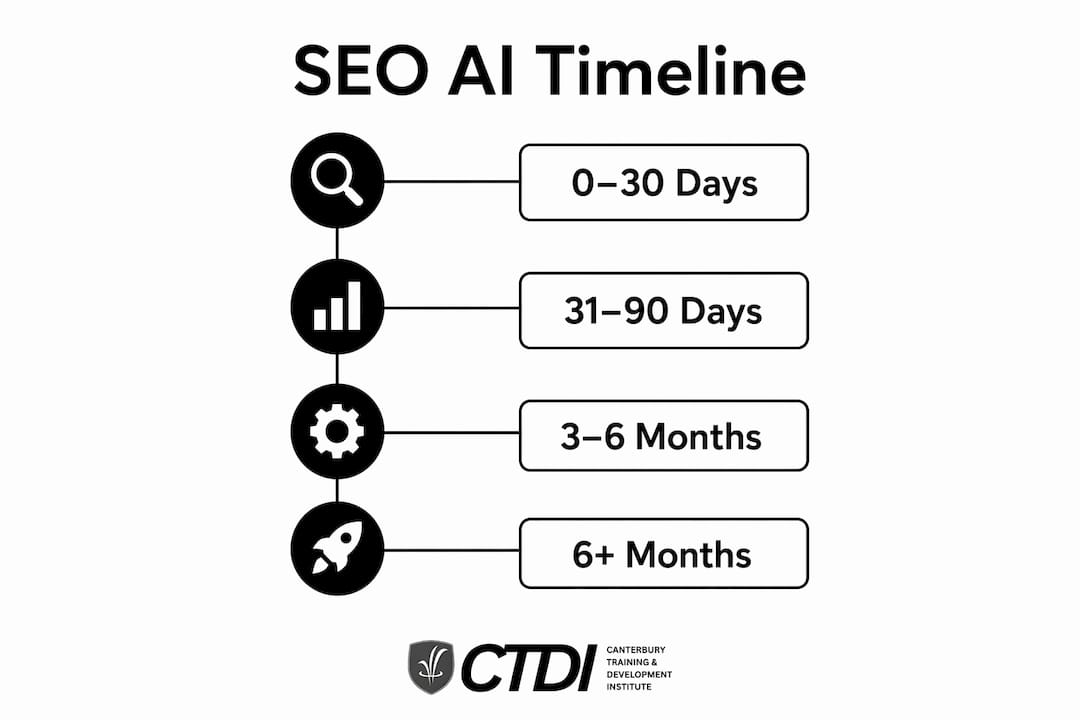
Table of Contents
- What are the top SEO trends to plan for in 2026?
- How do ChatGPT, Bing Copilot, Perplexity, and Google AI Overviews change what you optimise for?
- How do you measure the impact of AI Overviews and zero-click search?
- How should you restructure content so generative engines recommend you?
- Why does user-generated content matter more for AI credibility?
- How do AI tools reshape SEO workflows and the skills your team needs?
- What technical work is now baseline for 2026?
- What do these SEO trends mean for Australian businesses and local search?
- What should your team do in the next six months?
- Which KPIs should you track in the AI-search era?
- What does the mid-2026 data say, and how does CTDI apply it?
- Key takeaways
- The gap between "AI-ready" and actually ready
- Edu's digital marketing courses are built for exactly this shift
- Curated sources and further reading
What are the top SEO trends to plan for in 2026?
SEO is splitting into three measurable disciplines: traditional rankings, Answer Engine Optimisation (AEO — earning citations in AI answers), and Generative Engine Optimisation (GEO — earning recommendations from generative engines). The "death of SEO" narrative misses this entirely. The craft is not dying; it is branching.
Here are the eight trends shaping strategy right now:
-
AI search and AEO/GEO. AI search tools are expected to handle roughly 25% of global queries by mid-2026, shifting user behaviour away from multi-link SERPs toward personalised direct answers. Optimising for citations and recommendations is now as urgent as optimising for rankings. Short-term impact: high. Focus: micro-answer blocks, schema, entity signals.
-
AI Overviews and zero-click search. Google AI Overviews, ChatGPT Search, and Perplexity surface answers before users reach organic results. Organic CTR falls significantly on pages featuring AI Overviews. Short-term impact: immediate. Focus: featured-snippet content, FAQ schema, conversion triggers on answer-aware landing pages.
-
Entity SEO and brand mentions. Brand mention consistency across high-authority sources often outperforms pure link-count strategies for earning AI citations. Unlinked mentions, Reddit threads, and YouTube citations all contribute. Short-term impact: medium. Focus: digital PR, Wikipedia/Wikidata presence, sameAs schema.
-
Granular structured data. Structured data is now a baseline requirement; granular schema types (Person, Organisation, Course, FAQ, BreadcrumbList) are critical for AI engines to parse and surface content. Short-term impact: high for education and service sites. Focus: schema audit, automated validation.
-
AI tools reshaping SEO workflows. Prompt testing, repeated-query monitoring, and AI-assisted content ideation are becoming standard. The skill gap between teams that have integrated these tools and those that have not is widening fast. Short-term impact: operational. Focus: tooling standardisation, training.
-
UGC and community trust signals. AI engines draw on reviews, forum discussions, and social mentions to corroborate brand claims. Governing and surfacing quality UGC is now an SEO task. Short-term impact: medium. Focus: review schema, moderated community content, verified contributor highlights.
-
Local and Australian SEO implications. AI Overviews change local discovery by surfacing AI-generated summaries before map packs. Local entity signals — consistent NAP data, local citations, Australian accreditation signals — are critical. Short-term impact: high for local businesses. Focus: local schema, Google Business Profile, state/territory identifiers.
-
New KPIs for the AI-search era. Citation share, AI mention sentiment, repeat-query citation rate, and zero-click conversion triggers replace or augment rank tracking. Short-term impact: immediate for measurement teams. Focus: dashboard redesign, sampling methodology.
How do ChatGPT, Bing Copilot, Perplexity, and Google AI Overviews change what you optimise for?
Google AI Overviews, ChatGPT, and Perplexity now compete as distinct research channels, each sourcing and ranking content differently. A single-engine monitoring strategy is already obsolete.
AEO vs GEO: the practical difference
AEO (Answer Engine Optimisation) targets engines that cite sources in their answers — ChatGPT Search, Perplexity, and Google AI Overviews. The goal is to be quoted. GEO (Generative Engine Optimisation) targets engines that recommend products, services, or providers — Microsoft Bing Copilot's shopping and service recommendations, ChatGPT's agentic browsing, and Google's AI Mode. The goal is to be recommended.
Both layer on top of traditional SEO rather than replacing it. A page that ranks well but lacks structured micro-answers will earn clicks but miss citations. A page optimised for citations but with weak entity signals will be quoted without attribution.
What each engine type prefers:
- Google AI Overviews: concise, factual answers with clear authorship, FAQ schema, and strong E-E-A-T signals; prefers content already ranking in the top 10
- ChatGPT Search and ChatGPT browsing: entity-consistent content with sameAs references, reputable third-party mentions, and structured headings that chunk naturally into multi-turn conversation responses
- Microsoft Bing Copilot: Bing-indexed pages with Organisation and Product schema, clear pricing and service details, and local entity signals for service-area recommendations
- Perplexity: heavily weighted toward cited sources; prefers pages with clear author credentials, publication dates, and outbound links to primary sources
Actionable levers:
- Add an author block to every content page: name, credentials, LinkedIn URL, and a sameAs schema link
- Write a micro-answer block at the top of each section: one direct question as an H2 or H3, followed by a 1–3 sentence answer a reader (or AI) can lift verbatim
- Prioritise FAQPage, Person, and Organisation schema for immediate AI comprehension gains
- Chunk long-form content into labelled sections of 150–300 words so multi-turn AI conversations can pull discrete answers without context bleed
Example micro-answer structure:
What is Answer Engine Optimisation? Answer Engine Optimisation (AEO) is the practice of structuring content so AI-powered answer engines can cite or summarise it directly. It focuses on concise, factual responses, structured data, and verified author credentials rather than keyword density alone.
Pro Tip: Run the same query across ChatGPT, Perplexity, Bing Copilot, and Google AI Overviews and note which sources each engine cites. The overlap tells you which domains carry cross-engine authority — those are your PR and link-building targets.
How do you measure the impact of AI Overviews and zero-click search?
The numbers are stark. Some AI-mode conversations result in zero-click behaviour for up to 93% of queries in sampled tests. For informational content, that is not a future risk — it is the current state.
The measurement problem is that most teams are still tracking single-session rankings. A page can hold position one while its click-through rate collapses because an AI Overview answers the query above it. Traditional rank tracking misses this entirely.
Measurement checklist:
- Citation frequency: run the same query 5–10 times across each AI engine and record how often your domain is cited; average across runs to smooth randomness
- Zero-click share: compare Google Search Console impressions to clicks for informational queries; a widening gap signals AI Overview cannibalisation
- Downstream conversions: segment traffic by landing page type (answer pages vs product pages) and track whether AI-driven impressions correlate with assisted conversions in GA4
- Mention sentiment: use brand monitoring tools to track whether AI-generated answers describe your brand positively, neutrally, or not at all
- Repeat-query average: never rely on a single AI query result; build a sampling cadence (weekly or fortnightly) and track citation rate as a rolling average
Short A/B test ideas:
- Add a micro-answer block to one version of a high-traffic page and compare citation frequency over four weeks
- Test FAQ schema on five pages versus five without; measure zero-click share and assisted conversion rate
Pro Tip: Build "answer-aware" landing pages: pages that acknowledge the user already has a basic answer from an AI Overview and immediately offer the next step (a calculator, a checklist, a booking form). These convert zero-click visitors who arrive already informed.
How should you restructure content so generative engines recommend you?
GEO differs from AEO in one critical way: the engine is not just citing you, it is recommending you as a solution. That requires your content to answer not just "what is X" but "who should use X, when, and why."

Content architecture for GEO:
The most effective structure pairs a canonical short answer (1–3 sentences, liftable by any engine) with a longer context block (150–300 words) that provides the supporting evidence, use cases, and qualifications. Think of it as a two-layer page: the AI reads the short answer; the human reads the full context.
- Question heading (H2 or H3): phrase it as the user would ask it in a chat interface, not as a keyword
- Canonical short answer: 1–3 sentences, no jargon, no hedging, directly answers the heading question
- Supporting context block: evidence, examples, caveats, and links to primary sources
- Entity signals: named author, publication date, last-reviewed date, and schema markup
Micro-answer template:
- Heading: "Who should study digital marketing in 2026?"
- Short answer: "Anyone moving into content, brand, or growth roles benefits from formal digital marketing training in 2026. AI tools have raised the baseline — understanding how to direct and audit AI-generated campaigns is now a core professional skill."
- Supporting lines: "Employers increasingly list AI literacy alongside platform skills in job descriptions. A nationally accredited qualification signals both the technical and strategic depth hiring managers look for."
Editorial checklist for content teams:
-
Every page has at least one question-format H2 with a 1–3 sentence answer directly below it
-
No section exceeds 300 words without a sub-heading that resets the topic
-
Author name, credentials, and last-reviewed date appear on every page
-
FAQPage schema covers the top three questions on each page
-
Internal links use descriptive anchor text that names the destination topic, not "click here"
Content architecture in prose (for CMS mapping):
Picture a page as three nested layers. The outermost layer is the page title and meta description — the entry point for both search engines and AI crawlers. The middle layer is the structured body: question headings, micro-answer blocks, and supporting context sections, each tagged with the appropriate schema type. The innermost layer is the entity layer: author block, organisation details, publication metadata, and sameAs links. Map each layer to a CMS field so editors cannot publish without completing all three.
Why does user-generated content matter more for AI credibility?
AI engines do not trust a single source. They corroborate. When ChatGPT or Perplexity evaluates whether to recommend a brand, it draws on reviews, forum discussions, social mentions, and third-party articles alongside the brand's own content. Entity signals, unlinked mentions, Reddit and YouTube citations all contribute meaningfully to AI citations.
This changes how you think about UGC. It is no longer just a trust signal for human readers — it is evidence the AI uses to decide whether your brand is credible enough to recommend.
Practical moderation and verification guidelines:
- Mark verified contributors with a schema
authorproperty and a visible credential badge - Add
datePublishedanddateModifiedto all UGC-adjacent content so AI engines can assess recency - Moderate for factual accuracy, not just tone: an inaccurate positive review can undermine AI trust if it contradicts other sources
- Keep UGC crawlable: avoid loading reviews via JavaScript that blocks AI crawlers; render them server-side or via static HTML
Checklist for integrating UGC into answerable content:
- Summarise top review themes in a structured "What customers say" block with AggregateRating schema
- Highlight verified contributors in forum or community sections with explicit author markup
- Tag provenance: where did this review or comment originate? A schema
sourceOrganizationproperty helps AI engines assess credibility - Surface community Q&A as FAQ schema where the questions match real user queries
Unlinked mentions vs backlinks for AI visibility:
Backlinks remain valuable, but AI visibility correlates more strongly with brand mentions and entity signals than raw link counts. An unlinked mention on a high-authority domain — a journalist naming your brand in a feature, a Reddit thread recommending your course — carries real weight for AI citation probability. The practical implication: digital PR campaigns that earn coverage without a link are no longer wasted effort.
How do AI tools reshape SEO workflows and the skills your team needs?
Modern SEO requires cross-functional teams to prepare backend systems and content architectures for agentic AI retrieval. That is not a future state — teams that have not started this transition are already behind.
Tool categories to standardise in 2026:
- AI prompt testing platforms: tools that let you run repeated queries across ChatGPT, Perplexity, and Bing Copilot and log citation results (e.g. Semrush's AI Toolkit, Ahrefs' AI features, or custom prompt-logging scripts)
- Repeated-query AI visibility monitors: platforms that track how often your brand is cited across engines on a rolling basis, not just a single snapshot
- Schema validators: Google's Rich Results Test, Schema.org's validator, and Sitebulb's schema audit for automated coverage checks
- Entity-tracking systems: tools that monitor brand mention consistency across authoritative sources, including unlinked mentions
Workflow checklist:
- Prompt architecture: write content briefs that include the exact question the AI should be able to answer, not just the keyword
- Content chunking: break long articles into discrete, labelled sections before publishing; do not rely on AI to infer structure from prose
- Iterative experiments: treat each schema addition or micro-answer block as a testable hypothesis; log before/after citation rates
- Sign-off gates: every published piece requires a factual accuracy review and an E-E-A-T check before going live
Hiring and skills for 2026:
- Data science collaboration: SEOs need to work with analysts who can build citation-tracking pipelines and sampling models
- Schema engineers: developers who specialise in structured data implementation and API-based content delivery
- Content designers: writers who understand information architecture and can author for both human readers and AI retrieval
- AI prompt specialists: practitioners who understand how to phrase content so it performs well in multi-turn AI conversations
Vendor selection criteria worth applying: does the tool support multi-engine monitoring? Can it run repeated-query sampling rather than single snapshots? Does it integrate with your existing BI stack? Change management tip: frame every new tool adoption as "AI readiness" when presenting to leadership — it unlocks budget that "SEO tooling" rarely does.
Platforms like AnyLearns are already building adaptive learning experiences that surface course content inside AI discovery tools, which gives education providers a practical model for how structured content feeds generative recommendations.

What technical work is now baseline for 2026?
The technical bar has shifted. Schema and E-E-A-T are no longer differentiators — they are table stakes. If your site lacks them, AI engines will not cite you regardless of content quality.
Schema priorities for education and service sites:
OrganisationwithsameAslinks to ABN lookup, LinkedIn, Wikipedia (if applicable), and Google Business ProfilePersonfor every named author: name, job title, credentials, andsameAsto LinkedInCoursefor every course page: name, description, provider, duration, andeducationalCredentialAwardedFAQPageon every content page with at least three question-answer pairsBreadcrumbListon all pages to signal content hierarchyWebPagewithdatePublishedanddateModifiedon every page
E-E-A-T checklist:
- Named author with credentials on every article and course page
- Institutional accreditation displayed prominently (e.g. ASQA registration for Australian RTOs)
- Publication date and last-reviewed date visible in the page body, not just metadata
- Verified third-party mentions: link out to authoritative sources that reference your organisation
- Clear "About" and "Contact" pages with structured data matching the Organisation schema
Implementation tips:
- Map every schema type to a CMS field so schema updates automatically when content changes
- Use API endpoints to deliver structured content to AI crawlers separately from rendered HTML where possible
- Run automated schema validation on every deploy using a CI/CD hook to Google's Rich Results Test API
- Version your schema: log changes with dates so you can correlate schema updates with citation rate changes
Measurement hooks:
- Add citation-tracking UTM parameters to answer-aware landing pages so you can attribute AI-referred traffic
- Implement server-side event points for answer interactions (e.g. a user clicking "learn more" after an FAQ answer)
- Tag schema versions in a data layer so analytics can segment performance by schema state
What do these SEO trends mean for Australian businesses and local search?
AI Overviews are changing local discovery in a specific way: instead of a map pack plus organic results, users increasingly see an AI-generated summary that names two or three providers. If your entity signals are weak, you will not be named — even if you rank on page one.
For Australian businesses, the local entity layer matters more than ever. AI engines cross-check NAP data (name, address, phone) across directories including Yellow Pages, True Local, and industry-specific listings. Inconsistency across these sources reduces citation probability.
Checklist for Australian businesses:
- Verify and complete your Google Business Profile with accurate categories, service areas, and Australian business hours
- Add state and territory identifiers to your schema:
addressRegion(e.g. "NSW", "VIC") andaddressCountry"AU" - Include localised FAQ blocks that reference your city or region explicitly ("digital marketing courses in Sydney" rather than just "digital marketing courses")
- Gather and respond to Google reviews; AggregateRating schema should reflect your current rating
- List your business on Australian-specific directories (True Local, Hotfrog, StartLocal) and keep NAP data identical across all of them
- For regulated industries: display your Australian accreditation prominently (ASQA registration number for RTOs, for example)
Example use case for an Australian online education provider:
An RTO like CTDI can surface its courses in AI-driven discovery by structuring each course page with Course schema (including educationalCredentialAwarded and provider with the RTO's ASQA registration), adding a localised FAQ block ("Is this course nationally recognised in Australia?"), and building entity signals through mentions in Australian education directories, media coverage, and LinkedIn thought leadership. The CTDI blog's AI resources demonstrate this approach in practice.
Regulatory and market notes:
- Australian data localisation considerations mean hosting and data storage choices can affect trust signals for local AI engines; prefer Australian-hosted infrastructure where practical
- ASQA accreditation is a verifiable credential that AI engines can cross-reference; make your RTO registration number machine-readable in schema
- The Australian Competition and Consumer Commission (ACCC) guidelines on digital platforms are evolving; monitor for any changes affecting how AI search tools operate in Australia
What should your team do in the next six months?
The roadmap below is timeboxed and role-assignable. Resist the temptation to do everything at once — the 0–30 day phase matters most because it establishes your citation baseline before you start testing.
0–30 days: quick wins
- Audit your top 10 pages for FAQ schema coverage; add FAQPage schema to any page missing it
- Add author blocks (Person schema + visible byline with credentials) to every article and course page
- Write one micro-answer block per top product or course page: question heading + 1–3 sentence answer
- Run a repeated-query baseline test across ChatGPT, Perplexity, Bing Copilot, and Google AI Overviews; log results in a shared spreadsheet
- Verify Organisation schema with sameAs links to your ABN, LinkedIn, and Google Business Profile
31–90 days: workflows and tooling
- Set up a repeated-query monitoring cadence: run the same 10–20 queries weekly and track citation rate as a rolling average
- Build entity maps: list every authoritative source that mentions your brand and identify gaps (missing Wikipedia entry, inconsistent ABN listing, no Wikidata entry)
- Create editorial templates for content teams: question heading, micro-answer block, supporting context, author block, schema checklist
- Identify one PR campaign target: a high-authority Australian publication or industry directory where a mention would strengthen entity signals
3–6 months: scale and measurement
- Build an AI visibility dashboard (see KPIs section below) and present it to leadership alongside traditional rank tracking
- Run a targeted PR campaign to earn entity mentions on three or more high-authority Australian domains
- Hire or contract a schema engineer and an AI prompt specialist if budget allows; alternatively, upskill existing team members through accredited training
- Review and update all Course schema to include
educationalCredentialAwarded,duration, andproviderfields
Resourcing checklist:
| Role | Minimal viable team | Optional external help |
|---|---|---|
| SEO lead | In-house | AI visibility consultant |
| Schema engineer | Contracted | Agency with structured data specialisation |
| Content designer | In-house | Freelance content architect |
| Data analyst | Shared with marketing | BI specialist for citation dashboards |
| PR/entity specialist | In-house or agency | Digital PR firm with Australian media contacts |
Prioritisation matrix: if you have limited capacity, rank tasks by two criteria: citation impact (how much will this improve AI citation probability?) and implementation speed (how quickly can it be done?). FAQ schema and author blocks score high on both. Entity PR campaigns score high on impact but low on speed — start them early so they compound over the six-month window.
Which KPIs should you track in the AI-search era?
Rank position is still worth tracking, but it tells you less than it used to. A page can hold position one while its effective visibility collapses inside AI Overviews. The metrics below capture what rank tracking misses.
Recommended KPIs:
- Citation share: percentage of repeated queries (across a defined query set) where your brand is cited by each AI engine
- AI mention sentiment: positive, neutral, or negative framing in AI-generated answers that reference your brand
- Repeat-query citation rate: average citation frequency across 5–10 runs of the same query; smooths out the randomness of single-session results
- Zero-click conversion triggers: micro-conversions (newsletter sign-ups, calculator uses, FAQ interactions) that indicate a user arrived already informed from an AI answer
- Assisted conversions from AI-driven impressions: GA4 attribution paths that include an AI-referred session before a conversion event
Implementation notes:
- Set a sampling frequency: weekly for high-priority queries, fortnightly for secondary ones
- Run repeated-query averages: never report a single AI query result as representative; always average across at least five runs
- Integrate AI visibility metrics with existing BI tools by exporting citation logs to BigQuery or your preferred data warehouse
- Track AI visibility as a baseline alongside rankings — the two metrics tell different stories and both matter
Minimal day-one dashboard layout:
| Metric | Source | Frequency |
|---|---|---|
| Citation share by engine | Manual query log or AI monitoring tool | Weekly |
| Zero-click share (impressions vs clicks) | Google Search Console | Weekly |
| AI mention sentiment | Brand monitoring tool | Fortnightly |
| Repeat-query citation rate | Averaged query log | Fortnightly |
| Assisted conversions (AI-referred) | GA4 attribution report | Monthly |
| Schema coverage score | Sitebulb or Rich Results Test | Monthly |
What does the mid-2026 data say, and how does CTDI apply it?
The data picture is clear. AI search tools are expected to handle roughly 25% of global queries by mid-2026, and some AI-mode conversations result in zero-click behaviour for up to 93% of queries in sampled tests. For Australian education providers, that second figure is the one that demands attention: informational queries ("what is digital marketing?", "how long does an online diploma take?") are precisely the queries most likely to be answered by an AI Overview without a click.
CTDI course page: AEO/GEO structure example
A CTDI course page structured for AI discovery would include:
Courseschema withname,description,provider(Organisation with ASQA registration),educationalCredentialAwarded, andduration- A micro-answer block at the top: "Who is this course for? This course suits working professionals and career changers seeking a nationally accredited qualification in digital marketing, delivered fully online at their own pace."
- An FAQ section with three to five questions matching real user queries ("Is this course recognised by Australian employers?", "Can I study while working full-time?")
- Named course designer with credentials and a
Personschema block sameAslinks connecting the provider to its ABN record and LinkedIn page
Author credentials: Sam is a digital marketing educator and editorial contributor at Edu (CTDI), with expertise in AI-driven search strategy and vocational education content. Edu's Advanced Diploma of Digital Marketing is a nationally accredited qualification covering AI-powered marketing, SEO strategy, and content architecture — directly aligned with the skills this article covers.
Key takeaways
AI visibility engineering is the defining SEO shift of 2026: teams that structure content for citations, prove E-E-A-T explicitly, and track repeat-query citation rates will outperform those still optimising for rank position alone.
| Point | Details |
|---|---|
| AI handles a significant share of queries | By mid-2026, AI search tools are expected to handle roughly 25% of global search queries, making citation optimisation urgent. |
| Zero-click risk is real | Up to 93% of AI-mode queries in sampled tests result in zero-click behaviour; informational pages need conversion triggers, not just rankings. |
| Schema is now baseline | Granular schema (Course, Person, Organisation, FAQ) is a minimum requirement for AI engines to parse and surface your content. |
| Entity signals beat link counts | Brand mention consistency and unlinked citations on authoritative sources correlate more strongly with AI visibility than raw backlink counts. |
| Edu's digital marketing diploma | CTDI's Advanced Diploma of Digital Marketing covers AEO, GEO, schema strategy, and AI-powered marketing — the exact skills this roadmap requires. |
The gap between "AI-ready" and actually ready
Most teams I speak with have added FAQ schema and called it done. That is the equivalent of putting a sign on your shopfront and assuming customers will find you. The structural work — entity mapping, micro-answer architecture, repeated-query monitoring — is where the real gap sits, and it is a skills gap as much as a technical one.
What concerns me about how 2026 SEO trends are being discussed is the focus on tactics over systems. Adding schema to five pages is a tactic. Building a CMS template that enforces micro-answer blocks, author markup, and schema on every new piece of content is a system. The teams pulling ahead are the ones treating AI visibility as an operational discipline, not a checklist item.
For Australian businesses specifically, the accreditation angle is underused. An ASQA-registered RTO has a verifiable, machine-readable credential that most competitors lack. That is an entity signal sitting unused on most course pages. The same logic applies to any Australian business with a verifiable licence, registration, or industry membership — these are trust signals AI engines can cross-reference, and most sites are not surfacing them in schema.
The skill development angle matters here too. The essential AI skills that practitioners need in 2026 are not purely technical — they include content design, prompt architecture, and the ability to brief developers on structured data requirements. Teams that invest in formal training now will close that gap faster than those relying on self-directed learning alone.
Edu's digital marketing courses are built for exactly this shift
The skills this article covers — AEO strategy, schema implementation, AI visibility measurement, and content architecture — are the curriculum of Edu's Advanced Diploma of Digital Marketing. It is a nationally accredited qualification, delivered fully online and self-paced, designed by practitioners who work in the field.

For teams looking to upskill collectively, Edu's corporate training partnerships offer structured group enrolment with flexible scheduling — practical for marketing and SEO teams that cannot take people offline for extended periods. The course covers AI-powered marketing strategy, structured data fundamentals, and the measurement frameworks outlined in this article.
If you are ready to formalise your AI visibility skills with a qualification that Australian employers recognise, enrol now and start at your own pace.
Curated sources and further reading
The sources below back the claims in this article and are worth bookmarking for ongoing reference:
- Moz: 2026 SEO Trends — Predictions from 20 Industry Experts: the most comprehensive practitioner survey on 2026 SEO priorities; supports the AI search share figure and entity signal recommendations throughout this article.
- Sitebulb: SEO in 2026 — 17 Expert Tips & Predictions: practitioner interviews from brightonSEO and Women in Tech SEO; particularly useful for the E-E-A-T and multichannel visibility sections.
- Search Engine Land: How AI search is reshaping link building strategy: covers the shift from backlink counts to entity signals and unlinked mentions; supports the UGC and PR sections.
- Ahrefs: SEO trends: data on organic CTR impact from AI Overviews; useful for the zero-click measurement section.
- Gist: Is SEO dead? The future of SEO: clear explanation of the three-discipline model (rankings, citations, recommendations); supports the trends overview and KPIs section.
- iPullRank: Relevance engineering: the technical case for treating SEO as relevance engineering; supports the schema and workflow sections.
- Pew Research Center: Google users are less likely to click on links when an AI summary appears: primary research on zero-click behaviour; supports the measurement and KPI sections.
- CTDI Advanced Diploma of Digital Marketing: Edu's nationally accredited course covering the skills this article recommends; relevant for the training and promo sections.