

A unit of competency is the national standard describing the skills, knowledge and evidence a person needs to perform a specific workplace task. It's the basic building block of every nationally recognised qualification and skill set, and every one is published on Training. If you're enrolling in a course, assessing a learner, or checking a qualification's validity, understanding this one document type explains most of how Australian vocational training actually works.
TL;DR:
- Units of competency are standardized benchmarks that ensure consistent assessment and recognition across all Australian vocational training providers.
- The key parts of a unit include the code and title, elements and performance criteria, foundation skills, and assessment requirements, which guide how competence is measured.
- Performance evidence requires learners to demonstrate observable tasks multiple times, while knowledge evidence covers underlying facts and concepts, both within real or simulated settings.
- Units are grouped into qualifications and skill sets within training packages, with updated or superseded units tracked through modification history and mapping reports.
- Verifying a unit involves checking its current status, usage, and assessment details on Training.gov.au, emphasizing the importance of unit currency and compliance in qualification validation.
Table of Contents
- What is a unit of competency and why does it matter?
- The parts of a unit of competency you need to understand
- What do performance evidence and knowledge evidence actually require?
- How units fit into qualifications, skill sets and training packages
- How to verify a unit of competency on Training.gov.au
- What three real unit pages actually show
- Why this matters for how CTDI builds its online courses
- What actually happens when a unit gets rewritten
- Sources
What is a unit of competency and why does it matter?
Australian VET doesn't measure learning in classroom hours. It measures learning against a fixed standard, and a unit of competency is that standard written down. A learner is either competent against the criteria in the unit, or they're not yet. There's no partial credit for turning up.
This outcome-focused approach is deliberate. It means someone with years of on-the-job experience can be assessed against a unit and awarded a Statement of Attainment without sitting through content they've already mastered, and it's why self-paced online delivery can work for accredited training in the first place.
Three things flow from that structure:
- Portability — a unit completed with one provider counts the same everywhere, because the standard doesn't change with the training organisation.
- Regulatory oversight — the Australian Skills Quality Authority (ASQA) monitors how training packages and their units are delivered and assessed.
- A public record — every current and superseded unit sits on the national register, so anyone can check exactly what a qualification actually covers.
That last point matters more than most people realise. A unit code on a resume or a training plan is a specific, checkable claim, not a vague description of a course.
The parts of a unit of competency you need to understand
Open any unit page on Training.gov.au and you'll find the same skeleton every time, because the Standards for Training Packages mandate it. Once you know the pattern, you can read any unit in the system, from horticulture to cybersecurity.
- Code and title — a unique identifier (e.g. BSBOPS304) followed by a plain-English name for the task.
- Application — a short paragraph explaining who uses this unit and in what context, including any licensing or regulatory notes.
- Elements and performance criteria — the elements list the major steps of the task; the performance criteria under each element spell out exactly how competent performance looks.
- Foundation skills — the underlying literacy, numeracy and employability skills (reading rosters, calculating stock, communicating with a supervisor) needed to meet the criteria.
- Range of conditions (where included) — the boundaries or contexts the unit applies to, such as equipment types or work environments.
- Assessment requirements — a separate but linked document setting out performance evidence, knowledge evidence and assessment conditions.
Optional fields like prerequisite units or a competency field code appear on some units and not others, depending on the training package.
Pro Tip: Skip straight to the elements, performance criteria and assessment requirements first. That's where the assessable detail lives. The application paragraph is useful context, but it won't tell you what a learner actually has to demonstrate.
What do performance evidence and knowledge evidence actually require?
Assessment requirements are where a unit stops being theory and becomes a checklist an assessor can actually work from. The Standards for Training Packages break this into three distinct pieces, and mixing them up is one of the most common mistakes new trainers make.
- Performance evidence — the observable tasks a learner must demonstrate, and usually how many times. For BSBOPS304, that means actually delivering and monitoring a customer service task on more than one occasion, not just describing how you'd do it.
- Knowledge evidence — the underpinning facts and concepts a learner needs to explain, such as complaint handling procedures, relevant workplace policies, or legislative obligations.
- Assessment conditions — the setting the assessment has to happen in: a real or simulated workplace, specific equipment or software, and an assessor with current relevant industry experience.
Assessment conditions are easy to skim past, but they're often the deciding factor in whether an assessment is even valid. A unit that requires assessment "in the workplace or a simulated workplace environment" gives an RTO built around competency-based assessment some flexibility, but it doesn't remove the requirement to replicate real conditions convincingly.
How units fit into qualifications, skill sets and training packages
A single unit rarely stands alone. Training packages group units into full qualifications and shorter skill sets, and the same unit often appears across several qualifications at once, sometimes as core and sometimes as an elective.
- Training package → qualification → units is the structural chain: the package sets the overall industry scope, the qualification defines a job outcome, and units are the components that build toward it.
- Unit mapping reports on Training.gov.au show exactly which qualifications currently use a given unit, and which older unit it replaced if any.
- Modification history on each unit page flags when a unit was updated, whether it's "current" or "superseded", and links to whatever unit took its place.
When a unit is superseded partway through a course, RTOs generally have a transition window to move learners onto the new version, and mapping reports spell out whether that transfer is direct or requires a gap assessment. Learners checking their own qualification should look at the mapping report before assuming an older unit code is worthless. Often it isn't, it's just been renamed or folded into a broader unit.
How to verify a unit of competency on Training.gov.au
Checking a unit yourself takes about two minutes once you know where to look.
- Search Training.gov.au by unit code (most reliable) or title.
- Check the current status field. "Current" means it's active; "superseded" means a newer version has replaced it.
- Open the usage recommendation and modification history tabs to see the release date and any linked replacement unit.
- Cross-reference significant regulatory questions against ASQA or DEWR guidance rather than relying on a training provider's marketing page.
- Record the code, release number, and assessment requirements document for anything you need as evidence, such as a job application or recognition of prior learning claim.
The NCVER RTO hub is a useful secondary stop if you're after reporting standards or AVETMISS data rather than the unit text itself.
What three real unit pages actually show
Reading a live unit page tells you more in five minutes than any general description. Take three common examples.
- BSBOPS304 – Deliver and monitor a service to customers lists elements around identifying customer needs, delivering service and handling complaints, with performance evidence requiring the learner to actually deliver a service on multiple occasions, not just describe the process.
- HLTAID009/HLTAID011 (first aid units) set unusually strict assessment conditions: assessment must happen in a setting that replicates a real workplace incident, using current resuscitation equipment, with a fixed skills-recency requirement built into the knowledge evidence.
- A hospitality or community services unit typically pairs foundation skills (reading rosters, basic numeracy for stock or budgets) with a range of conditions section defining the specific settings, cafés, aged care facilities, community programs, the unit is meant to cover.
Once you've compared two or three units side by side, the pattern becomes obvious: the structure is identical, but the evidence expectations shift entirely with the industry.
Why this matters for how CTDI builds its online courses
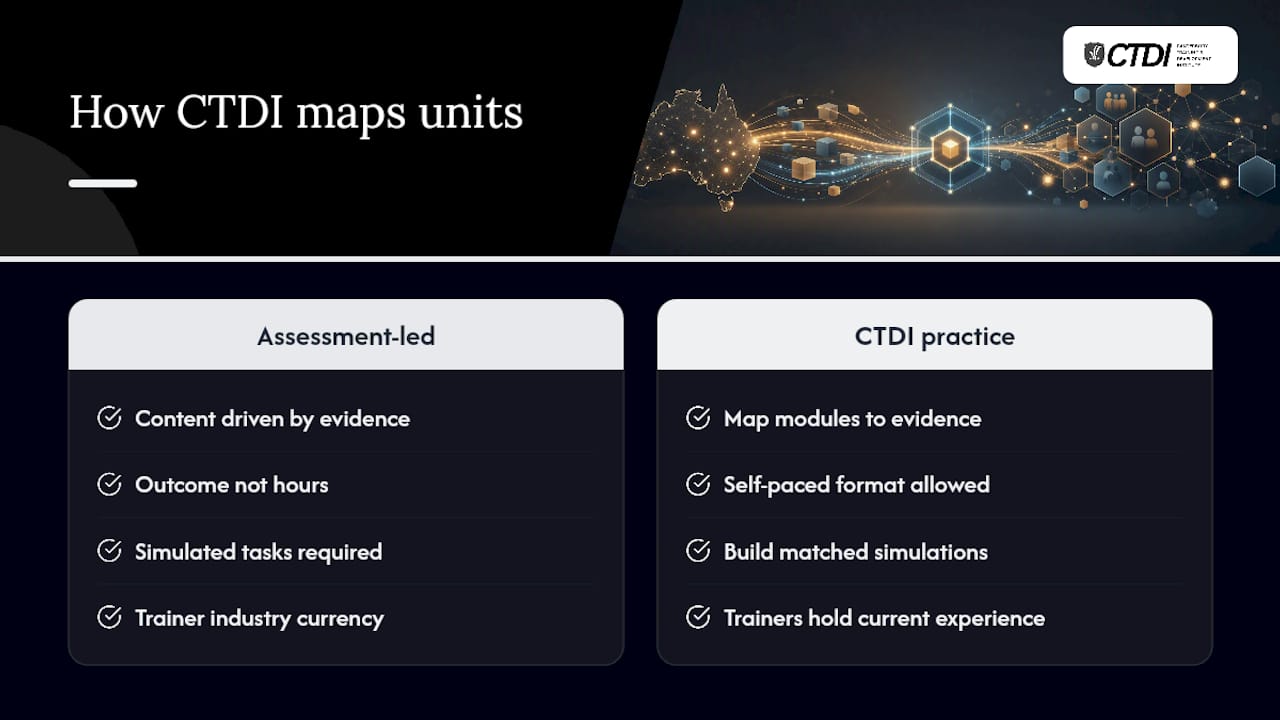
CTDI designs its accredited AI, digital marketing and sustainability courses by mapping every module directly to the assessment requirements of the units they deliver, not the other way around. That means performance evidence and knowledge evidence dictate what a learner actually has to produce, well before any content gets written.
Because units are outcome-focused rather than time-based, a self-paced online format can genuinely satisfy assessment conditions, provided the simulated tasks, trainer industry currency and learner support are built to match. CTDI's trainers hold current vocational experience in the fields they assess, which is one of the assessment conditions most units explicitly require. If you want to see how a specific course maps to its units before enrolling, browse CTDI's current course offerings or get in touch with the student support team for the mapping detail behind any qualification.
What actually happens when a unit gets rewritten
Most explainers stop at "units get updated periodically." What they skip is how disruptive that process is for the people relying on the old version. A unit doesn't just get a facelift, it gets rebuilt by an industry reference committee, tested against current workplace practice, and pushed through a validation process before DEWR endorses the new release. That can take the performance evidence in a completely different direction, not just add a new dot point.
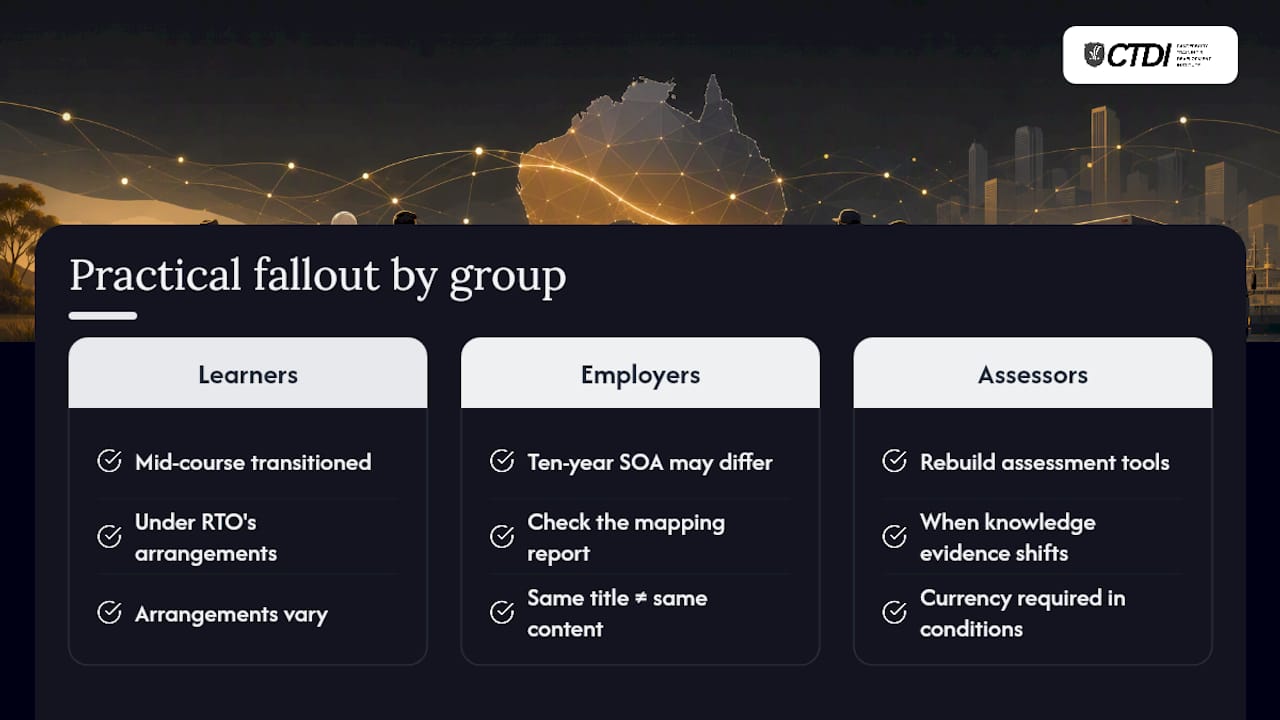
The practical fallout lands on three groups differently. Learners mid-course get transitioned under an RTO's own arrangements, which vary. Employers checking a staff member's ten-year-old Statement of Attainment need to actually check the mapping report, because "same title" doesn't guarantee "same content" anymore. Assessors face the real burden: rebuilding assessment tools every time a knowledge evidence list shifts, which is why currency in the industry, not just familiarity with the paperwork, is baked into the assessment conditions themselves.
The system rewards people who treat the unit code as a live document, not a one-time reference they checked at enrolment.
— Sam