

TL;DR:
- Future skills encompass interdisciplinary capabilities that enable individuals to adapt in a rapidly changing work environment. They include personal, social, and societal competencies that remain relevant amidst technological advances like AI and automation. Developing these skills through holistic, ongoing training is essential for workforce readiness through 2030 and beyond.
Future skills are defined as the interdisciplinary knowledge, capabilities, and values individuals need to navigate complex 21st-century work and life. The University of Kiel's Key Skills Centre (ZfS), the OECD, and the World Economic Forum each publish frameworks that map these competencies across personal, collaborative, and societal domains. Unlike a fixed list of technical abilities, future skills are designed to remain relevant despite rapid technological change, including the rise of artificial intelligence, automation, and digital transformation. Understanding what future skills are, and how to develop them, is now a baseline requirement for individuals, educators, and business leaders planning for workforce readiness through 2030 and beyond.
What is future skills? core definitions explained
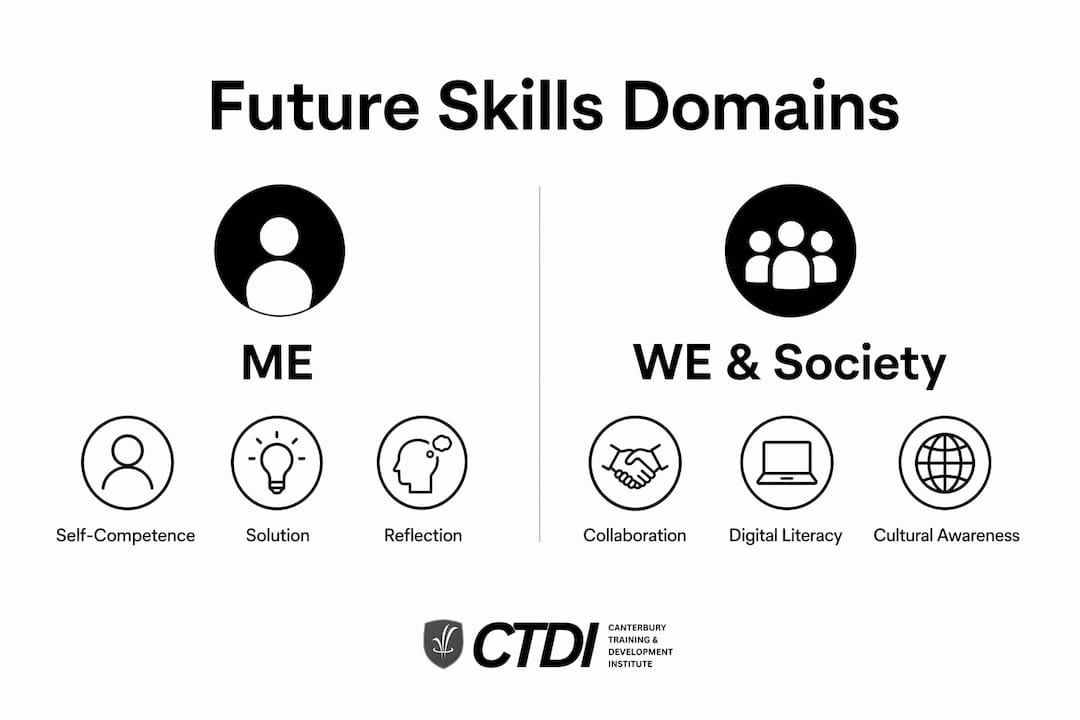
Future skills, sometimes called 21st-century competencies, are best understood as a cluster of capabilities that support learning and adaptation rather than static knowledge. The University of Kiel's ZfS offers one of the most structured future skills definitions, organising them across three dimensions: ME, WE, and SOCIETY. Each dimension contains three competence fields, giving nine fields in total.
The ME dimension covers self-competence, solution competence, and reflection competence. These are the personal capabilities that let an individual manage their own learning, solve problems independently, and critically assess their own thinking. The WE dimension addresses communication, cooperation, and agile competence, which are the skills needed to work effectively with others in changing environments. The SOCIETY dimension includes transformative, digital, and media competence, covering the ability to contribute to broader social and technological change.
The OECD takes a complementary approach. Its OECD Skills Outlook 2025 identifies nine critical 21st-century skills: literacy, numeracy, adaptive problem solving, extraversion, emotional stability, agreeableness, conscientiousness, open-mindedness, and the willingness to delay gratification. That last trait is less obvious than the others. It reflects the capacity to invest in long-term learning rather than seeking immediate rewards, which is exactly the mindset required for continuous professional development.
The World Economic Forum adds a workforce lens. Its Future of Jobs Report 2025 projects that AI and big data literacy, analytical thinking, creative thinking, resilience, and leadership will grow substantially in employer importance by 2030. These are not purely technical skills. They blend cognitive capability with social and emotional intelligence.

What are the core categories of future skills?
The three major frameworks share significant common ground, but each emphasises different priorities. The table below compares them directly.
| Framework | Core Categories | Distinctive Emphasis |
|---|---|---|
| University of Kiel (ZfS) | ME, WE, SOCIETY dimensions across 9 competence fields | Holistic personal, social, and societal development |
| OECD Skills Outlook 2025 | Literacy, numeracy, problem solving, Big Five personality traits | Information processing and social-emotional traits |
| WEF Future of Jobs 2025 | AI literacy, analytical thinking, creativity, resilience, leadership | Workforce demand and employer expectations to 2030 |
The overlap between these frameworks is telling. All three prioritise adaptability, social-emotional capability, and the ability to process complex information. None of them treat technical skills as sufficient on their own. This is the key insight: future skills are not a technology checklist. They are a combination of cognitive, interpersonal, and self-management capabilities that make technical knowledge usable in real-world conditions.
Pro Tip: When reviewing your own skill set or designing a training programme, map your competencies against all three frameworks. A gap in the SOCIETY dimension, such as weak digital or media competence, often explains why strong technical workers still struggle to communicate or lead change.
Future skills examples drawn from these frameworks include critical thinking, digital literacy, cross-cultural communication, emotional regulation, systems thinking, and the ability to learn new tools quickly. These are not abstract ideals. They are the competencies that separate workers who adapt from those who stall when conditions change.
Why are future skills important for careers and workforces?
The importance of future skills becomes concrete when you look at what employers are actually forecasting. The WEF projects that technological skills such as AI, cybersecurity, and data analysis, alongside socio-emotional skills such as curiosity and leadership, will grow substantially in employer demand by 2030. That is not a distant horizon. Organisations are already restructuring roles around these expectations.
The UK government's priority skills analysis to 2030 covers ten sectors and identifies persistent gaps, particularly in digital and AI domains. The analysis confirms that education pathways exist for many priority skills, but supply consistently falls short of demand. This gap is not theoretical. It translates directly into recruitment difficulty and retention risk for employers.
The consequences of lacking future skills differ by audience:
- Individuals face reduced employability, slower career progression, and greater vulnerability to role displacement by automation.
- Educators risk delivering curricula that prepare students for jobs that no longer exist, rather than building the adaptive capabilities that transfer across roles.
- Business leaders face workforce gaps that limit their ability to adopt new technologies, respond to market shifts, or retain high-performing staff.
The AI skills supply-demand gap has existed for years and is expected to widen sharply over the next five years. That gap signals a systemic failure to treat future skills development as an ongoing organisational priority rather than a one-off training event.
Lifelong learning is the structural response to this challenge. The OECD frames future skills as the foundation beneath specialised skills, the capabilities that make it possible to keep learning and adapting as specific technical requirements change. Without that foundation, specialised training depreciates quickly.
How can you develop future skills effectively?
Building future skills requires a deliberate approach, not just exposure to new tools or occasional workshops. The following steps reflect guidance from the OECD, WEF, and UK government research.
-
Audit your current competencies against a recognised framework. Use the ZfS ME/WE/SOCIETY model or the OECD's nine-skill framework as a diagnostic. Identify which dimensions are underdeveloped. Most people find their SOCIETY dimension competencies, particularly digital and media literacy, lag behind their ME and WE skills.
-
Prioritise skills with long relevance windows. The average AI skill lifespan is under three years. That means specific AI tool knowledge depreciates fast. Invest in the underlying analytical and adaptive problem-solving capabilities that make it easier to learn the next generation of tools.
-
Embed learning into daily work, not just formal training. The WEF's continuous skills development model recommends treating upskilling as an ongoing organisational behaviour rather than a periodic event. This means structured reflection, peer learning, and role-based application of new skills.
-
Use diverse assessment methods. Measuring future skills is genuinely difficult. Cognitive skills like literacy and numeracy respond well to standardised tests. Social-emotional traits like agreeableness or open-mindedness require diverse assessment tools including self-assessment, peer review, and behavioural observation. Build assessment into your training design from the start.
-
Align training programmes to all three ZfS dimensions. Curricula that omit cooperative, reflective, or transformative competences produce graduates who are technically capable but limited in adaptability and societal impact. A holistic curriculum design covers ME, WE, and SOCIETY competences together.
-
Refresh training regularly. Given that AI-related skill lifespans sit under three years, training design must include periodic updates and role-based application rather than one-off certification. Build a review cycle into any skills programme from the outset.
Pro Tip: For communication skill-building, tools like Grammarly and Hemingway Editor help individuals practise clear written expression, which directly supports the WE dimension's communication competence. Pair them with structured feedback from colleagues for maximum effect.
Online diplomas in AI, digital marketing, and sustainability offer structured pathways for workplace upskilling that address multiple future skills dimensions simultaneously. They are particularly effective when combined with on-the-job application of new knowledge.
What are the emerging trends in future skills through 2030?
The future skills outlook through 2030 is shaped by three forces: accelerating AI adoption, shifting employer expectations, and persistent supply gaps in critical competencies.
The WEF projects that AI and big data literacy will become one of the fastest-growing skill demands across industries. This is not limited to technology sectors. Healthcare, education, logistics, and finance are all restructuring roles around data interpretation and AI-assisted decision-making. The implication is that AI literacy is becoming a baseline expectation, not a specialist advantage.
"Employers expect technological and socio-emotional skills to grow substantially in importance by 2030, with AI and big data literacy, analytical thinking, and resilience identified as the highest-priority competencies." — WEF Future of Jobs Report 2025
The UK government's cross-sector analysis reinforces this. Across ten sectors, digital and AI skills consistently appear in the priority gap category. Education pathways exist, but they are not scaling fast enough to meet demand. The result is a structural mismatch that affects both individual career prospects and organisational capability.
The table below illustrates projected shifts in skill demand through 2030, based on WEF and UK government data.
| Skill Category | Current Demand Level | Projected 2030 Demand | Key Driver |
|---|---|---|---|
| AI and big data literacy | High | Very high | Automation and AI adoption |
| Analytical thinking | High | Very high | Data-driven decision-making |
| Creative thinking | Moderate | High | Automation of routine tasks |
| Resilience and adaptability | Moderate | High | Rapid organisational change |
| Cybersecurity skills | Moderate | High | Digital infrastructure growth |
| Social-emotional skills | Moderate | High | Human-AI collaboration |
One common misconception deserves direct correction: future skills are not a fixed list. The frameworks from ZfS, OECD, and WEF are reference points, not permanent catalogues. As technology and society evolve, the specific competencies that matter most will shift. The skill of learning how to learn, what the OECD calls adaptive problem solving, is the one capability that remains relevant regardless of what changes around it.
The essential AI skills conversation is also expanding beyond technical proficiency. Employers increasingly want workers who can apply AI tools ethically, communicate AI-generated insights clearly, and critically evaluate AI outputs. These are future skills in the fullest sense: interdisciplinary, adaptive, and grounded in both technical and human-centric competence.
Key takeaways
Future skills are the interdisciplinary competencies spanning personal, collaborative, and societal domains that determine whether individuals and organisations can adapt and grow as technology and work conditions change.
| Point | Details |
|---|---|
| Future skills span three domains | The ZfS ME/WE/SOCIETY framework covers personal, collaborative, and societal competencies together. |
| AI skill lifespans are short | AI-related skills depreciate in under three years, requiring regular training refresh cycles. |
| Employer demand is rising fast | WEF projects AI literacy, analytical thinking, and resilience will grow substantially by 2030. |
| Assessment requires diverse methods | Social-emotional skills cannot be measured by standardised tests alone; use peer review and observation. |
| Holistic training outperforms narrow technical focus | Programmes that omit cooperative or reflective competences limit adaptability and long-term impact. |
Why i think most organisations are still getting future skills wrong
Most organisations treat future skills as a technology problem. They invest in AI training, digital tools, and data literacy programmes, then wonder why their workforce still struggles to adapt. The issue is not the technical content. The issue is that they are skipping the WE and SOCIETY dimensions entirely.
I have seen this pattern repeatedly. A business rolls out an AI upskilling programme, ticks the box, and moves on. Six months later, the tools are underused because the team lacks the communication and cooperation competencies to apply them collaboratively. The technical skill landed. The contextual skill did not.
The OECD's framing is the one I keep returning to: future skills underpin specialised skills. They are the substrate, not the surface. If you build technical capability on a weak foundation of self-management, social-emotional intelligence, and reflective thinking, the technical capability will not hold.
For educators, the implication is uncomfortable. Curricula that focus narrowly on employability outcomes, measured by job placement rates, often miss the deeper competencies that make graduates genuinely adaptable over a career. A student who can use the current version of a tool but cannot learn the next version is not future-ready.
For business leaders, the practical advice is to treat the ZfS ME/WE/SOCIETY model as an internal audit tool. Run your training catalogue against all nine competence fields. The gaps you find will tell you more about your workforce risk than any job market report.
The societal dimension is the one most organisations ignore entirely. Transformative competence, the ability to contribute to meaningful change rather than just execute tasks, is what separates organisations that lead from those that follow. That is worth building deliberately.
— Sam
Build your future skills with Edu
Edu, the Canterbury Training & Development Institute, offers nationally recognised online diplomas designed to develop the future skills that employers are actively seeking. Whether you are building AI qualifications online or exploring digital marketing and sustainability, CTDI's self-paced programmes are built around industry-relevant, practical learning that fits around your existing commitments.
Courses are delivered 100% online, designed by industry experts, and structured to develop both technical and adaptive competencies across the ME, WE, and SOCIETY dimensions. If you are ready to take the next step in your career or workforce planning, enrol now and explore the full range of diplomas available through CTDI.
FAQ
What is future skills in simple terms?
Future skills are the interdisciplinary knowledge, capabilities, and values that help individuals adapt and contribute effectively in complex, changing work and social environments. They span personal, collaborative, and societal competencies rather than focusing on any single technical ability.
What are three examples of future skills?
Analytical thinking, digital literacy, and emotional resilience are three widely recognised future skills examples cited by the WEF Future of Jobs Report 2025. Each combines cognitive capability with adaptability, making them relevant across industries and roles.
How do i start developing future skills for jobs?
Audit your competencies against a recognised framework such as the ZfS ME/WE/SOCIETY model or the OECD's nine-skill framework, then prioritise skills with long relevance windows such as adaptive problem solving and communication. Online diplomas in AI, digital marketing, or sustainability offer structured starting points.
How long do ai-related future skills stay relevant?
The average lifespan of AI-related skills is under three years, according to the UK government's rapid evidence review on AI skills. This means training programmes must include regular refresh cycles rather than relying on one-off certification.
Why do future skills matter for online learning?
Online learning directly supports future skills development by building self-management, digital literacy, and adaptive problem solving through flexible, self-paced formats. These are the same competencies the OECD identifies as foundational to lifelong learning and workforce adaptability.